Classic form
Financial hardship application form with a fortnightly budget on it
A hardship application is filled in by somebody having a bad year, often on a phone, and every extra field costs an applicant who needed the help. This sixteen field form asks what changed, what comes in and goes out each fortnight, and what the customer can genuinely pay, then says plainly that nothing is disconnected while it is read.
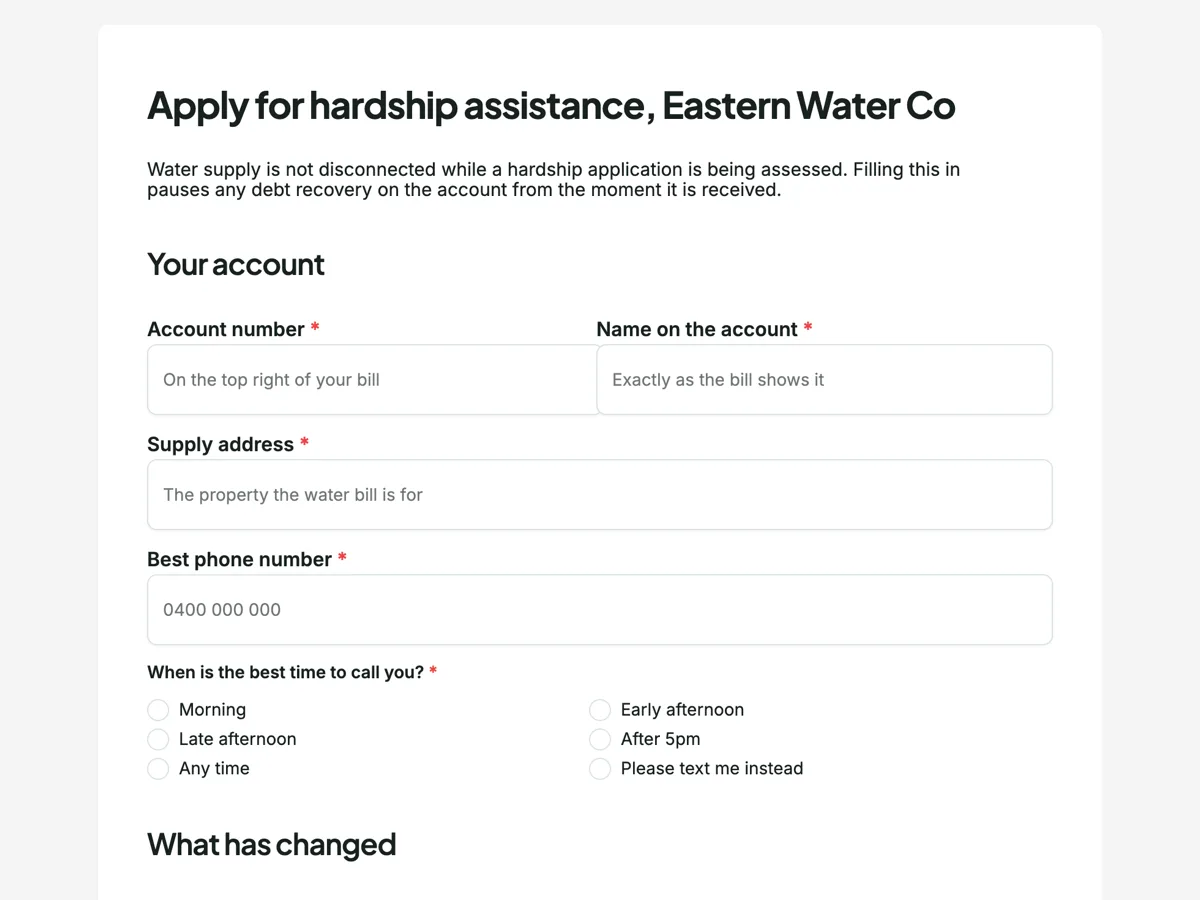
The form itself
A static copy of the finished form, exactly as it renders. Nothing here can be filled in or submitted, so read it as a reference and build your own from the button above.
Every field, and what it collects
The complete field list, in the order respondents meet it.
- Account numberShort textRequired
- Name on the accountShort textRequired
- Supply addressShort textRequired
- Best phone numberShort textRequired
- When is the best time to call you?Single choiceRequired
- Options: Morning · Early afternoon · Late afternoon · After 5pm · Any time · Please text me instead
- What is making it hard to pay right now?Multiple choiceRequired
- Options: Lost a job or had hours cut · Illness, injury or a hospital stay · Caring for someone who is unwell · A relationship ended · A death in the family · Family violence · Rent or mortgage went up · A large unexpected bill · A water leak I did not know about · Something else
- Anything you want the hardship officer to knowLong text
- Do you receive a Centrelink or Department of Veterans Affairs payment?Single choiceRequired
- Options: Yes, JobSeeker · Yes, Age Pension · Yes, Disability Support Pension · Yes, Parenting Payment · Yes, Carer Payment · Yes, a DVA payment · Yes, another payment · No
- Concession card heldSingle choiceRequired
- Options: Pensioner Concession Card · Health Care Card · DVA Gold Card · None · I think I am eligible but do not hold one
- Money coming in each fortnightTableRequired
- Columns: Where it comes from · Who receives it · Amount per fortnight
- Money going out each fortnightTableRequired
- Columns: What it is for · Amount per fortnight · Behind on this one
- What you could pay towards water each fortnight, in dollarsNumberRequired
- Support you would like to talk aboutMultiple choiceRequired
- Options: A payment plan I can keep to · Pausing payments for a short time · Checking I am getting every concession I am entitled to · Help applying for a utility relief grant · A check for a hidden leak at the property · Advice about the rest of my debts
- Anything that supports your applicationFile upload
- Optional. Photos of documents are fine, so is a screenshot from the Centrelink app. Images or PDF, up to 10 MB each.
- DeclarationMultiple choiceRequired
- Options: The information I have given is true to the best of my knowledge · I understand recovery action on this account is paused while this is assessed
- SignatureSignatureRequired
Your account
What has changed
Money in and money out
Evidence, only if you have it
What each block of this application collects
The account block is four short fields plus the best time to call, which is asked because a hardship officer ringing at the wrong hour is the most common reason an application stalls after it is submitted. The change block is a ten option tick list rather than a written explanation, so somebody who does not want to write can still be assessed, with a long text box left optional beside it. The two government questions separate the payment type from the concession card, because a customer can receive JobSeeker without holding a card and can hold a Health Care Card without being on a payment, and both facts unlock different assistance. The budget block takes fortnightly figures in two tables, four rows in and six rows out, with a behind on this one column that finds the other arrears. The affordable payment number is the single most useful field on the page.
The Australian pieces on this form
Everything about the money questions follows how Australian household budgeting actually works. Income and expenses are asked per fortnight because Centrelink pays fortnightly, and a customer on a payment knows their fortnight far better than their month. The payment list names JobSeeker, the Age Pension, the Disability Support Pension, Parenting Payment and Carer Payment individually, along with a Department of Veterans Affairs option, because the name of the payment is a fact people can answer instantly. The concession question names the Pensioner Concession Card, the Health Care Card and the DVA Gold Card, and adds an option for a customer who thinks they are eligible but does not hold one, which is how a utility finds unclaimed concessions. The support list offers help applying for a utility relief grant, which is administered at the state level.
How to adapt this form
An energy retailer keeps this shape exactly and adds a question about life support equipment at the property, because that changes the disconnection rules entirely and has to be flagged before anything else. A council collecting rates arrears swaps the supply address for a property number and adds a question about whether the property is owner occupied, since hardship relief for an investment property works differently. A financial counselling service using the same budget tables drops the account block, adds a creditor table with balances, and turns the affordable payment number into a total across all debts.
What makes this form work
The first line removes the reason people do not apply
The introduction says water is not disconnected while an application is assessed, and the welcome screen repeats it. Fear of disconnection is what keeps hardship forms unfilled, so the fact sits above the first field rather than in a policy page nobody opens.
Reasons are a tick list including family violence
Ten options let a customer answer a required question without writing a sentence about the worst year of their life, and family violence appears as its own option because it carries a distinct support pathway. The written box beside it is deliberately optional.
The expenses table asks what else is behind
Six rows of what it is for, amount per fortnight and a behind on this one column. It finds the rent arrears and the electricity debt that decide whether this customer needs a payment plan or a financial counsellor, and it does it without adding a single extra question.
Questions people ask
Will water be disconnected while a hardship application is assessed?
No, and the form says so twice, in the introduction and in the second declaration tick. Recovery action on the account pauses from the moment the application is received. Saying it at the top of the page matters because the fear of disconnection is what stops people applying, and an unstarted application helps nobody.
Why are income and expenses asked per fortnight rather than monthly?
Because Australian government payments land fortnightly and most households on them budget the same way. Asking for a monthly figure forces a conversion that people get wrong in both directions. Fortnightly also matches the payment plan the officer will offer, so the number the customer writes is the number they are held to.
What if there is no evidence to attach?
The application still works. The upload is optional, its own paragraph says no application is refused for want of a document, and photos or a screenshot of the Centrelink app are accepted. Evidence usually speeds up a decision rather than enabling one, which is a distinction worth stating rather than leaving people to guess.
Why ask what the customer can afford instead of calculating it?
Because a plan the customer proposed is kept far more often than a plan derived from a budget table. The number field allows zero, which is a real and acceptable answer for some households, and the officer uses the two tables to sanity check it rather than to overrule it.
Does a hardship application affect a credit record?
The paragraph above the declaration says this information is not shared with a credit reporting body. A water utility is not a credit provider in the way a lender is, and applying for hardship assistance is not a default. Customers ask this constantly, so the answer belongs on the form rather than in a policy document.
Why does the expenses table have a behind on this one column?
Because arrears elsewhere change what is possible here. A household behind on rent and electricity as well as water needs a financial counsellor more than it needs a payment plan, and that column is what surfaces it in six rows without asking six more questions.
Build your own in about a minute
The button below opens the generator with this use case already described. Change the wording to match your own, generate, then edit anything you like.
Make my financial hardship application form with a fortnightly budget on itOther form examples
Guarantor application form for a residential tenancy
A guarantor signs up to pay rent and damage that somebody else owes, often for a tenancy they will never live in. This thirteen field form collects the identity, income and obligations that make the promise assessable, and puts the full text of the guarantee directly above the tick and the signature.
Foster carer application form for a first enquiry, not an assessment
Becoming a foster carer takes months of assessment, training and home visits, and the form at the front of it only has to work out whether a conversation is worth having. This seventeen field application records the household, the space, the checks already held and the kinds of care a person can realistically offer.
Travel grant application form for a conference, with itemised costs
A travel grant panel is deciding between twenty applicants who all want to go somewhere useful, and the difference between them is almost always the costings. This twelve field form takes the accepted abstract, the acceptance letter and a six row cost table that asks how each figure was estimated.
Want the steps in the builder? Read Every form field and when to use it, then Automate your form with add-ons. For everything this generator can do, see the form maker.
Written and checked by the OneCraft team. Last checked .