Classic form
Foster carer application form for a first enquiry, not an assessment
Becoming a foster carer takes months of assessment, training and home visits, and the form at the front of it only has to work out whether a conversation is worth having. This seventeen field application records the household, the space, the checks already held and the kinds of care a person can realistically offer.
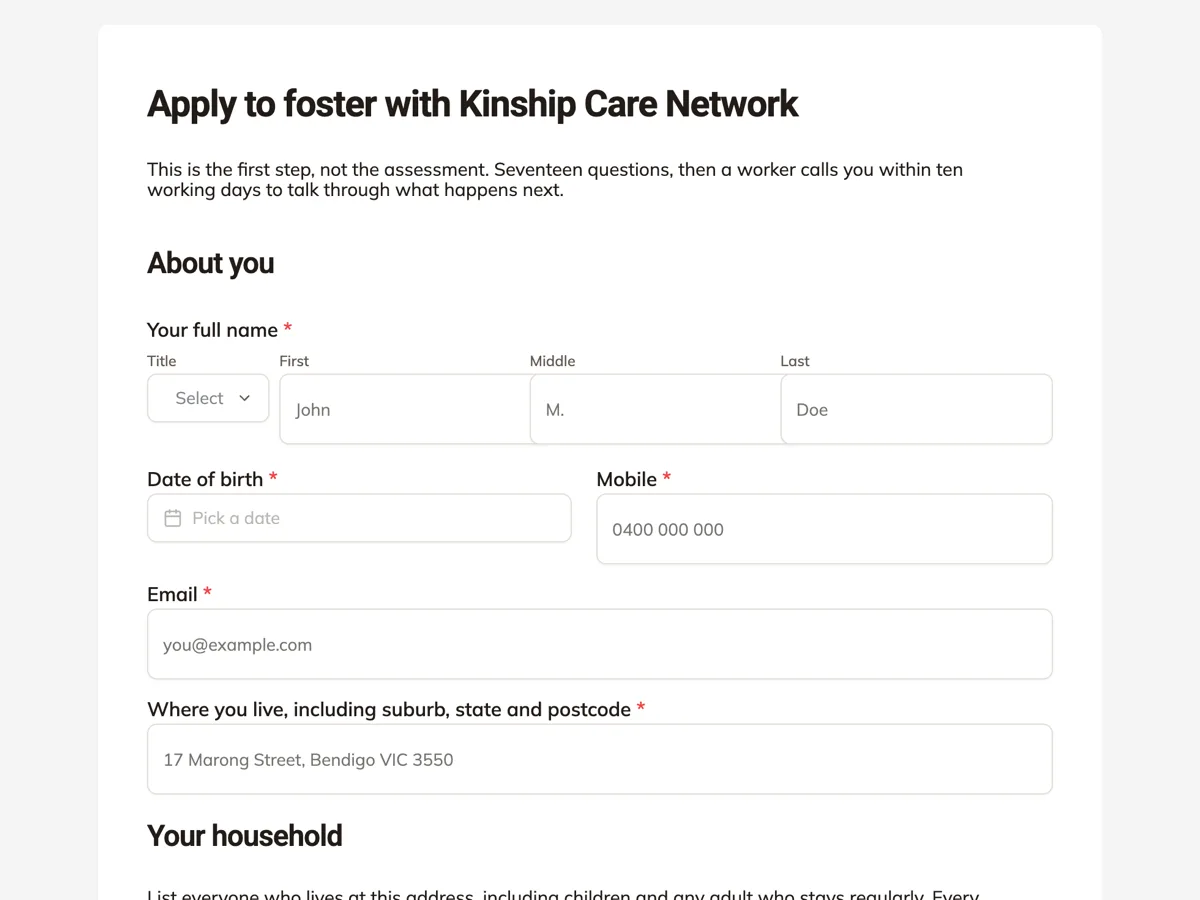
The form itself
A static copy of the finished form, exactly as it renders. Nothing here can be filled in or submitted, so read it as a reference and build your own from the button above.
Every field, and what it collects
The complete field list, in the order respondents meet it.
- Your full nameNameRequired
- Date of birthDateRequired
- MobileShort textRequired
- EmailShort textRequired
- Where you live, including suburb, state and postcodeShort textRequired
- Everyone living at this addressTableRequired
- Columns: Full name · Relationship to you · Age · Lives here full time
- Bedrooms available for a child, not counting shared or study roomsNumberRequired
- Types of care you are interested inMultiple choiceRequired
- Options: Emergency, a placement at a few hours notice · Respite, a weekend or a week at a time · Short term, weeks to months · Long term, until the child is 18 · Kinship care for a child already related to me · Not sure yet, I want to talk it through
- Age groups you feel able to care forMultiple choiceRequired
- Options: 0 to 2 · 3 to 5 · 6 to 10 · 11 to 14 · 15 to 18 · Sibling groups
- Working with children check numberShort textRequired
- Working with children check expiryDateRequired
- National police checkSingle choiceRequired
- Options: I hold one issued in the last 12 months · I hold one, but it is older than 12 months · I have applied and I am waiting · I have not applied yet
- Your experience caring for children, paid or unpaidLong textRequired
- Why you want to foster, in your own wordsLong textRequired
- RefereesTableRequired
- Columns: Full name · How they know you · Years known · Phone
- DeclarationMultiple choiceRequired
- Options: The information I have given is true and complete to the best of my knowledge · I consent to screening checks on me and on every household member over 18 · I understand that this application is a first step and not an approval to care for a child
- Your signatureSignatureRequired
About you
Your household
The care you can offer
Checks you already hold
Experience and referees
Declaration
What each block of this application collects
The first block is identity and contact, with a full legal name because every check that follows is run against it. The household block is the heart of the form: six rows for everyone at the address with their relationship, age and whether they live there full time, and a bedrooms number that deliberately excludes study and shared rooms, since those are the two rooms people count when they want the answer to be higher. The care block asks what a person can actually offer, with emergency, respite, short term, long term and kinship as separate options plus a not sure yet choice, and an age group list that names sibling groups because keeping siblings together depends on carers volunteering for it. The checks block records what is already held.
The Australian pieces on this form
Fostering is administered by the states and territories, so the checks block asks for the two things every jurisdiction requires in some form: a working with children check with its number and expiry date, and a national police check with a status rather than a number, since many applicants have applied and are waiting. The working with children field accepts the words applied for, because an applicant who has lodged and is waiting should not be blocked by a form. The declaration consents to screening every household member over eighteen, which is the standard requirement across Australian schemes and the reason the household table asks for ages rather than just names.
How to adapt this form
An agency recruiting only respite carers cuts the care types list to one line and adds a weekend availability grid, because respite recruitment lives or dies on which weekends people can take. A kinship care pathway removes the age group tick list entirely, since the child is already known, and replaces it with a relationship to the child field and a question about the current living arrangement. An agency in a state with a different check name changes the two check field labels and nothing else, because the shape of the question, a number plus an expiry plus a status, is the same everywhere.
What makes this form work
The household table asks who lives here full time
Six rows with name, relationship, age and a full time column, so an adult child who stays three nights a week appears rather than being left off. That fourth column is what turns a list of names into the screening list the agency actually has to run.
Care types include not sure yet
Emergency, respite, short term, long term and kinship are real and different commitments, and the sixth option lets somebody say they want to talk it through. That option gets picked often, and it converts far better than forcing a guess that the applicant then feels bound by.
The checks accept an in progress answer
The working with children field takes the words applied for and the police check question offers I have applied and I am waiting. Both reflect how the paperwork actually arrives, and neither turns a form into a dead end for someone who started the process last week.
Questions people ask
Does a foster carer application decide anything?
No. It starts a conversation and nothing more, which is why the thank you screen says a recruitment worker calls within ten working days. Assessment takes months and includes training, home visits, referee interviews and a full screening of every adult in the household. The form exists so that call starts from facts rather than from a blank page.
Why does every adult in the household need a check?
Because a child is placed in a home, not with an individual. Australian schemes screen every household member over eighteen for that reason, and the household table asks for ages so the agency knows who that will be. Leaving an adult off does not avoid the check, it just means the assessment stalls when they are discovered.
Can someone apply while waiting on a working with children check?
Yes. The field accepts the words applied for, because the check can take weeks and the recruitment conversation does not have to wait for it. The police check question has a waiting option for the same reason. Blocking an application on a document that is already in progress loses good carers for no benefit.
How many bedrooms does a foster carer need?
Requirements vary by state and by the age of the child, so the form asks for a number rather than applying a rule. It excludes study and shared rooms because those are the two answers that inflate the count, and a worker discusses the real arrangement on the call. A carer offering respite only often needs less space than one offering long term care.
Will a past conviction rule someone out?
Not automatically, and the paragraph above the declaration says so plainly. Some offences are absolute barriers and most are not. What does end an application reliably is a history that the agency finds during screening after the applicant chose not to mention it, which is why the declaration asks for true and complete rather than for a clean record.
Why ask why you want to foster in a long text box?
Because it is the answer a recruitment worker reads before making the call, and it cannot be produced by a tick list. The placeholder says there is no right answer and that a person reads it, which is true and which measurably improves what people write. It is also the field that makes an applicant stop and decide whether they are ready.
Build your own in about a minute
The button below opens the generator with this use case already described. Change the wording to match your own, generate, then edit anything you like.
Make my foster carer application form for a first enquiry, not an assessmentOther form examples
Volunteer application form with screening and referees on it
A volunteer sign up sheet collects a name. A volunteer application decides whether somebody can be placed near children, food and a van, which is a different question. This sixteen field form carries a working with children check number, a graded criminal history declaration with room to explain, two referees and a six by three availability grid.
Pet adoption application form with the home check questions built in
A rescue is matching an animal that already has a history to a home it cannot see, and the decision turns on fencing, hours alone and whether the landlord has actually said yes. This fifteen screen application asks those in the first half and spends the second half on the animals already in the house.
Bursary application form built around financial need
A bursary committee is comparing families it has never met, using figures that arrive in six different formats. This fourteen field application asks for income as a band, circumstances as a tick list and a statement, and pins the whole decision to two uploads that every family can actually produce.
Want the steps in the builder? Read Every form field and when to use it, then Control who can fill in your form. For everything this generator can do, see the form maker.
Written and checked by the OneCraft team. Last checked .