Classic form
Volunteer application form with screening and referees on it
A volunteer sign up sheet collects a name. A volunteer application decides whether somebody can be placed near children, food and a van, which is a different question. This sixteen field form carries a working with children check number, a graded criminal history declaration with room to explain, two referees and a six by three availability grid.
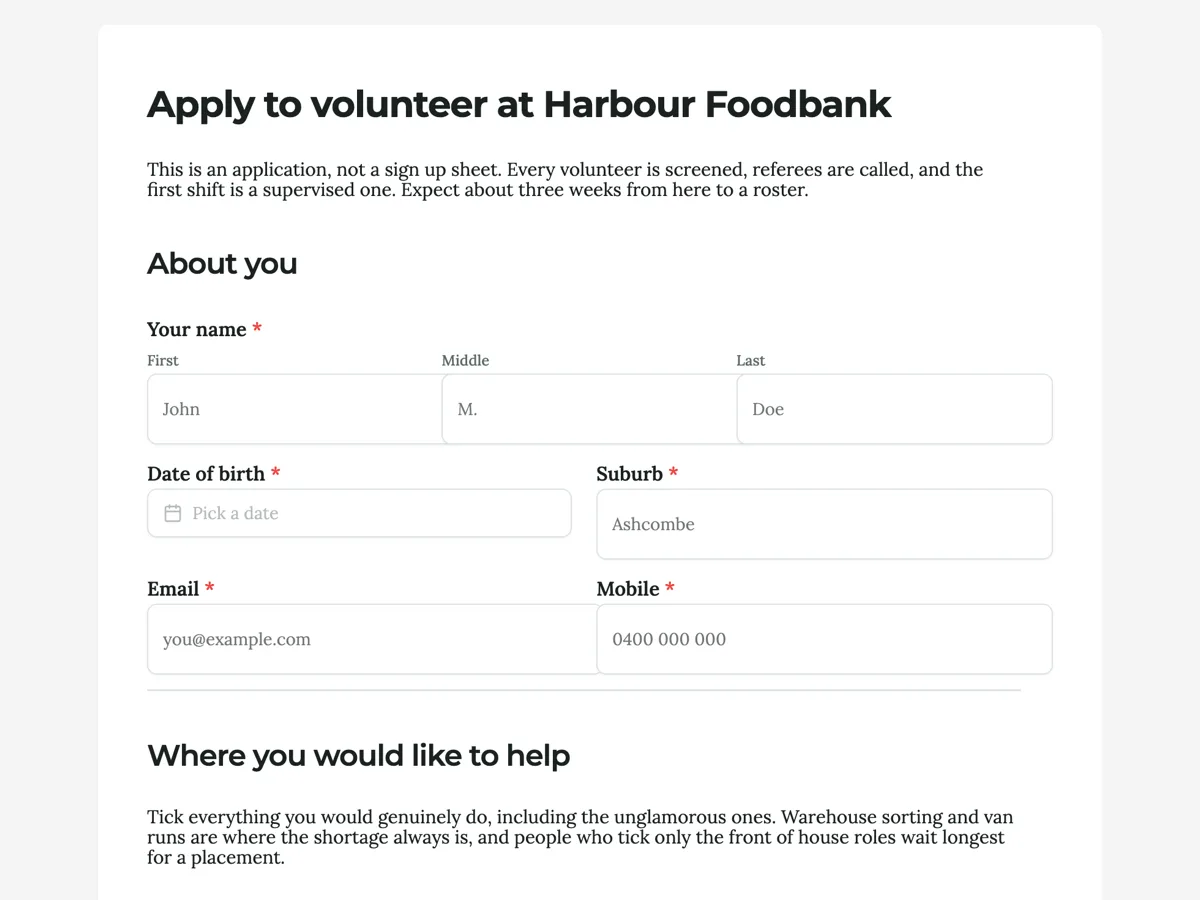
The form itself
A static copy of the finished form, exactly as it renders. Nothing here can be filled in or submitted, so read it as a reference and build your own from the button above.
Every field, and what it collects
The complete field list, in the order respondents meet it.
- Your nameNameRequired
- Date of birthDateRequired
- SuburbShort textRequired
- EmailShort textRequired
- MobileShort textRequired
- Roles you are interested inMultiple choiceRequired
- Options: Warehouse sorting and packing · Van run, collections from donors · Van run, deliveries to agencies · Front of house at the pantry · Cooking in the community kitchen · Phone calls to clients on the delivery list · Administration and data entry · Fundraising events, occasional weekends
- When could you do a regular shift?Rating gridRequired
- Statements:
- Monday
- Tuesday
- Wednesday
- Thursday
- Friday
- Saturday
- How long could you commit for?Single choiceRequired
- Options: Twelve months or more · Six to twelve months · Three to six months · A university or school placement with an end date · Occasional events only, not a regular shift
- Driver licence and vehicleSingle choiceRequired
- Options: Full licence, and I could drive the van · Full licence, but I would rather not drive the van · Probationary licence · No licence
- Working with children check numberShort textRequired
- Check expiryDate
- Criminal history declarationSingle choiceRequired
- Options: I have no criminal history to declare · I have a criminal history and I am willing to discuss it · I have a pending charge · I would rather discuss this with the coordinator before answering
- Anything you would like to explainLong text
- RefereesTableRequired
- Columns: Name · How they know you · Phone · Email
- Anything that affects the work you can do, or the support you would needLong textRequired
- SignatureSignatureRequired
About you
Where you would like to help
Screening
Health, access and declaration
What makes this an application and not a sign up
A sign up form asks when you are free. An application decides whether you can be placed, and that decision needs three things a sign up never collects: a current check, a declaration that is answered honestly, and two people who will vouch for you. The difference shows in the wording as much as the fields. The intro says referees are called and the first shift is supervised, and the thank you screen commits to ten working days either way, because the slowest thing in volunteer recruitment is silence.
The Australian pieces on this form
The working with children check is a state issued clearance and it is free for volunteers, which the paragraph above the field says because most applicants assume it costs money and stall there. The field accepts the word applied, so a keen volunteer is not blocked by a check that takes weeks. The criminal history question is graded rather than binary because Australian volunteer screening guidance treats a record as a conversation, not an automatic bar, and the paragraph underneath states that plainly so people answer instead of walking away.
How to adapt this form
A sports club swaps the roles list for coaching, managing, canteen and ground duty, and adds a coaching accreditation number beside the check. An aged care or hospital volunteer programme adds an immunisation status question and a police check, since the clearance required is a different one. A one off event, such as a festival or a fun run, should not use this form at all: drop the screening block and the referees and use a six field sign up, because the risk profile of a four hour supervised shift is not the same.
What makes this form work
The criminal history question has four answers and a paragraph
Nothing to declare, willing to discuss, a pending charge, or rather talk first. Underneath, a note that a record does not stop somebody volunteering but finding out later does. That is what gets an honest tick.
The check field accepts the word applied
A working with children check takes weeks and the paragraph says it is free for volunteers. Letting somebody type applied keeps a good candidate in the process instead of bouncing them at the one field they cannot yet answer.
Availability is a six by three grid, not a wish
Six days down, morning, afternoon and evening across, answered as checkboxes so multiple shifts per day are possible. A coordinator reads it as a roster rather than reconstructing one from a sentence.
Questions people ask
How long should a volunteer application form be?
Sixteen fields here, which is long for a form and short for a screening process. The test is whether every field changes a decision. Roles and availability decide placement, the check and the declaration decide eligibility, the referees decide trust, and the access question decides what a first shift looks like. Nothing here is collected because it might be useful later.
Is it legal to ask about criminal history?
Asking is normal in volunteer screening where the role involves children or vulnerable people, and it is the basis of most charity recruitment policies. What matters is how it is asked. Four graded options, a box to explain, and a paragraph saying a record is not an automatic bar produce honest answers. A yes or no tick with no context produces silence and withdrawn applications.
Why use a grid for availability instead of tick boxes?
Because a volunteer coordinator rosters by day and shift together, and a flat list of eighteen checkboxes is unreadable. The matrix puts six days down the side and three shifts across, answered as checkboxes so several shifts can be chosen per day. It exports as one column with each day and its answers paired, which reads like a roster note.
Should referees be contacted before shortlisting?
No, and the form says so. The paragraph above the table states referees are only called if the applicant is shortlisted and asks the applicant to warn them. Calling every referee for every application burns goodwill fast, and a referee who was told to expect the call answers properly instead of treating it as a cold call.
What does the access question actually achieve?
It moves the conversation about adjustments from the first shift to the application, where it can be planned. Lifting limits, a hearing loop, an interpreter and a wheelchair accessible shift are all named in the placeholder, which signals that the question is genuine. It is required and it accepts none, so nobody has to decide whether silence means anything.
Can the form email the volunteer coordinator?
Yes, with the email alert add on switched on. Alerts go to one address through the platform email service, with the submitted values formatted into the message body, so a coordinator reads the whole application without opening the builder. The matrix arrives as its statement and answer pairs and the referee table as the filled rows.
Build your own in about a minute
The button below opens the generator with this use case already described. Change the wording to match your own, generate, then edit anything you like.
Make my volunteer application form with screening and referees on itOther form examples
Foster carer application form for a first enquiry, not an assessment
Becoming a foster carer takes months of assessment, training and home visits, and the form at the front of it only has to work out whether a conversation is worth having. This seventeen field application records the household, the space, the checks already held and the kinds of care a person can realistically offer.
Financial hardship application form with a fortnightly budget on it
A hardship application is filled in by somebody having a bad year, often on a phone, and every extra field costs an applicant who needed the help. This sixteen field form asks what changed, what comes in and goes out each fortnight, and what the customer can genuinely pay, then says plainly that nothing is disconnected while it is read.
Pet adoption application form with the home check questions built in
A rescue is matching an animal that already has a history to a home it cannot see, and the decision turns on fencing, hours alone and whether the landlord has actually said yes. This fifteen screen application asks those in the first half and spends the second half on the animals already in the house.
Want the steps in the builder? Read Every form field and when to use it, then View, export and manage responses. For everything this generator can do, see the form maker.
Written and checked by the OneCraft team. Last checked .