Classic form
Business credit application form for a 30 day trading account
Granting a customer thirty day terms is unsecured lending, and the paperwork that goes with it has to stand up when an account stops paying. This eighteen field application records the entity, its age, its payment habits and the person who guarantees the debt, with the credit reporting consent written where it is read.
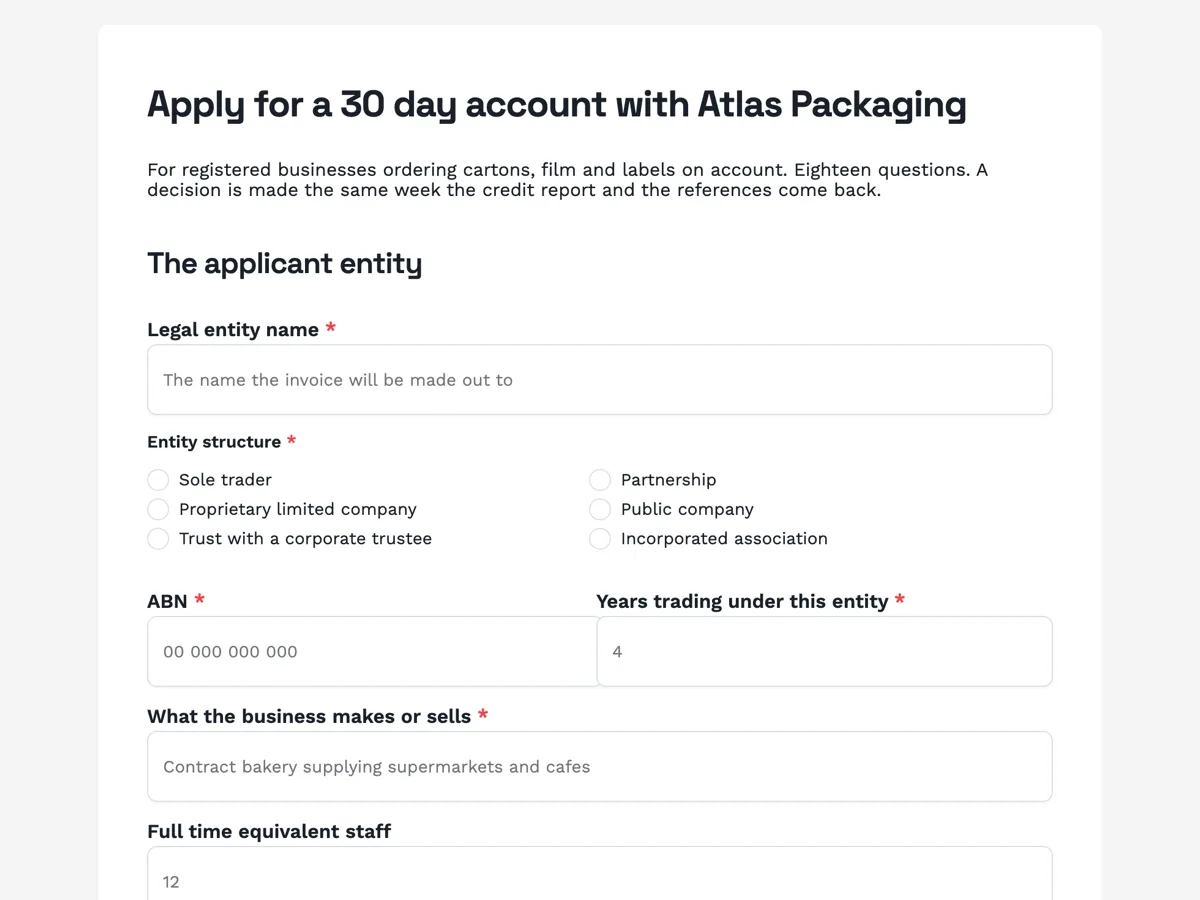
The form itself
A static copy of the finished form, exactly as it renders. Nothing here can be filled in or submitted, so read it as a reference and build your own from the button above.
Every field, and what it collects
The complete field list, in the order respondents meet it.
- Legal entity nameShort textRequired
- Entity structureSingle choiceRequired
- Options: Sole trader · Partnership · Proprietary limited company · Public company · Trust with a corporate trustee · Incorporated association
- ABNShort textRequired
- Years trading under this entityNumberRequired
- What the business makes or sellsShort textRequired
- Full time equivalent staffNumber
- Registered business address, including suburb, state and postcodeShort textRequired
- Accounts payable contactShort textRequired
- Email invoices are sent toShort textRequired
- How should invoices arrive?Single choiceRequired
- Options: PDF to the accounts payable email above · PDF to the email above and a copy to the site that ordered · Uploaded to our supplier portal, details supplied after approval · Printed and posted with the delivery
- Statement day that suits your payment runDropdown
- Options: Last day of the month · 25th of the month · 20th of the month · 15th of the month · No preference
- Bank and branchShort textRequired
- Name the account is held inShort textRequired
- Trade referencesTableRequired
- Columns: Supplier · Contact and phone · Terms held · Average monthly spend
- Terms requestedSingle choiceRequired
- Options: 30 days from end of month · 14 days from invoice · 7 days from invoice · Cash on delivery with an approved limit
- Monthly credit limit sought, excluding GSTNumberRequired
- ConsentsMultiple choiceRequired
- Options: I consent to a commercial credit report being obtained on the entity · I consent to a PPSR registration over goods supplied but not yet paid for · I authorise the three referees above to answer questions about this account
- Guarantor signature, drawn or typedSignatureRequired
The applicant entity
Who pays the invoices
Banking and trade references
The account requested
Guarantee
Question banks built on this form
What each block of this application collects
The entity block is about risk that can be looked up: legal name, structure, ABN, and the number of years this particular entity has traded, which is a different question from how long the people have been in the industry. A company registered nine months ago with twenty years of trade behind its directors is a real and common case, and the years trading number is what makes the credit team ask rather than assume. The accounts payable block is about getting paid: the person, the inbox, the delivery method and the statement day that matches the customer payment run, since an invoice that lands two days after a run waits a month.
The Australian pieces on this form
The entity structure list includes a trust with a corporate trustee and an incorporated association because both are ordinary Australian trading structures and both change who can validly give a guarantee. The credit limit is asked excluding GST, which is how wholesale terms are quoted here. The consent block names two distinct things that Australian credit practice keeps separate: obtaining a commercial credit report on the entity and its guarantors, and registering a security interest on the Personal Property Securities Register over goods that have been delivered but not paid for. Each is a separate tick, so neither is buried inside the other, and the paragraph above them explains what a credit reporting body is told about how the account is conducted.
How to adapt this form
A supplier who only ever trades with companies deletes the sole trader and partnership options and adds an ACN field, which lets the credit check start from a company number rather than a name. A business offering staged limits replaces the single limit number with a radio of three tiers and a paragraph explaining what evidence unlocks the next one, because tiering reduces the number of applications that fail outright. An exporter adds a currency and country of supply pair above the terms question, since credit insurance and retention of title both work differently once goods leave the country, and the guarantee paragraph then needs a governing law line beneath it.
What makes this form work
Years trading is a number field, not a date
A number with a minimum of zero and a maximum of one hundred and twenty is quick to answer honestly and quick to sort. It separates a nine month old entity from a nineteen year old one at a glance, which is the single strongest signal on the page before the credit report arrives.
The reference table carries terms and spend
Four columns, supplier, contact and phone, terms held and average monthly spend, turn a referee call into a comparison. A clean reference on seven day terms and two hundred dollars a month says something very different from a clean reference on thirty day terms and nine thousand.
Consent is three ticks, each naming one thing
The credit report, the PPSR registration and the authority to call the referees are separate options in one required checkbox. Each is a sentence the applicant can read on its own, which is the difference between a consent that is recorded and a consent that is defensible.
Questions people ask
What is the difference between years trading and how long the owners have worked in the industry?
Years trading counts this legal entity only. A new company set up for tax or succession reasons can have decades of experience behind it and still show one year here. The form asks the narrow question because that is what a credit report scores, and the referee calls then fill in the wider history the number cannot show.
Why does the form ask which statement day suits the customer?
Because most businesses pay in weekly or fortnightly runs, and an invoice that arrives just after a run effectively ages by a full cycle before anyone looks at it. Matching the statement to the customer payment run costs the supplier nothing and removes a common cause of an account appearing overdue when it is simply mistimed.
Is a drawn signature enough for a personal guarantee?
It records that the guarantor signed, which is what this form is for. Many suppliers treat the drawn signature as the application record and then send the guarantee out separately for e-signature, so the signed document carries a certificate of completion. The form sets the account up; it is not a substitute for legal advice on the guarantee itself.
Why are the credit report and PPSR consents separate ticks?
Because they authorise different things. One lets the supplier pull a commercial credit report on the entity and the guarantor. The other lets the supplier register an interest in goods already delivered. Rolling both into a single tick makes the consent weaker and harder to explain later, and separating them costs the applicant one extra click.
Can this application collect a payment or a deposit?
No. A form on this product collects and records answers, and a credit application has nothing to charge for. Where a supplier asks for a deposit before granting terms, that is invoiced separately once the limit is approved. The account application stays a record of who applied, what they asked for and what they consented to.
How many trade references are enough?
Three is the working standard and the table is fixed at three rows for that reason. Two suppliers can both be unusually generous, and four rarely changes a decision. What improves the decision is the extra columns: the terms each referee gives and the average monthly spend, which tell the credit team whether a clean reference is meaningful or trivial.
Build your own in about a minute
The button below opens the generator with this use case already described. Change the wording to match your own, generate, then edit anything you like.
Make my business credit application form for a 30 day trading accountOther form examples
Financial hardship application form with a fortnightly budget on it
A hardship application is filled in by somebody having a bad year, often on a phone, and every extra field costs an applicant who needed the help. This sixteen field form asks what changed, what comes in and goes out each fortnight, and what the customer can genuinely pay, then says plainly that nothing is disconnected while it is read.
Trade account application form with the director guarantee on the same page
A merchant opening a trade account is lending money to a business it has never invoiced, and the decision turns on three referees and a personal guarantee. This form puts the ABN, the directors, the references and the guarantee in one seventeen field page, signed before it is sent.
Commercial lease application form for a retail tenancy
A landlord letting a shop is choosing a business that will still be trading in three years, and the application is where that judgement is made. This sixteen field form asks what the premises will be used for in the words that go into the lease, what fit out it needs, and who is standing behind the entity.
Want the steps in the builder? Read Every form field and when to use it, then View, export and manage your responses. For everything this generator can do, see the form maker.
Written and checked by the OneCraft team. Last checked .