Classic form
Guarantor application form for a residential tenancy
A guarantor signs up to pay rent and damage that somebody else owes, often for a tenancy they will never live in. This thirteen field form collects the identity, income and obligations that make the promise assessable, and puts the full text of the guarantee directly above the tick and the signature.
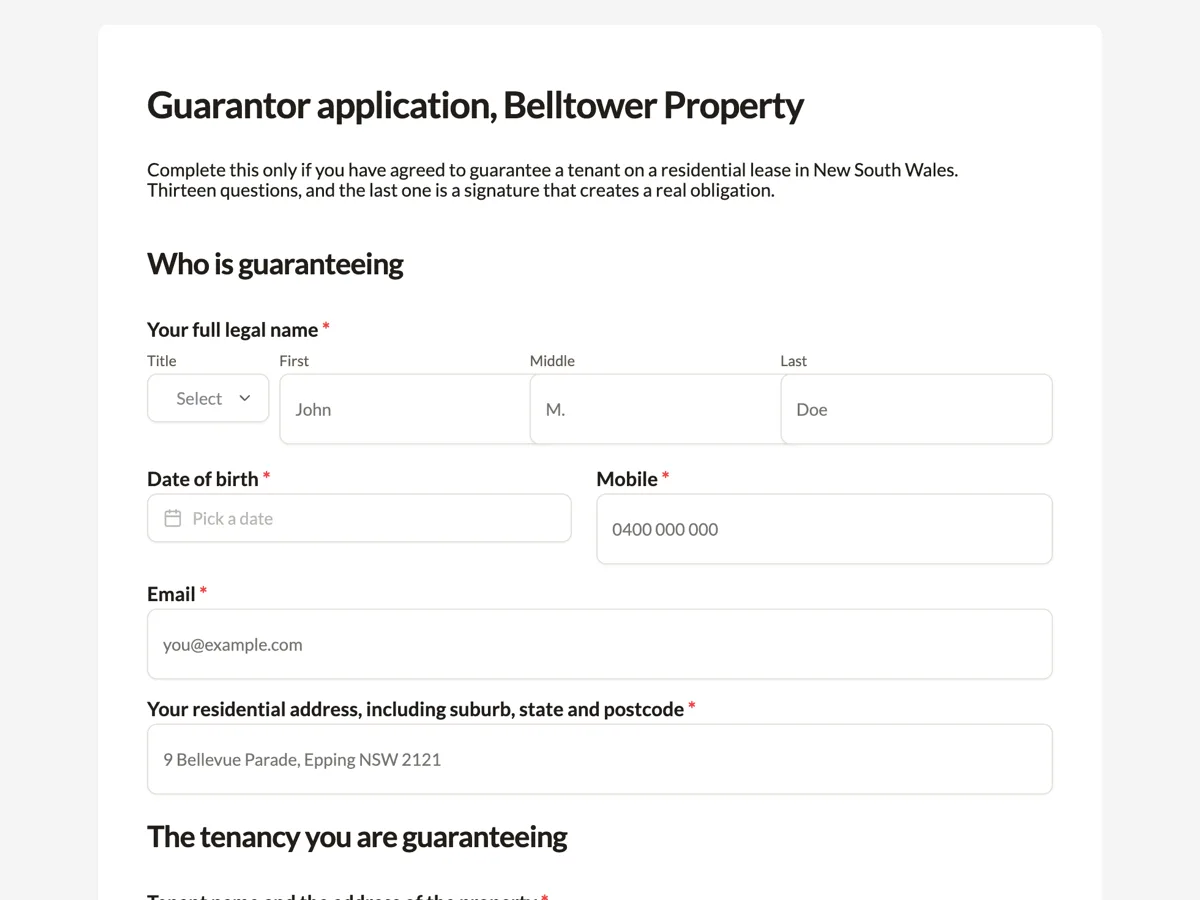
The form itself
A static copy of the finished form, exactly as it renders. Nothing here can be filled in or submitted, so read it as a reference and build your own from the button above.
Every field, and what it collects
The complete field list, in the order respondents meet it.
- Your full legal nameNameRequired
- Date of birthDateRequired
- MobileShort textRequired
- EmailShort textRequired
- Your residential address, including suburb, state and postcodeShort textRequired
- Tenant name and the address of the propertyShort textRequired
- Your relationship to the tenantDropdownRequired
- Options: Parent · Step parent or guardian · Grandparent · Sibling · Other family member · Employer · Friend · Company director guaranteeing an employee
- Employment statusSingle choiceRequired
- Options: Full time, permanent · Part time, permanent · Casual · Self employed · Contractor on a fixed term · Retired, on superannuation or a pension · Not currently working
- Gross annual income before tax, in dollarsNumberRequired
- Assets and liabilitiesTableRequired
- Columns: Asset or liability · Type · Approximate value · Amount still owing
- Photo identification and evidence of incomeFile uploadRequired
- Two files: photo ID such as a driver licence or passport, and either two recent payslips or a most recent tax notice of assessment. Images or PDF, up to 10 MB each.
- AcknowledgementMultiple choiceRequired
- Options: I have read the guarantee above and I understand it is not limited to the amount of the bond · I understand the guarantee continues while the tenancy continues, including after the fixed term · I have been given the chance to get independent legal advice before signing
- Guarantor signatureSignatureRequired
Who is guaranteeing
The tenancy you are guaranteeing
Your capacity to pay
The guarantee
What each block of this form collects
The identity block takes the full legal name with a title and a middle name, because the guarantee has to name the person the way their identity document does, along with date of birth, mobile, email and a residential address that is deliberately not the rented property. The tenancy block is one line naming the tenant and the address, and a relationship dropdown whose eight options run from parent to a company director guaranteeing an employee, which is a real and quite different case. The capacity block is the assessment: employment status as a radio, gross annual income as a number, and a five row table for assets and liabilities that asks for the approximate value and the amount still owing side by side, so a mortgaged home appears honestly rather than as an asset alone. The evidence upload takes identification and either payslips or a notice of assessment.
The Australian pieces on this form
The wording follows New South Wales residential tenancy practice. The guarantee paragraph names rent, water usage, damage and reasonable costs, which is how liability is described under a residential tenancy agreement here, and says plainly that it is not limited to the bond, since the bond is held by the state bond authority and is usually far smaller than the exposure. The second tick addresses the point guarantors most often get wrong: a fixed term tenancy that is not renewed continues on a periodic basis under the same agreement, so the guarantee continues too. The third tick records that the guarantor had the chance to take independent legal advice, which is standard practice before a personal guarantee is accepted.
How to adapt this form
An agency operating in another state changes the guarantee paragraph to that state legislation and renames the bond reference to its own authority, because the words are the part that has to be local rather than the fields. A student accommodation provider taking overseas guarantors adds a country of residence dropdown and a currency selector beside the income number, since an income figure without a currency is unusable. A commercial agency guaranteeing a company lease replaces the employment radio with an entity structure question and the payslip upload with two years of financial statements, and adds a directorship line to the assets and liabilities table.
What makes this form work
The guarantee text sits above the tick, not behind a link
The full paragraph names rent, water usage, damage and reasonable costs, says it is not limited to the bond and says it continues past the fixed term. A guarantor cannot reach the signature without scrolling through it, which is the difference between a signed form and an informed one.
Value and amount owing are separate columns
The assets and liabilities table has five rows and four columns, and the last two are approximate value and amount still owing. A mortgaged house lands on one row with both numbers visible, so the agency sees a net position rather than a list of things the guarantor happens to be near.
The relationship dropdown includes an employer
Eight options cover the family cases, then add employer and a company director guaranteeing an employee. Those two change how the evidence is read and how the guarantee is enforced, and a form that only offers parent or friend quietly pushes them into the wrong box.
Questions people ask
Is a guarantor liable only for the amount of the bond?
No, and the first acknowledgement tick exists because that is the most common misunderstanding. A bond is a security deposit held by the state bond authority and it is usually a few weeks of rent. A guarantee covers what the tenant does not pay under the agreement, which can include months of rent and the cost of damage well beyond the bond.
When does a tenancy guarantee end?
When the tenancy ends and everything owing under it has been paid, or earlier if the landlord agrees in writing. It does not end automatically at the end of the fixed term, because a tenancy that rolls on continues under the same agreement.
Why does the form ask for assets and liabilities rather than just income?
Because income alone does not show capacity. A guarantor earning well with two mortgages and a car loan has less room than one earning less with none. The table asks for the value and the amount still owing in adjacent columns, which shows the net position in five rows without requiring a financial statement.
What identity documents should a guarantor upload?
Photo identification such as a driver licence or a passport, plus evidence of income: two recent payslips, or the most recent notice of assessment for someone self employed. The upload accepts images and PDF, up to four files of ten megabytes each, which covers a phone photo of a licence and a downloaded payslip without any conversion.
Can a guarantee be signed by drawing on a phone?
The signature on this form is drawn or typed by the person filling it in and is stored with the response, which is what makes the form a record of the promise. Many agencies also send the guarantee out for e-signature afterwards so the executed document carries a certificate of completion.
Should the guarantor form be sent to the tenant or to the guarantor?
To the guarantor, on their own link. Sending it through the tenant means the tenant fills it in, which defeats the identity evidence and makes the signature worthless. This form is deliberately short enough that a guarantor can finish it on a phone the day the tenant application goes in.
Build your own in about a minute
The button below opens the generator with this use case already described. Change the wording to match your own, generate, then edit anything you like.
Make my guarantor application form for a residential tenancyOther form examples
Commercial lease application form for a retail tenancy
A landlord letting a shop is choosing a business that will still be trading in three years, and the application is where that judgement is made. This sixteen field form asks what the premises will be used for in the words that go into the lease, what fit out it needs, and who is standing behind the entity.
Trade account application form with the director guarantee on the same page
A merchant opening a trade account is lending money to a business it has never invoiced, and the decision turns on three referees and a personal guarantee. This form puts the ABN, the directors, the references and the guarantee in one seventeen field page, signed before it is sent.
Financial hardship application form with a fortnightly budget on it
A hardship application is filled in by somebody having a bad year, often on a phone, and every extra field costs an applicant who needed the help. This sixteen field form asks what changed, what comes in and goes out each fortnight, and what the customer can genuinely pay, then says plainly that nothing is disconnected while it is read.
Want the steps in the builder? Read Every form field and when to use it, then Control who can fill in your form. For everything this generator can do, see the form maker.
Written and checked by the OneCraft team. Last checked .