Classic form
Return to work plan form for an injured worker
A return to work form sets out how an injured worker comes back: the certificate of capacity it follows, suitable duties and who supervises them, hours per week, restrictions and when the plan is reviewed. This Australian civil contractor version is signed by the worker and the supervisor, so both have agreed to the same plan.
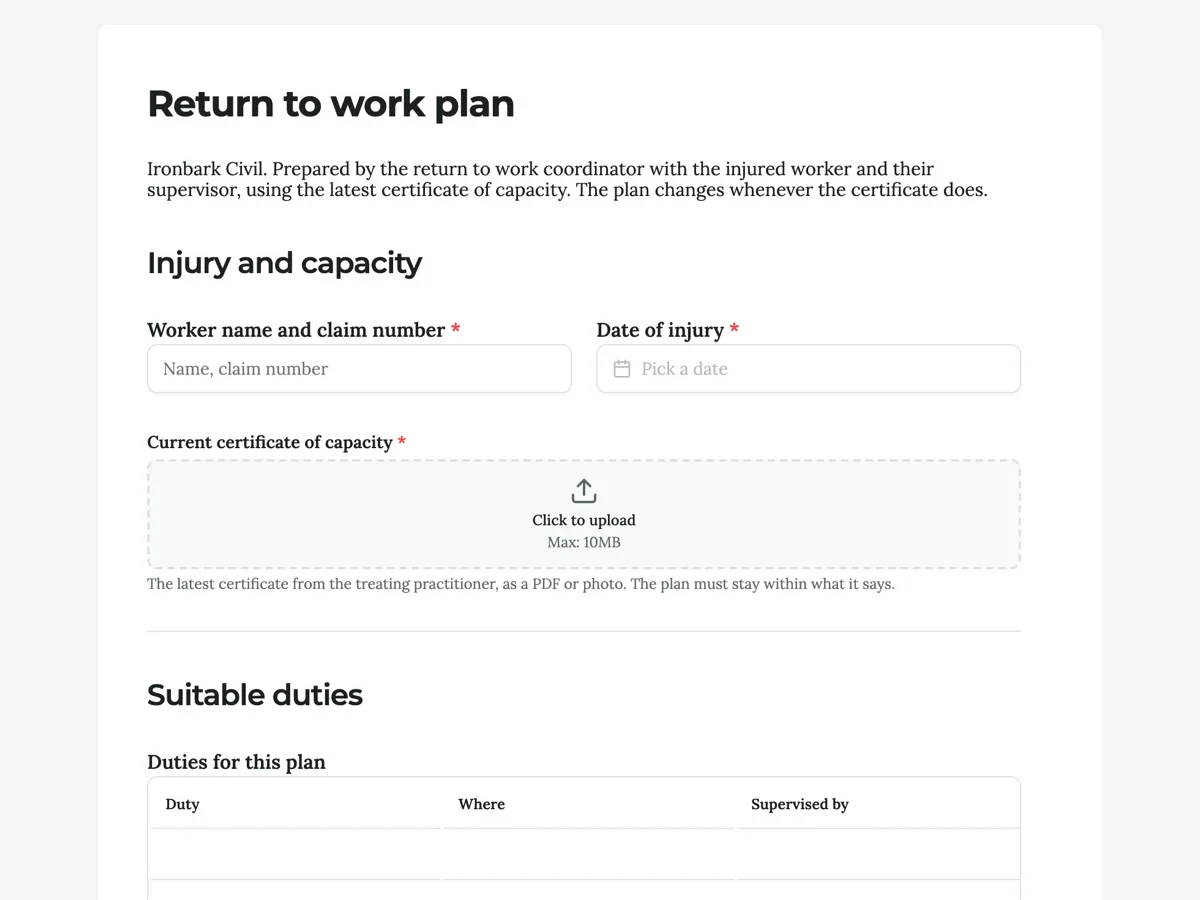
The form itself
A static copy of the finished form, exactly as it renders. Nothing here can be filled in or submitted, so read it as a reference and build your own from the button above.
Every field, and what it collects
The complete field list, in the order respondents meet it.
- Worker name and claim numberShort textRequired
- Date of injuryDateRequired
- Current certificate of capacityFile uploadRequired
- The latest certificate from the treating practitioner, as a PDF or photo. The plan must stay within what it says.
- Duties for this planTable
- Columns: Duty · Where · Supervised by
- Hours per weekNumberRequired
- Restrictions from the certificateMultiple choice
- Options: No lifting over 10 kg · No repetitive bending · No operating plant · No working at height · Seated work with breaks · No driving
- First reviewDateRequired
- Second reviewDate
- Return to work coordinatorShort textRequired
- WorkerSignatureRequired
- SupervisorSignatureRequired
Injury and capacity
Suitable duties
What each field on this form collects
The worker's name and claim number sit beside the date of injury, and a required upload takes the current certificate of capacity. A four row table lists suitable duties with where they happen and who supervises. A number records hours per week, and a checklist copies the restrictions from the certificate. Two review dates share a row, the coordinator is named, and the worker and supervisor sign side by side.
The certificate decides the plan
A return to work plan works within what the treating practitioner has certified the worker can do. The upload is required and its description says the plan must stay within it. Restrictions are a checklist so they can be copied straight from the certificate, and when a new certificate arrives the plan is updated. WorkSafe Victoria's return to work pages describe the employer's obligations to provide suitable or pre injury employment, plan the return and consult the worker; other states set similar duties through their own schemes.
Duties that are real work
Suitable duties should be meaningful work that fits the restrictions, not sitting in the site office with nothing to do. The duties table asks where each duty happens and who supervises it, so the worker knows who to go to and the supervisor knows what has been agreed. On a civil site, that might mean traffic control paperwork, plant pre start audits or training new starters on procedures. Review dates keep the plan moving as capacity improves, and a missed review is visible because the dates are on the record.
How to adapt this form
An office adds workstation adjustments and working from home days. A cleaning business adds the sites and shifts. A business in another state replaces WorkSafe Victoria's references with its own scheme's terms, such as a different name for the certificate, while keeping the same structure. A large employer with several coordinators adds a dropdown of coordinators so plans can be sorted by who is managing them, and a question on whether the worker has been told about the support services in the scheme.
What makes this form work
The certificate is attached
A required upload of the current certificate of capacity. Anyone reading the plan can check that the duties and hours sit within what the doctor certified.
Each duty has a supervisor
Duty, where and supervised by for four rows. The worker knows who to go to, and the supervisor has signed to the same list of duties.
Reviews are dated
A required first review and an optional second. A plan that never gets reviewed keeps a worker on light duties longer than they need.
Questions people ask
What should a return to work plan include?
The worker's capacity from the current certificate, suitable duties, hours, restrictions, supervision, review dates and the people involved. It should be developed with the worker, their supervisor and the treating practitioner's advice, and updated when the certificate changes. State schemes set specific requirements.
Who prepares a return to work plan?
Usually the employer's return to work coordinator, working with the worker, their supervisor, the treating practitioner and the insurer. In Victoria and other states, employers of a certain size must appoint a coordinator. Check your state scheme for the rules.
What is a certificate of capacity?
A certificate from the treating practitioner describing what the worker can and cannot do, for how long, and when they will be reviewed. It is the basis for the return to work plan. A new certificate usually means the plan needs updating.
Does the worker have to agree to the plan?
Return to work works best when the worker takes part and agrees, which is why this form has the worker's signature. State schemes describe the obligations of both sides, including the worker's obligation to take part. Disagreements can usually be raised with the insurer or the regulator.
How often should the plan be reviewed?
Whenever the certificate changes, and at regular intervals agreed in the plan, often every two to four weeks early in the return. This form records the first and second review dates so they are not missed, and a new plan is saved at each review.
Can the plan be shared with the insurer?
Yes. Each plan can be saved as a PDF, with the certificate added as a page after the form, and sent to the insurer. Limit who else can see the responses, since they include health information about the worker that should only reach people who need it.
Build your own in about a minute
The button below opens the generator with this use case already described. Change the wording to match your own, generate, then edit anything you like.
Make one like thisOther form examples
Disciplinary meeting record for a fair process
A disciplinary meeting record captures who attended, including any support person, the allegation as it was put, the evidence shown, the employee's response in their own words and the outcome. This Australian version is built around the steps that make a process fair, because those are what a tribunal looks at later.
Parental leave form for Australian employees
A parental leave form records the expected birth or placement date, the leave start and end dates, how the employee will be paid while away and how they would like to stay in touch and come back. This Australian version follows the Fair Work notice rules and separates government Parental Leave Pay from the employer's own paid leave.
Flexible working request form for Australian employees
A flexible working request form records which eligible ground applies, what change the employee wants, the proposed pattern, when it should start and for how long, and how the work will be covered. This Australian version lists the grounds from the Fair Work Act and states the 21 day written reply rule up front.
Want the steps in the builder? Read Upload, table and signature fields, then Send the plan to the insurer as a PDF. For everything this generator can do, see the form maker.
Written and checked by the OneCraft team. Last checked .