Contract clause
Approval clause: draft approval and deemed approval
An approval clause sets which deliverables need the client's sign off before they are published or the project moves on, how long the client has to approve or comment, the grounds on which it can refuse, what happens if it says nothing, and what approval does and does not mean for later claims.
An approval clause controls the gate between a draft and the next step: the client sees the work, approves it or asks for changes within a set time, and silence counts as approval after a deadline. For sponsored content it also keeps the creator's voice intact by limiting changes to facts and required elements.
Nuwan Madhusanka · Co-founder
3 min read · Published
Sample clause
Written for influencer agreement between a fictional creator and Harbour Mist, a fictional skincare brand, for three sponsored posts and a short video.
Approval. (a) The Creator sends each draft to the Brand at least 3 days before its live date. (b) The Brand has 2 business days to approve the draft or request one round of changes. Changes are limited to factual errors, product claims, missing required elements and the advertising disclosure. (c) The Brand may not require changes to the Creator's tone, style or personal opinions, but may decline to proceed with a draft that breaches this agreement, in which case the Fee for that deliverable is not payable. (d) If the Brand does not respond within 2 business days, the draft is approved. (e) Approval confirms the draft may be published. It does not make the Brand responsible for statements the Creator adds after approval, and does not waive either party's rights for a breach of this agreement.
Sample wording, not legal advice.
Variants
Stage approval in a project
Website and software projects where each stage is signed off before the next starts.
At the end of each stage the Developer will present the work for approval. The Client will approve it or list the changes needed within 5 business days. Approved stages are not reopened without a change request.
Approval not unreasonably withheld
Contracts where one party's consent is needed for an action, such as assignment or a subcontractor, and the other should not refuse without reason.
Where this agreement requires a party's approval or consent, it must not be unreasonably withheld or delayed, and a refusal must be given in writing with reasons.
Brand use approval in sponsorship
Sponsorships where the event organiser uses the sponsor's logo and the sponsor wants to approve each use.
The Organiser will submit each use of the Sponsor's marks for approval at least 5 business days before publication. The Sponsor will respond within 3 business days, and approval will not be unreasonably withheld.
What to negotiate
Deadlines make approval workable
Approval without a deadline lets one side stall a project indefinitely. A fixed period to respond, followed by deemed approval, keeps work moving. The period should be realistic for the person approving: two business days suits a social post, five or ten suits a website stage or a legal document.
Limit the grounds for changes
An open approval right can become a way to rewrite the work. Limiting changes to factual errors, legal requirements and agreed elements, as the sample does for sponsored content, protects the creator's style while still letting the brand fix what matters. In projects, approval against the agreed specification serves the same purpose.
What approval does not mean
Approving a draft should not waive later claims for defects that were not obvious, or make the approver liable for content added after approval. The sample says so. For advertising, both the brand and the creator can be responsible for misleading claims, so approval of claims matters to both.
The risk of leaving it out
Without an approval clause, a client can delay a project by not responding, then object after publication, and a creator can find their content rewritten into an advertisement in someone else's voice. In sponsored content, unclear approval also leaves product claims unchecked, which matters because misleading claims can expose both brand and creator.
Approval and advertising law
In Australia, misleading or deceptive conduct in trade or commerce is prohibited under section 18 of the Australian Consumer Law, and that includes sponsored posts that make false product claims or fail to make clear they are advertising. A brand's approval step is where product claims and the disclosure are checked, which is why the sample limits the brand's changes to those matters. Law checked on 21 October 2026. This page explains how the law works and is not legal advice.
Deemed approval
Deemed approval treats silence as consent after a deadline. Courts generally give effect to it in commercial contracts if it is clear. It is most useful where the work cannot move on without approval, such as the next website stage or a post's live date. A client should check that deemed approval does not also count as acceptance of defects, and providers should send drafts in a way that proves they were received.
Approval in the examples
The influencer example sets approval, disclosure and licence rules together: drafts 3 days before live, 2 business days for one round of changes limited to factual errors and missing elements. The web design example builds approval into its stages and revision rounds. The sponsorship example requires approval of brand use. Each sets a deadline and a scope for the approval right.
Where the clause sits in a generated document
Influencer, sponsorship, design, web and content agreements carry this clause near the deliverables. When asking the AI document generator for one, list what needs approval, the time to respond, the permitted grounds for changes, deemed approval and what approval does not waive.
Documents that carry this clause
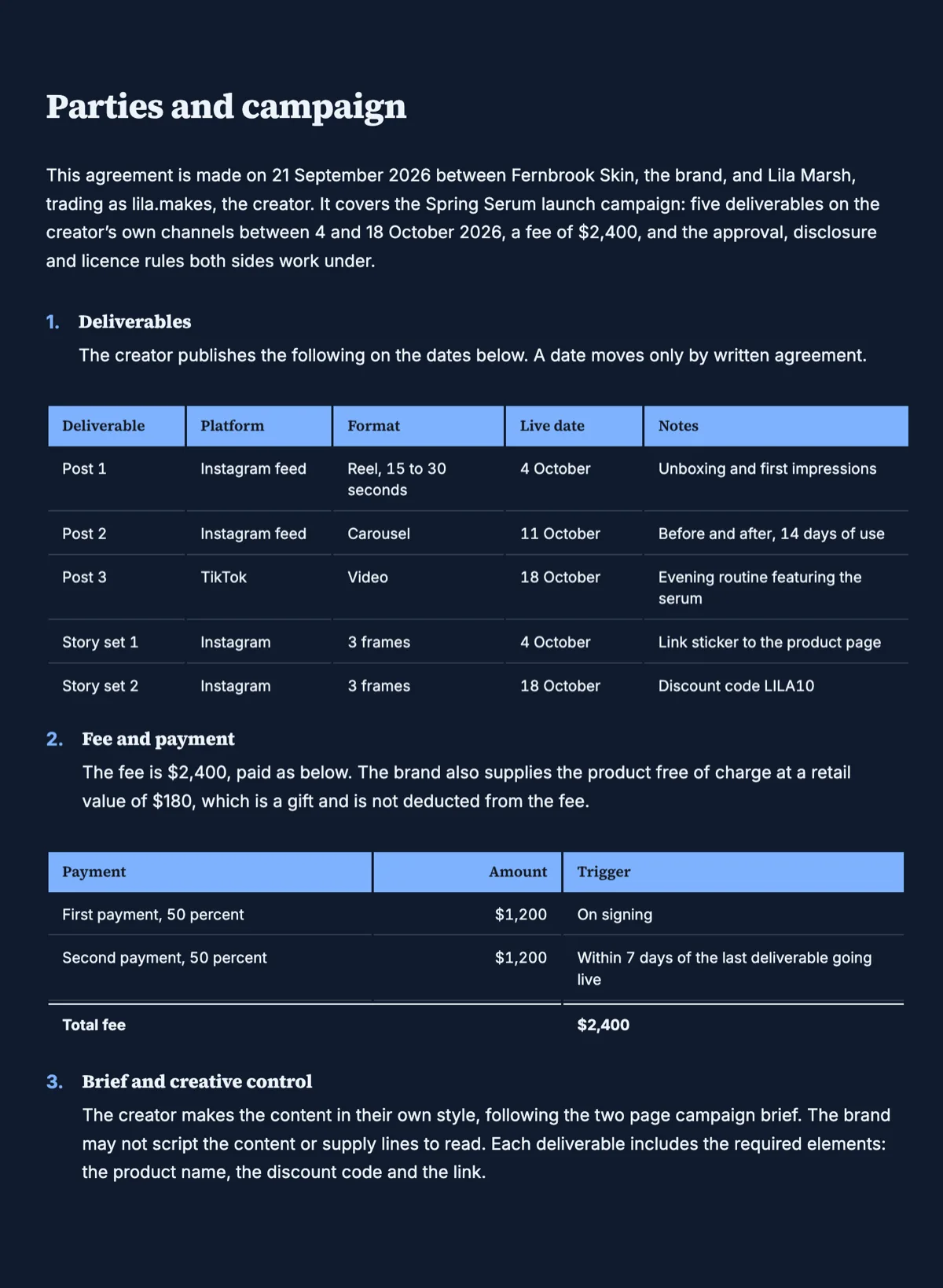 Influencer agreement template with the posts, dates and rights in one tableA creator deal is a schedule of posts and a set of permissions, and the disputes are about the reuse and the disclosure, not the fee. This agreement lists each deliverable with its platform and live date, splits the $2,400 fee across delivery, gives the brand a 12 month licence rather than ownership, and puts the ad label rule in the creator's obligations.
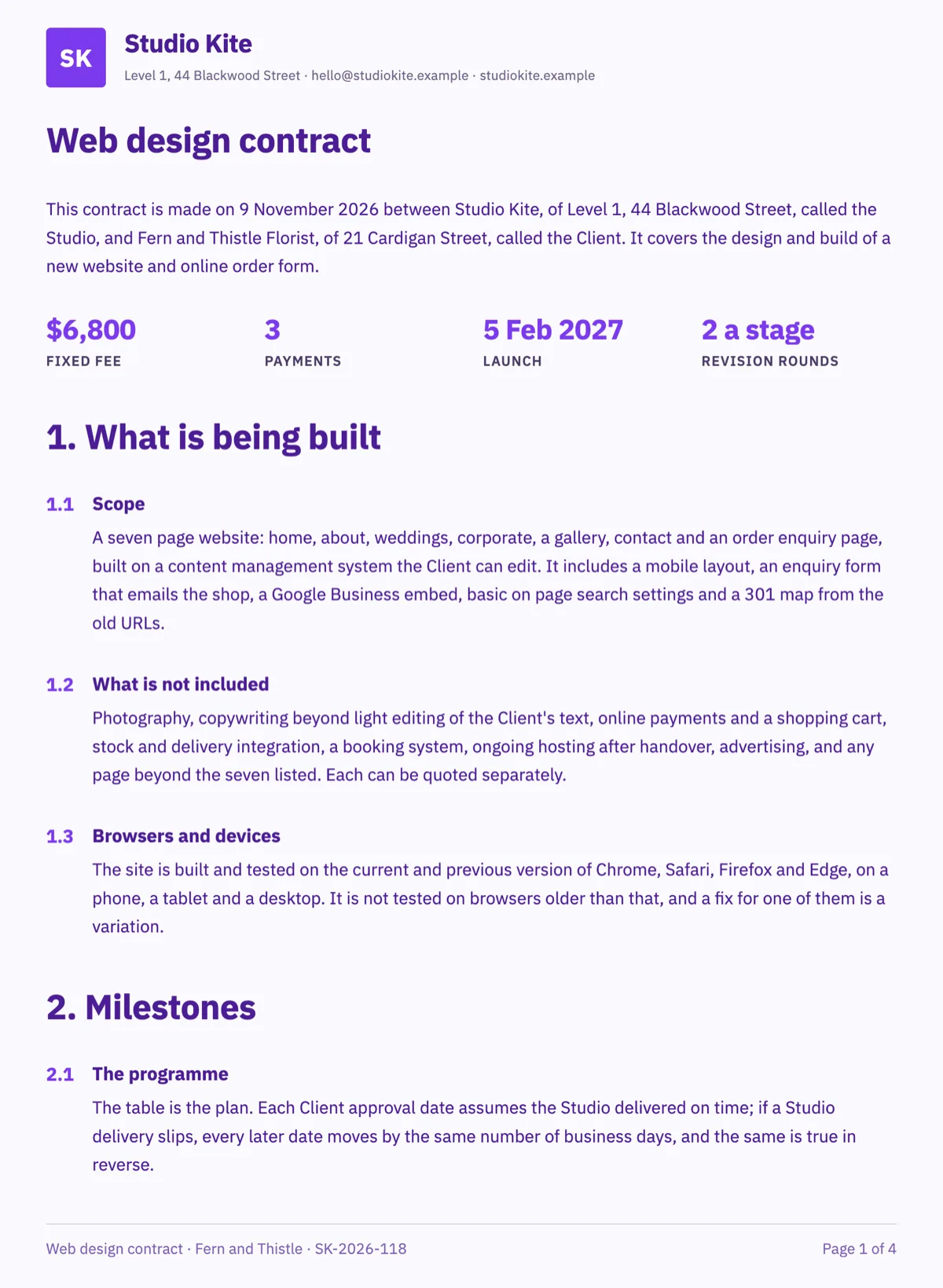 Web design contract template with milestones and revision roundsWebsite projects rarely fail on design. They stall because the content never arrives and nobody wrote down what happens next. This contract dates every milestone on both sides, deems a stage approved if the client goes quiet, and moves the launch by a day for every day the copy is late.
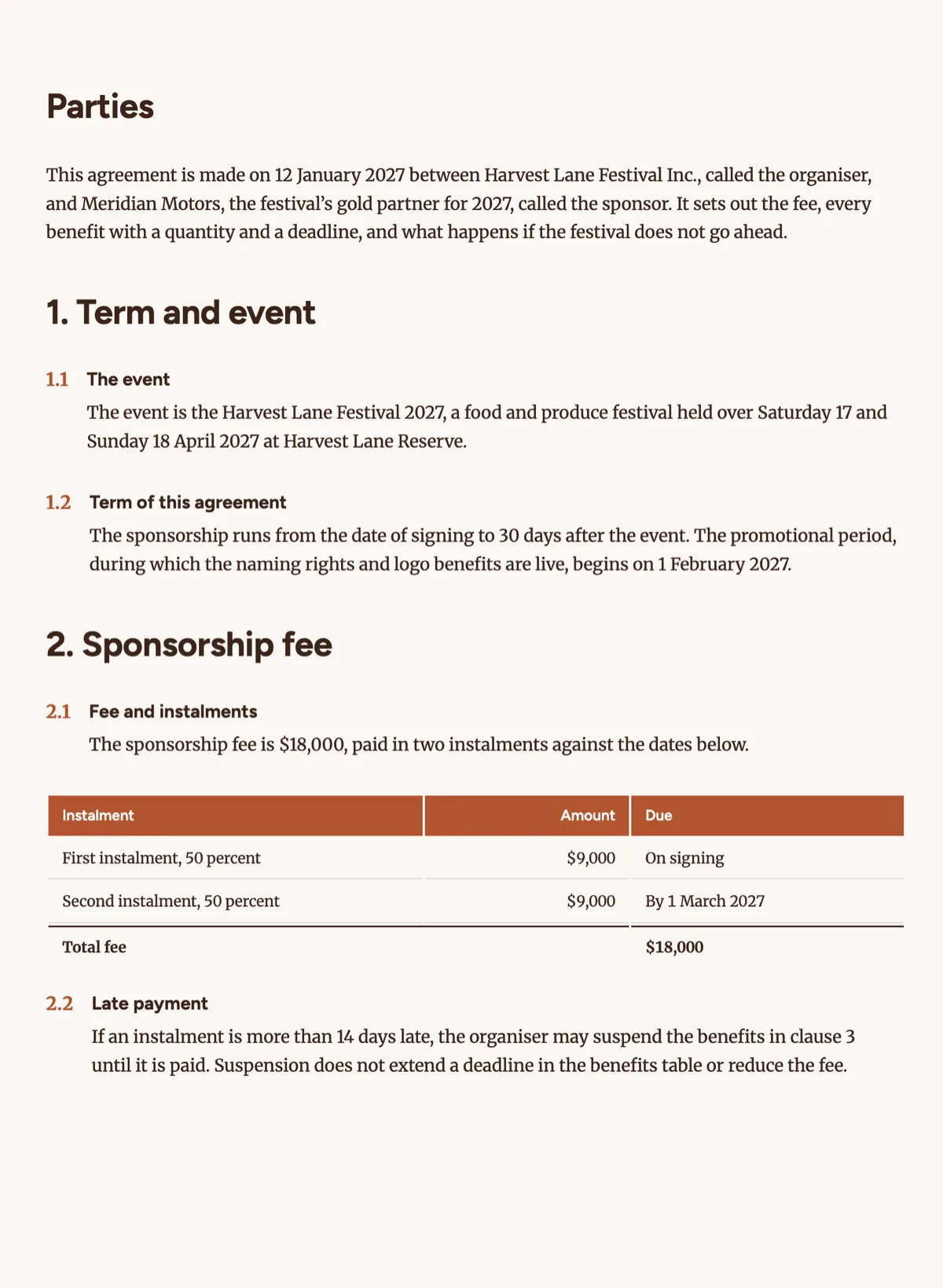 Sponsorship agreement template that lists every benefit with a numberSponsorship falls apart in the delivery, when nobody can find the email that said how many banners and which stage. This agreement is the benefits list as a table with quantities and dates, the $18,000 fee in instalments tied to those dates, and the two clauses sponsors care about most: exclusivity, and what happens if the event does not go ahead.
Questions people ask
What is an approval clause?
It is the term that sets which work needs the client's sign off, how long the client has to respond, what changes it can ask for, and what happens if it does not respond. It controls when a draft becomes final and the project can move on.
What does deemed approval mean?
Work is treated as approved if the client does not respond within the agreed time. It prevents a project stalling because one person is too busy to reply. The clause should make clear what deemed approval covers and what rights it does not waive.
Can a brand rewrite an influencer's post?
Only as the agreement allows. Many influencer agreements limit the brand's changes to factual errors, product claims, required elements and disclosure, leaving the creator's voice alone. If the brand wants full control of the words, that should be agreed and priced up front.
What does not unreasonably withheld mean?
It means the party whose approval is needed must have a genuine, reasonable basis to refuse, related to its legitimate interests under the contract, and cannot refuse for an unrelated or arbitrary reason. Courts judge reasonableness on the circumstances at the time.
Does approving a draft mean I accept any defects?
Not necessarily, and the clause should say so. Approval usually confirms the work may go ahead or be published. Defects that were not obvious at approval, or breaches of the agreement, can still be raised, especially where consumer guarantees apply.
Put the clause in a finished document
The button opens the document generator with a starting description already filled in. Change it to match your own agreement before you run it.
Create a document with OneCraftRelated clauses
- Revisions clause: rounds of changes for creative workRevisions clause sample for design, web and writing contracts: revision rounds, what counts as a revision, consolidated feedback, extra rounds and deadlines.
- Usage rights clause for creative and influencer workUsage rights clause sample for design, photo and influencer contracts: what the client may use, where and for how long, licence or assignment, and extensions.
- Acceptance testing clause: deciding when the work is doneAn acceptance testing clause sets how a deliverable is tested and when it counts as accepted. Sample 10 day test wording, deemed acceptance and staged variants.
- Standard of care clause: how good the work has to beA standard of care clause sets the quality bar for work. Australian sample wording, due care and skill, best and reasonable endeavours, and fitness for purpose.
For everything the document generator can do, see the document maker.
Step by step in the builder: Create a document with AI, then Document builder components.
Written and checked by the OneCraft team. Last checked .