Contract clause
Usage rights clause for creative and influencer work
A usage rights clause sets how a client may use creative work it pays for, such as photographs, designs or creator content: the media and channels, the territory, the period, whether use is exclusive, and whether the creator keeps copyright and grants a licence or assigns ownership outright.
A usage rights clause decides what a client actually buys when it pays for creative work: ownership of the copyright, or permission to use the work in set ways for a set time. Getting it wrong either way is costly, so the clause names the channels, territory, period and exclusivity, and prices any use beyond them.
Indunil Asanka · Co-founder
3 min read · Published
Sample clause
Written for agreement between a fictional creator and Harbour Mist, a fictional skincare brand, for three sponsored posts and a short video.
Usage Rights. (a) The Creator keeps copyright in the Content. On payment of the Fee, the Creator grants the Brand a non exclusive licence to use the Content as follows. (b) Organic use: the Brand may share and repost the Content on its own social media accounts for 12 months from the first post date. (c) Paid use: the Brand may use the Content in paid social advertising in Australia and New Zealand for 3 months from the first post date. Further paid use requires a written extension at $600 a month. (d) The Brand may crop and resize the Content and add captions and its logo, but must not otherwise edit it or use it in a way that suggests the Creator endorses another product. (e) Use in print, broadcast, outdoor or packaging is not licensed. (f) The Creator may show the Content in their portfolio after it has been published.
Sample wording, not legal advice.
Variants
Full assignment on payment
Logos and brand identities, where the client needs to own the work outright and register it as a trade mark.
On payment in full, the Designer assigns to the Client all copyright in the approved logo, secondary mark and colour and type system. Concepts not chosen remain the Designer's property.
Personal use licence
Wedding and portrait photography, where clients print and share images but commercial use needs permission.
The Photographer owns the copyright in all images. The Clients may print the images, share them with family and friends and post them online. Commercial use by the Clients or their vendors requires the Photographer's written consent.
Exclusive time limited licence
Hotel, venue or product photography where the client wants no competitor using the same images for a period.
The Photographer grants the Client an exclusive licence for 3 years to use the Images on its website, social media and printed brochures. The Photographer will not license the Images to anyone else during that period.
What to negotiate
Licence or assignment
An assignment transfers copyright; the creator can no longer use or license the work. A licence leaves copyright with the creator and gives the client permission for set uses. Clients often ask for assignment by default, but a well defined licence is usually cheaper and enough. Under the Copyright Act 1968, an assignment, or an exclusive licence, must be in writing and signed.
Paid use is a separate price
Organic sharing on the brand's own account and paid advertising are different uses with different value, because paid ads put the content in front of far more people. Creators commonly charge for paid use by period, as the sample does, and the clause should make extensions written and priced in advance.
Edits and context
A clause should say what edits the client may make and what uses are off limits, such as implying the creator endorses a competitor or a political cause. Edits that distort the work can also engage the creator's moral right of integrity, which the attribution clause page covers.
The risk of leaving it out
Without a usage rights clause, the client's rights depend on default copyright rules and what a court implies from the circumstances, which is often less than the client assumed. A brand that runs paid ads with a creator's content on an unclear agreement can face a claim for unlicensed use, and a creator can lose income from use they never priced.
Who owns copyright by default
Under the Copyright Act 1968, the author of a work usually owns the copyright, unless the work is made by an employee in the course of employment, when the employer owns it. Freelancers and contractors keep copyright in what they create unless they assign it in writing. A special rule applies to photographs commissioned for private or domestic purposes, such as a wedding, where the person who commissioned them owns the copyright unless the parties agree otherwise. Law checked on 21 October 2026. This page explains how the law works and is not legal advice.
Channels, territory and period
The three dimensions of a licence are where the work may be used, such as social media, website, print or broadcast; in which countries; and for how long. The photo licence example licenses hotel images for three years with renewal or take down at the end. The graphic design example assigns the approved logo on payment. The influencer example sets approval, disclosure and licence rules for a fixed run of posts.
Disclosure of sponsored content
Content made under a paid deal must not mislead consumers. Under the Australian Consumer Law, failing to disclose that a post is sponsored can be misleading conduct, and the advertising industry's codes require clear disclosure. A usage rights clause often sits beside a disclosure clause requiring the creator, and the brand when it reposts, to label the content as advertising.
Where the clause sits in a generated document
Influencer, photography, videography, graphic design and photo licence agreements carry this clause. When asking the AI document generator for one, state whether copyright is assigned or licensed, the channels, territory, period and exclusivity, the price of extensions and any limits on edits.
Documents that carry this clause
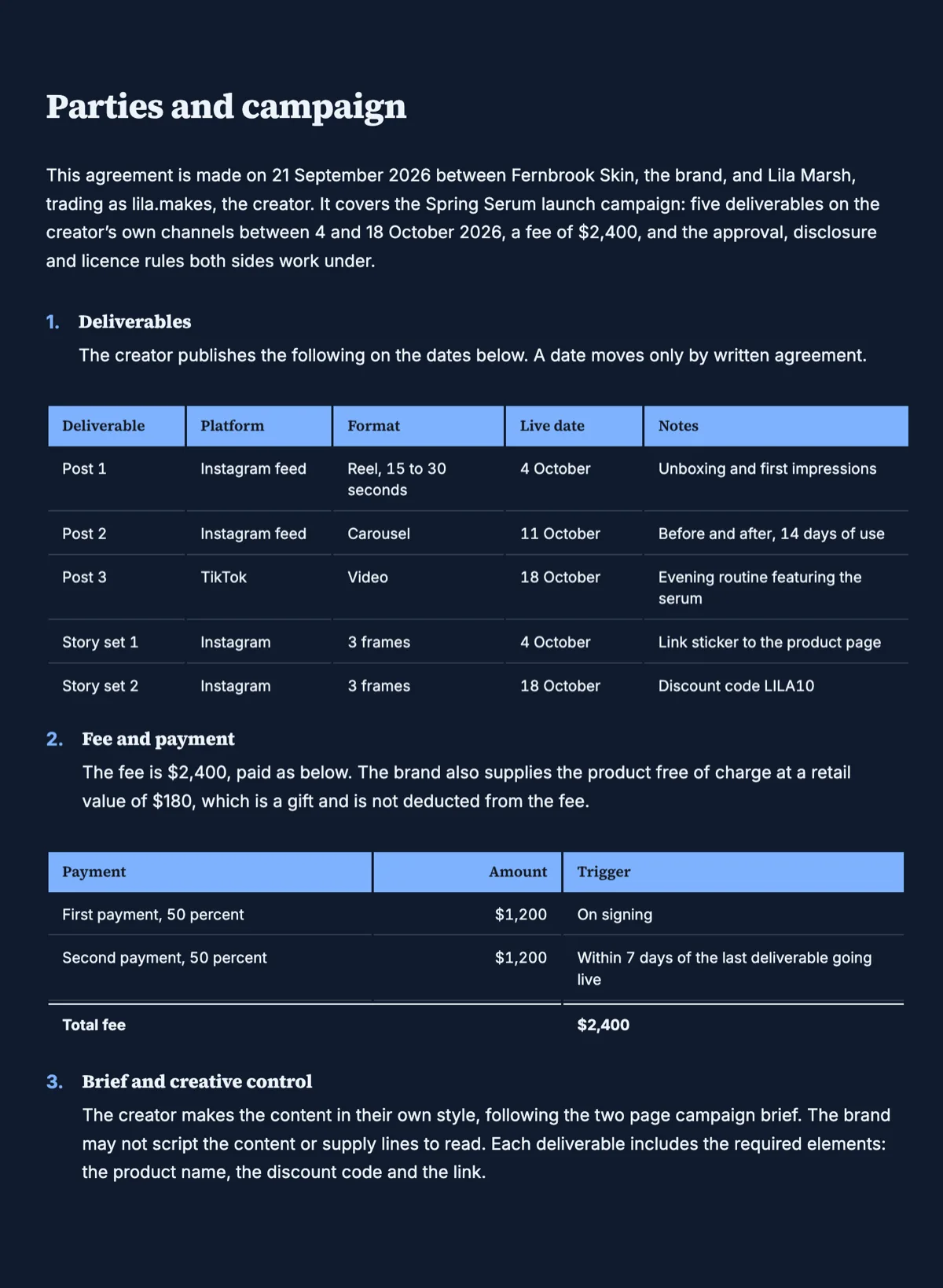 Influencer agreement template with the posts, dates and rights in one tableA creator deal is a schedule of posts and a set of permissions, and the disputes are about the reuse and the disclosure, not the fee. This agreement lists each deliverable with its platform and live date, splits the $2,400 fee across delivery, gives the brand a 12 month licence rather than ownership, and puts the ad label rule in the creator's obligations.
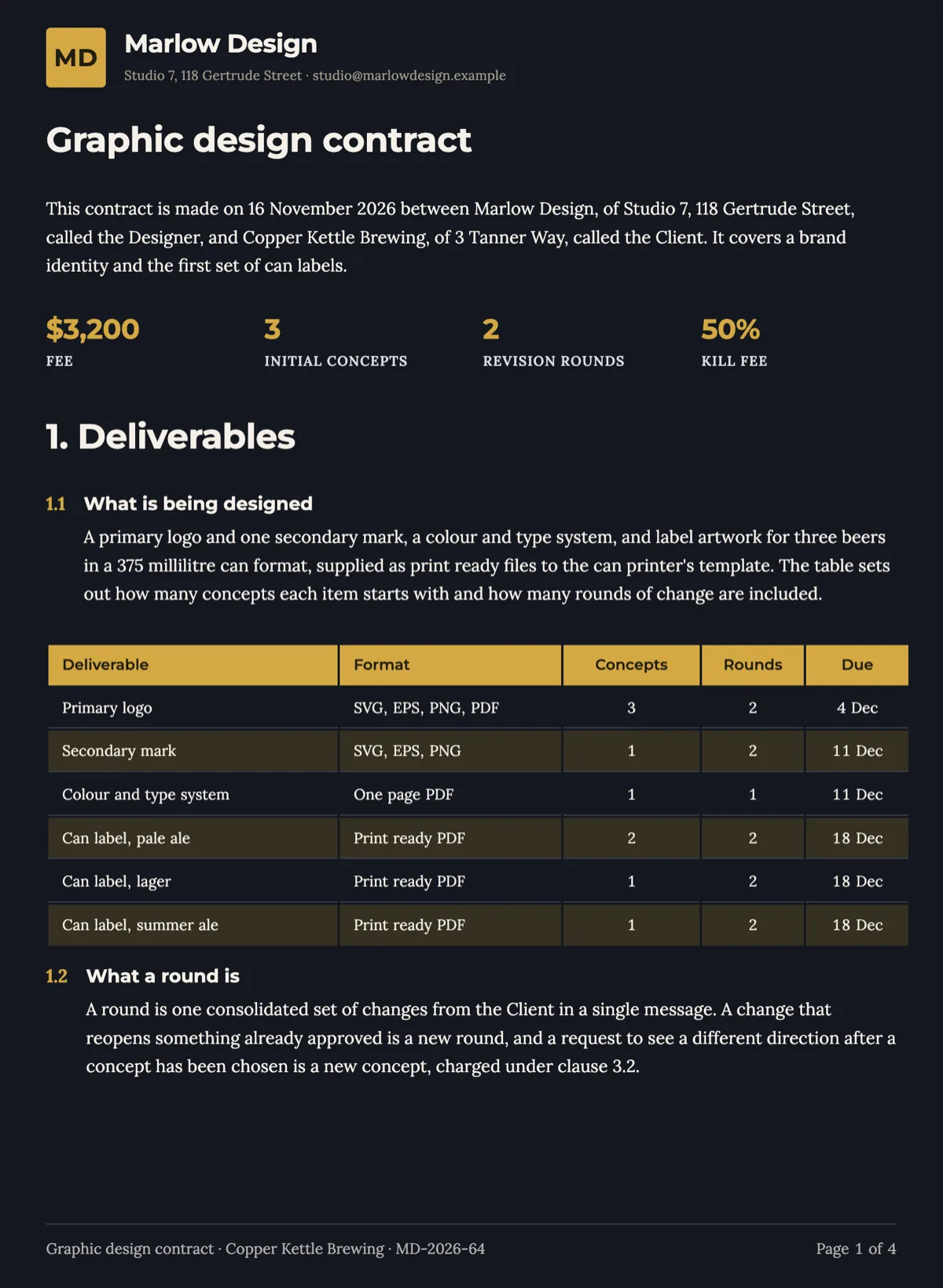 Graphic design contract template with concepts, rounds and usage rightsTwo things end design relationships: an endless run of revisions nobody priced, and a client who does not know whether they can put the logo on a shirt they sell. This contract counts the concepts and rounds for every deliverable and sets out the usage rights medium by medium.
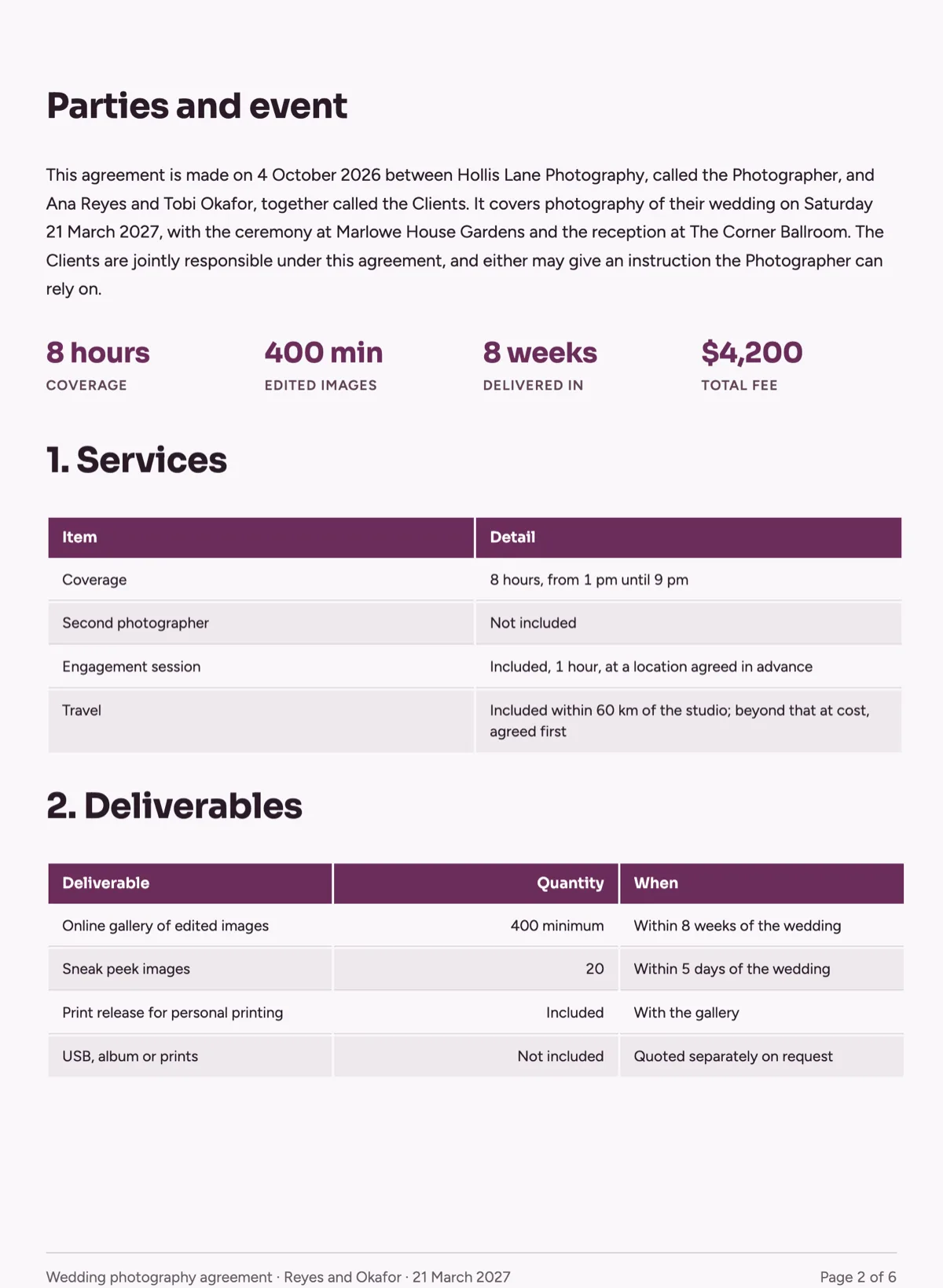 Photography contract template with deliverables you can countA photography contract is mostly a list of numbers: hours, images, weeks, dollars and the date after which the deposit is gone. This one writes every number down, then handles the three things that go wrong with weddings, a postponement, a sick photographer and an argument over who owns the photos.
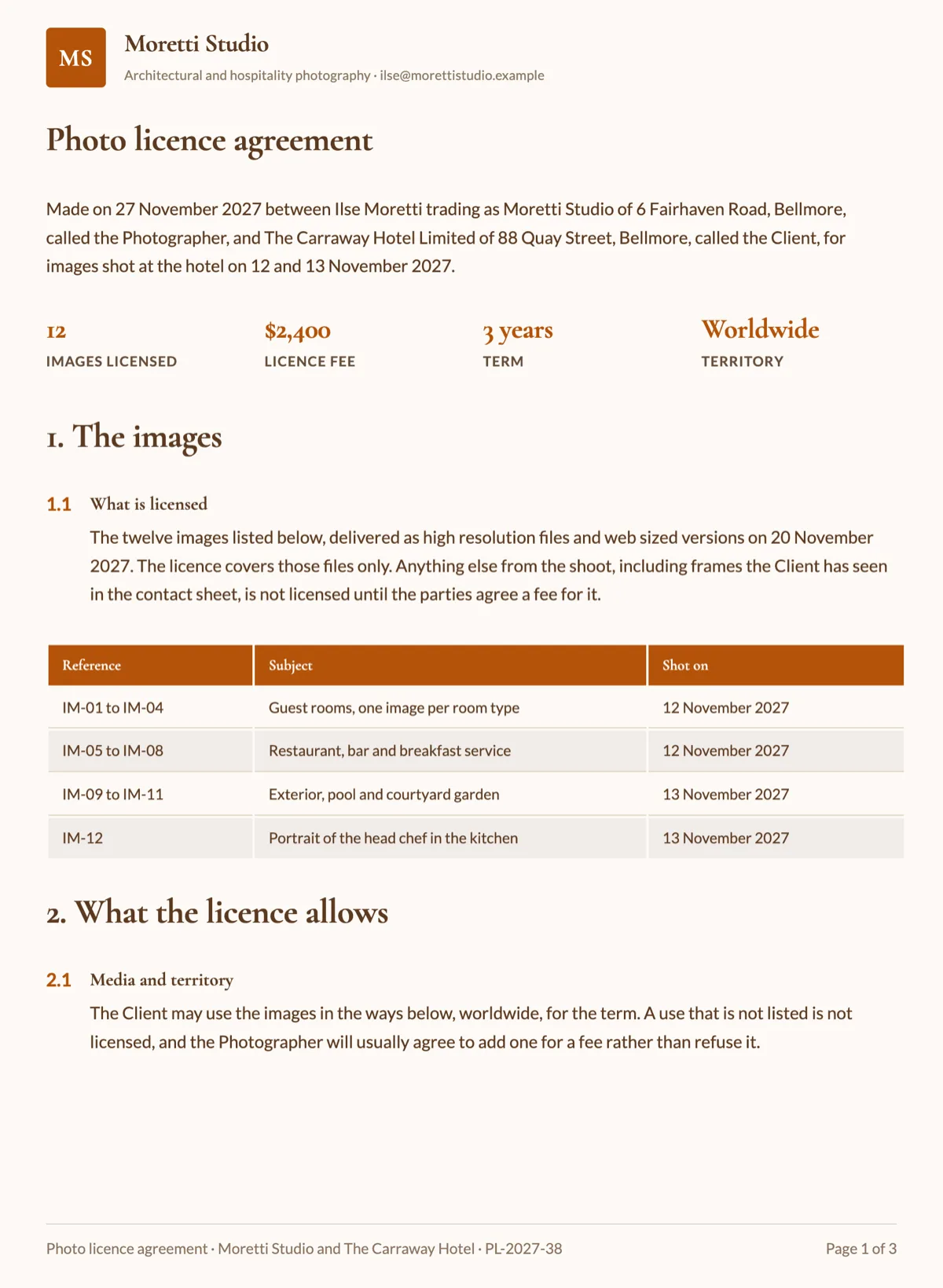 Photo licence agreement covering media, territory and durationA photo licence says which images, for which uses, for how long. Everything else is detail. This one licenses twelve hotel images to the hotel that commissioned them for three years worldwide at $2,400, with a table that marks paid advertising as an extra and resale as not available at any price.
Questions people ask
What are usage rights in a contract?
They are the permissions a client receives to use creative work, such as photos, designs or videos: where it may be used, for how long, in which countries and whether exclusively. They may come as a licence, with the creator keeping copyright, or as an assignment of copyright.
Do I own the photos I paid for?
Not automatically. A professional photographer usually keeps copyright and gives a licence, unless the contract assigns it. For photos commissioned for private or domestic purposes, such as a wedding, Australian law gives copyright to the person who commissioned them unless agreed otherwise.
What is the difference between organic and paid usage?
Organic usage means sharing content on the brand's own accounts without paying to promote it. Paid usage means using it in advertising, such as boosted posts or ads, which reaches far more people. Creators usually price paid use separately, often by month.
Does a usage rights clause need to be in writing?
A non exclusive licence can be informal, but an assignment of copyright, or an exclusive licence, must be in writing and signed under the Copyright Act 1968. Writing every licence down avoids disputes about what was agreed. Keep it with the invoice.
Can a brand edit a creator's content?
Only as far as the licence allows. Clauses often allow cropping, resizing and adding a logo or caption, but not changes that alter the message. Edits that distort the work can also infringe the creator's moral right of integrity. Spell the limits out.
Put the clause in a finished document
The button opens the document generator with a starting description already filled in. Change it to match your own agreement before you run it.
Create a document with OneCraftRelated clauses
- Attribution clause: credit lines and moral rightsAttribution clause sample for licences: how the creator is credited, where the credit appears, when none is needed, and moral rights consents in Australia.
- Photo consent clause: sample for staff, clients and childrenPhoto consent clause sample for Australia: consent to be photographed or filmed, how images are used, withdrawal, children and parents, and the Privacy Act.
- Licence grant clauseA licence grant clause gives permission to use intellectual property without owning it. Sample photo licence wording and the six terms every grant settles.
- Work made for hire clauseA work made for hire clause makes the commissioning party the author under US law. Sample wording, the nine statutory categories, and the assignment fallback.
For everything the document generator can do, see the document maker.
Step by step in the builder: Create a document with AI, then Document builder components.
Written and checked by the OneCraft team. Last checked .