Contract clause
Attribution clause: credit lines and moral rights
An attribution clause says how and where the creator of a work must be credited when it is used, such as a photographer's name beside an image or a composer's name in film credits, and when no credit is required. It works alongside the creator's moral right of attribution under the Copyright Act 1968.
An attribution clause sets the credit a creator gets when their work is used: the exact wording, where it goes, and the cases where a credit is impractical and not required. In Australia individual creators also have a moral right to be attributed, which the clause can shape but cannot simply sign away.
Nuwan Madhusanka · Co-founder
3 min read · Published
Sample clause
Written for photo licence between Moretti Studio, a fictional architectural photographer, and The Carraway Hotel, a fictional boutique hotel.
Credit. (a) Where the Client uses an Image on its website or in printed material, it will credit the Photographer next to the Image, or in the credits section of the page or publication, as: Photo: Moretti Studio. (b) On social media, the Client will tag @morettistudio in the post or the first comment. (c) No credit is required where it is not reasonably practicable, such as in a thumbnail, a background image behind text or a paid advertisement smaller than 300 pixels wide. (d) The Client must not credit the Images to anyone else, or credit the Photographer for any image it did not take. (e) An accidental omission of credit is not a breach if the Client adds the credit within 5 business days after being told of it.
Sample wording, not legal advice.
Variants
Music credit
A composer licensing music for a film or video, where credits roll at the end.
The Licensee will credit the Composer in the end credits of the Production as: Original music by Rhea Lin, in a size and position no less favourable than other music credits.
No credit required
Personal use licences, stock style licences or content where a credit would be out of place.
The Clients may post the images online with no credit required. Any commercial use requires the Photographer's written consent and a credit in the form the Photographer specifies.
Moral rights consent
Commissioned work that the client may adapt or use without a credit, where the creator gives a written consent.
The Designer consents to the Client using the Work without attribution and making changes to it for the purposes described in Schedule 2, for the purposes of Part IX of the Copyright Act 1968.
What to negotiate
Exact wording and placement
A credit that is buried or misspelled does little for the creator. The clause should give the exact form, such as Photo: Moretti Studio, and say where it goes: next to the work, in a credits section, or as a tag. Clients prefer flexibility on placement; creators prefer the credit next to the work.
Reasonable exceptions
Credits are impractical in thumbnails, small ads and some designs. Listing those exceptions, as the sample does, protects the client from technical breaches while keeping the credit where it matters. A short cure period for accidental omissions avoids disputes over a forgotten caption.
Moral rights cannot be assigned
In Australia a creator's moral rights belong to them personally and cannot be assigned, even when copyright is. A client that needs to use work without a credit or alter it substantially should obtain a written consent covering those acts. The moral rights consent clause page covers consents in detail.
The risk of leaving it out
Without an attribution clause, a client may use work with no credit, which can infringe the creator's moral right of attribution where it was reasonable to credit them, or credit the wrong person, which can infringe the right against false attribution. A creator relying only on moral rights has less certainty than a clause gives about the wording and placement.
The moral right of attribution
Part IX of the Copyright Act 1968 gives individual creators three moral rights: the right of attribution of authorship, the right not to have authorship falsely attributed, and the right of integrity, not to have the work subjected to derogatory treatment. The right of attribution is not infringed if it was reasonable in all the circumstances not to attribute, and a creator can give written consent to acts that would otherwise infringe. Law checked on 21 October 2026. This page explains how the law works and is not legal advice.
Credits in the examples
The photo licence example sets the term, copyright and credit together, with a credit line for the hotel's use of architectural images. The music licence example covers fee, credit and warranties in one section, so the composer's credit sits beside the payment. The wedding photography example takes the opposite approach for personal use, with no credit required, and keeps commercial use subject to consent.
Credits and licences together
Attribution is often part of the price. A creator may accept a lower fee in return for a prominent credit, or charge more for use without credit. Linking the credit to the licence, so a use without the required credit is outside the licence, gives the creator a copyright remedy as well as a contract one; a client should push for the cure period so that a forgotten credit does not put it in breach of copyright.
Where the clause sits in a generated document
Photo, music and trade mark licences, design contracts and publishing agreements carry this clause beside the licence grant. When asking the AI document generator for one, give the exact credit line, where it appears on each channel, the exceptions, any cure period and any moral rights consent.
Documents that carry this clause
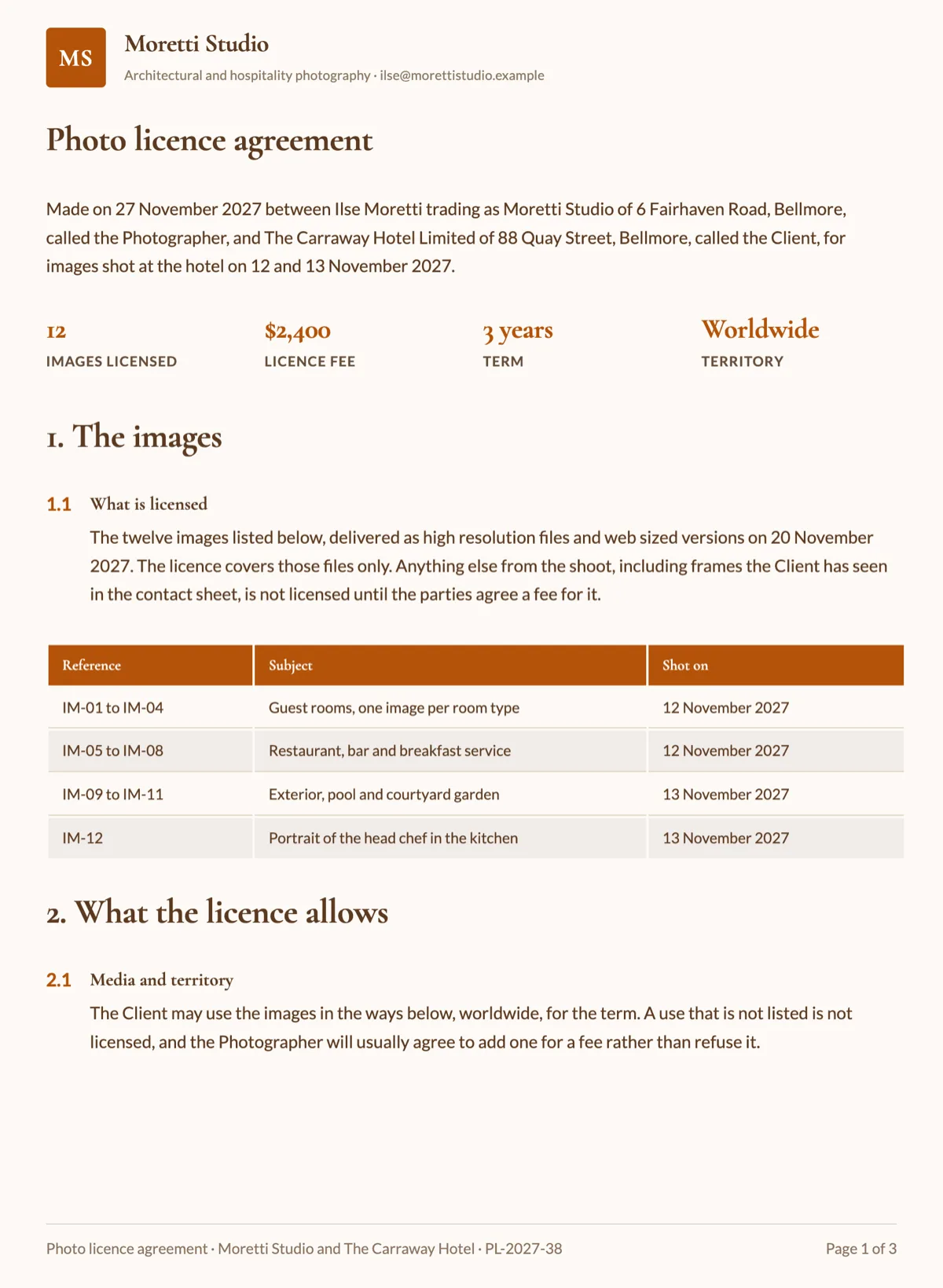 Photo licence agreement covering media, territory and durationA photo licence says which images, for which uses, for how long. Everything else is detail. This one licenses twelve hotel images to the hotel that commissioned them for three years worldwide at $2,400, with a table that marks paid advertising as an extra and resale as not available at any price.
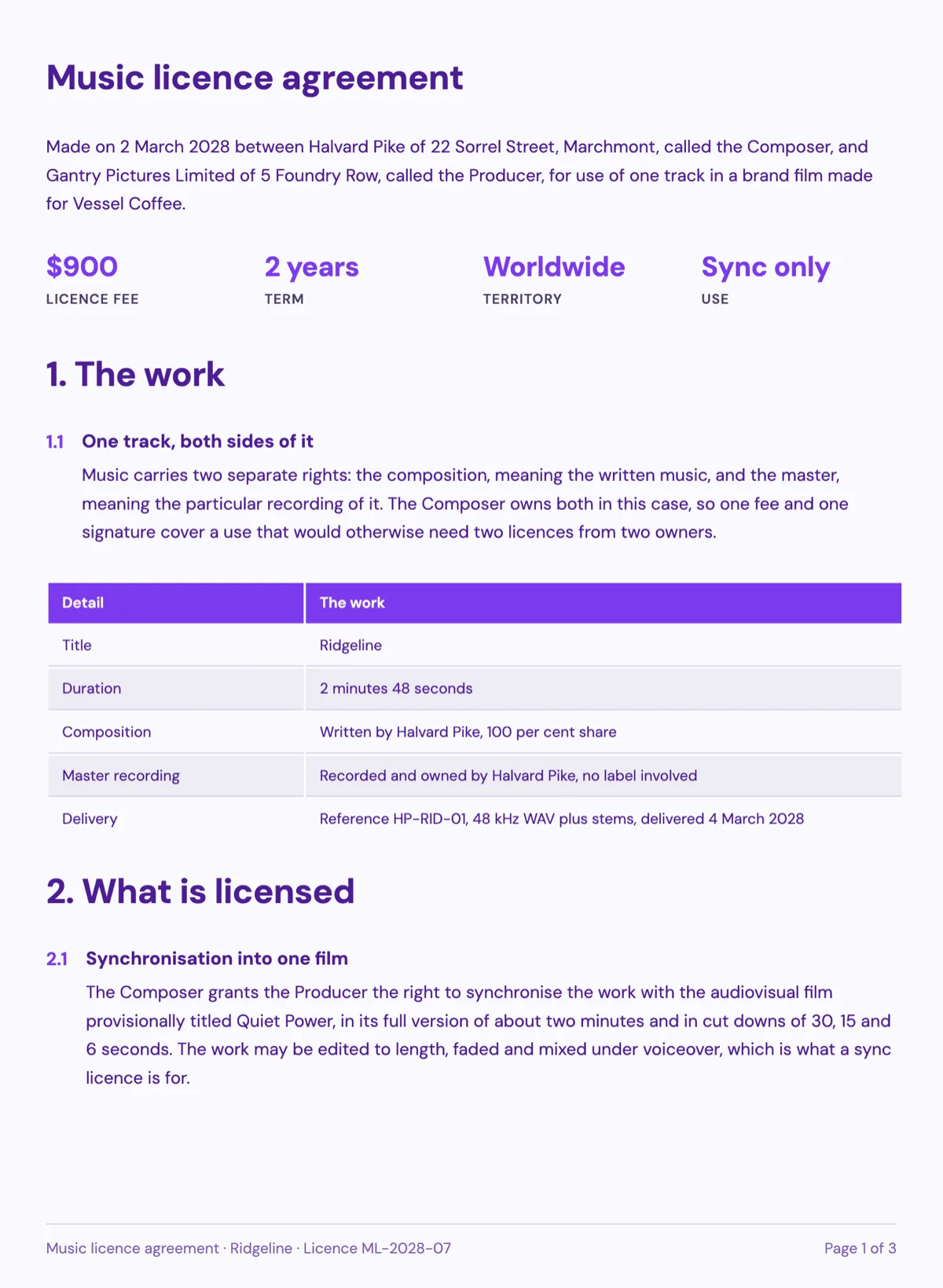 Music licence agreement for sync use, term and creditsMusic carries two rights, the composition and the recording, and a sync licence needs both. This one works because the composer owns both: one fee of $900 covers a single track in a single brand film, worldwide for two years, with paid social at twelve months and broadcast and cinema left off the list.
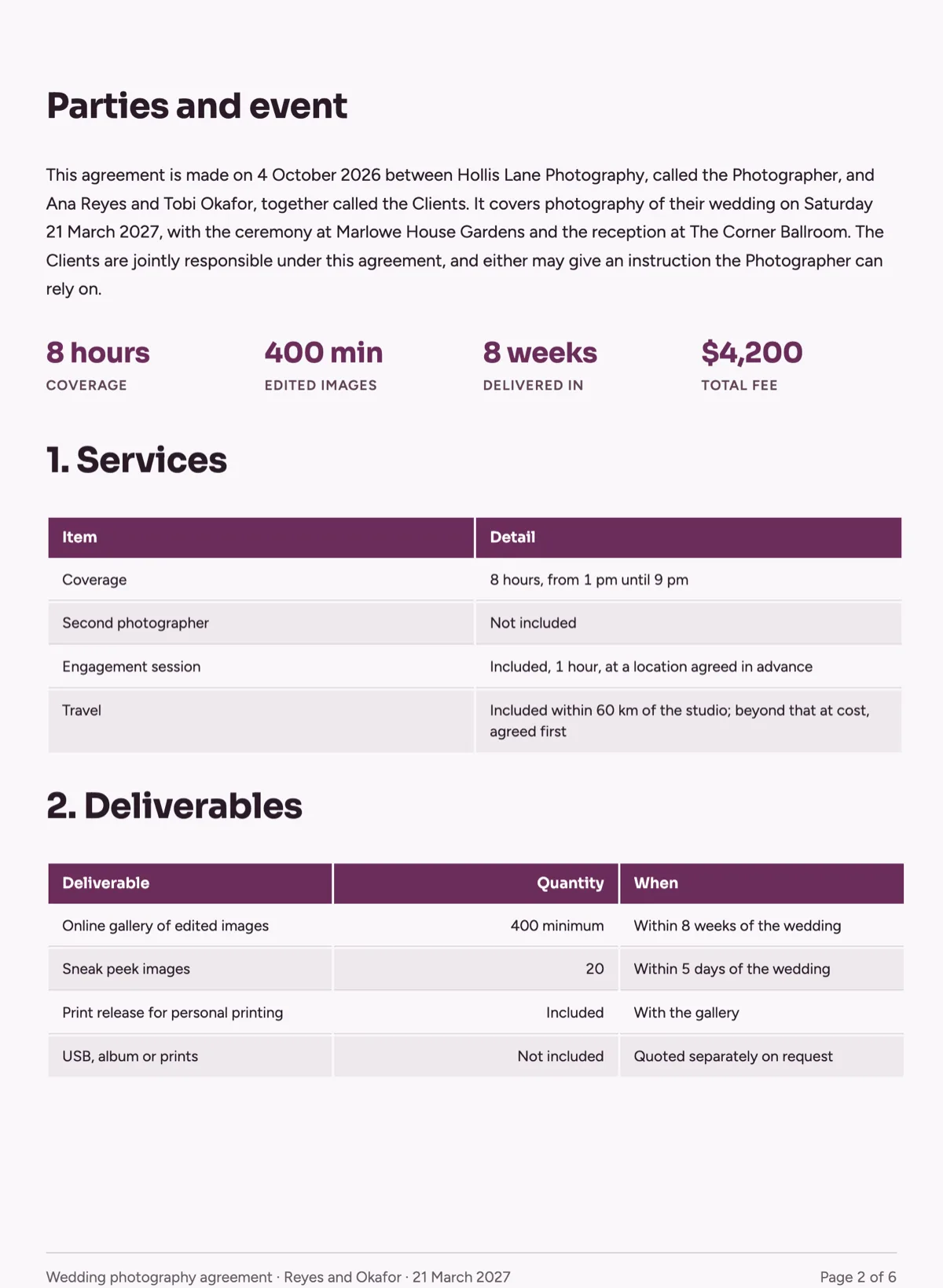 Photography contract template with deliverables you can countA photography contract is mostly a list of numbers: hours, images, weeks, dollars and the date after which the deposit is gone. This one writes every number down, then handles the three things that go wrong with weddings, a postponement, a sick photographer and an argument over who owns the photos.
Questions people ask
What is an attribution clause?
It is the part of a licence or creative contract that says how the creator must be credited when the work is used: the wording, where it appears and when no credit is needed. It turns the general moral right of attribution into precise, agreed terms.
Do I have to credit a photographer in Australia?
Usually, where it is reasonable to do so, because the photographer has a moral right of attribution, unless they have consented in writing to no credit. The licence may also require a specific credit line, making it a contract term as well.
Can a creator waive the right to be credited?
Australian moral rights cannot be waived or assigned, but the creator can give a written consent to specified acts, such as use without credit, and the consent can be broad. A contract term saying the creator waives all moral rights is not effective without such a consent.
What happens if the credit is left off by mistake?
It may infringe the creator's moral right and breach the licence. Many clauses include a cure period, such as adding the credit within 5 business days of being told, so that an accidental omission is not a breach if it is promptly fixed.
Is a tag on social media enough credit?
It can be, if the clause says so. Many licences accept tagging the creator's account in the post or the first comment as the credit for social media, while requiring a written credit line on websites and in print. Say so in the clause.
Put the clause in a finished document
The button opens the document generator with a starting description already filled in. Change it to match your own agreement before you run it.
Create a document with OneCraftRelated clauses
- Photo consent clause: sample for staff, clients and childrenPhoto consent clause sample for Australia: consent to be photographed or filmed, how images are used, withdrawal, children and parents, and the Privacy Act.
- Usage rights clause for creative and influencer workUsage rights clause sample for design, photo and influencer contracts: what the client may use, where and for how long, licence or assignment, and extensions.
- Moral rights consent clauseIn Australia moral rights cannot be assigned, only consented to. Sample consent wording for a copywriter, the three rights, and the UK waiver and US position.
- Publicity clauseA publicity clause says whether a supplier can name a client, use its logo or issue a release. Sample agency wording, consent variants and what to negotiate.
For everything the document generator can do, see the document maker.
Step by step in the builder: Create a document with AI, then Document builder components.
Written and checked by the OneCraft team. Last checked .