Contract clause
Photo consent clause: sample for staff, clients and children
A photo consent clause records a person's agreement to be photographed or filmed and how the images may be used, such as on a website or social media, for how long, and how the person can withdraw consent. For children, a parent or guardian consents. It sits beside copyright terms but deals with the person shown, not the photographer.
A photo consent clause deals with the person in the picture: whether they agree to be photographed, where the images will appear, for how long, and how they can say no later. Under Australia's Privacy Act an identifiable photo can be personal information, and for children the consent comes from a parent or guardian.
Indunil Asanka · Co-founder
3 min read · Published
Sample clause
Written for work experience agreement between a fictional veterinary clinic, Southside Vet, a high school student and the student's parent.
Photographs. (a) The Clinic will not photograph or film the Student without the written consent of the Student's parent or guardian. (b) If consent is given, images may be used only on the Clinic's website and social media accounts to show the work experience program, for up to 2 years, and the Student will not be named. (c) The parent or guardian may withdraw consent at any time by email. The Clinic will remove the images from its own website and accounts within 10 business days, but cannot recall printed material already distributed. (d) The Student must not take photographs of clients, their animals or records at the Clinic, or share any image taken at the Clinic, including on social media. (e) Images are stored securely and deleted when no longer needed for the purpose above.
Sample wording, not legal advice.
Variants
Model release for a commercial shoot
A paid model in a campaign, where the brand needs broad rights to use the images in advertising.
The Model consents to the Photographer and the Brand photographing them and using the images in advertising for the Harbour Mist campaign in all media in Australia and New Zealand for 2 years, and waives any right to approve the final images.
Event attendee consent
A conference or community event where photos of the crowd will be posted afterwards.
Photographs will be taken at the event and may appear on the Organiser's website and social media. Attendees who do not wish to be photographed can collect a red lanyard at registration, and the photographers will avoid them.
Staff photo consent
Employees whose photos appear on a team page or in marketing, where consent should be voluntary and revocable.
With the Employee's consent, the Employer may use the Employee's photograph and name on its website team page while they are employed. The Employee may withdraw consent at any time, and the photograph will be removed within 10 business days and after employment ends.
What to negotiate
Specific, informed and current
Consent works best when it is specific about the uses, given with enough information to understand them, and current. A blanket consent to any use forever is weaker than one naming the channels and the period. The OAIC's guidance on consent describes these elements for personal information.
Withdrawal and what it covers
People change their minds, especially about images of children. A clause should explain how to withdraw consent and what the business will do, while being honest about the limits: printed material already distributed, or posts shared by others, cannot always be recalled, as the sample's sub clause (c) says.
Paid models are different
A model paid for a commercial shoot usually gives a broad release in return for the fee, including advertising use and no approval of final images. That is a commercial bargain and should state the territory, period and media, and any further fee for uses beyond them, in the same way as a usage rights clause.
The risk of leaving it out
Photographing clients, students or children and posting the images without clear consent risks complaints, a breach of privacy obligations where the Privacy Act applies, and real harm, such as revealing the location of a child in a protected situation. A clause and a consent form make the rules clear before anyone picks up a camera.
Photos and the Privacy Act
A photograph or video of an identifiable person is personal information under the Privacy Act 1988, and an organisation covered by the Act must collect and use it in line with the Australian Privacy Principles, including telling people why it is collected and using it only for that purpose or with consent. Many small businesses with annual turnover of $3 million or less are exempt, but health service providers are covered whatever their size. Law checked on 21 October 2026. This page explains how the law works and is not legal advice.
Children and young people
For children, a parent or guardian gives consent, and schools, sports clubs and care providers usually have their own policies on images. The work experience example says the clinic will not photograph the student without a parent's written consent, and stops the student sharing photos of clients or animals. Images of children should never be published with identifying details without that consent.
Consent and copyright are separate
Consent from the person photographed does not give the right to use the photograph; copyright usually belongs to the photographer, and the usage rights clause deals with that. A commercial shoot therefore needs two things: a model release from the person and a licence or assignment from the photographer. The model release example records what the model agrees to and what is excluded.
Where the clause sits in a generated document
Model releases, work experience and volunteer agreements, event terms, employment documents and photography contracts carry this clause. When asking the AI document generator for one, name the uses and channels, the period, how consent is withdrawn and, for children, the parent or guardian's consent.
Documents that carry this clause
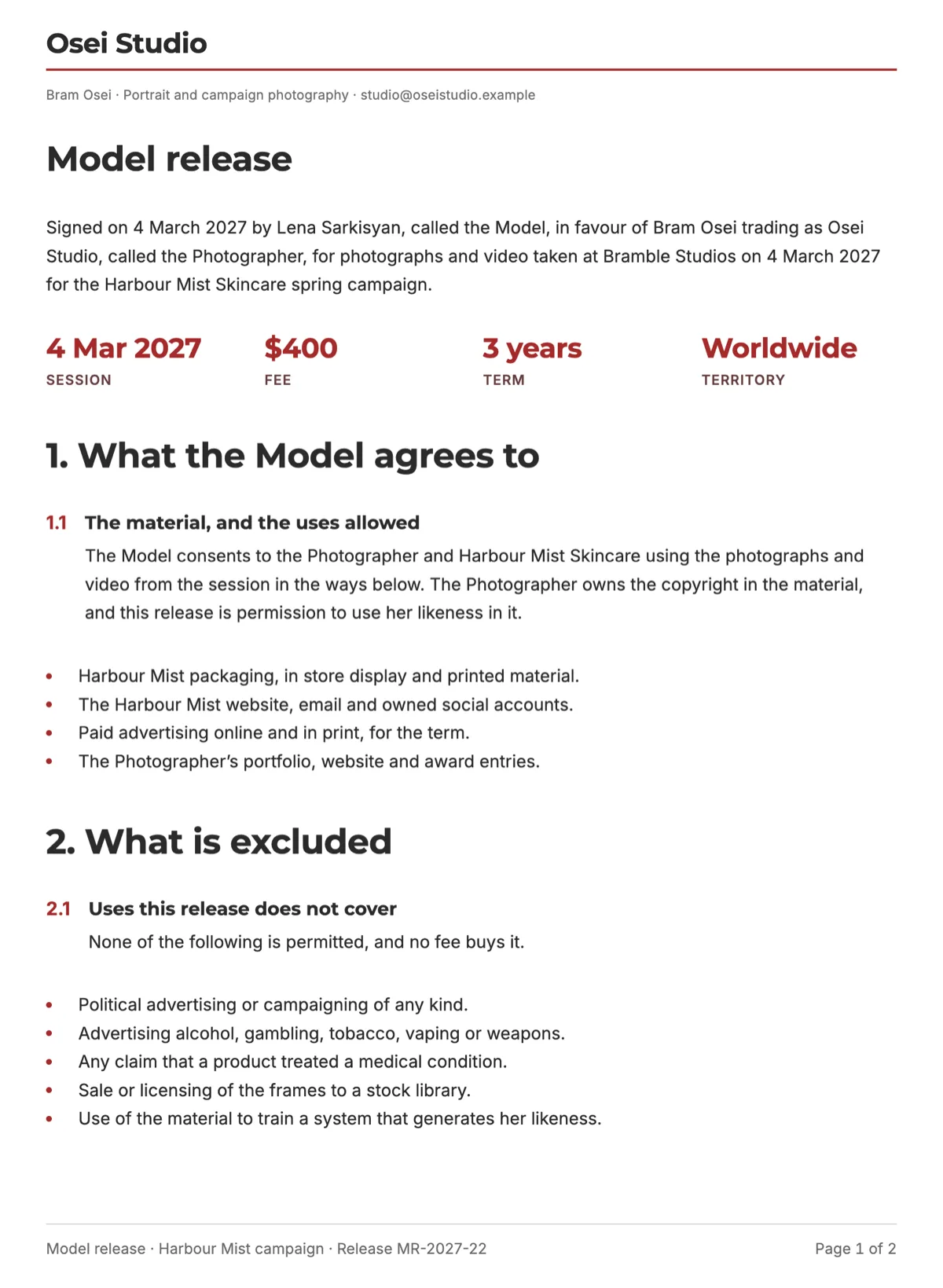 Model release template with uses allowed and uses excludedA model release is only as good as its two lists: what the photographs may be used for, and what they may never be used for. This one covers a skincare campaign shoot, runs for three years worldwide for $400, and rules out political advertising, alcohol and gambling, medical claims, stock libraries and training a system on the model's likeness.
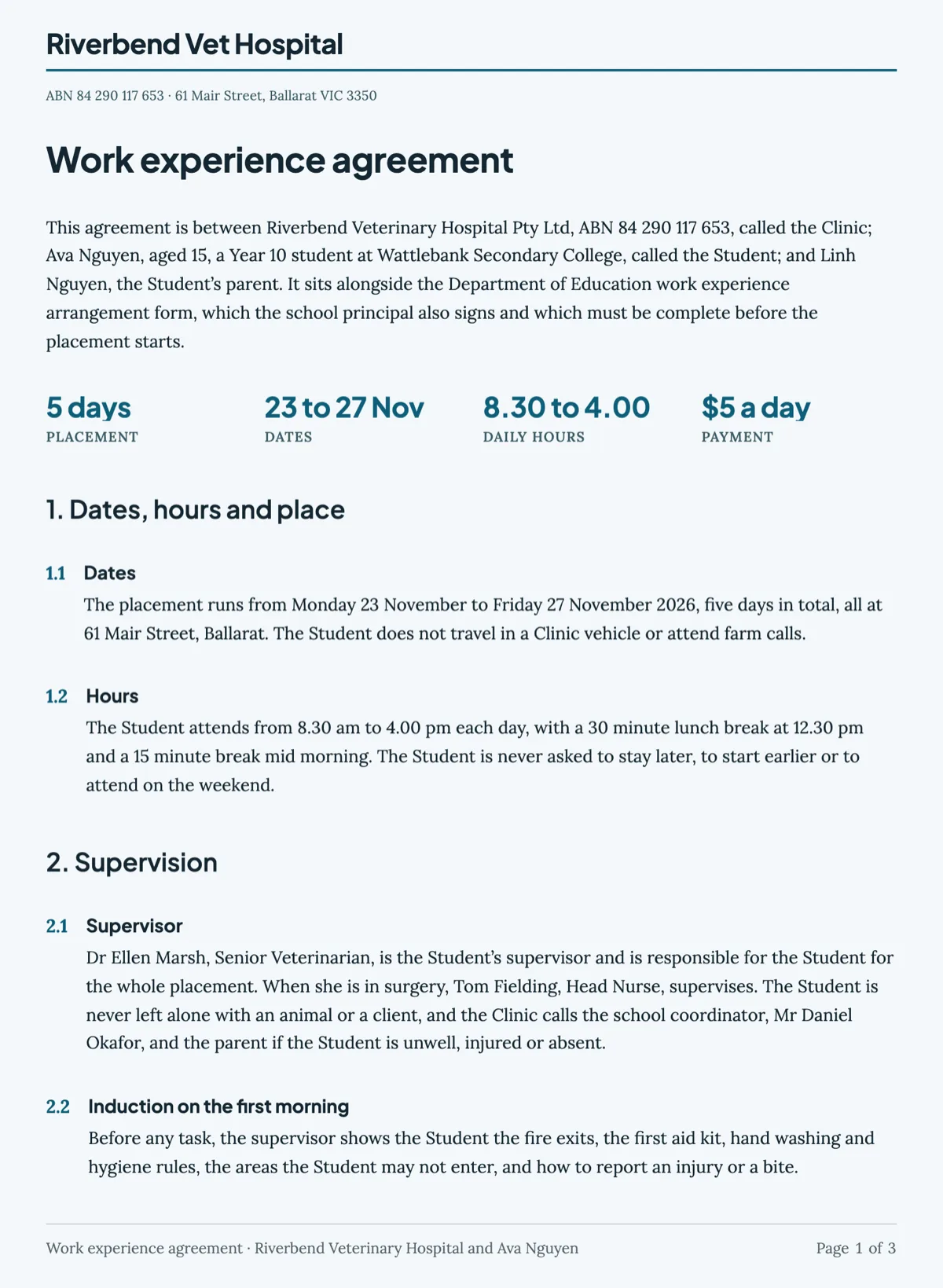 Work experience agreement template for a Year 10 student placementA work experience agreement template sets out when and where a school student will be, who is responsible for them, what they may and may not do, and who covers them if they are hurt. In Victoria it sits alongside the Department of Education arrangement form, and for a student under 18 a parent signs as well.
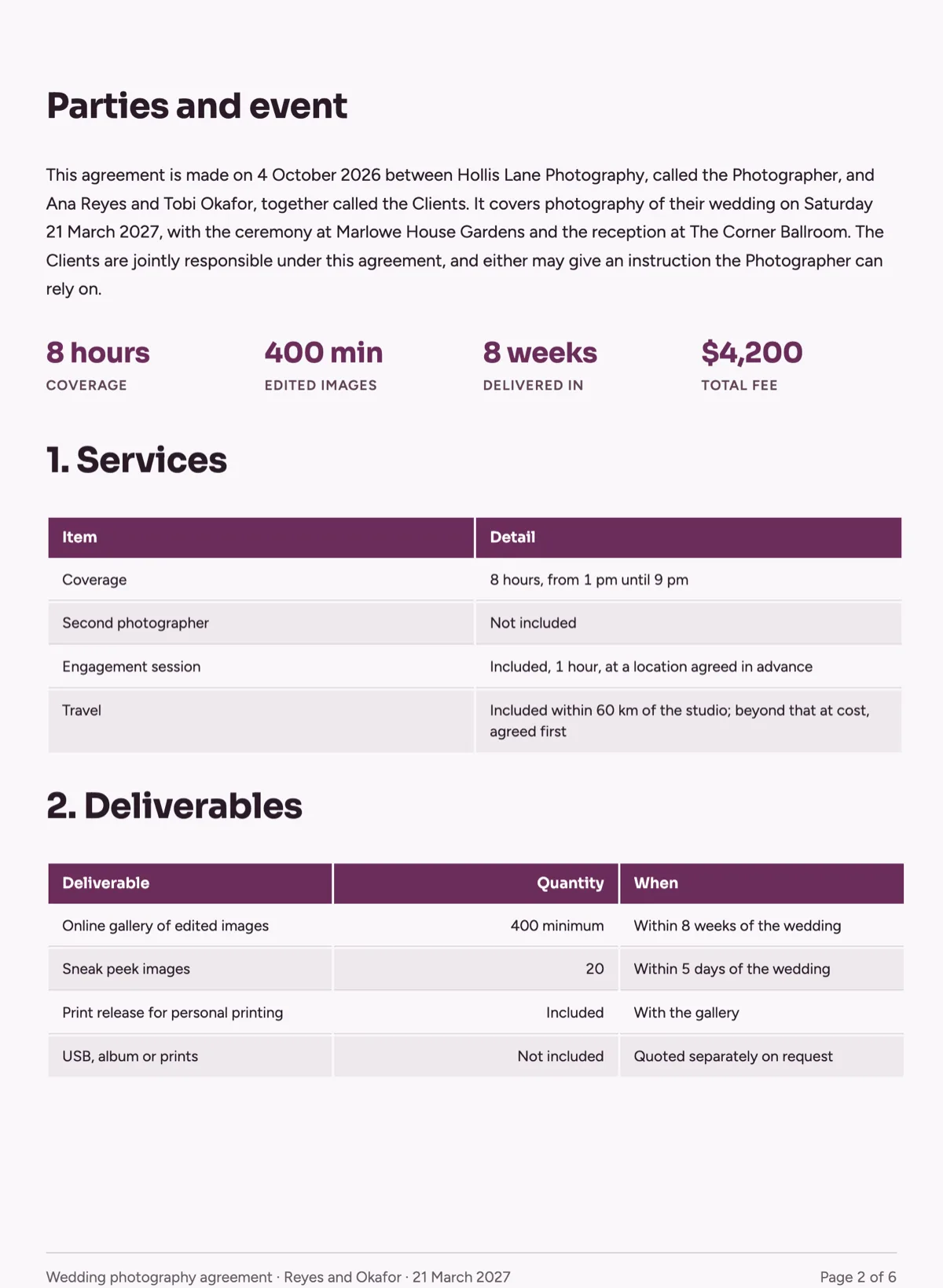 Photography contract template with deliverables you can countA photography contract is mostly a list of numbers: hours, images, weeks, dollars and the date after which the deposit is gone. This one writes every number down, then handles the three things that go wrong with weddings, a postponement, a sick photographer and an argument over who owns the photos.
Questions people ask
Do I need consent to take someone's photo in Australia?
There is no general law against photographing people in public, but businesses covered by the Privacy Act must handle identifiable images as personal information, and using someone's image to promote a business without consent can raise other legal issues. Getting written consent is the safe practice.
Who gives consent for a child's photo?
A parent or guardian, usually in writing. Schools, clubs and care providers often collect consent once a year with options for each use. Older teenagers' own views should also be respected, and any withdrawal by a parent acted on promptly.
Can photo consent be withdrawn?
Yes. A person can usually withdraw consent for future use at any time. The business should remove the images from its own channels within a stated period, but may not be able to recall printed material already distributed or posts shared by others.
What is the difference between a model release and photo consent?
A model release is a broad commercial consent, usually given by a paid model for advertising use, often irrevocable for the agreed period. A general photo consent is narrower, often voluntary and revocable, and used for staff, clients, students and event attendees.
Does the Privacy Act apply to small businesses?
Many small businesses with annual turnover of $3 million or less are exempt, but some are covered whatever their size, including health service providers and businesses that trade in personal information. Even when exempt, following the same consent practices is sensible.
Put the clause in a finished document
The button opens the document generator with a starting description already filled in. Change it to match your own agreement before you run it.
Create a document with OneCraftRelated clauses
- Usage rights clause for creative and influencer workUsage rights clause sample for design, photo and influencer contracts: what the client may use, where and for how long, licence or assignment, and extensions.
- Attribution clause: credit lines and moral rightsAttribution clause sample for licences: how the creator is credited, where the credit appears, when none is needed, and moral rights consents in Australia.
- Privacy clause in a service contractA privacy clause tells a customer what happens to their details and points to the privacy policy. Australian sample for a membership form, with three variants.
- Publicity clauseA publicity clause says whether a supplier can name a client, use its logo or issue a release. Sample agency wording, consent variants and what to negotiate.
For everything the document generator can do, see the document maker.
Step by step in the builder: Create a document with AI, then Document builder components.
Written and checked by the OneCraft team. Last checked .