Contract clause
At will employment clause: sample and the state exceptions
An at will employment clause states that either the employer or the employee can end the employment at any time, with or without cause or notice, for any lawful reason. It is used in the United States, where at will is the default rule in every state except Montana, to stop other documents creating job security.
In most of the United States, employment is at will whether or not a document says so. The clause exists less to create that rule than to protect it from offer letters, handbooks and managers' promises that could be read as promising more.
Indunil Asanka · Co-founder
4 min read · Published
Sample clause
Written for an offer letter and employee handbook of Juniper Street Coffee Roasters, a fictional coffee roaster in Portland, Oregon.
At Will Employment. (a) Your employment with Juniper Street Coffee Roasters is at will. Either you or the Company may end the employment relationship at any time, with or without cause and with or without notice, for any lawful reason. (b) Nothing in this letter, the Employee Handbook, any policy, or any statement by a manager creates a contract of employment for a specific period or changes the at will relationship. (c) The at will nature of your employment may be changed only by a written agreement signed by you and the Company's Chief Executive Officer that expressly refers to this clause. (d) This clause does not limit any right you have under federal, state or local law.
Sample wording, not legal advice.
Variants
Offer letter statement
Every offer letter, so the at will status is stated before the employee accepts.
Your employment is at will, meaning that you or the Company may end it at any time, for any lawful reason, with or without notice. This letter is not a contract for any particular period of employment.
Handbook disclaimer
The start of an employee handbook, where policies on discipline and benefits could otherwise be read as contractual promises.
This handbook describes the Company's current policies. It is not a contract and does not promise employment for any period. Employment with the Company is at will, and the Company may change these policies at any time.
Fixed term contract, no at will
Senior hires or project roles where both sides want a defined term and protection against early termination.
The Executive's employment will continue for two years from the Start Date unless ended earlier under clause 12 for Cause, death or disability. The Executive's employment is not at will during that term.
What to negotiate
Implied contracts from handbooks
Courts in many states have found that a handbook promising termination only for cause, or setting out a progressive discipline process as mandatory, created an implied contract limiting at will employment. A clear disclaimer, repeated in the offer letter and the handbook, and wording that describes discipline steps as guidance rather than guarantees, reduce that risk.
Public policy and statutory exceptions
At will does not allow dismissal for an unlawful reason. Federal and state laws forbid dismissal for discrimination, retaliation for complaints, taking protected leave or union activity, and most states recognise a public policy exception, for example dismissing an employee for refusing to break the law or for serving on a jury. The clause's last paragraph acknowledges those rights.
Who can change the status
Managers sometimes promise a job for life or until the project ends. The sample limits any change to a written agreement signed by the chief executive that refers to the clause, which makes it hard for an oral promise to override at will status. Employees who are offered security in a role should ask for it in writing in that form.
The risk of leaving it out
Leaving out an at will statement does not remove the default rule, but it gives employees more room to argue that an offer letter, handbook or promise created job security, especially where documents describe discipline procedures or permanent positions. Disputes over an implied contract are expensive even when the employer wins.
At will and its exceptions by state
Every US state except Montana starts from at will employment. Montana's Wrongful Discharge from Employment Act, in Title 39, chapter 2, part 9 of the Montana Code, requires good cause for dismissal after an employee completes a probationary period. Elsewhere, three common law exceptions apply in different combinations: the public policy exception, recognised in most states; the implied contract exception, recognised in many, based on handbooks or assurances; and an implied covenant of good faith and fair dealing, recognised in only a minority of states. Statutory protections, such as anti discrimination and whistleblower laws, apply everywhere. Law checked on 21 October 2026. This page explains how the clause works and is not legal advice.
What at will does and does not mean
At will means no reason is needed to end employment, and no notice is required unless a law or contract says otherwise. It does not mean any reason is lawful. Dismissing someone because of race, sex, age, disability, religion, national origin, pregnancy, or for reporting unlawful conduct, remains unlawful. Some states also require final pay on the last day, and federal law requires notice of mass layoffs in certain cases, so at will status does not remove every obligation at termination.
Outside the United States
At will employment is essentially an American concept. In Australia, the UK, Canada and most other countries, employees are entitled to notice or pay in lieu and, after a qualifying period, protection from unfair dismissal. An at will clause in an Australian or UK contract has no effect on those statutory rights. Employers hiring across borders need a contract written for each country rather than a US template with the at will clause left in.
Keeping documents consistent
The clause works only if other documents agree with it. An offer letter promising a permanent position, a handbook stating employees will only be dismissed for cause, or a performance plan saying the employee will keep their job if targets are met, can each undercut it. Review the offer letter, handbook and policy documents together, and use the same at will wording in each.
Documents that carry this clause
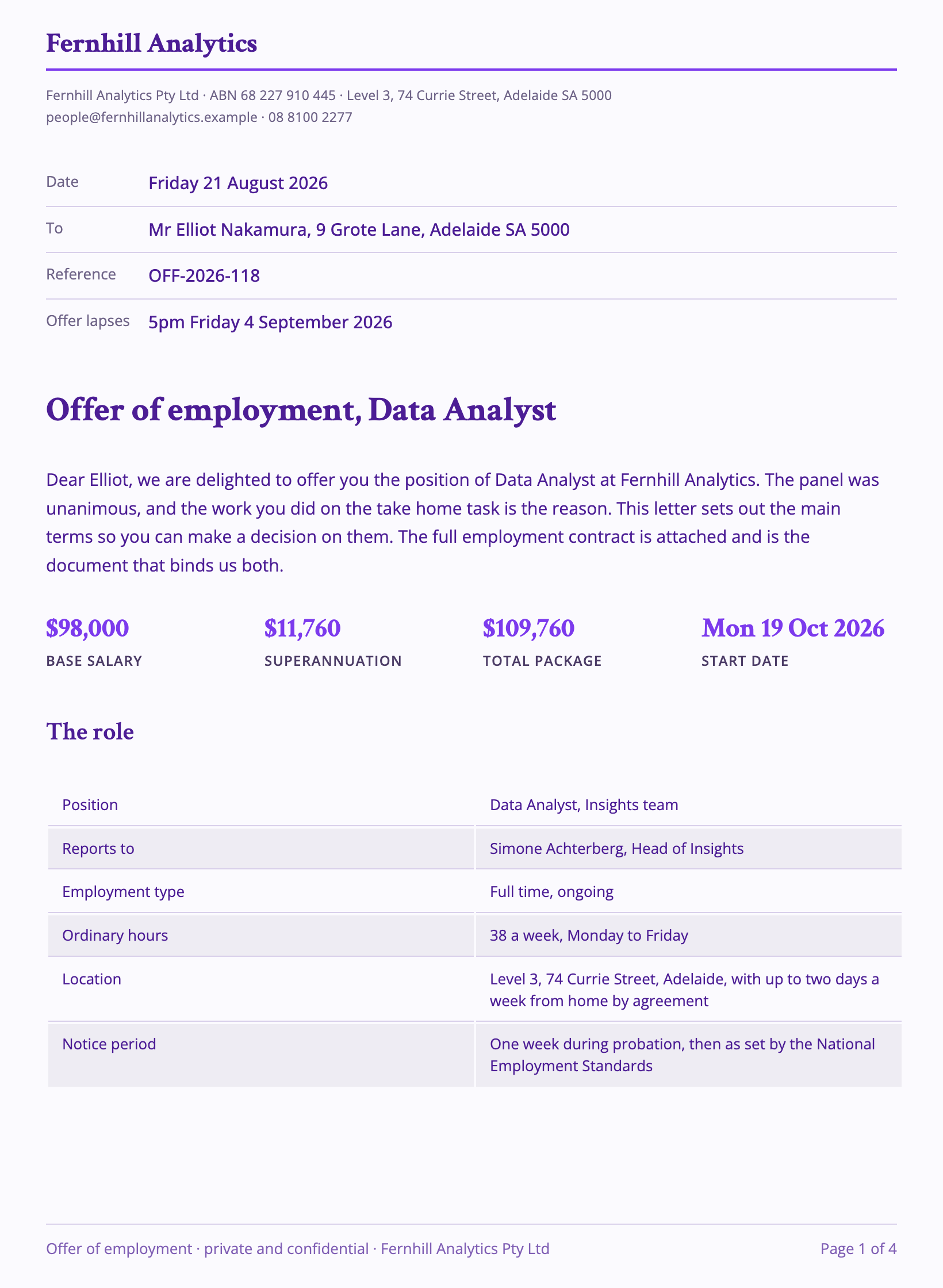 Job offer letterAn offer of $98,000 plus $11,760 of superannuation, with the three checks it depends on and a clear instruction not to resign until they clear. The letter also names what is not in the offer, which is the part candidates most often assume.
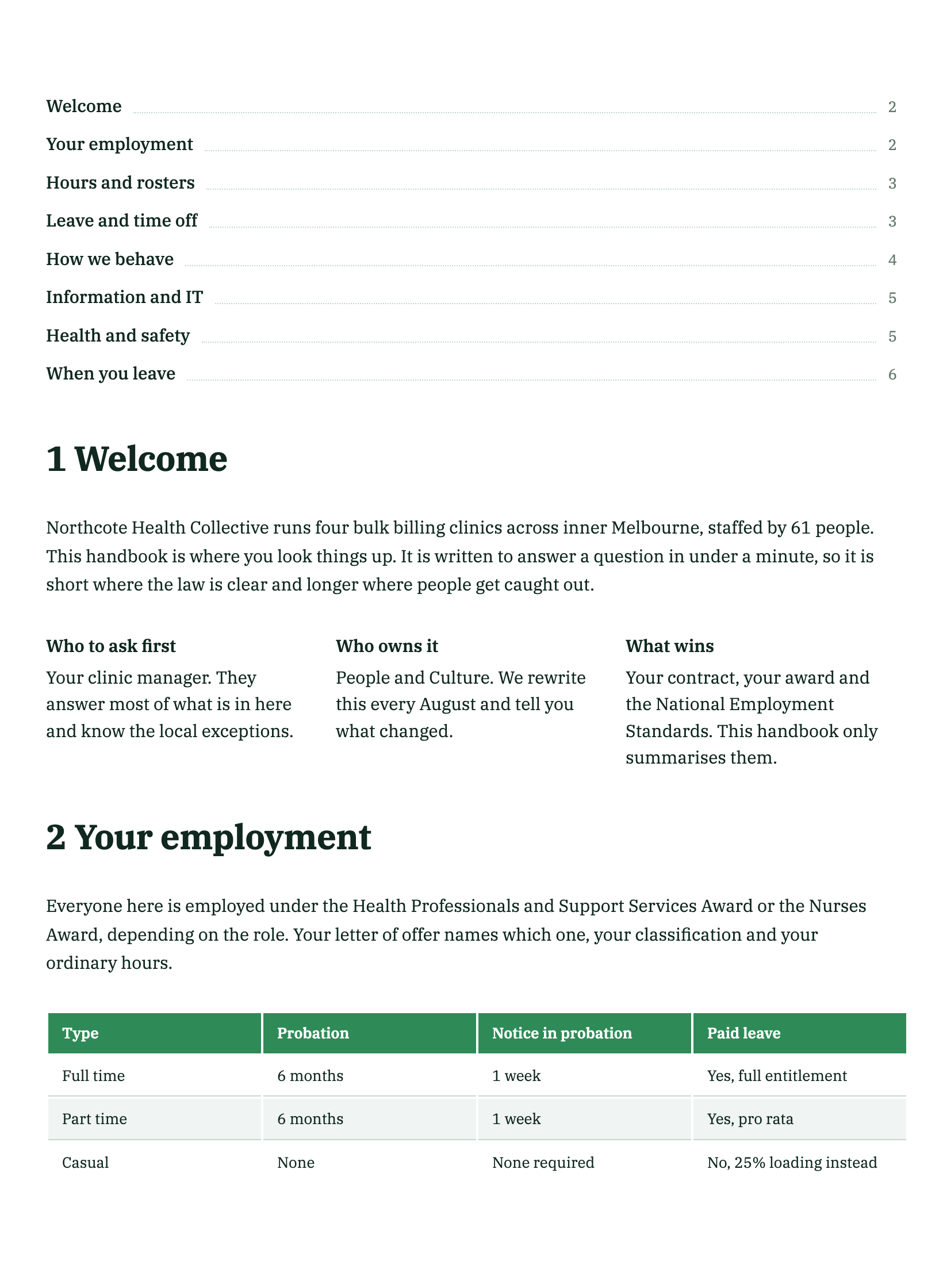 Employee handbookThe handbook a new starter actually reads in their first week, written for a four clinic health provider with 61 staff. Eight sections, each answering a question in under a minute: what kind of employment you are on, when you work, what leave you get, how we expect people to behave in front of patients, what you may and may not do with a patient record, the five safety rules, and how notice works when you go. It says plainly that the award and the National Employment Standards win wherever the handbook differs from them.
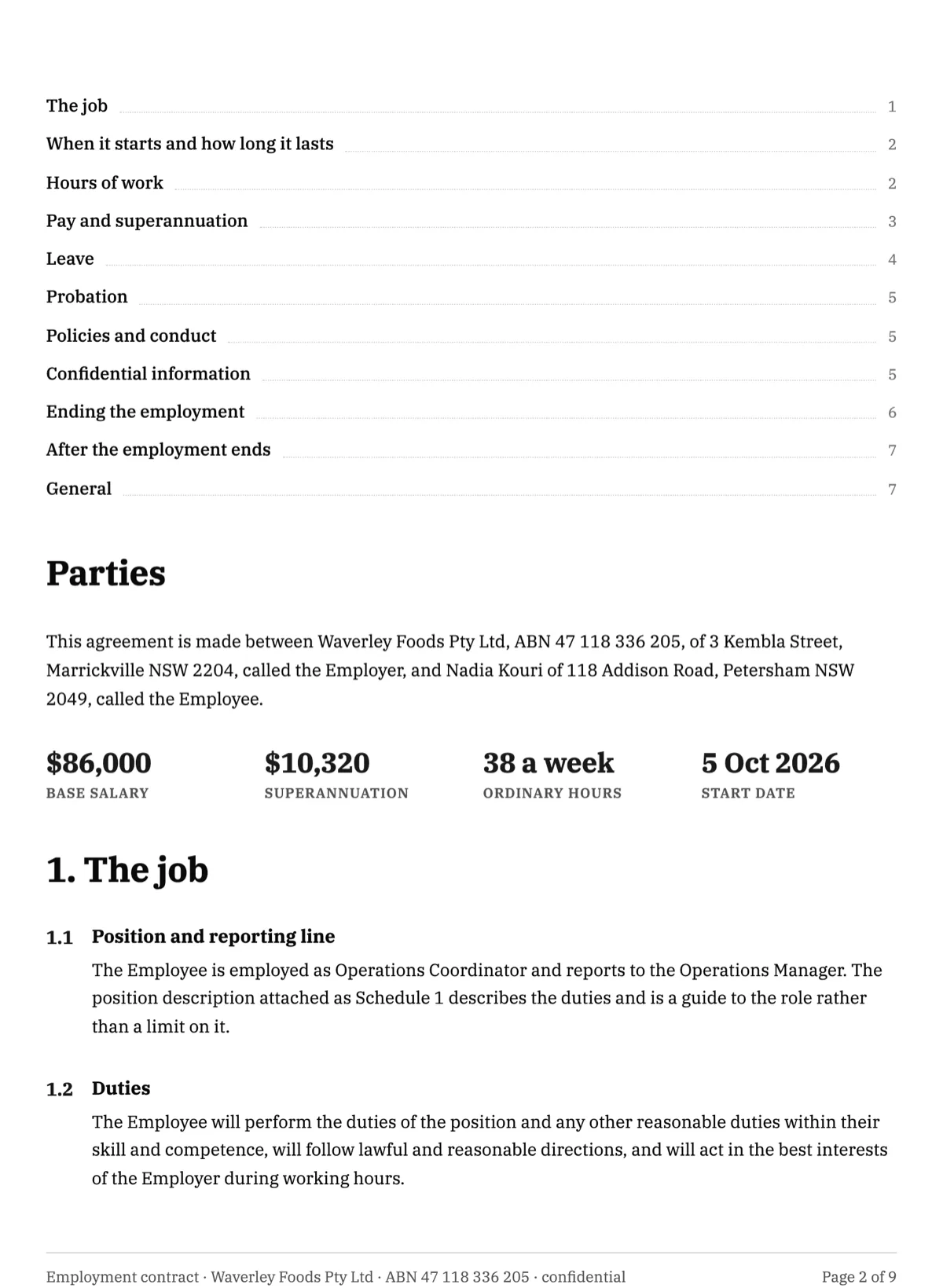 Employment contractA full time ongoing contract for an operations coordinator on $86,000 plus $10,320 of superannuation. Eleven numbered clauses, a leave table drawn from the National Employment Standards, and a notice table that scales with service.
Questions people ask
What does at will employment mean?
It means either the employer or the employee can end the employment at any time, for any lawful reason or no reason, with or without notice. It is the default rule in every US state except Montana. It does not permit dismissal for reasons the law forbids, such as discrimination or retaliation.
Can an at will employee be fired for no reason?
Yes, in most states, as long as the real reason is not an unlawful one. An employer does not have to give a reason. But if the employee can show the actual reason was discriminatory, retaliatory, or against public policy, the dismissal is unlawful regardless of at will status.
Which state is not at will?
Montana. Its Wrongful Discharge from Employment Act requires good cause to dismiss an employee who has completed the probationary period, with limited exceptions such as employees covered by a collective agreement. All other states start from at will employment, though the exceptions each one recognises differ.
Does an at will clause stop me suing for wrongful termination?
No. It confirms the employer did not need a reason, but you can still claim if the dismissal broke a law, such as discrimination or whistleblower protections, or an exception your state recognises. The clause also cannot waive rights given by federal or state statute.
Should an at will employee give two weeks' notice?
Notice is not legally required for at will employees, but it is customary and often expected for references and final pay arrangements. Some employers pay out accrued vacation only if notice is given, under their own policy, so check the handbook before deciding.
Put the clause in a finished document
The button opens the document generator with a starting description already filled in. Change it to match your own agreement before you run it.
Create a document with OneCraftRelated clauses
- Probation period clause in an employment contractA probation period clause sets a trial period, a review and the notice during it. Australian sample wording, extension rules and the minimum employment period.
- Notice period clause in an employment contractA notice period clause sets how much notice ends employment. Australian sample wording, the National Employment Standards minimums and three variants.
- Termination for cause clause: defining material breach before you need itA termination for cause clause ends a contract for serious breach. Sample wording, what counts as material, cure periods and immediate termination events.
For everything the document generator can do, see the document maker.
Step by step in the builder: Create a document with AI, then Document builder components.
Written and checked by the OneCraft team. Last checked .