Contract clause
Attorney fees clause: a prevailing party sample
An attorney fees clause changes the American rule, under which each side pays its own lawyers, by letting the winner of a dispute recover its reasonable attorney fees and costs from the loser. It usually defines who counts as the prevailing party and what fees and costs are covered.
In the US each party normally pays its own lawyers, win or lose. An attorney fees clause changes that for disputes under the contract, usually letting the prevailing party recover reasonable fees. California and Florida go further: by statute, a clause that favours only one side is read as working both ways.
Nuwan Madhusanka · Co-founder
3 min read · Published
Sample clause
Written for commercial lease between a fictional San Francisco landlord and Presidio Frames, a fictional picture framing shop.
Attorney Fees. (a) In any action or proceeding to enforce or interpret this Lease, the prevailing party is entitled to recover its reasonable attorney fees, expert fees and costs from the other party, in addition to any other relief. (b) The prevailing party is the party that obtains a judgment or award substantially in its favor on the main issues in dispute, as determined by the court or arbitrator. A party that dismisses its claim without prejudice is not a prevailing party. (c) If a dispute is resolved by settlement, each party bears its own fees and costs unless the settlement provides otherwise. (d) This clause applies to fees incurred in any appeal and in collecting a judgment.
Sample wording, not legal advice.
Variants
Prevailing party
The common form, giving either party fees if it wins, which discourages weak claims on both sides.
In any dispute arising out of this Agreement, the prevailing party may recover its reasonable attorney fees and costs from the non prevailing party.
One way clause, and why it becomes mutual
Form contracts written for one party, such as a landlord or lender, which in California and Florida operate for both sides anyway.
The Tenant will pay the Landlord's attorney fees incurred in enforcing this Lease. (In California under Civil Code section 1717 and in Florida under section 57.105(7), this is treated as reciprocal.)
Capped fees
Smaller contracts where unlimited fee shifting would outweigh the amount in dispute.
The prevailing party may recover reasonable attorney fees and costs, up to the lesser of $25,000 and the amount awarded on the claim.
What to negotiate
Define prevailing party
Mixed results are common: a party wins some claims and loses others. Without a definition, courts decide who prevailed, often by looking at the main issues and the net result. A clause can define it, leave it to the court, or provide that neither side recovers fees on a split result.
One way clauses
A clause that only lets the drafter recover fees can be a trap for the drafter in states with reciprocity statutes. California Civil Code section 1717 and Florida Statutes section 57.105(7) make a one way contractual fee provision apply to both parties. A landlord or lender in those states should draft a mutual clause it is comfortable with.
Scope and settlement
Decide whether the clause covers only contract claims or all disputes arising out of the relationship, including tort claims, and whether it covers arbitration, appeals and collection. Many clauses say fees are not recoverable if the case settles, which encourages settlement.
The risk of leaving it out
Without an attorney fees clause, a party with a small but valid claim may find it costs more to sue than to absorb the loss, because it cannot recover its legal fees even if it wins. That gives the other side leverage to ignore obligations. With a clause, a weak defense carries the risk of paying the other side's fees.
The American rule and its exceptions
Under the American rule, each party to litigation pays its own attorney fees unless a statute or a contract provides otherwise. Many statutes shift fees in particular areas, such as civil rights claims under 42 USC 1988, which lets a court award a reasonable fee to the prevailing party. A contractual attorney fees clause is the private equivalent for disputes under the contract. Law checked on 21 October 2026. This page explains how the law works and is not legal advice.
States that make one sided clauses mutual
California Civil Code section 1717 provides that where a contract gives one party attorney fees for enforcing it, the prevailing party, whichever side, is entitled to them. Florida Statutes section 57.105(7) does the same, making a one way fee clause reciprocal. Several other states have similar reciprocity statutes or case law. The drafter of a form contract in those states should assume any fee clause works both ways.
Who is the prevailing party
Courts generally treat the prevailing party as the one that succeeds on a significant issue and achieves some of the benefit it sought, and in California the party recovering greater relief on the contract. A defendant can prevail by defeating the claim. A voluntary dismissal or a settlement often leaves no prevailing party under section 1717. Defining the term in the clause, as the sample does, narrows the room for argument.
Where the clause sits in a generated document
Leases, service agreements and loan agreements carry this clause among the boilerplate near the dispute and governing law clauses. When asking the AI document generator for a US contract, say whether fees are mutual, how prevailing party is defined, whether settlement and appeals are covered, and any cap.
Documents that carry this clause
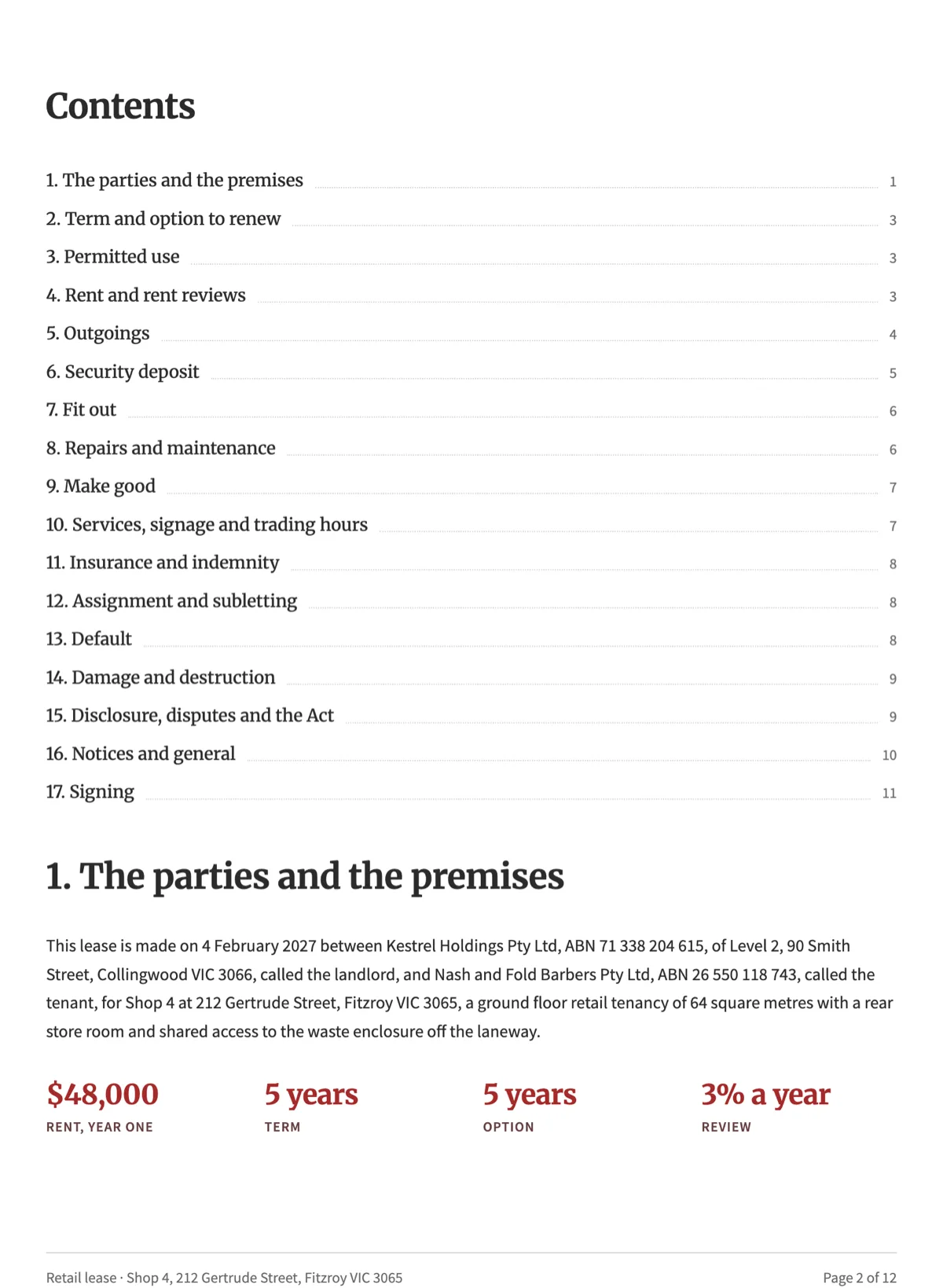 Commercial lease agreement template with outgoings and fit out termsA retail lease is decided by three numbers and two clauses: the rent, the review, the outgoings, the fit out contribution and the make good. This 12 page Victorian lease sets all five out in the open, including the outgoings the landlord is not allowed to recover at all.
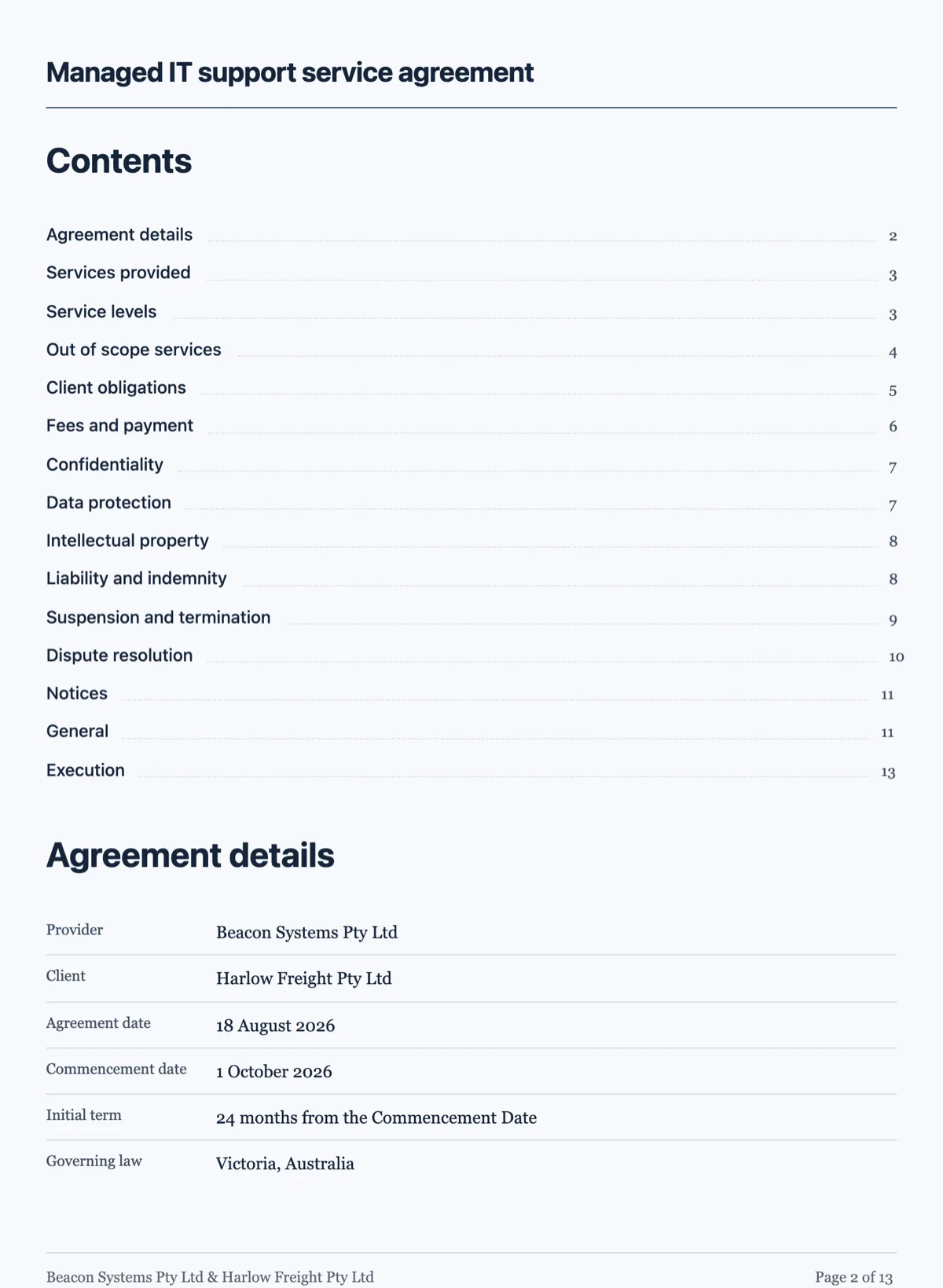 Service agreement template with scope, service levels and an exitA service agreement template has to say what is supplied, how well, for what fee, who is liable for what, and how either side gets out. This one is filled in for Beacon Systems supporting Harlow Freight's IT for an initial 24 months from 1 October 2026 at $8,400 a month plus GST, with 40 hours included and $220 an hour beyond them. Twelve numbered clauses cover the services, a four level severity table, client duties, fees with a CPI adjustment, confidentiality, privacy, IP, a liability cap, termination and a three step dispute ladder under Victorian law.
Questions people ask
Are attorney fees clauses enforceable?
Generally yes. US courts enforce contractual attorney fees clauses, awarding the prevailing party reasonable fees as determined by the court. Some states limit them in consumer contracts, and in states with reciprocity statutes a one sided clause is enforced in favor of whichever party wins.
Who is the prevailing party?
Usually the party that achieves its main objective in the litigation, by winning a judgment or defeating the claim. On mixed results, courts weigh what each side won. In California, the court decides which party recovered greater relief on the contract, and may find there is none.
Does a one sided fee clause work in California?
Not as written. Under Civil Code section 1717, if a contract gives one party fees for enforcing it, the prevailing party in an action on the contract gets fees, whether or not it is the party named. Florida has the same rule under section 57.105(7).
Are attorney fees recoverable in arbitration?
If the arbitration agreement or the contract's fee clause covers arbitration, and the arbitration rules allow it, the arbitrator can award fees to the prevailing party. Clauses should say expressly that they apply to arbitration as well as court proceedings.
What does reasonable attorney fees mean?
The court decides, often by multiplying a reasonable hourly rate by the hours reasonably spent, and adjusting for the result and the complexity of the case. A party does not automatically recover everything it paid its lawyers, only what the court finds reasonable.
Put the clause in a finished document
The button opens the document generator with a starting description already filled in. Change it to match your own agreement before you run it.
Create a document with OneCraftRelated clauses
- Arbitration clause with a Singapore seat: a SIAC sampleArbitration clause Singapore sample: SIAC model wording, a Singapore seat, the International Arbitration Act, tribunal size and the law of the clause.
- Costs clause: each party bears its own costs, and the exceptionsCosts clause sample: each party bears its own legal costs, duty and fees, enforcement costs, settlement deeds, and limits on charging a tenant for a lease.
- Dispute resolution clause: the ladder before anyone goes to courtA dispute resolution clause sets the steps parties must take before suing. Sample three tier ladder with day counts, and negotiation, mediation and arbitration.
- Jury waiver clause: giving up a jury trial before a disputeA jury waiver clause for an Atlanta equipment lease: a conspicuous, separately initialled waiver, why it uses capitals, and why California and Georgia refuse.
For everything the document generator can do, see the document maker.
Step by step in the builder: Create a document with AI, then Document builder components.
Written and checked by the OneCraft team. Last checked .