Contract clause
Costs clause: each party bears its own costs, and the exceptions
A costs clause says who pays the legal and other costs of preparing, negotiating, signing and enforcing a contract. The usual position is that each party bears its own costs, with exceptions for duty and registration fees, for costs caused by one party's request, and for enforcing the contract after a breach.
A costs clause answers a small question that causes surprising disputes: who pays the lawyers and the fees for the contract itself. The usual answer is that each party pays its own, but leases, loans and settlement deeds carve out duty, registration and enforcement costs, and the law limits what some parties can pass on.
Nuwan Madhusanka · Co-founder
3 min read · Published
Sample clause
Written for settlement deed between a fictional owners corporation and a fictional builder resolving a defects claim on a Brisbane apartment building.
Costs. (a) Each party bears its own legal costs, expert fees and filing fees of the Proceedings and of negotiating, preparing and signing this Deed, whatever was spent before the date of this Deed. (b) Neither party will seek a costs order against the other in the Proceedings, and the parties will file consent orders dismissing the Proceedings with no order as to costs. (c) Any duty payable on this Deed is paid by the Builder. (d) If a party breaches this Deed, it must pay the other party's costs of enforcing it, including legal costs on an indemnity basis. (e) This clause survives completion of this Deed.
Sample wording, not legal advice.
Variants
Each party bears its own costs
The standard boilerplate for most commercial agreements where both sides take their own advice.
Each party pays its own costs of negotiating, preparing and signing this agreement and any document under it.
Borrower pays the lender's costs
Loans and security documents, where the lender's costs of documenting and enforcing the facility are passed to the borrower.
The Borrower pays the Lender's reasonable legal costs of preparing this agreement and the security, and all costs of enforcing them, including on an indemnity basis.
Lease costs with a retail limit
Commercial leases, noting that retail leases laws restrict passing a landlord's lease preparation costs to a retail tenant.
Each party pays its own legal costs of this Lease. The Tenant pays any registration fees and any costs of a variation or assignment it requests, to the extent permitted by law.
What to negotiate
Indemnity basis or standard basis
When a court awards costs, it usually awards them on a standard basis, which covers only part of what the winner actually paid. A clause providing for enforcement costs on an indemnity basis aims to recover close to the full amount. Courts generally respect such clauses in commercial contracts, but still require the costs to be reasonable.
Costs caused by a request
A fair exception to each party bearing its own costs is that a party asking for something, such as consent to an assignment, a variation or an early release, pays the other's reasonable costs of dealing with it. The clause should cap them or require them to be reasonable and documented.
Statutory limits on passing costs
Some laws stop a party from passing its costs on. In England and Wales the Costs of Leases Act 1958 says a tenant is not liable to pay the landlord's solicitor's costs of a lease unless the parties agree in writing. Australian retail leases laws similarly limit what a landlord can charge a retail tenant for preparing a lease.
The risk of leaving it out
Without a costs clause, the parties may argue at the end about whose lawyers prepared which document and who should pay, and a settlement may unravel over legal fees. In litigation, the court's general rules decide costs, which may not match what the parties would have agreed, and enforcement costs above the standard basis are usually not recovered.
Costs in settlement deeds
A settlement deed ends a dispute and usually states that each party bears its own costs and that the proceedings are dismissed with no order as to costs. Without that wording, a party could later ask the court for costs of the proceedings, reopening an argument the settlement was meant to close. The settlement agreement example states that neither party pays the other's legal costs, expert fees or filing fees, whatever was spent before signing.
Leases and options
In leases, the costs clause commonly says each party pays its own legal costs and the tenant pays duty and registration fees; the commercial lease example says exactly that. In options to purchase, each party usually bears its own costs if the option lapses, as the option example states, so the buyer cannot claim back money spent on investigations. In England and Wales, the Costs of Leases Act 1958 means a tenant pays the landlord's lease costs only if agreed in writing. Law checked on 21 October 2026. This page explains how the law works and is not legal advice.
Enforcement costs
A party that breaches a contract and is sued may be ordered to pay costs, but usually only on the standard basis. A clause making the defaulting party pay enforcement costs on an indemnity basis, common in loans and settlement deeds, shifts more of the real cost to the party at fault. In some consumer contracts, a one sided costs term may be an unfair term, so it should apply only to genuine breaches and reasonable costs.
Where the clause sits in a generated document
Almost every agreement has a costs clause in its general terms. When asking the AI document generator for one, say whether each party bears its own costs, who pays duty and registration, who pays the costs of requests such as variations, and whether enforcement costs are recoverable on an indemnity basis.
Documents that carry this clause
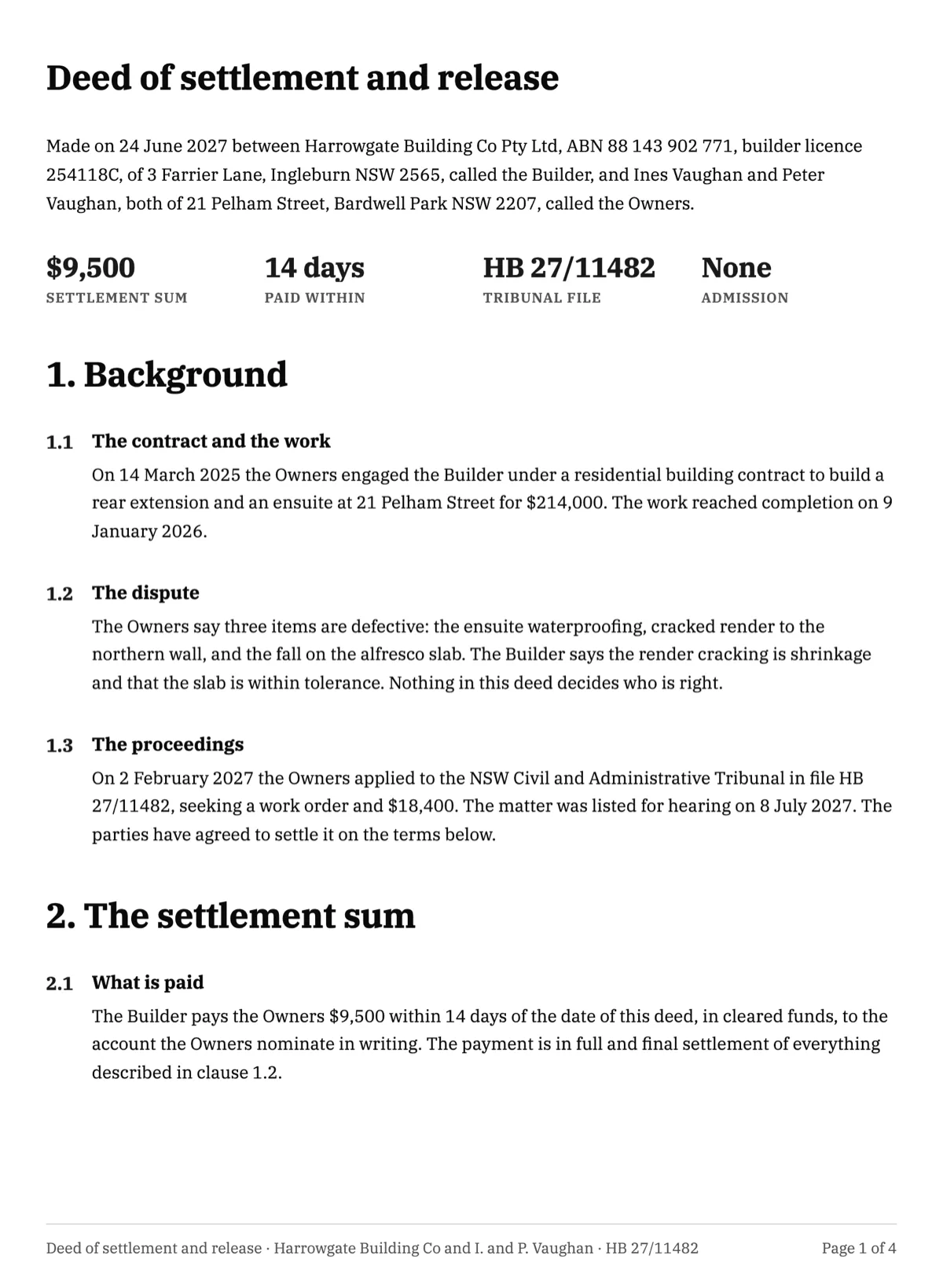 Settlement agreement template with a payment, a release and no admissionA settlement is only worth signing if the money and the release are tied together in the right order. This four page deed settles a home building defect claim for $9,500, makes the release conditional on the payment landing, and says in one clause what happens if it does not: sue on the deed, or go back to the tribunal as if the deed had never been made.
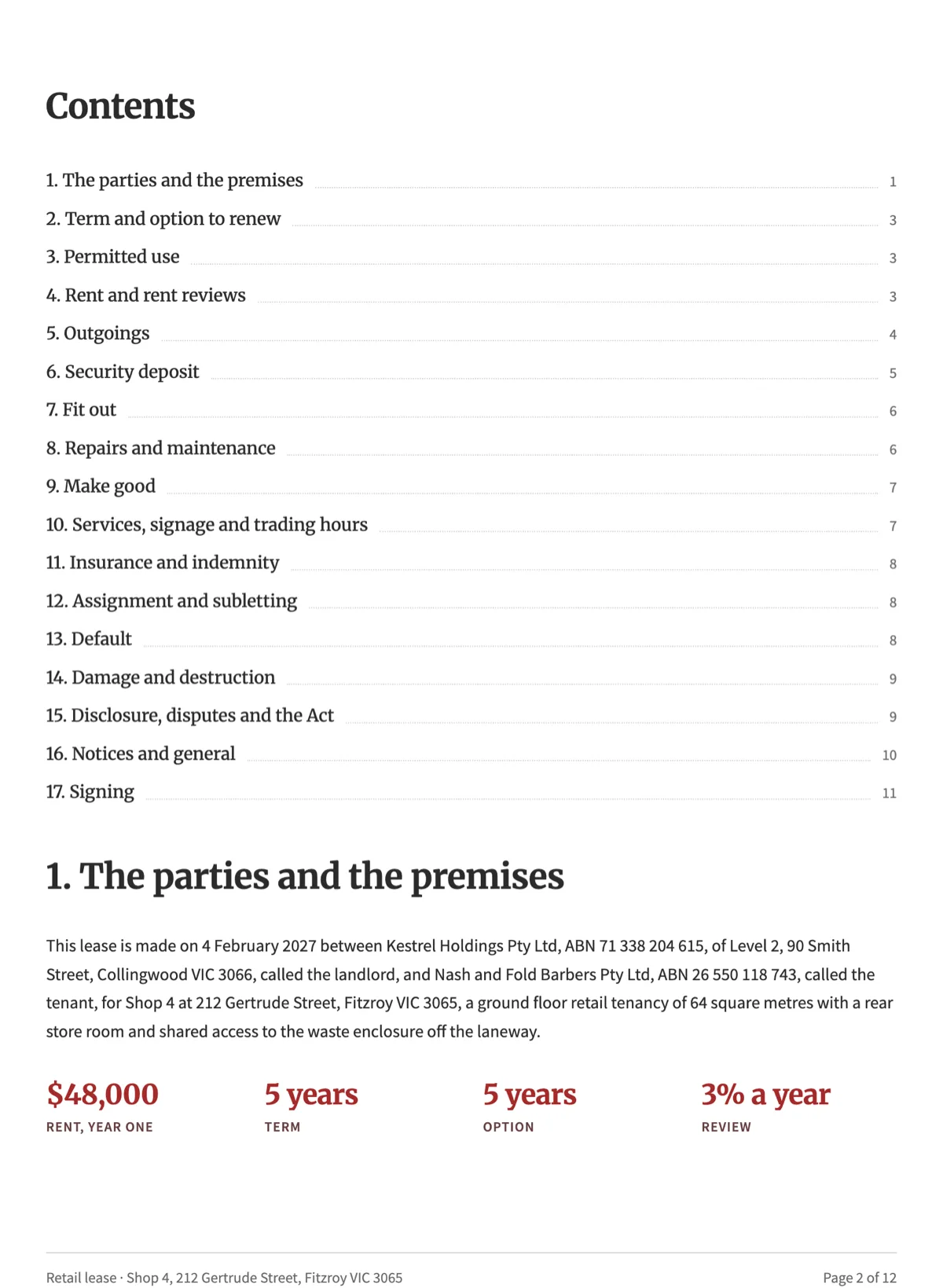 Commercial lease agreement template with outgoings and fit out termsA retail lease is decided by three numbers and two clauses: the rent, the review, the outgoings, the fit out contribution and the make good. This 12 page Victorian lease sets all five out in the open, including the outgoings the landlord is not allowed to recover at all.
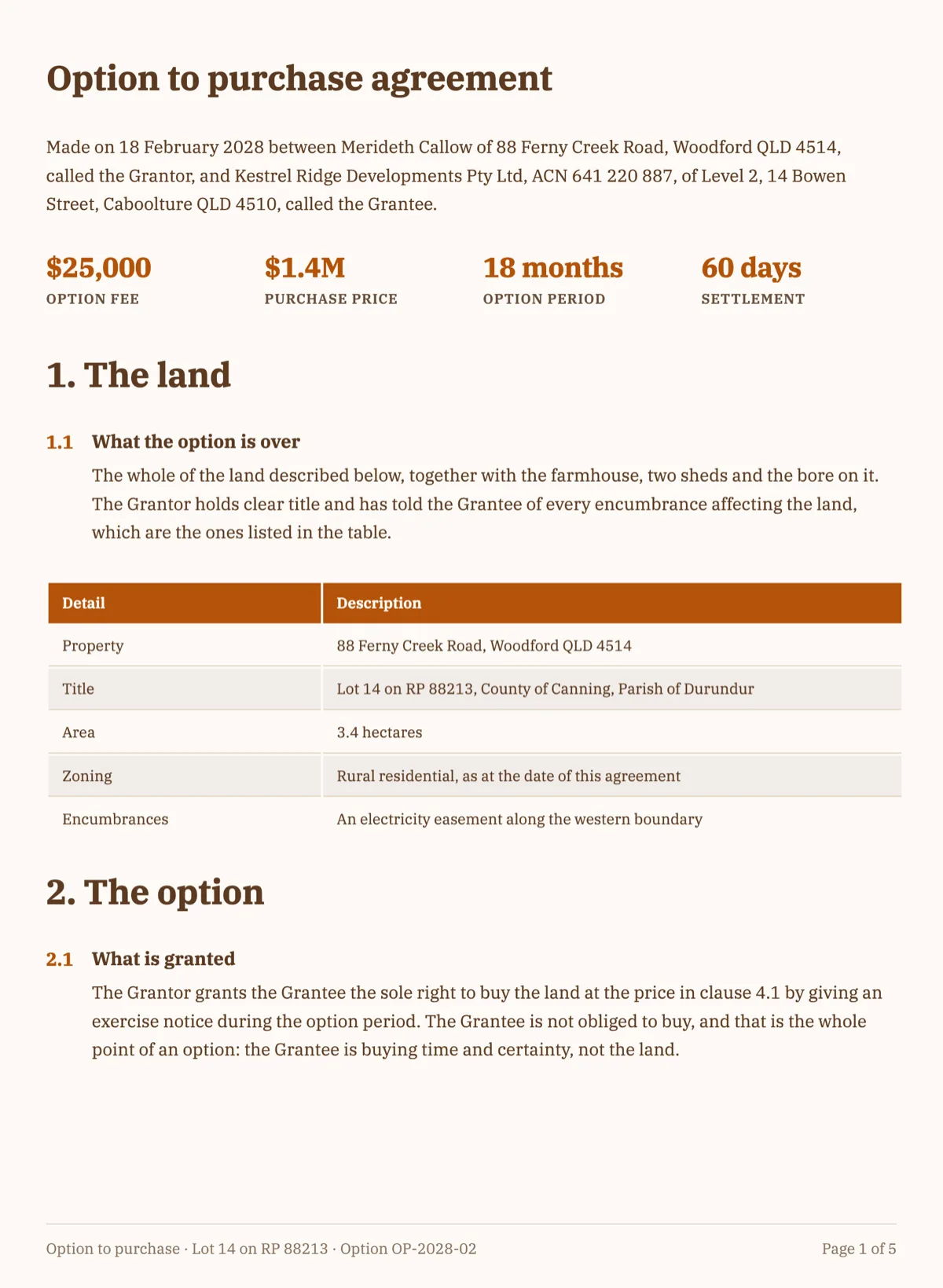 Option to purchase agreement with a fee, a window and a caveatAn option to purchase buys time rather than land. The grantee pays a fee for the exclusive right to buy at a fixed price within a set window, and can walk away without buying anything. This one gives a developer 18 months over a 3.4 hectare block at Woodford for $25,000, at a fixed price of $1,400,000.
Questions people ask
What does each party bears its own costs mean?
It means each side pays its own lawyers and advisers for the contract or dispute, and neither can claim those costs from the other. It is the usual boilerplate in commercial agreements and in settlements, unless the parties agree a specific exception.
What are indemnity costs?
Costs recovered on a fuller basis than the standard basis a court usually applies, aiming to cover nearly all reasonable costs actually incurred. Contracts often give a party indemnity costs for enforcing the contract after the other party's breach. Courts still check reasonableness.
Does a tenant have to pay the landlord's lease costs?
Only if the lease says so and the law allows it. Australian retail leases laws limit charging a retail tenant for the landlord's lease preparation costs, and in England and Wales a tenant pays them only if agreed in writing under the Costs of Leases Act 1958.
Who pays costs if a contract is silent?
Each party normally bears its own costs of preparing and signing it. In litigation, the court's rules decide, usually ordering the loser to pay part of the winner's costs on the standard basis, subject to the court's discretion. A clause avoids the argument.
Should a settlement say no order as to costs?
Usually, yes. It confirms that neither party will seek costs from the court for the proceedings being settled. Without it, a party might apply for costs after the settlement, which can reopen a dispute the parties thought was over. State it in the deed.
Put the clause in a finished document
The button opens the document generator with a starting description already filled in. Change it to match your own agreement before you run it.
Create a document with OneCraftRelated clauses
- Attorney fees clause: a prevailing party sampleAttorney fees clause sample for US contracts: the prevailing party recovers reasonable fees, defining prevailing, and states that make one way clauses mutual.
- Arbitration clause with a Singapore seat: a SIAC sampleArbitration clause Singapore sample: SIAC model wording, a Singapore seat, the International Arbitration Act, tribunal size and the law of the clause.
- Entire agreement clause: the written contract is the whole dealAn entire agreement clause says the signed contract is the whole deal. Australian sample wording, non reliance and US integration variants, and the ACL limit.
- Release clause: giving up claims for goodA release clause gives up claims one party has against another. Australian sample wording for a building settlement and the unknown claims problem.
For everything the document generator can do, see the document maker.
Step by step in the builder: Create a document with AI, then Document builder components.
Written and checked by the OneCraft team. Last checked .