Contract clause
Capital contribution clause: sample for partnerships and joint ventures
A capital contribution clause sets what each partner or participant puts into a business or venture, in cash, property or work, when they must contribute it, what it is valued at, whether more can be called for, and what happens to each person's capital when they leave or the business ends.
A capital contribution clause records who puts what into a partnership or joint venture and on what terms: the amount and form, the date, the agreed value of anything other than cash, whether further calls can be made, and how capital is returned. It is the clause partners argue about first when a business is sold or one of them leaves.
Indunil Asanka · Co-founder
3 min read · Published
Sample clause
Written for partnership agreement of Harbourline Physiotherapy, a fictional two partner practice in Newcastle NSW.
Capital. (a) Initial capital. Each Partner contributes the following capital on the Commencement Date: Partner A, $60,000 in cash; Partner B, $35,000 in cash and the treatment equipment listed in Schedule 2, agreed at a value of $25,000. (b) Capital accounts. The capital contributed by each Partner is recorded in a separate capital account. No interest is paid on capital. (c) Further capital. The Partners may by unanimous written decision call for further capital in proportion to their capital accounts, to be paid within 30 days. (d) Withdrawal. A Partner may not withdraw capital while the partnership continues, except with the written agreement of all Partners. (e) On leaving. A departing Partner is repaid the balance of their capital account, adjusted for their share of profits and losses to the leaving date, within 90 days.
Sample wording, not legal advice.
Variants
Equal cash contributions
Partners starting a business from scratch with no assets to bring and an equal stake intended.
Each Partner contributes $50,000 in cash to the partnership account on or before the Commencement Date.
Joint venture cash calls
An unincorporated joint venture for a project, where participants fund costs as they arise in agreed percentages.
The Management Committee may issue a cash call for working capital, and each Participant pays its percentage share within 14 days. An unpaid call carries interest and may be paid by the other Participant, which then has the remedies in clause 6.2.
Sweat equity
A partner contributing skills or work rather than money, where the agreed value of that work counts as capital.
Partner B's contribution of services in establishing the business during the first 12 months is valued at $30,000 and credited to Partner B's capital account on the first anniversary, if Partner B is still a Partner.
What to negotiate
Value non cash contributions now
Equipment, a client list or a lease brought into the business should be valued in the agreement, ideally with a schedule or an independent valuation. A contribution with no agreed value becomes a dispute when the business is sold. The value also matters for tax and for each partner's share on exit.
Capital is not the profit share
Partners can contribute different amounts of capital and still share profits equally, or the reverse. Under the partnership acts, partners share capital and profits equally unless they agree otherwise, so the agreement should state both separately. Interest on capital is one way to reward a partner who put in more without changing the profit split.
Calls and defaults
A clause that allows further capital calls should say who decides, the time to pay, and what happens if a partner does not pay: dilution, interest on the shortfall, or a right for the other partner to fund it and recover it from future distributions, as the joint venture example does.
The risk of leaving it out
Without a capital contribution clause, the partnership acts' default rules apply, and partners share capital equally whatever each actually put in. A partner who contributed most of the money can find, on a sale or dissolution, that the law treats the capital as shared equally unless they can prove an agreement otherwise.
The default rule in the partnership acts
Each Australian state has a partnership act with similar default rules. In Victoria, the Partnership Act 1958 provides that, subject to any agreement, partners are entitled to share equally in the capital and profits of the business, and that a partner is not entitled to interest on capital before profits are ascertained. A written clause overrides those defaults. That is why the sample records each partner's contribution and its value. Law checked on 21 October 2026. This page explains how the law works and is not legal advice.
Capital accounts and current accounts
Many partnerships keep two accounts for each partner: a capital account for long term contributions and a current account for profit shares and drawings. Keeping them separate stops drawings eating into capital without anyone noticing, and makes the exit calculation straightforward. The partnership agreement example sets out capital, then profits, losses and drawings, in that order.
Joint ventures and companies
In an unincorporated joint venture, participants usually contribute in agreed percentages and fund costs by cash calls, as the joint venture example does with a 55 to 45 split and a working capital figure. In a company, capital is contributed by subscribing for shares and is governed by the constitution and the Corporations Act, which is a different structure; a shareholders agreement then deals with future funding.
Where the clause sits in a generated document
Partnership agreements and joint venture agreements carry this clause near the start. When asking the AI document generator for one, list each person's contribution, the value of non cash items, whether interest is paid on capital, how calls work and how capital is repaid on exit.
Documents that carry this clause
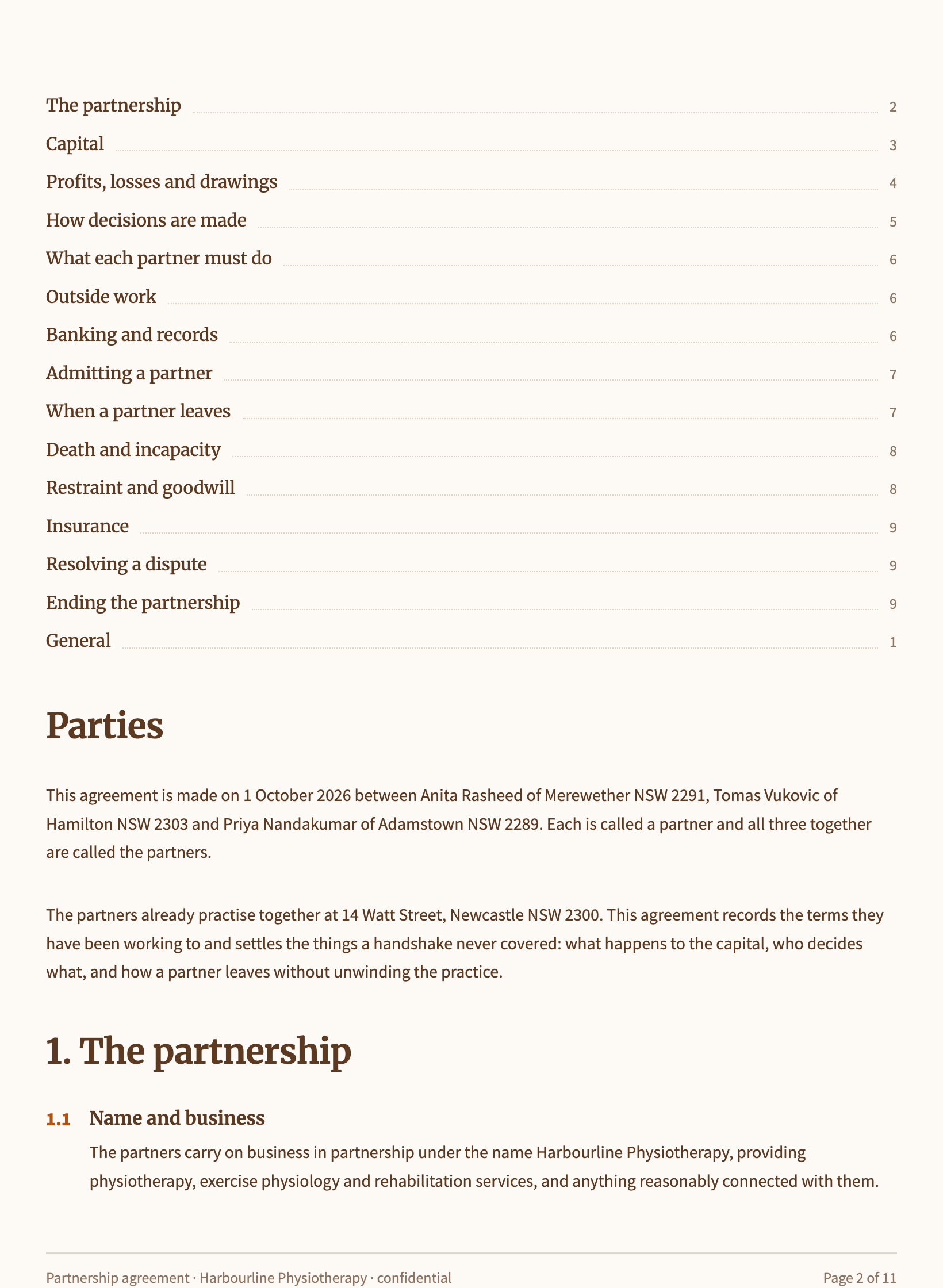 Partnership agreement templateThree physiotherapists have run one Newcastle practice together since 2024 without anything in writing. This agreement records what the handshake never covered: uneven capital sitting beside uneven hours, the six decisions no partner can make alone, and what a leaving partner is owed.
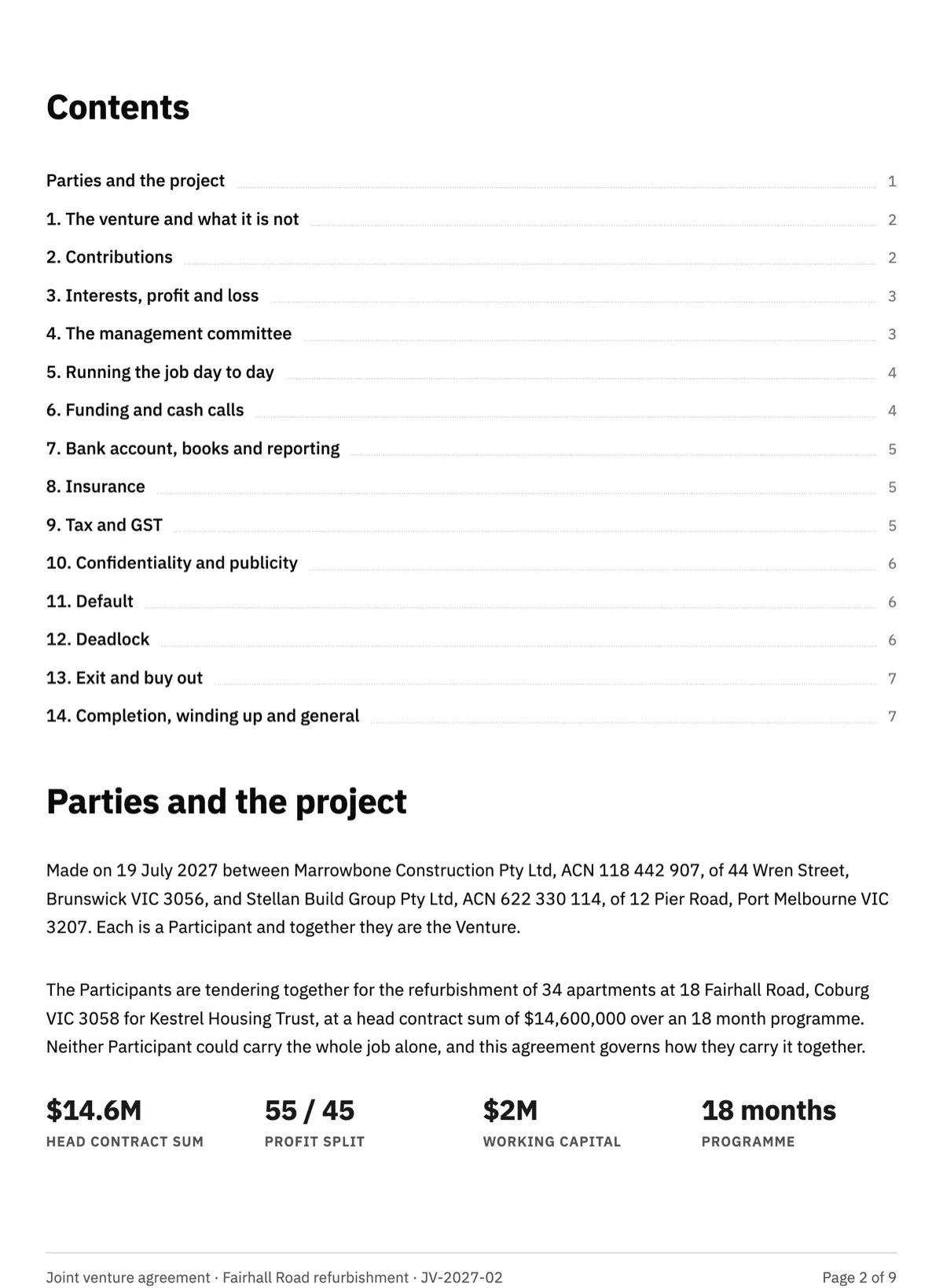 Joint venture agreement template with contributions and splitAn unincorporated joint venture has no company to fall back on, so everything a company structure would supply has to be written down. This one puts two builders together for a single $14.6 million refurbishment, splits it 55/45, and sets out who funds it, who decides, how a deadlock breaks and how either of them gets out.
Questions people ask
What is a capital contribution in a partnership?
It is what each partner puts into the business to fund it, in cash, property or sometimes work, recorded at an agreed value. It belongs to the partnership while the business runs and is usually repaid to the partner, adjusted for profits and losses, when they leave or the partnership ends.
Do partners have to contribute equally?
No. Partners can contribute different amounts and agree how that affects their rights. If the agreement says nothing, the partnership acts generally treat partners as sharing capital equally, which is why unequal contributions should always be written down. A schedule of contributions settles it.
Is interest paid on partnership capital?
Only if the partners agree. The default rule is that no interest is payable on capital before profits are worked out. Paying interest on capital rewards a partner who contributed more, without changing how the remaining profit is shared. The rate should be stated.
Can a partner take their capital out?
Usually not while the partnership continues, unless the other partners agree, because the business needs it. Most agreements repay a departing partner's capital account within a set period after they leave, sometimes in instalments to protect the business's cash flow.
How is equipment valued as a contribution?
By agreement, ideally supported by an independent valuation or recent purchase invoices, and written into a schedule. The agreed value is credited to the partner's capital account. It is worth checking the tax effect of transferring the asset into the partnership with an accountant.
Put the clause in a finished document
The button opens the document generator with a starting description already filled in. Change it to match your own agreement before you run it.
Create a document with OneCraftRelated clauses
- Profit sharing clause: sample for partners and joint venturesProfit sharing clause sample for partnerships and joint ventures: the split, how profit is worked out, drawings, losses, and the equal sharing default rule.
- Reserved matters clause: sample for shareholder and joint venture agreementsReserved matters clause sample for shareholder and joint venture agreements: the decisions needing unanimous or special approval, thresholds and deadlock links.
- Deadlock clause: breaking a tie in a 50 50 companyA deadlock clause sets how a 50 50 company breaks a tie between its owners. Sample wording with escalation, mediation, a shotgun buy sell and variants.
- Good leaver bad leaver clause: pricing a departing founder's sharesA good leaver bad leaver clause prices a departing founder's shares by why they left. Sample wording, a leaver price table, three variants and the penalty risk.
For everything the document generator can do, see the document maker.
Step by step in the builder: Create a document with AI, then Document builder components.
Written and checked by the OneCraft team. Last checked .