Contract clause
Profit sharing clause: sample for partners and joint ventures
A profit sharing clause sets how the profits and losses of a partnership or joint venture are divided between the parties, how profit is calculated, when it is paid out, what each party may draw in advance, and how losses are borne. Without one, partnership law shares profits equally.
A profit sharing clause decides who gets what out of a partnership or joint venture: the percentage split, the accounts profit is measured from, when it is distributed, what partners can draw during the year and who carries a loss. Partnership acts share profits equally unless the partners agree otherwise, so unequal partners need the clause in writing.
Nuwan Madhusanka · Co-founder
3 min read · Published
Sample clause
Written for joint venture between Saltbush Builders and Kestrel Civil, two fictional contractors delivering a $14.6 million school building project.
Interests, Profit and Loss. (a) Interests. The Participants hold the following interests in the Venture: Saltbush Builders 55 per cent and Kestrel Civil 45 per cent. (b) Profit. Profit means the revenue of the Venture less all costs properly incurred for the Project, as shown in the Venture accounts prepared under clause 7. (c) Distribution. Profit is distributed in proportion to the interests within 30 days after the accounts for each half year are approved by the Management Committee, after keeping a reserve of $250,000 for defects. (d) Losses. Losses are borne in the same proportions, and each Participant must contribute its share of any shortfall in a cash call under clause 6. (e) Nothing in this clause makes the Participants partners or agents of each other.
Sample wording, not legal advice.
Variants
Equal partnership with drawings
Two or more partners sharing equally, who need regular drawings to live on before the year's profit is known.
The Partners share net profits and losses equally. Each Partner may draw $6,000 a month on account of profit, and drawings are deducted from that Partner's share when the annual accounts are finalised.
Salary first, then split
A partnership where one partner works more hours, and the parties want to reward that before splitting the rest.
Before profit is shared, Partner A is credited with a partnership salary of $40,000 a year. The remaining profit is shared 50 per cent to each Partner.
Profit share in an employment or services contract
A key employee or contractor rewarded with a share of profit rather than an ownership interest.
The Manager receives 5 per cent of the Business's net profit before tax for each financial year, as shown in the audited accounts, paid within 30 days after the accounts are signed. This is remuneration, not a share in the Business.
What to negotiate
Define profit before you split it
A percentage of profit is only as good as the definition of profit. The clause should say which accounts are used, which costs come off, whether partners' salaries and interest on capital are deducted first, and how disputed items are resolved. Tying it to accounts prepared on stated principles prevents arguments every year.
Reserves before distribution
A construction joint venture can have defects costs years after practical completion. Holding back a reserve before profit is distributed, as the sample does, stops participants taking out money they later have to put back. The clause should say when the reserve is released.
Losses follow profit unless stated
Partnership law shares losses in the same proportions as capital and profits unless the partners agree otherwise. A participant who agrees a larger profit share usually carries a larger share of losses. If a party's loss exposure is meant to be capped, the agreement must say so clearly.
The risk of leaving it out
Partners without a written profit sharing clause share profits equally under the partnership acts, however much more one of them works or contributes. For a joint venture, the absence of a clause leaves the split, the timing and the treatment of losses to be argued from emails and conduct, usually when the project has gone badly and money is short.
The equal sharing default
Without a written split, the state partnership acts fill the gap, and their answer is equality: each partner takes the same share of profit and carries the same share of loss, whatever money or hours they put in, and no partner is paid a salary for working in the business unless the others agree. Victoria's Partnership Act 1958 is a typical example. Partners who have agreed something else, such as 60 and 40 or a salary first, need to say so in the agreement.
Unincorporated joint ventures
Construction and resources projects often use unincorporated joint ventures, where participants share the output or the profit of a single project rather than carrying on a business in common. The agreement usually states that it does not create a partnership, as the sample's last sub clause does, because a partnership would make each participant liable for the other's debts. Whether a court agrees depends on the substance, not only the words. Law checked on 21 October 2026. This page explains how the law works and is not legal advice.
Tax and drawings
A partnership does not pay income tax itself; each partner is taxed on their share of the net income, whether or not it was drawn. Drawings are advances on that share, not salary, which is why the drawings variant deducts them when the accounts are finalised. Business.gov.au summarises how partnerships are taxed and the record keeping they need.
Where the clause sits in a generated document
Partnership agreements and joint venture agreements carry the profit sharing clause after the capital clause. When asking the AI document generator for one, give the percentages, the definition of profit, the timing of distributions, any reserve and how drawings or partner salaries work.
Documents that carry this clause
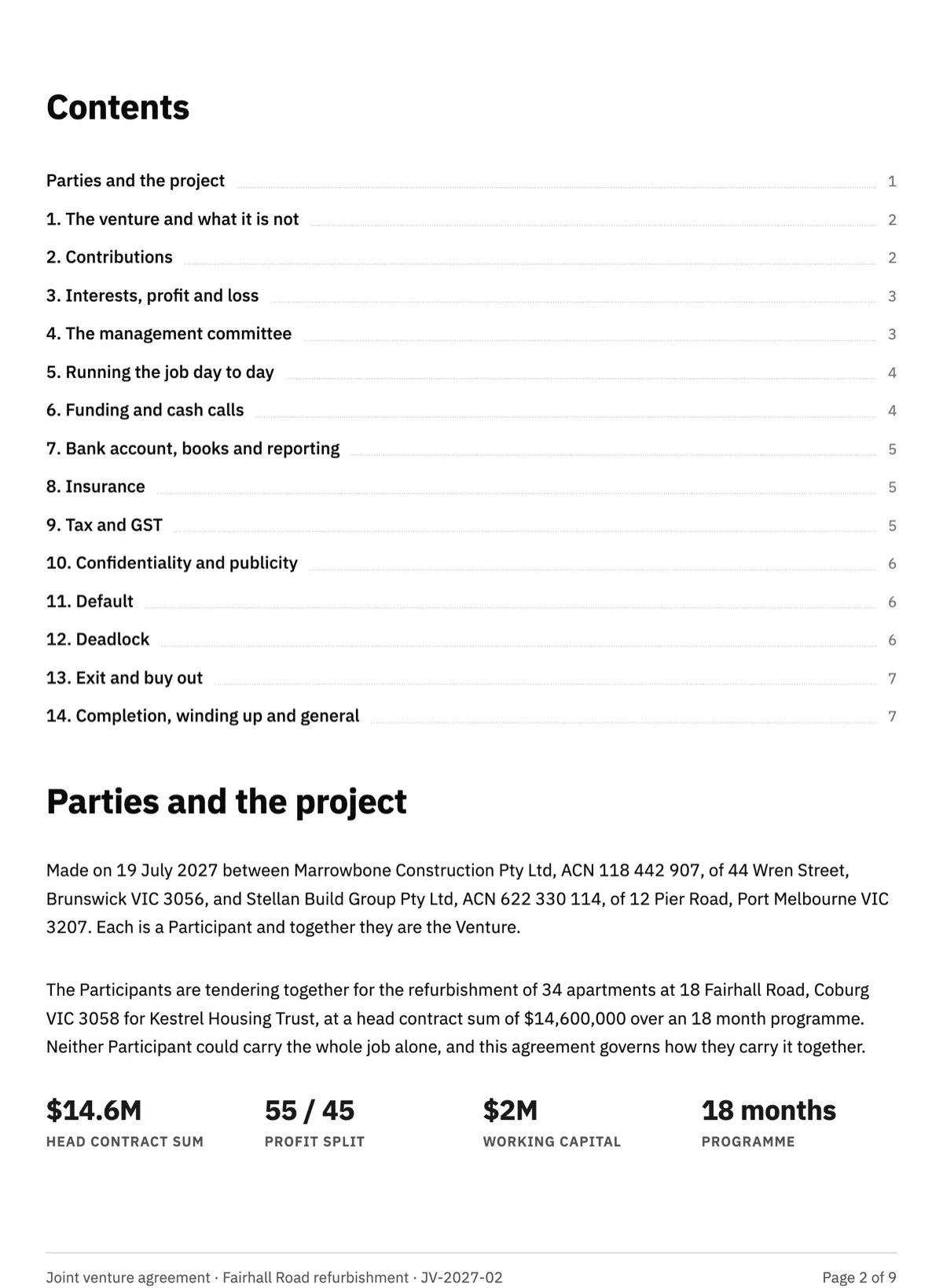 Joint venture agreement template with contributions and splitAn unincorporated joint venture has no company to fall back on, so everything a company structure would supply has to be written down. This one puts two builders together for a single $14.6 million refurbishment, splits it 55/45, and sets out who funds it, who decides, how a deadlock breaks and how either of them gets out.
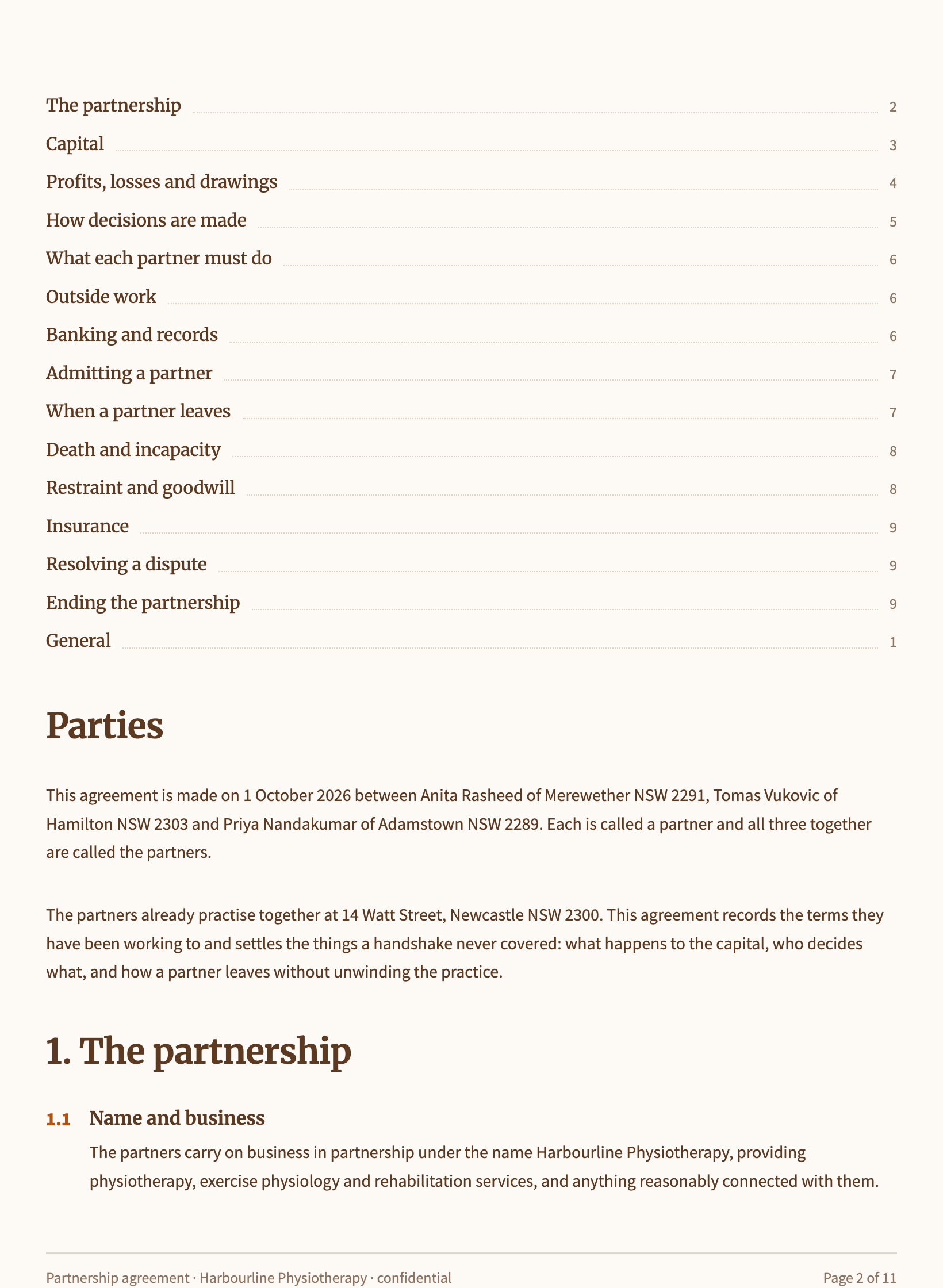 Partnership agreement templateThree physiotherapists have run one Newcastle practice together since 2024 without anything in writing. This agreement records what the handshake never covered: uneven capital sitting beside uneven hours, the six decisions no partner can make alone, and what a leaving partner is owed.
Questions people ask
How are profits shared in a partnership?
As the partnership agreement says. If it says nothing, the partnership acts share profits and losses equally among the partners, regardless of capital contributed or hours worked. Most agreements set percentages, sometimes after salaries or interest on capital are paid first.
Is a profit share the same as owning part of the business?
Not necessarily. Partners and joint venturers share profit because of their interest. An employee or contractor can be given a profit share as pay without owning anything, which the clause should say expressly so the arrangement is not mistaken for a partnership.
What are partner drawings?
Amounts partners take out during the year on account of their expected share of profit. They are not wages. When the year's accounts are finalised, drawings are deducted from each partner's share, and any excess drawn may need to be repaid or carried forward.
Do losses follow the profit share?
By default, yes: partners bear losses in the same proportions as they share profits. A joint venture agreement usually requires each participant to fund its share of losses through cash calls. Any different rule, such as a cap on one party's losses, must be written in.
Should profit be distributed every year?
It depends on the business. Partnerships often distribute after the annual accounts, while project joint ventures distribute at milestones or half yearly and keep reserves for defects and claims. The clause should set the timing and any reserve rule. Reserves are released by a stated date.
Put the clause in a finished document
The button opens the document generator with a starting description already filled in. Change it to match your own agreement before you run it.
Create a document with OneCraftRelated clauses
- Reserved matters clause: sample for shareholder and joint venture agreementsReserved matters clause sample for shareholder and joint venture agreements: the decisions needing unanimous or special approval, thresholds and deadlock links.
- Personal guarantee clause: a director's guarantee samplePersonal guarantee clause sample for a director guaranteeing a company's debts: the guarantee and indemnity, limits, independent advice and how to get released.
- Deadlock clause: breaking a tie in a 50 50 companyA deadlock clause sets how a 50 50 company breaks a tie between its owners. Sample wording with escalation, mediation, a shotgun buy sell and variants.
- Remuneration clause: the pay terms in an employment contractA remuneration clause sets what an employee is paid, how often and what the figure includes. Australian sample wording, package and hourly variants.
For everything the document generator can do, see the document maker.
Step by step in the builder: Create a document with AI, then Document builder components.
Written and checked by the OneCraft team. Last checked .