Contract clause
Personal guarantee clause: a director's guarantee sample
A personal guarantee clause makes an individual, usually a director, personally liable to pay a company's debt or perform its obligations if the company does not. It is often paired with an indemnity, so the guarantor must also cover the creditor's loss even if the main obligation turns out to be unenforceable.
A personal guarantee puts a director's own house and savings behind a company's promise to pay. Lenders, landlords and suppliers ask for one when a company has few assets of its own. The clause decides how much the guarantor can lose, for how long, and whether the guarantor can ever be released.
Nuwan Madhusanka · Co-founder
3 min read · Published
Sample clause
Written for director's guarantee given by the two directors of Kerfwell Joinery Pty Ltd, a fictional joinery business, to a private lender.
Guarantee and Indemnity. (a) Each Guarantor guarantees to the Lender the payment of all amounts the Borrower owes under the Loan Agreement and indemnifies the Lender against any loss if those amounts are not recoverable from the Borrower for any reason. (b) The liability of each Guarantor is limited to $85,000 plus interest and reasonable enforcement costs from the date of demand. (c) The Lender may demand payment from a Guarantor without first suing the Borrower, but must first give the Borrower 14 days' notice of the default. (d) Each Guarantor confirms that, before signing, it received independent legal advice and a copy of the Loan Agreement. (e) This guarantee ends when all amounts under the Loan Agreement are paid, and the Lender will then give a written release within 10 business days.
Sample wording, not legal advice.
Variants
Unlimited all monies guarantee
A lender with a running facility or several loans that wants the guarantee to cover everything the company owes it, now or later.
Each Guarantor guarantees payment of all money the Borrower owes or will owe the Lender on any account, whether actually or contingently, alone or with any other person.
Lease guarantee
A landlord leasing premises to a company and wanting the directors to stand behind the rent and the make good obligations.
The Guarantor guarantees the Tenant's payment of rent and outgoings and performance of its obligations under the Lease, including any holding over, up to an amount equal to 12 months' rent at the rate current at the date of demand.
Time limited guarantee
A supplier or landlord prepared to release the director once the company has a track record.
This guarantee applies only to amounts falling due before 30 June 2028. After that date the Guarantor is released, except for amounts already demanded.
What to negotiate
Cap it
An all monies guarantee can cover debts the guarantor never knew about, including future borrowings. A cap tied to the loan amount, or to a number of months' rent, limits the exposure to what the guarantor understood when signing. Most commercial creditors will accept a cap when asked.
Get out when you step down
A director who resigns or sells their shares usually remains liable under a guarantee unless the creditor releases them. Negotiate a release on a sale of shares or after a period of good payment, and make sure the release is written and signed by the creditor.
Independent advice and disclosure
Lenders commonly require a certificate of independent legal advice so the guarantor cannot later claim they did not understand. Under the Banking Code of Practice, banks that subscribe to it give guarantors information about the borrower and time to consider before signing. Guarantors should read the main contract, not only the guarantee.
The risk of leaving it out
For a creditor, dealing with a company that has few assets and no guarantee means that if the company fails, the debt is likely to be lost, because the directors are not personally liable for company debts in the ordinary course. For a director, signing a guarantee with no cap or release clause can mean liability for years after they have left the business.
Guarantee and indemnity together
A guarantee makes the guarantor liable only if, and to the extent that, the principal debtor is liable. If the main contract is unenforceable, the guarantee falls with it. An indemnity is a separate promise to cover the creditor's loss, which survives even if the main obligation fails. That is why most documents are called a guarantee and indemnity, like the deed of guarantee and indemnity example for a shop lease.
Director guarantees and company limited liability
A company is a separate legal entity, and its directors are generally not liable for its debts. A personal guarantee deliberately removes that protection for the debt it covers. Directors can also be personally liable in some other cases, such as insolvent trading under the Corporations Act 2001 and certain unpaid tax debts, but a guarantee is the most direct route for a creditor. Law checked on 21 October 2026. This page explains how the law works and is not legal advice.
Protections for guarantors
Banks that subscribe to the Banking Code of Practice give prospective guarantors key information about the borrower and its facility, suggest independent legal advice and give time to consider before signing. Private lenders, landlords and suppliers are not bound by the Code, so for them the guarantee itself is where protections such as a cap, notice before demand and a release must be written. A guarantor should ask for the same information a bank would give.
Where the clause sits in a generated document
Loan agreements, commercial leases and credit applications carry guarantees, often as a separate deed signed by each guarantor. When asking the AI document generator for one, state who guarantees, the cap, any time limit, the notice to the borrower before demand, the independent advice certificate and the release on payment.
Documents that carry this clause
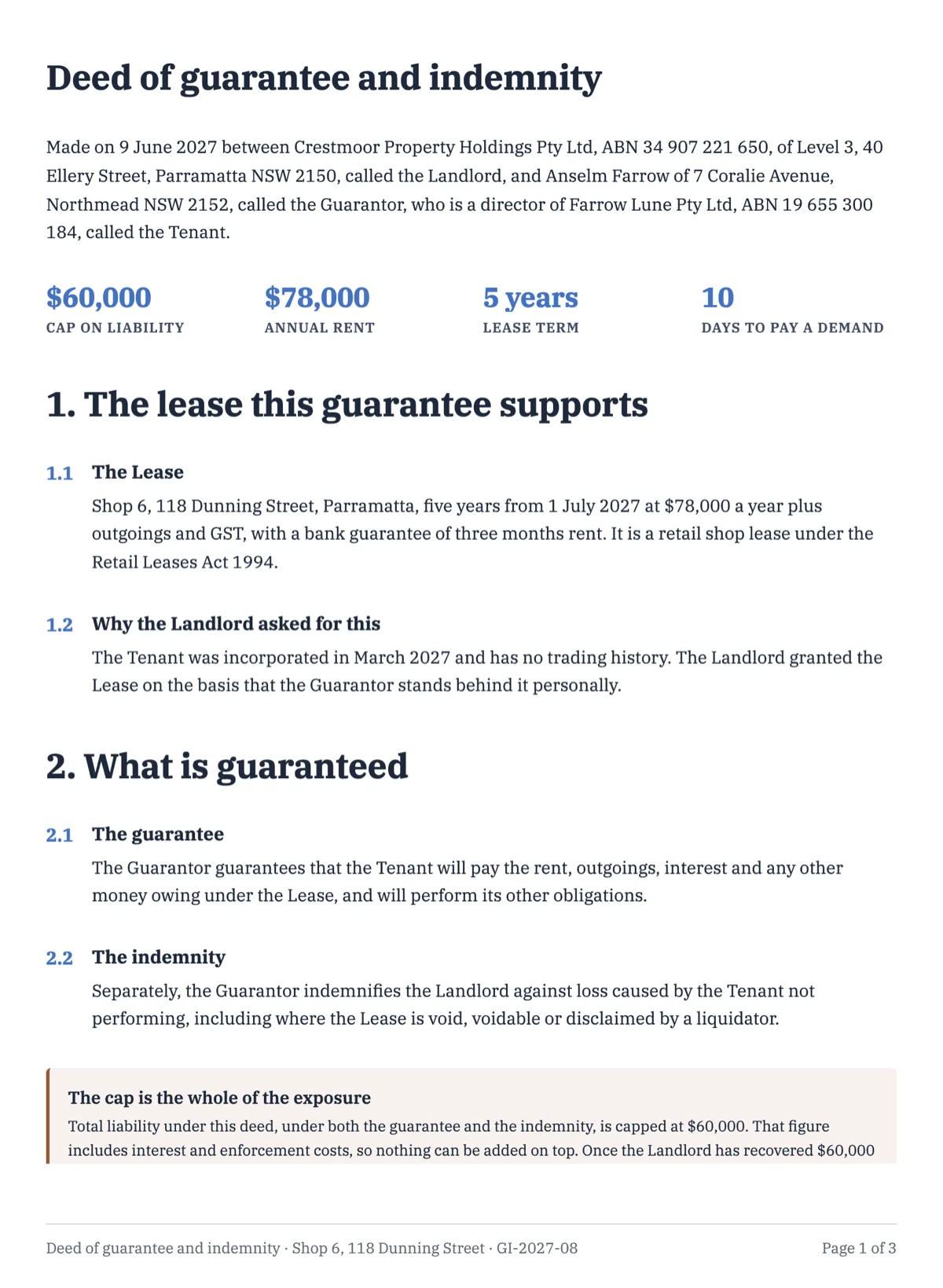 Personal guarantee template with a cap and a notice of demandA director asked to guarantee a lease wants to know one number: the most this can cost me. This three page deed answers it in a callout, capping the guarantor at $60,000 including interest and enforcement costs, then sets out the two steps the landlord has to take before a demand can be made at all.
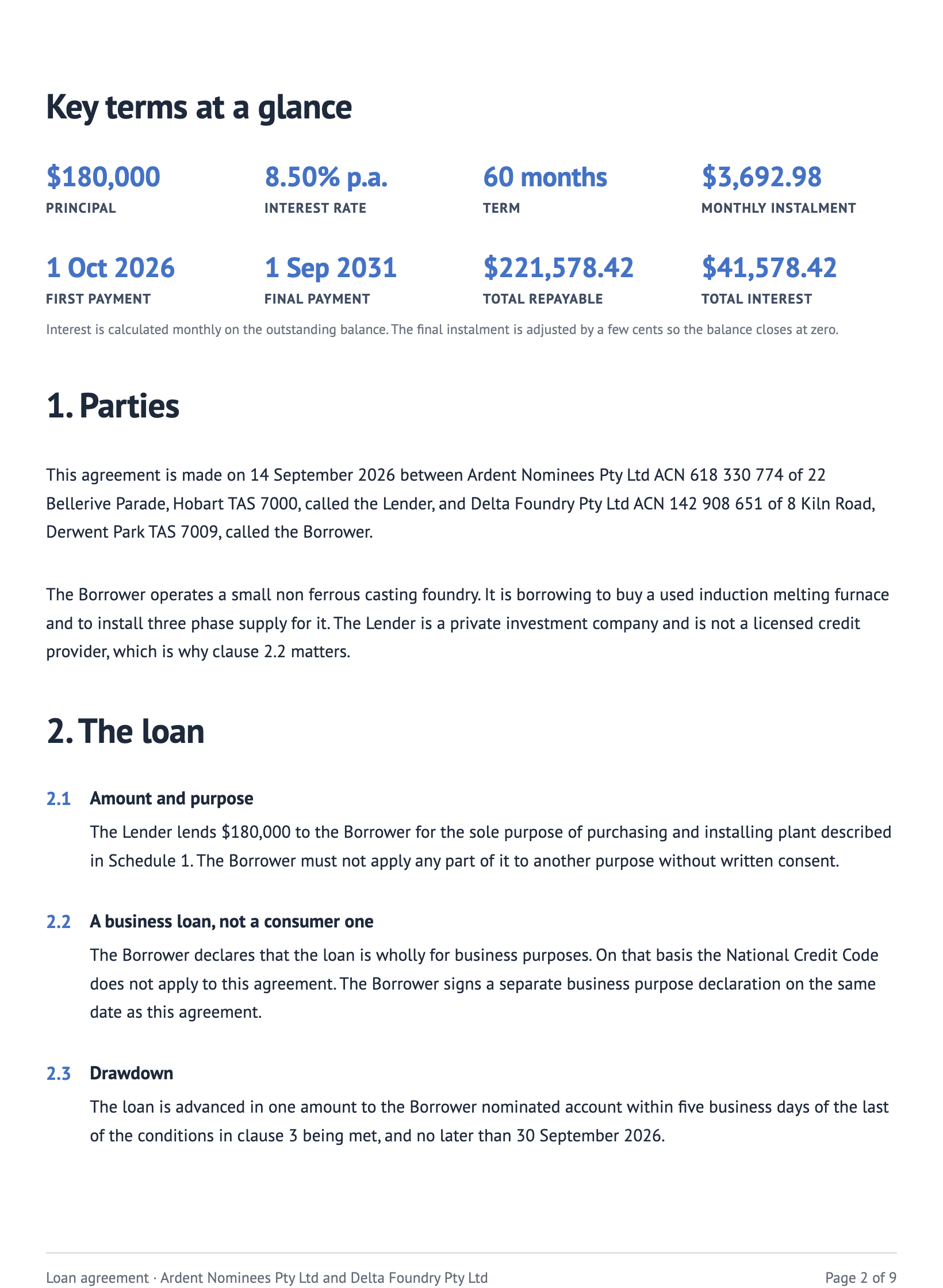 Loan agreement templateA Tasmanian foundry is borrowing $180,000 from a private investment company to buy a used induction furnace. The lender is not a bank, so everything a bank would take for granted has to be written down: what has to happen before the money moves, what is registered over what, and how long the borrower gets to fix a default.
Questions people ask
What is a personal guarantee clause?
It is a promise by an individual, usually a director or owner, to pay a business's debt or perform its obligations if the business does not. It is often combined with an indemnity, so the individual also covers the creditor's loss if the debt itself cannot be enforced.
Can a director be released from a personal guarantee?
Only if the creditor agrees or the guarantee's own terms provide for release, such as on full repayment, a sale of shares or after a fixed date. Resigning as a director does not by itself end the guarantee, so a written release is essential.
Should a personal guarantee be capped?
From the guarantor's side, yes. A cap tied to the loan amount or to a set number of months' rent limits the exposure to what was understood at signing. Many creditors accept a cap, especially when the business has other security.
Do I need legal advice before signing a guarantee?
It is strongly advisable, and lenders often require a certificate of independent legal advice. A guarantee can put personal assets, including a home, at risk, and the terms of the main contract decide what the guarantor is liable for. Keep a copy of everything signed.
What is the difference between a guarantor clause and a personal guarantee?
They describe the same arrangement from different documents. A guarantor clause usually sits inside a lease or contract, while a personal guarantee is often a separate deed. Both make an individual answer for another party's obligations. The drafting points on this page apply to both.
Put the clause in a finished document
The button opens the document generator with a starting description already filled in. Change it to match your own agreement before you run it.
Create a document with OneCraftRelated clauses
- Events of default clause: sample for a business loanEvents of default clause sample for an Australian business loan: missed payments, insolvency, false statements, cure periods, and the ipso facto stay.
- Prepayment clause: sample wording for repaying a loan earlyPrepayment clause sample for loans: repaying early in full or in part, notice, how part payments apply, break costs on fixed rates and the home loan fee ban.
- Guarantor clause in a leaseA guarantor clause for a student tenancy with a parent as guarantor: rent and obligations for the fixed term, a 12 week cap, and renewal only with new consent.
- Indemnity clause: promising to cover someone else's lossAn indemnity clause is a promise to cover the other party's loss from a named event. Australian sample wording, three variants and what each side negotiates.
For everything the document generator can do, see the document maker.
Step by step in the builder: Create a document with AI, then Document builder components.
Written and checked by the OneCraft team. Last checked .