Contract clause
Events of default clause: sample for a business loan
An events of default clause lists the things that let a lender treat a loan as in default, such as a missed payment, insolvency, a false statement or a breach of another term, and says what the lender may then do, usually demand early repayment, charge default interest or enforce security.
An events of default clause is the trigger list in a loan or finance agreement: if any listed event happens, the lender can act, usually by demanding the whole balance and enforcing its security. Cure periods, materiality and Australia's ipso facto stay decide how quickly that can happen.
Indunil Asanka · Co-founder
3 min read · Published
Sample clause
Written for a three year business loan from a fictional private lender to Kerfwell Joinery Pty Ltd, a fictional joinery workshop.
Events of Default. Each of the following is an Event of Default: (a) the Borrower does not pay an amount when due and does not pay it within 7 days after the due date; (b) the Borrower breaches any other obligation and, if the breach can be remedied, does not remedy it within 14 days after the Lender gives notice; (c) a representation made by the Borrower in or for this agreement is false or misleading in a material respect when made; (d) an Insolvency Event occurs in relation to the Borrower or a Guarantor; (e) the Borrower ceases or threatens to cease carrying on its business. At any time while an Event of Default continues, the Lender may by notice declare all amounts owing immediately due and payable and may enforce any security, subject to any stay imposed by law.
Sample wording, not legal advice.
Variants
Payment default only
A simple loan between related parties or a small private loan where only missed payments should trigger enforcement.
If the Borrower fails to pay any instalment within 14 days after its due date, the Lender may give notice requiring the whole unpaid balance to be paid within a further 14 days.
Material adverse change trigger
A facility where the lender wants a broad trigger for a serious decline in the borrower's position, usually resisted by borrowers.
An event occurs which in the Lender's reasonable opinion has a material adverse effect on the Borrower's ability to meet its payment obligations under this agreement.
Cross default
A borrower with several facilities, where a default under one should allow action under the others.
Any financial indebtedness of the Borrower above $50,000 becomes due before its stated maturity because of a default, however described.
What to negotiate
Grace and cure periods
A borrower should ask for a short grace period for administrative payment failures and a cure period for breaches that can be fixed. Lenders accept these for non payment breaches more readily than for missed payments. Seven days for payments and fourteen days after notice for other breaches, as in the sample, is a common middle ground.
Materiality and thresholds
Triggers for false statements, other breaches and cross default should carry a materiality qualifier or a dollar threshold, so a minor error does not put the whole loan at risk. Subjective triggers such as a material adverse change in the lender's opinion should be limited to the reasonable opinion of the lender and tied to the borrower's ability to pay.
Insolvency events and the stay
Since 1 July 2018, the Corporations Act stays the enforcement of many rights triggered only by a company entering voluntary administration, a receivership over most of its property or a scheme of arrangement, known as the ipso facto stay. Default for non payment is not affected. A lender relying solely on an insolvency trigger may find it cannot act while the stay lasts.
The risk of leaving it out
A loan without an events of default clause leaves the lender to rely on general law, which usually means waiting for each instalment to fall due and suing for it separately. It also leaves the borrower uncertain about what conduct could put the loan at risk, so a lender's demand after a minor breach can turn into a costly dispute.
What the list usually covers
Most business loans list non payment, breach of other obligations, misrepresentation, insolvency of the borrower or a guarantor, cessation of business, cross default on other debt, and enforcement action by other creditors such as a judgment left unpaid. Facilities to larger companies add financial covenant breaches and a change of control. The list should match the size of the loan: a three year equipment loan does not need the triggers of a syndicated facility.
Insolvency events and the ipso facto stay
Under sections 415D, 434J and 451E of the Corporations Act 2001, rights under a contract cannot be enforced against a company merely because it has entered voluntary administration, had a managing controller appointed over all or substantially all of its property, or announced a scheme of arrangement to avoid winding up, while those processes run. Some contracts and rights are excluded by regulation. The stay does not stop a lender acting on a separate event of default, such as a missed payment. Law checked on 21 October 2026. This page explains how the law works and is not legal advice.
Notice of default
When an event of default occurs, the lender usually sends a notice stating the event, the amount owing and the time to pay before it accelerates the loan or enforces security. A clear notice protects the lender if the borrower later argues it was not warned. The notice of default example shows a private lender doing this after missed instalments, with the dates and amounts in a table.
Where the clause sits in a generated document
Loan agreements, promissory notes and facility letters carry the clause near the end, before enforcement and security. When asking the AI document generator for a loan agreement, list the events of default, the grace and cure periods and the lender's remedies in the prompt, so each becomes a numbered sub clause.
Documents that carry this clause
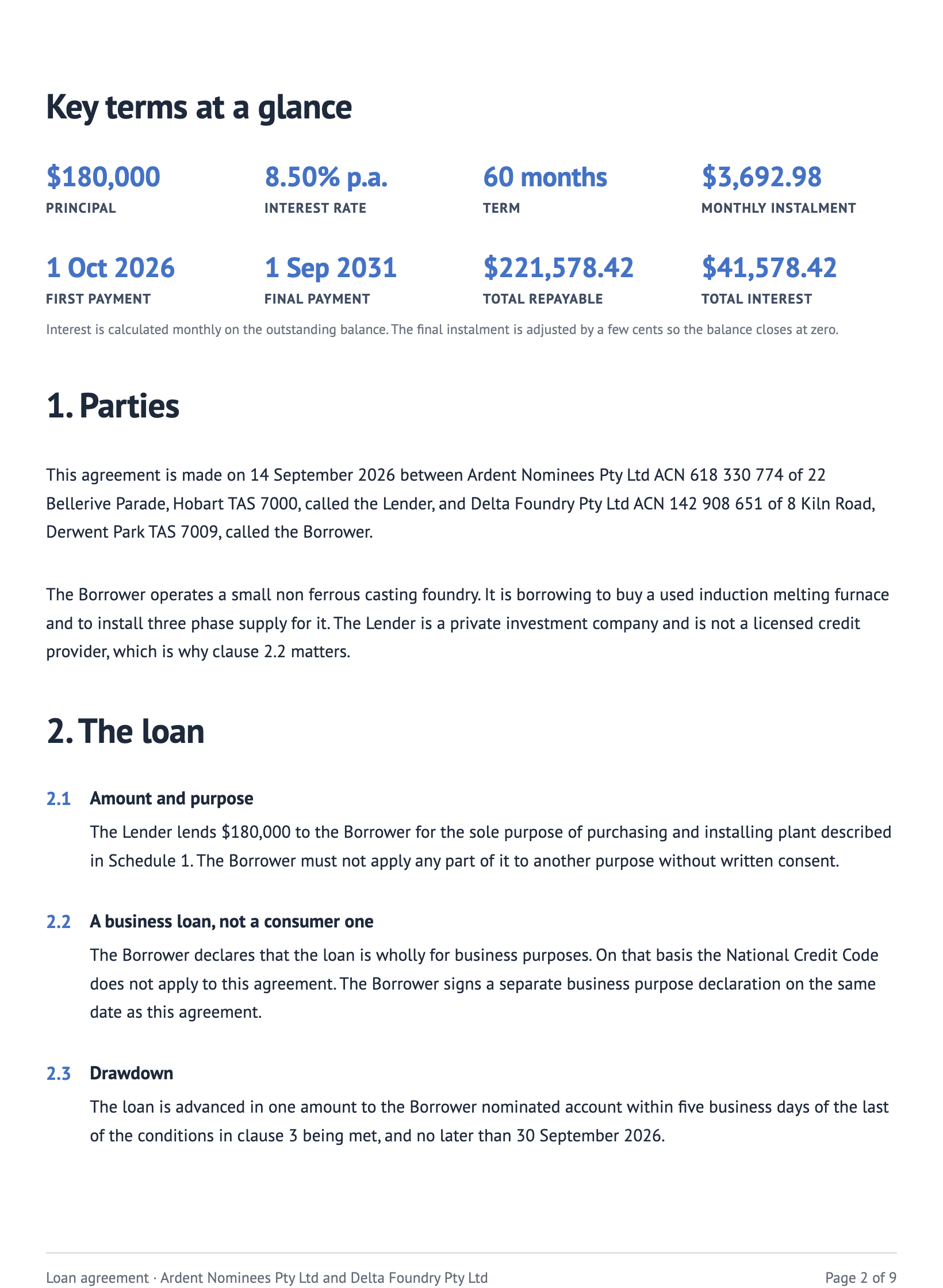 Loan agreement templateA Tasmanian foundry is borrowing $180,000 from a private investment company to buy a used induction furnace. The lender is not a bank, so everything a bank would take for granted has to be written down: what has to happen before the money moves, what is registered over what, and how long the borrower gets to fix a default.
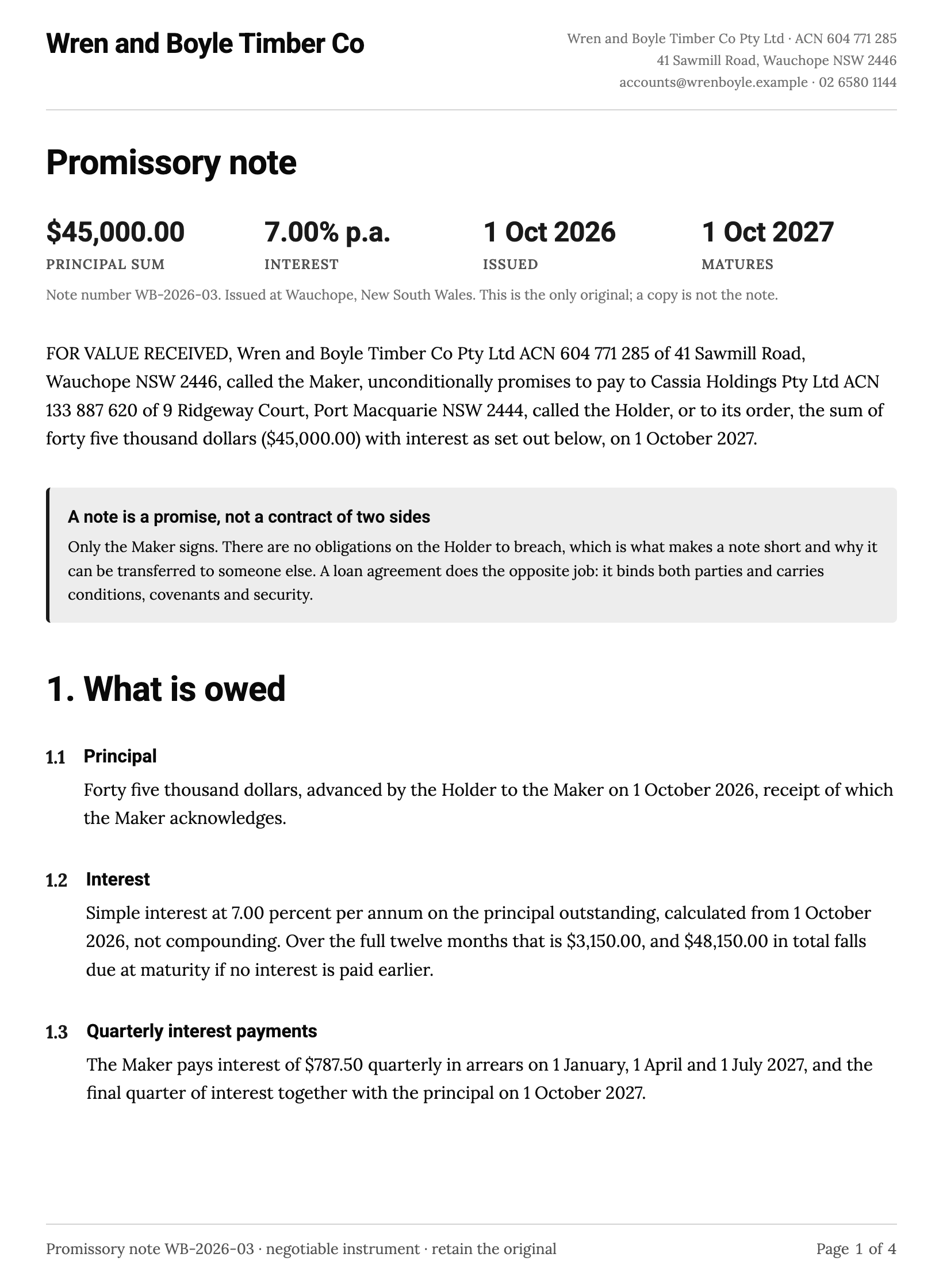 Promissory note templateA timber company owes $45,000 to a private lender and needs one page that says so. No conditions precedent, no covenants, no security. Only the maker signs, which is what keeps a note short and what lets the holder pass it on to somebody else.
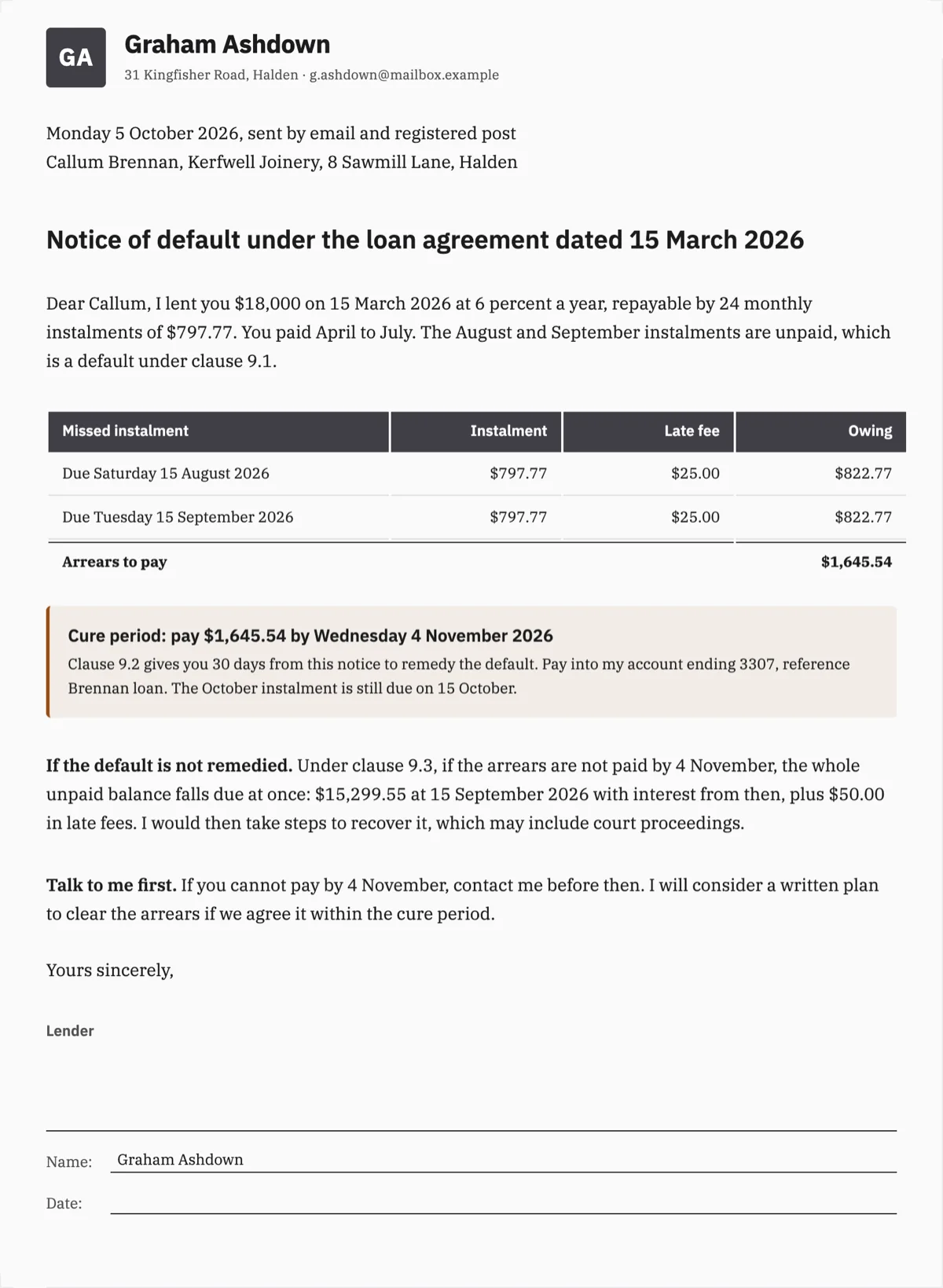 Notice of default template that gives a real chance to fix itA notice of default has to identify the loan, show exactly what is overdue, give the borrower a fixed date to put it right, and say what happens if they do not. This one page notice from a private lender after two missed instalments on an $18,000 business loan does that with an arrears table, a 30 day cure period and the acceleration clause quoted.
Questions people ask
What is an event of default in a loan?
It is an event listed in the loan agreement, such as a missed payment, insolvency or a false statement, that allows the lender to take action. The usual actions are demanding immediate repayment of the whole balance, charging default interest and enforcing any security or guarantee.
Does an event of default end the loan automatically?
Usually not. Most clauses say the lender may declare the balance due by notice, so the lender chooses whether and when to act. Some clauses make certain insolvency events automatic, though the ipso facto stay can limit those in Australia.
How long are cure periods in loan agreements?
A period after a breach, often 7 to 30 days, in which the borrower can fix the problem before it becomes an event of default. Lenders give cure periods for breaches that can be remedied, such as a late report, and shorter grace periods, if any, for missed payments.
What is the ipso facto stay?
Since 1 July 2018, Australian law stops a party enforcing contract rights against a company only because it has entered voluntary administration, receivership over most of its property or a restructuring scheme. A lender can still act on other defaults, such as non payment.
Can a lender demand repayment for a minor breach?
If the clause makes any breach an event of default with no materiality qualifier or cure period, technically yes, though lenders rarely do and courts read such clauses carefully. Borrowers should negotiate materiality and cure rights before signing rather than rely on the lender's goodwill.
Put the clause in a finished document
The button opens the document generator with a starting description already filled in. Change it to match your own agreement before you run it.
Create a document with OneCraftRelated clauses
- Prepayment clause: sample wording for repaying a loan earlyPrepayment clause sample for loans: repaying early in full or in part, notice, how part payments apply, break costs on fixed rates and the home loan fee ban.
- Capital contribution clause: sample for partnerships and joint venturesCapital contribution clause sample for partnerships and joint ventures: who puts in what and when, its value, further calls, interest and exit.
- Cross default clause: when a default elsewhere counts hereA cross default clause for a $3 million grain facility: a default on other debt over $150,000 is a default here, compared with cross acceleration.
- Acceleration clause: calling the whole loan after a defaultAn acceleration clause for an equipment loan: the whole balance due on notice after a default and a 14 day cure period, plus default notice rules by country.
For everything the document generator can do, see the document maker.
Step by step in the builder: Create a document with AI, then Document builder components.
Written and checked by the OneCraft team. Last checked .