Contract clause
Acceleration clause: calling the whole loan after a default
An acceleration clause lets a lender demand repayment of the whole outstanding loan immediately, rather than in the scheduled instalments, when the borrower defaults. Consumer credit laws in Australia, the UK and elsewhere require a default notice and a chance to remedy before a lender can accelerate a regulated loan.
An instalment loan is a promise to pay over time. The acceleration clause is what turns a missed instalment into a demand for everything, and the notice and cure periods around it decide how quickly that can happen.
Nuwan Madhusanka · Co-founder
4 min read · Published
Sample clause
Written for an equipment loan from Northwind Finance, a fictional lender, to Pinjarra Earthmoving, a fictional earthmoving business, to buy an excavator.
Acceleration. (a) Each of the following is an Event of Default: (i) the Borrower fails to pay any amount when due and does not pay it within 14 days after the Lender gives written notice of the failure; (ii) the Borrower breaches any other obligation and does not remedy it within 30 days after written notice, if it is capable of remedy; (iii) an Insolvency Event occurs in relation to the Borrower. (b) At any time after an Event of Default and while it continues, the Lender may by written notice declare all amounts owing under this agreement immediately due and payable, and the Borrower must pay them within 5 business days. (c) If the Borrower pays all overdue amounts and the Lender's enforcement costs before the Lender gives notice under paragraph (b), the Event of Default is treated as remedied.
Sample wording, not legal advice.
Variants
Automatic acceleration
Insolvency events, where waiting for notice may let assets disappear.
If an Insolvency Event occurs in relation to the Borrower, all amounts owing under this agreement become immediately due and payable without any notice or demand.
Notice based acceleration
Most commercial loans, where the lender decides whether to call the loan after a default.
Following an Event of Default which is continuing, the Lender may by notice to the Borrower declare that all or part of the Loan, together with accrued interest, is immediately due and payable.
Consumer loan version
Loans regulated by consumer credit law, where a default notice and a minimum remedy period are required.
Before the Lender begins enforcement, including requiring early repayment, it must give the Borrower a default notice under section 88 of the National Credit Code stating the default and allowing at least 30 days to remedy it.
What to negotiate
Cure periods
Borrowers should ask for a grace period for missed payments, such as 5 to 14 days after notice, and a longer period for other breaches that can be remedied. Lenders resist long periods for payment defaults but often accept them for technical breaches. A cure period stops a single late payment from putting the whole loan at risk.
Which defaults trigger it
The list of events of default decides when acceleration is available. Borrowers should resist triggers that are subjective, such as the lender considering a material adverse change has occurred, and those tied to other debts unless they meet a threshold. A cross default clause can make a default elsewhere a default here, which multiplies the risk.
The lender's discretion
Notice based acceleration gives the lender a choice; it may decide to waive the default or renegotiate. Borrowers should seek a provision that once a default is remedied, the right to accelerate for it ends, as in the sample. Lenders should avoid conduct that could be read as waiving a default, such as accepting late payments without reservation.
The risk of leaving it out
Without an acceleration clause, a lender facing a default can generally sue only for instalments as they fall due, which can mean waiting years while the borrower's position worsens, and enforcing security may be harder. For borrowers, the clause is a major risk, so the events of default and notice periods are where they should negotiate.
Default notice rules
Australia: for credit regulated by the National Credit Code, section 88 requires the credit provider to give a default notice allowing at least 30 days to remedy before it can begin enforcement proceedings, which includes accelerating, with limited exceptions. United Kingdom: under the Consumer Credit Act 1974, section 87, a default notice is needed before the creditor can terminate a regulated agreement or demand earlier payment, and the notice must give the debtor at least 14 days to remedy. United States: residential mortgages commonly follow uniform instruments that require notice of the default and at least 30 days to cure before acceleration, and state law adds further protections. Business loans are mostly governed by the contract. Law checked on 21 October 2026. This page explains how the clause works and is not legal advice.
Acceleration and enforcement of security
Once a loan is accelerated, the whole amount is due, and if it is not paid the lender can usually enforce its security, such as repossessing the excavator in the sample. For personal property in Australia, enforcement is also governed by the Personal Property Securities Act 2009. Lenders should follow the notice requirements of both the loan and the security documents exactly, because a defective notice can invalidate the enforcement.
Reversing an acceleration
Some loans allow a borrower to reinstate the loan after acceleration by paying the arrears and costs, and US mortgage instruments often give a reinstatement right before foreclosure. Under the National Credit Code, a debtor who remedies within the default notice period prevents enforcement. Commercial borrowers can ask the lender to rescind an acceleration notice as part of a workout, which lenders often agree to when a payment plan is reached.
Where the clause sits
Events of default and acceleration usually sit together near the end of a loan agreement, after the representations and covenants. In a loan agreement drafted with the AI document generator, ask for the events of default as a numbered list, the cure periods for each, and the acceleration clause, so the borrower can see the whole path from missed payment to demand.
Documents that carry this clause
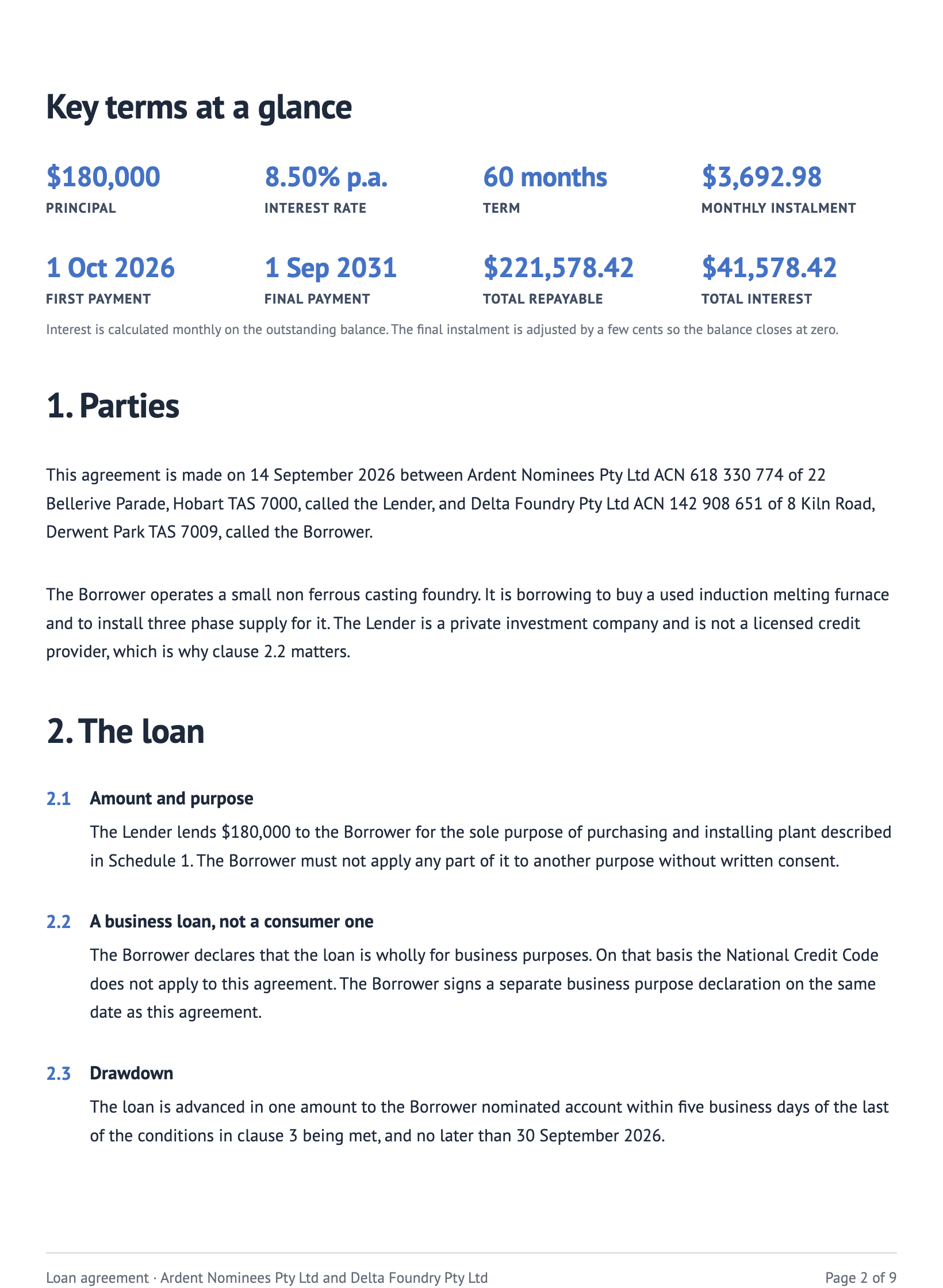 Loan agreement templateA Tasmanian foundry is borrowing $180,000 from a private investment company to buy a used induction furnace. The lender is not a bank, so everything a bank would take for granted has to be written down: what has to happen before the money moves, what is registered over what, and how long the borrower gets to fix a default.
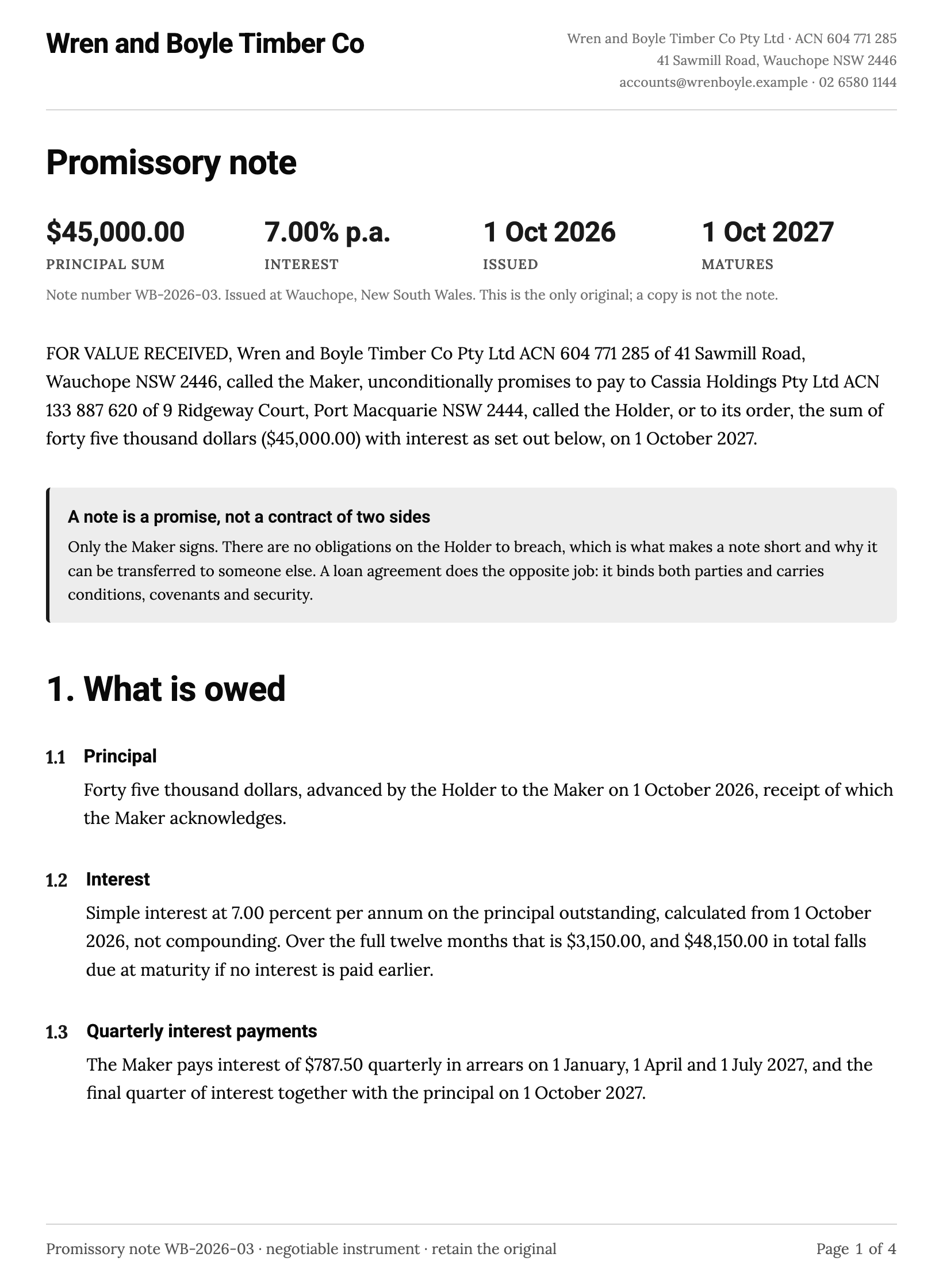 Promissory note templateA timber company owes $45,000 to a private lender and needs one page that says so. No conditions precedent, no covenants, no security. Only the maker signs, which is what keeps a note short and what lets the holder pass it on to somebody else.
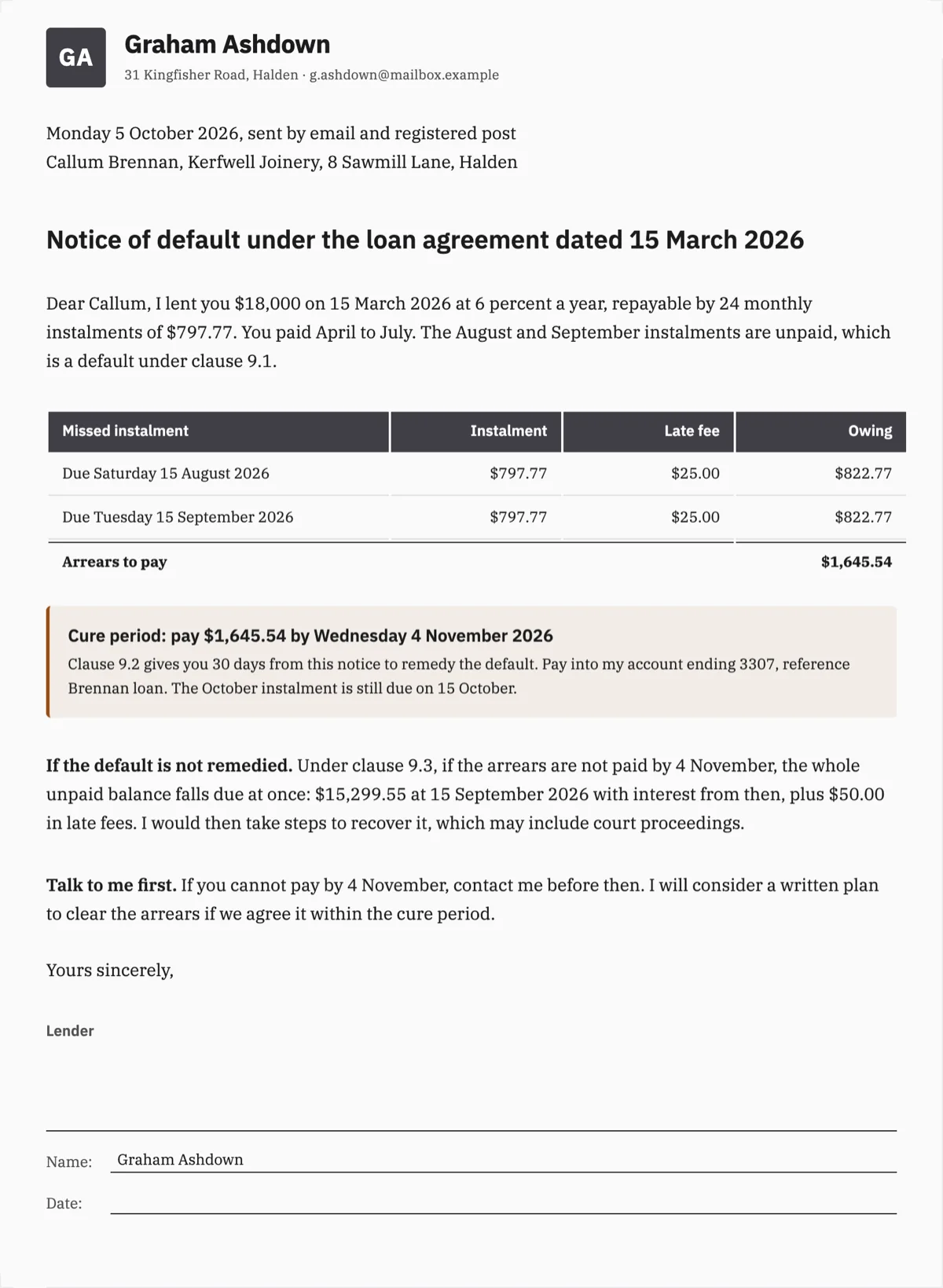 Notice of default template that gives a real chance to fix itA notice of default has to identify the loan, show exactly what is overdue, give the borrower a fixed date to put it right, and say what happens if they do not. This one page notice from a private lender after two missed instalments on an $18,000 business loan does that with an arrears table, a 30 day cure period and the acceleration clause quoted.
Questions people ask
What is an acceleration clause in a loan?
It is a term allowing the lender to demand the entire outstanding balance at once, instead of in instalments, if the borrower defaults. It turns a missed payment or other default into an immediate obligation to repay everything, usually after notice.
Does the lender have to give notice before accelerating?
Usually. Most commercial loans require written notice, and consumer credit laws require a formal default notice with a minimum period to remedy: at least 30 days under Australia's National Credit Code and at least 14 days under the UK Consumer Credit Act. Automatic acceleration on insolvency is a common exception.
Can an acceleration be reversed?
It can if the loan or the law gives a right to reinstate, or if the lender agrees. Paying the arrears within a default notice period prevents enforcement under consumer credit law. In commercial loans, rescinding acceleration is a matter for negotiation, often as part of a payment plan.
What counts as an event of default?
Whatever the loan lists: commonly missed payments, breach of covenants, untrue representations, insolvency, cross default on other debts, and sometimes a material adverse change. Each event usually has its own cure period, and the lender can accelerate only once an event has occurred and is continuing.
Is acceleration the same as foreclosure?
No. Acceleration makes the whole debt due at once. Foreclosure, or enforcement of security more generally, is what the lender may do next if the accelerated debt is not paid, such as selling the mortgaged property or repossessing financed equipment. Each step has its own notice requirements and timetable.
Put the clause in a finished document
The button opens the document generator with a starting description already filled in. Change it to match your own agreement before you run it.
Create a document with OneCraftRelated clauses
- Cross default clause: when a default elsewhere counts hereA cross default clause for a $3 million grain facility: a default on other debt over $150,000 is a default here, compared with cross acceleration.
- Late payment interest clause: setting a rate that holdsA late payment interest clause sets what accrues on an overdue invoice. Australian sample wording at 8 percent, cash rate linked and UK statutory variants.
- Termination for insolvency clauseA termination for insolvency clause ends a contract when the other side fails. Sample wording, trigger lists, and the Australian ipso facto stay since 2018.
- Due on sale clause in a US mortgageA due on sale clause for a Sacramento home loan: the balance due if the property is sold without consent, and the transfers the Garn St Germain Act protects.
For everything the document generator can do, see the document maker.
Step by step in the builder: Create a document with AI, then Document builder components.
Written and checked by the OneCraft team. Last checked .