Contract clause
Due on sale clause in a US mortgage
A due on sale clause lets a lender demand repayment of a mortgage in full if the borrower sells or transfers the property, or an interest in it, without the lender's consent. In the United States, the Garn St Germain Act makes these clauses enforceable but lists transfers a lender cannot use them against.
A mortgage is lent to a person, not to whoever owns the house next. The due on sale clause is how a lender stops a buyer simply taking over a borrower's loan, and federal law carves out the family and estate transfers where calling the loan would be unfair.
Indunil Asanka · Co-founder
4 min read · Published
Sample clause
Written for a home loan from a fictional lender to a borrower buying a house in Sacramento, California.
Transfer of the Property. (a) If all or any part of the Property, or any interest in it, is sold or transferred without the Lender's prior written consent, the Lender may require immediate payment in full of all sums secured by this Security Instrument. (b) The Lender will not exercise this option if exercise is prohibited by federal law, including the transfers listed in 12 U.S.C. section 1701j-3(d). (c) If the Lender exercises this option, it will give the Borrower notice of acceleration giving at least 30 days from the date of notice within which the Borrower must pay all sums secured. (d) The Lender may consent to a transfer and allow the transferee to assume this loan, on conditions including a credit assessment of the transferee.
Sample wording, not legal advice.
Variants
Standard due on sale
Most US residential mortgages, following the uniform instruments used for loans sold to the secondary market.
If all or any part of the Property or any interest in it is sold or transferred without the Lender's prior written consent, the Lender may require immediate payment in full of all sums secured by this Security Instrument, except where prohibited by applicable law.
Assumable loan
Loans designed to be taken over by a buyer, such as some government backed loans, subject to approval.
This loan may be assumed by a purchaser of the Property who meets the Lender's credit standards and agrees in writing to be bound by the Note and this Security Instrument. On a valid assumption, the original Borrower is released from further liability.
Commercial loan version
Loans on commercial property, which are outside the residential protections and often extend to changes of ownership of the borrower.
The Lender may declare the Loan immediately due if the Borrower sells, transfers or further encumbers the Property, or if any change in ownership or control of the Borrower occurs, without the Lender's prior written consent.
What to negotiate
Consent to assumption
Borrowers who may want to sell with the loan in place, for example when rates have risen, should look for terms allowing assumption with the lender's consent and stating the conditions. Lenders usually require the buyer to qualify and may charge a fee. Without such terms, consent is at the lender's discretion.
Transfers to a trust
Moving a home into a revocable living trust for estate planning is protected by federal law if the borrower remains a beneficiary and the transfer does not relate to a transfer of occupancy rights. Borrowers should still tell the lender, keep living in the home and keep the trust revocable, and check the trust meets the conditions before transferring.
Rate on assumption
Where assumption is allowed, the lender may be able to adjust the interest rate to current market rates as a condition. That can remove much of the benefit of assuming a low rate loan. Federal regulations allow lenders to require an assumption at a blended or market rate in some cases, so the terms of consent matter.
The risk of leaving it out
Without a due on sale clause, a buyer could take over a borrower's mortgage, possibly at a below market rate, without the lender assessing the new owner's credit. Lenders price loans assuming the clause exists, and almost all US residential mortgages include it. For borrowers, the practical risk is triggering it by a transfer that is not protected.
The exceptions checklist
For a loan on residential property with fewer than five dwelling units, 12 U.S.C. section 1701j-3(d) says a lender may not exercise a due on sale clause on: a subordinate lien that does not transfer occupancy rights; a purchase money security interest for household appliances; a transfer on the death of a joint tenant or tenant by the entirety; a lease of three years or less with no option to purchase; a transfer to a relative on the borrower's death; a transfer where the borrower's spouse or children become owners; a transfer to a spouse under a divorce decree, separation agreement or property settlement; a transfer into an inter vivos trust in which the borrower is and remains a beneficiary, not relating to occupancy rights; and other transfers set out in regulations. Law checked on 21 October 2026. This page explains how the clause works and is not legal advice.
How the Garn St Germain Act changed things
Before 1982, some states restricted due on sale clauses, allowing buyers to assume low rate loans. The Garn St Germain Depository Institutions Act of 1982 made due on sale clauses generally enforceable nationwide, preempting most state restrictions, while adding the federal exceptions above. Federal regulations, now administered for national banks and federal savings associations by the Office of the Comptroller of the Currency at 12 CFR part 191, add detail on how the rules apply.
In practice
Lenders rarely search for transfers, and many due on sale clauses are only triggered when a lender learns of a sale. But a transfer that is not exempt gives the lender the right to call the loan at any time, which is a serious risk if rates have risen. Borrowers considering a transfer, such as adding a partner to the title or moving the property into a company, should check whether it is exempt and, if not, seek the lender's consent first.
Outside the United States
Australian and UK mortgages achieve the same result differently. Loan agreements usually make sale of the property, or a transfer without consent, an event of default, and the lender's mortgage must be discharged on settlement of a sale, so buyers cannot simply take over a loan. Portability features, where a borrower moves the loan to a new property, are a product feature rather than an exception to a statute.
Documents that carry this clause
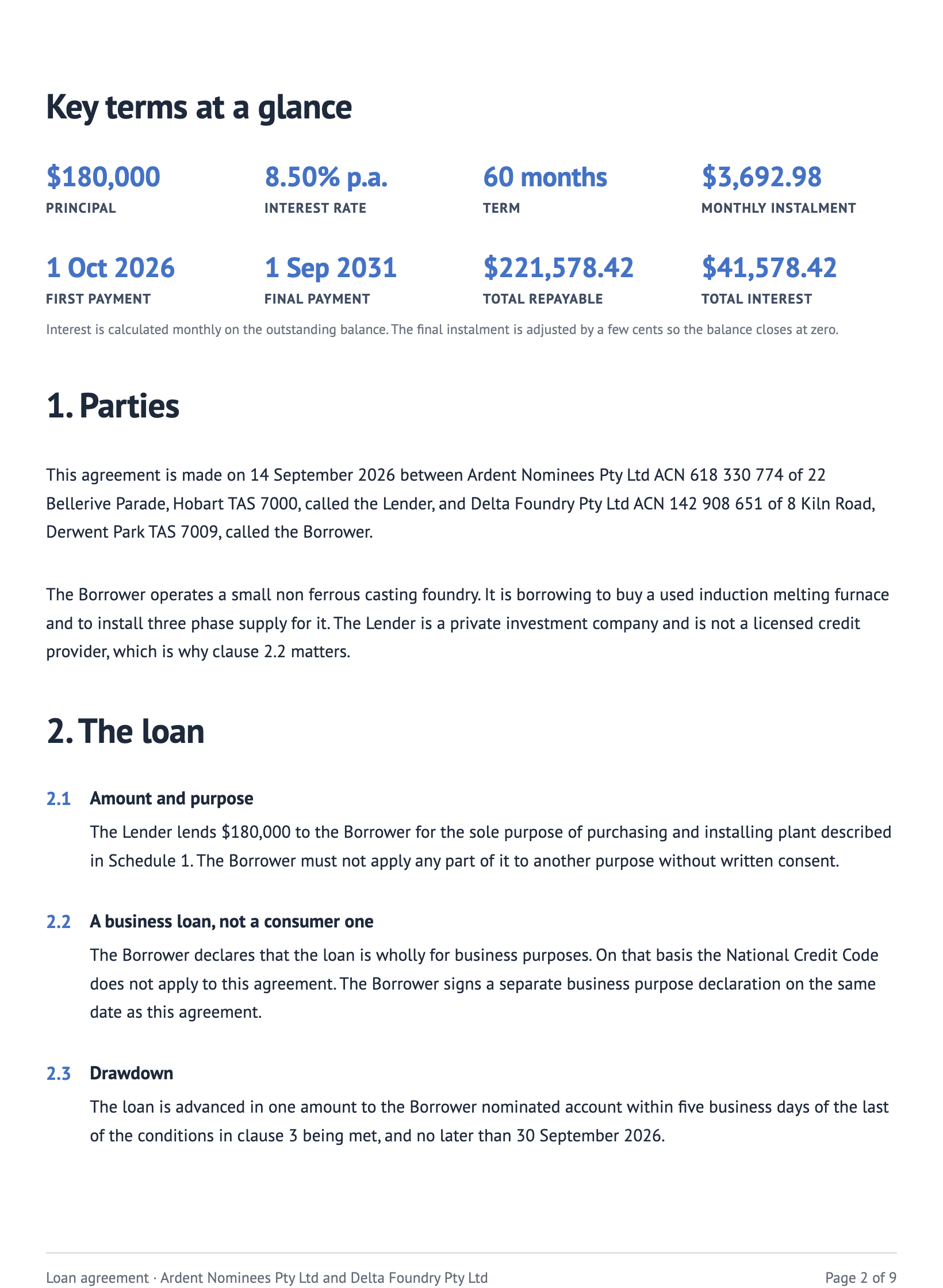 Loan agreement templateA Tasmanian foundry is borrowing $180,000 from a private investment company to buy a used induction furnace. The lender is not a bank, so everything a bank would take for granted has to be written down: what has to happen before the money moves, what is registered over what, and how long the borrower gets to fix a default.
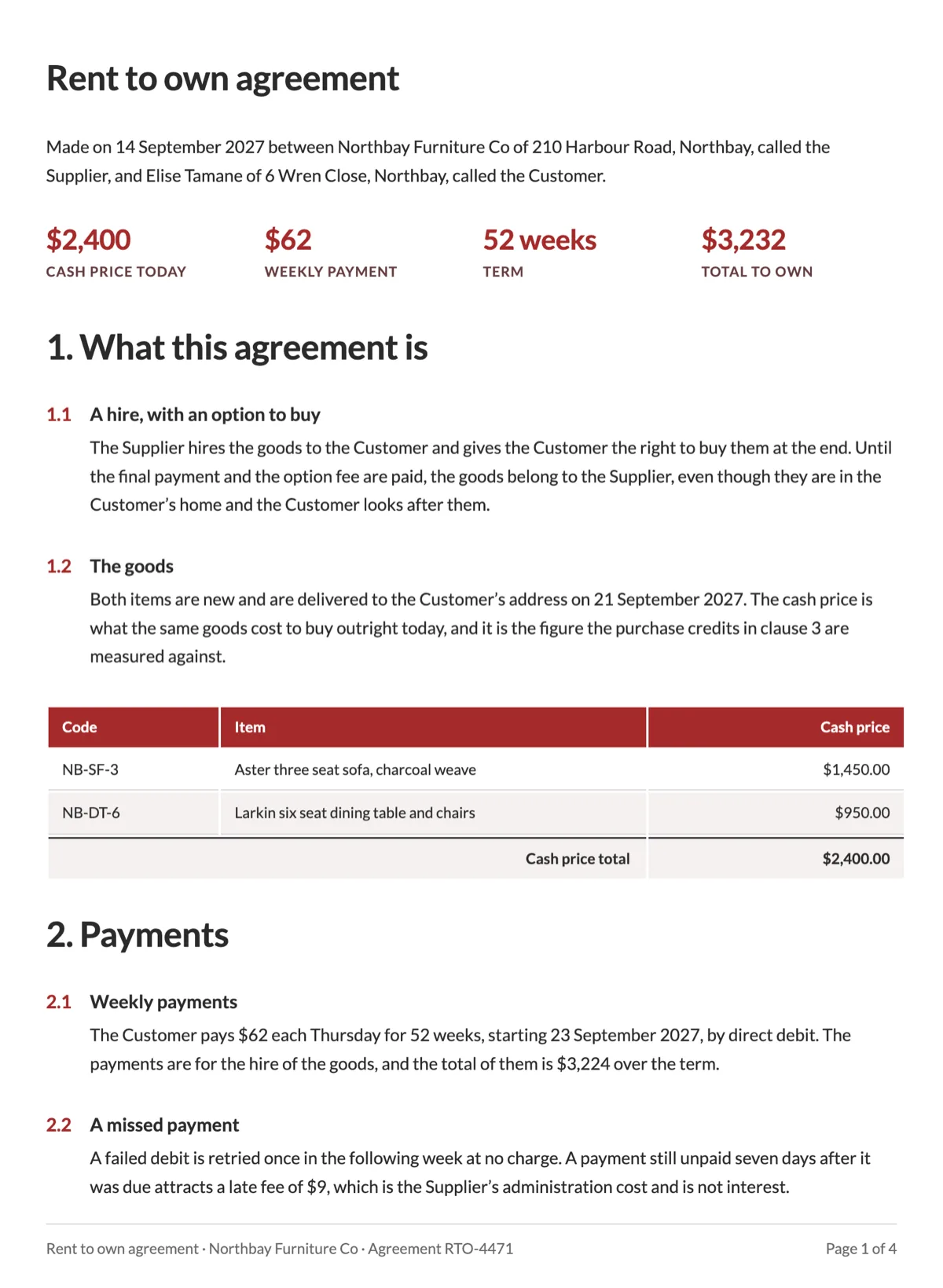 Rent to own agreement template with credits, price and defaultA rent to own agreement is a hire with an option to buy at the end, so the goods stay with the supplier until the last payment. This one covers a $2,400 sofa and dining set paid off at $62 a week for 52 weeks, with a table showing what has been credited and what the payout figure is at four points in the term.
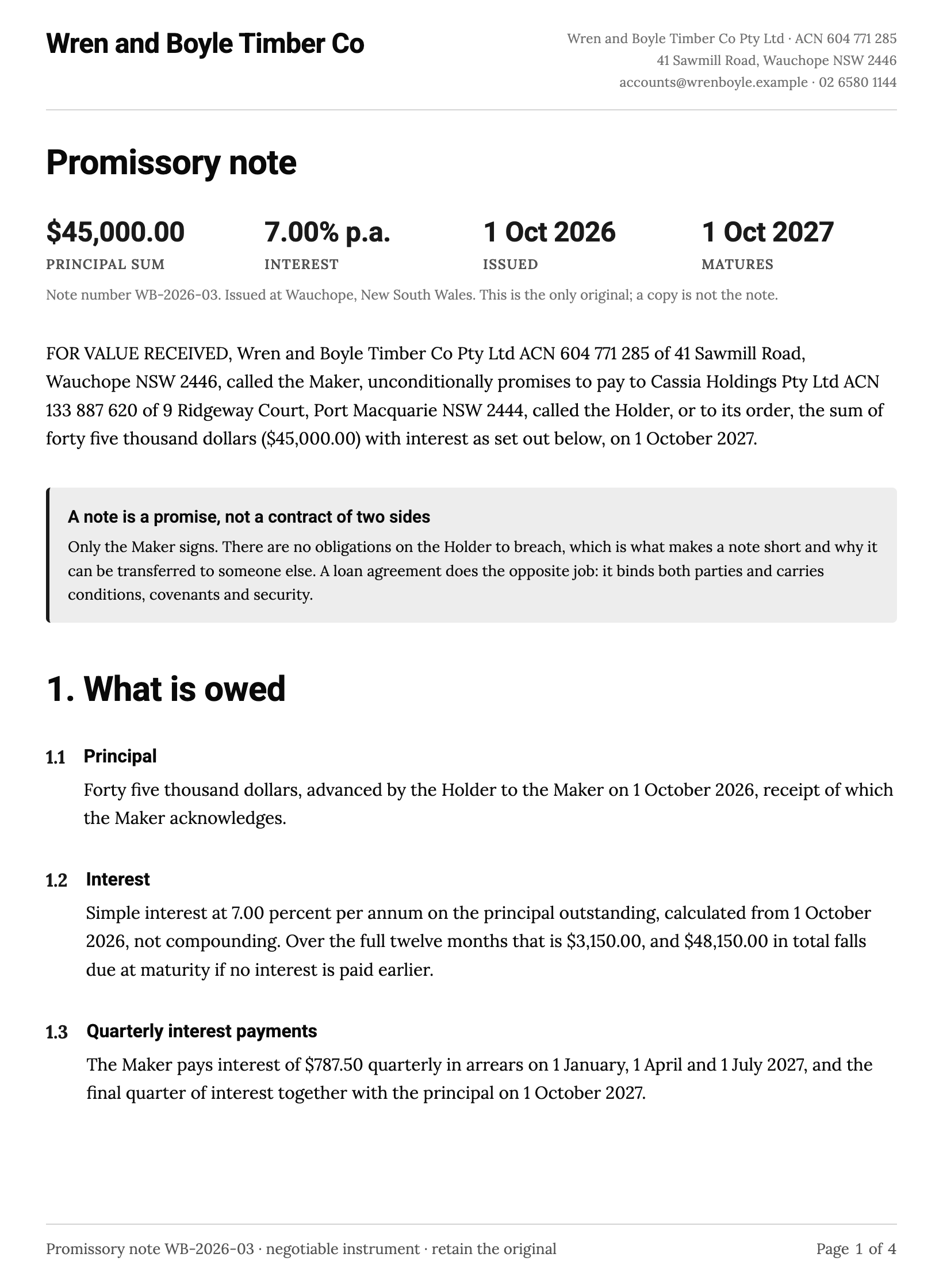 Promissory note templateA timber company owes $45,000 to a private lender and needs one page that says so. No conditions precedent, no covenants, no security. Only the maker signs, which is what keeps a note short and what lets the holder pass it on to somebody else.
Questions people ask
What is a due on sale clause?
It is a mortgage term letting the lender demand full repayment if the borrower sells or transfers the property, or an interest in it, without the lender's consent. It stops a buyer from taking over the loan without the lender's approval, and is standard in US residential mortgages.
Can I transfer my house to a trust without triggering it?
For a residential property with fewer than five units, federal law protects a transfer into an inter vivos trust in which you are and remain a beneficiary, if it does not transfer occupancy rights. Keep living there, keep the trust revocable, and tell your lender. Check the conditions before transferring.
Is my mortgage assumable?
Only if the loan documents allow it or the lender consents. Some government backed loans are assumable by qualified buyers, while most conventional loans include a due on sale clause that lets the lender refuse. Read the note and security instrument, or ask the lender in writing.
Does adding my spouse to the title trigger the clause?
No, for a residential property with fewer than five units. Federal law prevents the lender from exercising the clause on a transfer where the borrower's spouse or children become owners of the property. Transfers to other people, such as a business partner, are not protected.
What happens if the lender calls the loan?
The lender must give notice of acceleration, commonly at least 30 days to pay the full balance. If the balance is not paid, the lender can begin foreclosure under state law. Borrowers in that position usually refinance, sell, or negotiate with the lender to consent to the transfer.
Put the clause in a finished document
The button opens the document generator with a starting description already filled in. Change it to match your own agreement before you run it.
Create a document with OneCraftRelated clauses
- Acceleration clause: calling the whole loan after a defaultAn acceleration clause for an equipment loan: the whole balance due on notice after a default and a 14 day cure period, plus default notice rules by country.
- Assignment clause: who else may step into the contract's benefitsAn assignment clause controls whether a party can transfer its rights under a contract. Sample consent wording, a change of control trigger and three variants.
- Novation clause: agreeing now to swap a party laterA novation clause commits the parties to replace one party with another when a trigger occurs. Australian sample wording, deed form and business sale variants.
For everything the document generator can do, see the document maker.
Step by step in the builder: Create a document with AI, then Document builder components.
Written and checked by the OneCraft team. Last checked .