Contract clause
Cross default clause: when a default elsewhere counts here
A cross default clause makes a borrower's default under another debt, above an agreed threshold, an event of default under this loan too. It lets a lender act as soon as the borrower is in trouble with any creditor, rather than waiting until its own loan is missed.
A lender does not want to be the last to know. A cross default clause links a borrower's loans together, so a default with one creditor gives every lender with the clause the right to act, which is why the threshold and wording matter so much to borrowers.
Indunil Asanka · Co-founder
3 min read · Published
Sample clause
Written for a $3,000,000 working capital facility from a fictional regional bank to Lachlan Valley Grain, a fictional grain trading business.
Cross Default. An Event of Default occurs if: (a) any Financial Indebtedness of the Borrower is not paid when due or within any originally applicable grace period; (b) any Financial Indebtedness of the Borrower is declared, or otherwise becomes, due and payable before its specified maturity because of an event of default, however described; or (c) any creditor of the Borrower becomes entitled to declare any Financial Indebtedness due and payable before its specified maturity because of an event of default, however described, provided that no Event of Default occurs under this clause unless the total Financial Indebtedness affected is more than $150,000, and no amount disputed in good faith by appropriate means counts towards that total.
Sample wording, not legal advice.
Variants
Cross default
Lenders that want to act as soon as any other lender could act, whether or not it does.
An Event of Default occurs if any creditor of the Borrower becomes entitled to declare any Financial Indebtedness of the Borrower due and payable before its maturity because of an event of default, and the amount concerned exceeds the Threshold.
Cross acceleration
Borrowers with bargaining power, who want the clause triggered only when another lender actually calls its debt.
An Event of Default occurs only if Financial Indebtedness of the Borrower exceeding the Threshold is declared due and payable before its specified maturity because of an event of default.
Limited to the same lender
Relationship banking, where a borrower has several facilities with one bank and other debts are not relevant.
An Event of Default occurs if an event of default, however described, occurs under any other agreement between the Borrower and the Lender or any of the Lender's related bodies corporate.
What to negotiate
The threshold
A threshold stops a small dispute with a supplier from putting a major facility at risk. It is usually a fixed amount or a percentage of net assets, set so that only a default significant to the borrower's finances counts. Borrowers should make sure the threshold applies to all limbs of the clause and that it is in the same currency as their other debts or adjusts for exchange rates.
Grace periods
The clause should only bite once the other debt's own grace period has expired, so a payment a day late under another loan, which that lender would excuse, does not trigger this one. The sample's wording on any originally applicable grace period does that. Borrowers can also ask for a period to remedy the cross default before the lender can accelerate.
Disputed debts
Borrowers should exclude amounts disputed in good faith, so that a contractual dispute with a supplier is not treated as a financial default. Lenders accept that if the dispute is genuine and being pursued properly. The definition of financial indebtedness also matters: it should cover borrowings and similar items, not every trade debt.
The risk of leaving it out
Without a cross default clause, a lender may have to watch a borrower default on other debts, with other creditors enforcing against assets, while its own loan remains technically in good standing. For borrowers, an overly broad clause creates a domino effect, where one default anywhere can trigger defaults across every facility at once.
Cross default and cross acceleration compared
Consider a borrower that misses a $200,000 payment on an equipment loan from another lender, and that lender sends a default notice but does not yet call the loan. Under a cross default clause like the sample's, the bank can act now, because the other creditor has become entitled to accelerate and the amount exceeds $150,000. Under a cross acceleration clause, the bank cannot act unless and until the other lender actually declares its loan due. If the borrower then agrees a payment plan with the equipment lender, the cross acceleration bank is never affected, while the cross default bank may already have used its leverage. Law checked on 21 October 2026. This page explains how the clause works and is not legal advice.
Market standard drafting
The Loan Market Association in Europe and the Asia Pacific Loan Market Association publish recommended form facility agreements that include a cross default clause with a threshold, and most syndicated and many bilateral loans start from them. The standard form covers non payment after grace periods, early acceleration, and creditors becoming entitled to accelerate, with a threshold applying to all three, which is the structure the sample follows.
What counts as financial indebtedness
The definition usually includes money borrowed, bonds and notes, finance leases, receivables sold with recourse, derivative exposures and guarantees of others' debts. Trade payables on normal terms are usually excluded. Borrowers should check the definition carefully, because a broad definition with a low threshold can capture ordinary business disputes.
Managing the domino effect
A borrower with several facilities should map which ones contain cross default and which contain cross acceleration, and the thresholds in each. When trouble begins, the borrower should talk to all lenders early, because one lender's enforcement can trigger the others. Standstill agreements, where lenders agree not to act while a plan is worked out, are a common response.
Documents that carry this clause
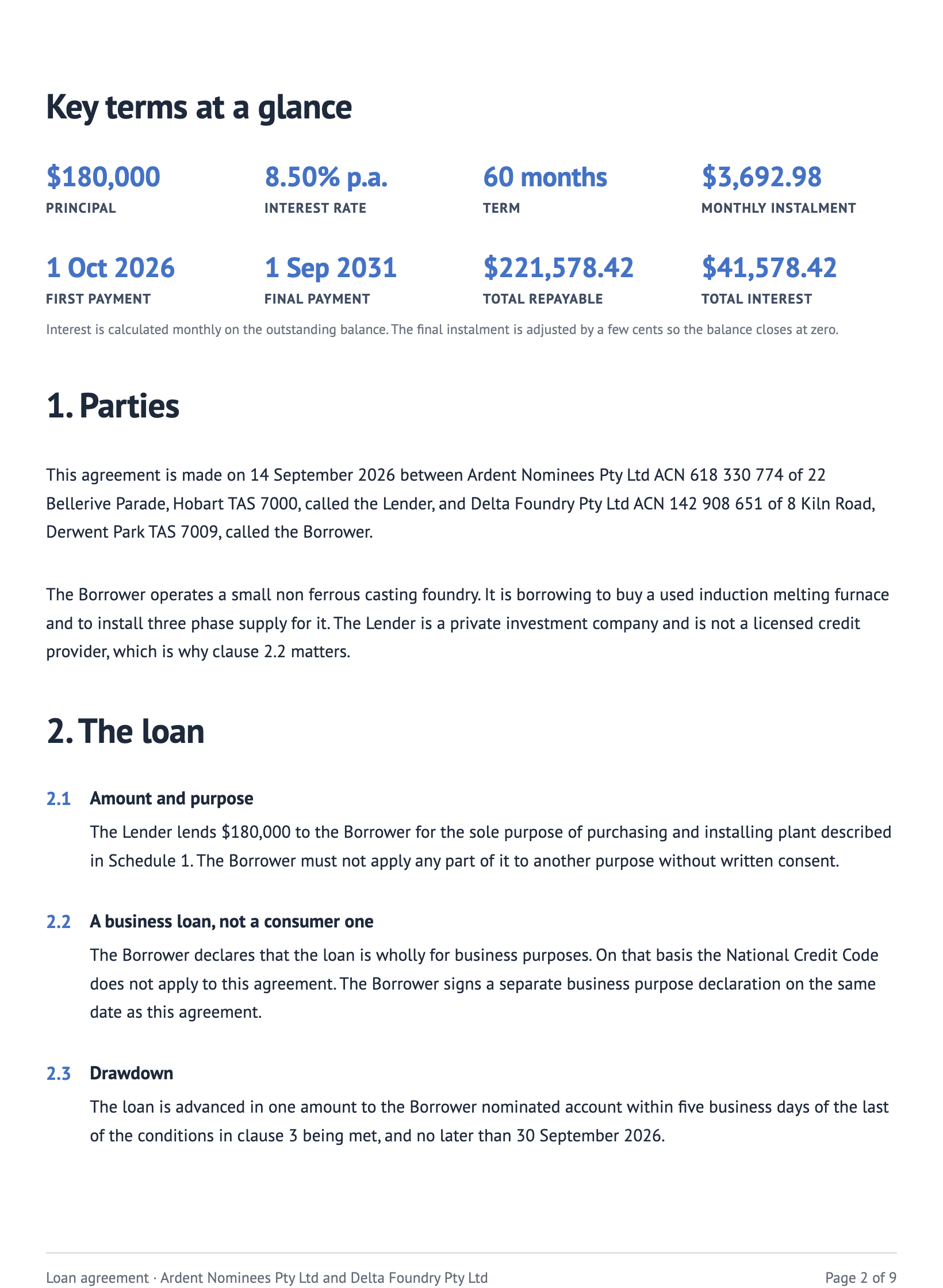 Loan agreement templateA Tasmanian foundry is borrowing $180,000 from a private investment company to buy a used induction furnace. The lender is not a bank, so everything a bank would take for granted has to be written down: what has to happen before the money moves, what is registered over what, and how long the borrower gets to fix a default.
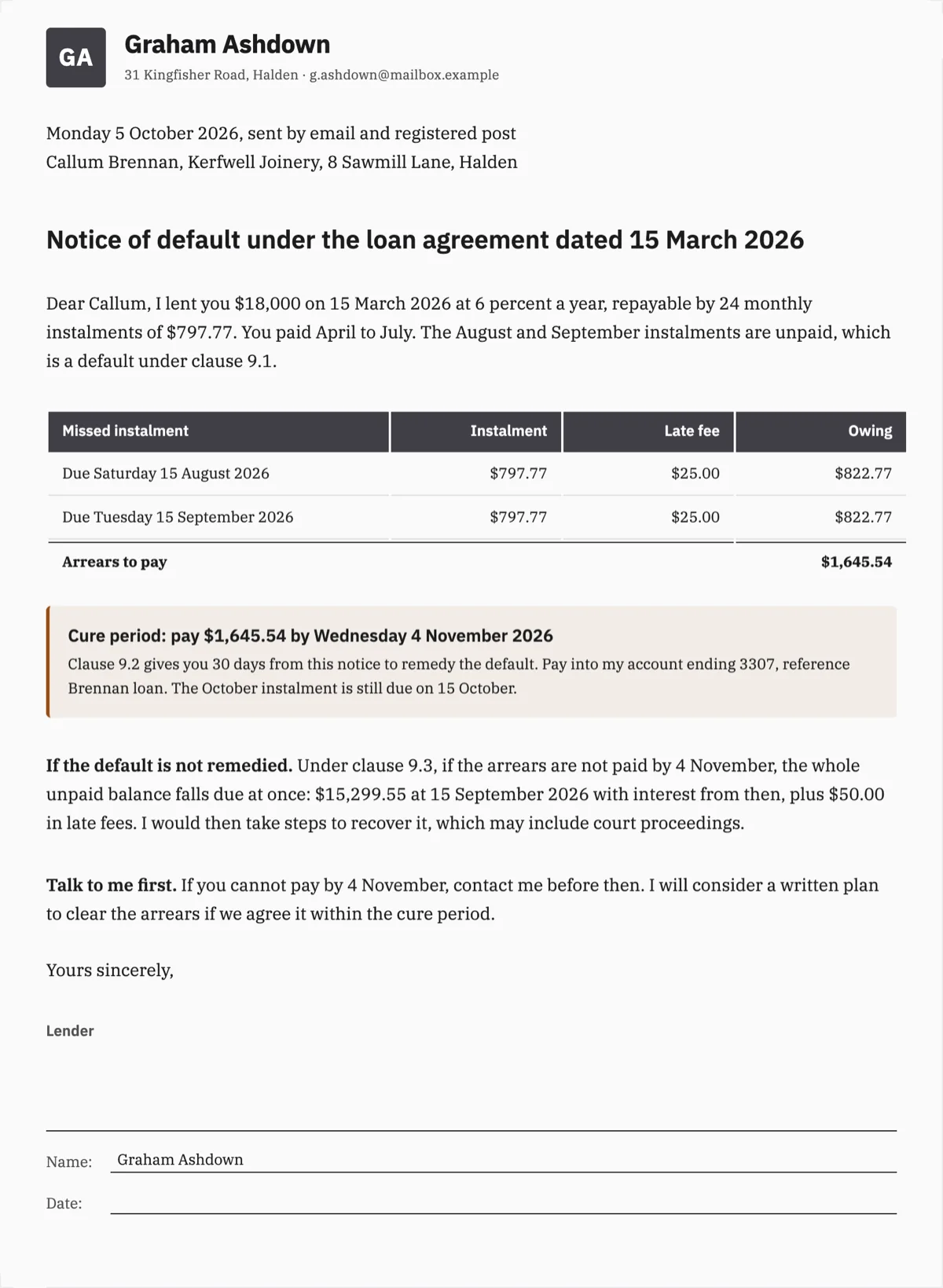 Notice of default template that gives a real chance to fix itA notice of default has to identify the loan, show exactly what is overdue, give the borrower a fixed date to put it right, and say what happens if they do not. This one page notice from a private lender after two missed instalments on an $18,000 business loan does that with an arrears table, a 30 day cure period and the acceleration clause quoted.
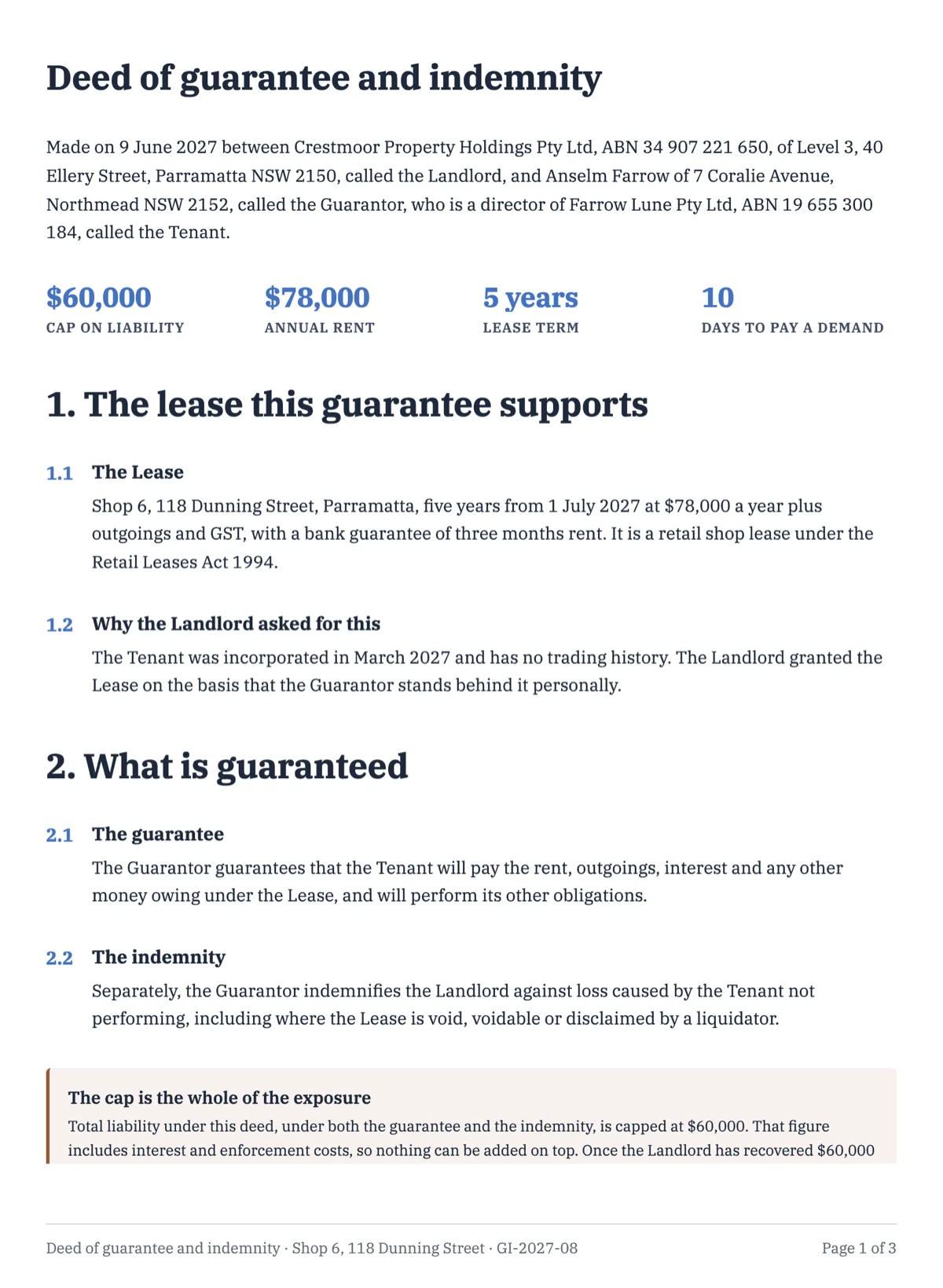 Personal guarantee template with a cap and a notice of demandA director asked to guarantee a lease wants to know one number: the most this can cost me. This three page deed answers it in a callout, capping the guarantor at $60,000 including interest and enforcement costs, then sets out the two steps the landlord has to take before a demand can be made at all.
Questions people ask
What is a cross default clause?
It is a loan provision that makes a default on another debt an event of default under this loan, if the amount exceeds an agreed threshold. It lets the lender act when the borrower is in difficulty with other creditors, without waiting for its own loan to be missed.
What is the difference between cross default and cross acceleration?
Cross default is triggered when another debt is in default, or when another creditor merely becomes entitled to accelerate it. Cross acceleration is triggered only when another creditor actually accelerates its debt. Cross acceleration is narrower, gives the borrower time to fix problems with the other lender, and is better for the borrower.
What threshold is normal?
It depends on the borrower's size. Thresholds are often set as a fixed amount that would be significant to the borrower's finances, or as a percentage of net assets or equity. A threshold too low lets minor disputes trigger defaults; too high defeats the purpose for the lender.
Do trade debts count for cross default?
Usually not. Most clauses apply only to financial indebtedness, such as borrowings, bonds, finance leases and guarantees of others' debts, and exclude ordinary trade payables on normal terms. Check the definition, because some clauses are drafted widely enough to catch other liabilities, which matters if a supplier dispute arises.
Can a cross default be waived?
Yes, the lender can waive it, often in exchange for a fee or tighter terms. Borrowers facing a default under another facility should approach all affected lenders early to seek waivers or a standstill, before any lender acts on its rights.
Put the clause in a finished document
The button opens the document generator with a starting description already filled in. Change it to match your own agreement before you run it.
Create a document with OneCraftRelated clauses
- Acceleration clause: calling the whole loan after a defaultAn acceleration clause for an equipment loan: the whole balance due on notice after a default and a 14 day cure period, plus default notice rules by country.
- Negative pledge clause: no security to anyone elseA negative pledge clause for an unsecured cafe group facility: no security to other lenders, a basket for equipment finance and liens by law, and the PPSR.
- Termination for insolvency clauseA termination for insolvency clause ends a contract when the other side fails. Sample wording, trigger lists, and the Australian ipso facto stay since 2018.
For everything the document generator can do, see the document maker.
Step by step in the builder: Create a document with AI, then Document builder components.
Written and checked by the OneCraft team. Last checked .