Contract clause
Negative pledge clause: no security to anyone else
A negative pledge clause is a promise by a borrower not to grant security over its assets to other creditors, usually with listed exceptions. It protects an unsecured lender from being pushed behind secured creditors, but it is a contractual promise only and does not itself create a security interest.
An unsecured lender is paid alongside other unsecured creditors if the borrower fails. A negative pledge keeps it there, rather than behind a queue of secured lenders that arrived later, by forbidding the borrower to grant new security without consent.
Nuwan Madhusanka · Co-founder
3 min read · Published
Sample clause
Written for an unsecured facility from a fictional lender to Mistral Cafe Group, a fictional operator of six cafes in Melbourne.
Negative Pledge. (a) The Borrower must not create or allow to exist any Security Interest over any of its present or future assets, other than Permitted Security. (b) Permitted Security means: (i) a Security Interest arising by operation of law in the ordinary course of business; (ii) a Security Interest over equipment securing only the purchase price or finance for that equipment, where the total amount secured by all such Security Interests does not exceed $250,000; (iii) retention of title arrangements with suppliers on their standard terms in the ordinary course of business; and (iv) any Security Interest the Lender has approved in writing. (c) Security Interest has the meaning in the Personal Property Securities Act 2009 and includes a mortgage over land.
Sample wording, not legal advice.
Variants
Strict negative pledge
Lenders wanting tight control, typically for borrowers with few assets or weak credit.
The Borrower must not create, or permit to subsist, any security interest over any of its assets, or enter into any arrangement having a similar effect, without the prior written consent of the Lender.
With a permitted security basket
Most operating businesses, which need routine equipment finance and supplier terms.
The negative pledge does not apply to security interests securing indebtedness in aggregate not exceeding $250,000, or to security interests arising under retention of title terms in the ordinary course of trading.
With equal and rateable security
Facilities where the lender accepts new security as long as it shares in it equally.
The Borrower may create security over its assets for other creditors only if, at the same time, it secures its obligations to the Lender equally and rateably with the other secured obligations, on terms satisfactory to the Lender.
What to negotiate
The basket
An operating business needs some routine security: equipment finance, vehicle leases, supplier retention of title and liens that arise by law. A permitted security basket, with a dollar cap, allows these without seeking consent each time. Borrowers should make the basket large enough for their normal needs and check that it covers finance leases and hire purchase, which are security interests under Australian law.
The PPSR in Australia
Under the Personal Property Securities Act 2009, many arrangements that do not look like security, such as finance leases, retention of title and some consignments, are security interests that can be registered on the Personal Property Securities Register. A negative pledge using the Act's definition therefore catches more than borrowers expect. The basket should name the arrangements the borrower relies on.
What counts as security
Lenders often extend the negative pledge to quasi security, such as selling receivables with recourse or sale and leaseback, which can achieve the same effect as a loan secured on assets. Borrowers should resist drafting so broad that ordinary transactions breach it, and agree a list of what is and is not caught.
The risk of leaving it out
Without a negative pledge, an unsecured lender can find that the borrower has since granted security over all its assets to a new lender, who will be paid first if the business fails. That can leave the unsecured lender recovering little or nothing. Because the clause is only a contract, it gives a claim against the borrower, not priority over a creditor that took security in breach of it.
Permitted security table
Common items in a permitted security list, and why each is there. Liens arising by law, such as a repairer's lien on equipment: unavoidable in normal business. Retention of title under supplier terms: standard in trade credit. Equipment finance and finance leases up to a cap: lets the business buy equipment without using its main facility. Security over cash for bank guarantees or card terminals: often required by banks. Existing security disclosed at signing: grandfathered so the borrower is not in breach on day one. Security approved by the lender in writing: the catch all for anything else. Law checked on 21 October 2026. This page explains how the clause works and is not legal advice.
A negative pledge is not a security interest
A negative pledge is a promise, not security. It is not registrable on the Personal Property Securities Register as a security interest, and a third party lender that takes security in breach of it usually gets priority anyway, unless it knew of the negative pledge and induced the breach in some circumstances. The unsecured lender's remedy is against the borrower: breaching the negative pledge is usually an event of default, allowing the lender to accelerate its loan.
Negative pledges in practice
Negative pledges are common in unsecured corporate facilities and in bond issues, where they protect bondholders from later secured lenders. Market form facility agreements, such as those published by the Loan Market Association, include a negative pledge with a list of permitted security. In shareholders' agreements, a similar restriction may stop the company granting security without investor consent.
Checking compliance
Before granting any security, check the negative pledge in every facility. A search of the borrower's own registrations on the Personal Property Securities Register shows what security already exists. Lenders often ask for a compliance certificate confirming no security has been granted beyond the permitted basket.
Documents that carry this clause
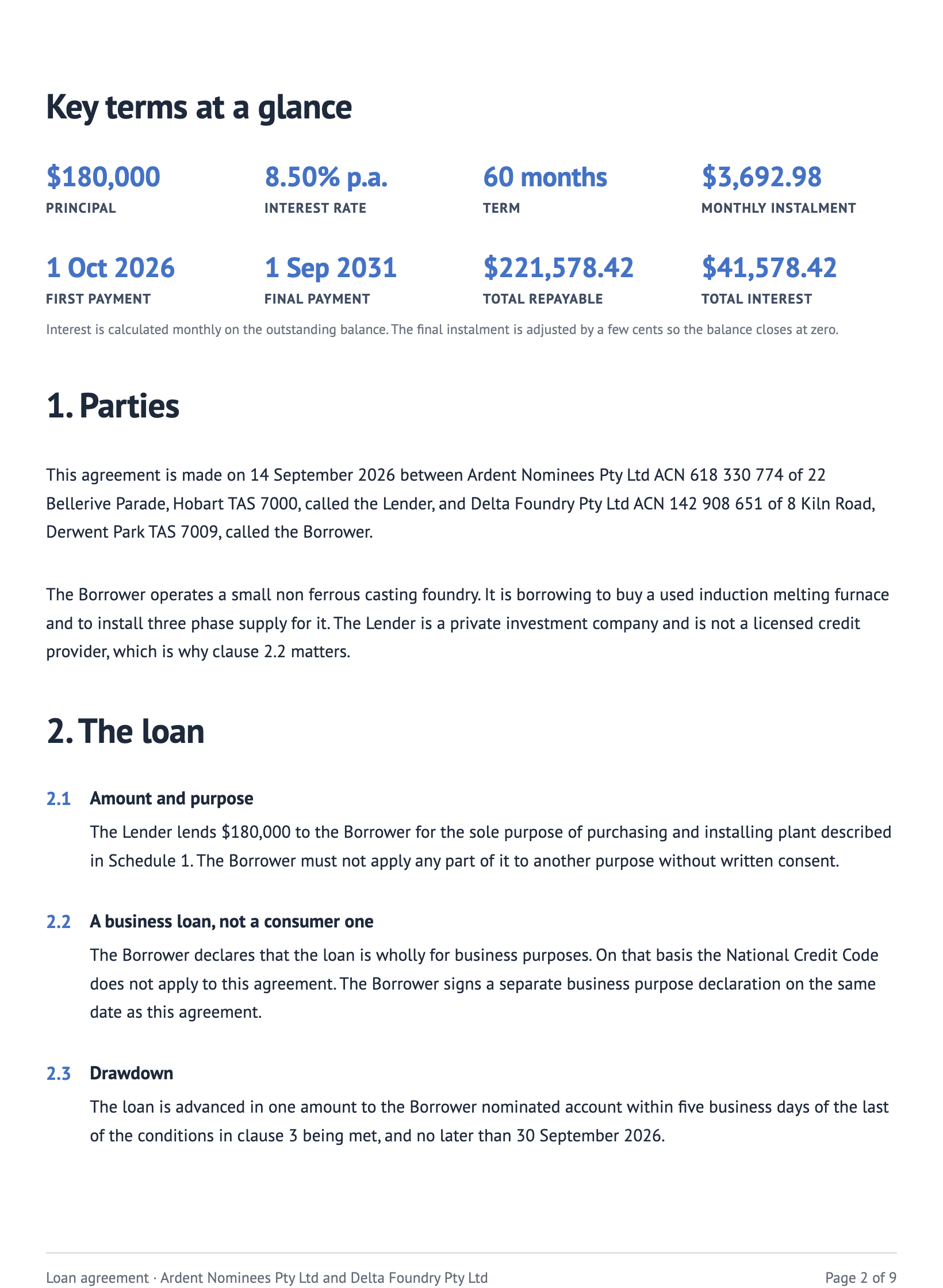 Loan agreement templateA Tasmanian foundry is borrowing $180,000 from a private investment company to buy a used induction furnace. The lender is not a bank, so everything a bank would take for granted has to be written down: what has to happen before the money moves, what is registered over what, and how long the borrower gets to fix a default.
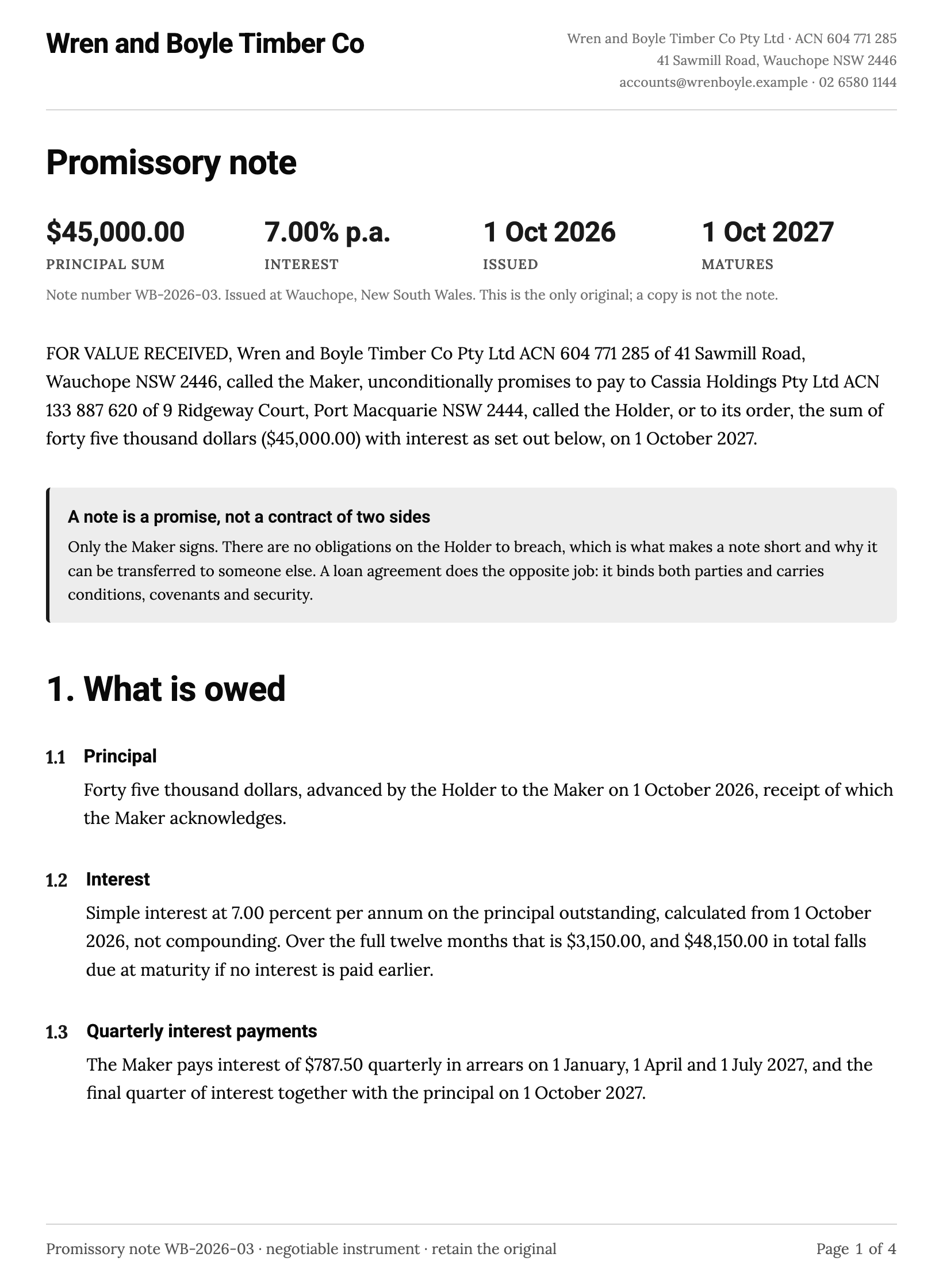 Promissory note templateA timber company owes $45,000 to a private lender and needs one page that says so. No conditions precedent, no covenants, no security. Only the maker signs, which is what keeps a note short and what lets the holder pass it on to somebody else.
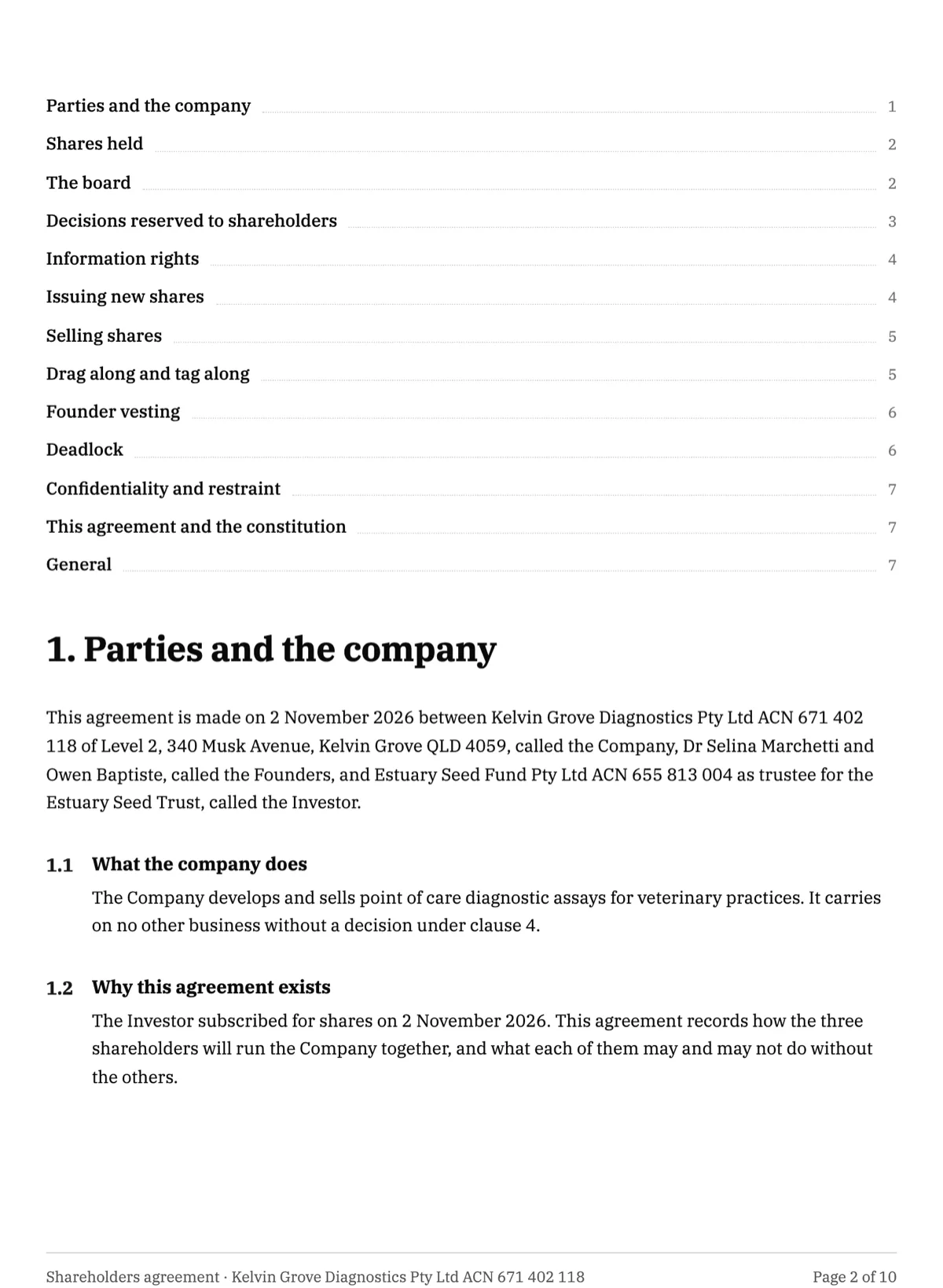 Shareholders agreement template for a company after a seed roundA shareholders agreement template sets out who owns what, who sits on the board, which decisions need shareholder consent, how shares are sold, and how a deadlock ends. This one is filled in for a Queensland veterinary diagnostics company that has just taken $1.5 million from one seed fund, leaving the two founders with 80 per cent between them. Its central number is an 85 per cent consent threshold for eight reserved matters, and the page below shows what that number does and does not protect.
Questions people ask
What is a negative pledge?
It is a promise by a borrower not to grant security over its assets to other creditors without the lender's consent, subject to listed exceptions. It keeps an unsecured lender from falling behind new secured creditors. Breaching it is usually an event of default under the loan.
Does a negative pledge stop equipment finance?
It can, unless the clause permits it. Most negative pledges include a permitted security basket that allows equipment finance and finance leases up to a set amount. Check the basket before signing a new equipment loan, because exceeding it may put the main facility in default.
Is a negative pledge registered?
No. In Australia a negative pledge is a contractual promise, not a security interest, so it is not registered on the Personal Property Securities Register. That is why a later lender that takes registered security may have priority, leaving the first lender with a claim against the borrower only.
What happens if a borrower breaches a negative pledge?
Usually it is an event of default, letting the lender accelerate its loan, and the lender may claim damages. It does not usually undo the security granted to the other creditor, who will normally have priority, unless that creditor was involved in the breach in a way that gives the first lender a claim against it.
Do bonds have negative pledges?
Often, yes. Corporate bonds commonly include a negative pledge so that bondholders are not subordinated to later secured lenders. Bond negative pledges are frequently limited to security for other bonds or capital market debt, allowing bank loans to be secured.
Put the clause in a finished document
The button opens the document generator with a starting description already filled in. Change it to match your own agreement before you run it.
Create a document with OneCraftRelated clauses
- Cross default clause: when a default elsewhere counts hereA cross default clause for a $3 million grain facility: a default on other debt over $150,000 is a default here, compared with cross acceleration.
- Acceleration clause: calling the whole loan after a defaultAn acceleration clause for an equipment loan: the whole balance due on notice after a default and a 14 day cure period, plus default notice rules by country.
- Retention of title clause and the PPSRA retention of title clause keeps ownership with the seller until goods are paid for. Australian sample wording, all monies variants and the PPSR timing rules.
For everything the document generator can do, see the document maker.
Step by step in the builder: Create a document with AI, then Document builder components.
Written and checked by the OneCraft team. Last checked .