Contract clause
Prepayment clause: sample wording for repaying a loan early
A prepayment clause says whether a borrower may repay a loan before it is due, in whole or in part, how much notice it must give, how a part payment is applied to the remaining instalments, and whether any fee or break cost is payable for repaying early.
A prepayment clause decides what happens when a borrower wants to pay a loan off early: whether it may, how much notice it gives, whether part payments shorten the term or lower the instalments, and what it pays for the privilege. On a fixed rate loan, break costs are the usual sticking point.
Nuwan Madhusanka · Co-founder
3 min read · Published
Sample clause
Written for a fixed rate business loan to Kerfwell Joinery Pty Ltd from Halden Capital Pty Ltd, both fictional, for a new CNC router.
Prepayment. (a) The Borrower may repay all or part of the loan before its due date by giving the Lender at least 5 business days' written notice. (b) A part prepayment must be at least $5,000 and is applied to the instalments in reverse order of their due dates, so the remaining instalments stay the same and the loan ends sooner. (c) No fee is payable for prepayment. Because the interest rate is fixed, the Borrower must also pay any break cost, being the Lender's reasonable loss from the early repayment, calculated as set out in Schedule 2 and shown in a written statement before the prepayment date. (d) Interest accrued to the prepayment date is payable with the prepayment. (e) An amount prepaid may not be redrawn.
Sample wording, not legal advice.
Variants
Free prepayment, no break costs
A variable rate loan, a loan between related parties, or an employee loan where the lender has no funding cost to protect.
The Borrower may repay all or part of the loan at any time without notice, fee or penalty, and interest stops on the amount repaid from the day it is received.
Part prepayment lowers the instalments
A borrower who wants lower repayments rather than a shorter term after paying down part of the loan.
After a part prepayment, the Lender will recalculate the remaining instalments so the loan is still repaid by the original final repayment date, and will give the Borrower a new repayment schedule.
Non call period
A lender that has priced the loan on earning interest for a minimum period, often in private credit, and wants to restrict early repayment at first.
The Borrower may not prepay during the first 12 months after drawdown. After that, the Borrower may prepay on 10 business days' notice, with a prepayment fee of 1 per cent of the amount prepaid in the second year and nil afterwards.
What to negotiate
Break costs should be a real loss
A break cost on a fixed rate loan compensates the lender for funding it cannot redeploy at the same rate. It should be calculated by a stated method, shown to the borrower, and reduced to nothing if rates have risen. A fixed percentage charged regardless of market movements is more likely to be challenged as a penalty.
Where the money goes
Applying a part prepayment in reverse order shortens the loan and saves the most interest; applying it to the next instalments merely pays ahead. Borrowers should ask which applies, and whether the lender will reduce instalments instead on request. The clause should also say whether prepaid amounts can be redrawn.
Consumer and home loan limits
For many consumer home loans in Australia, early termination fees on variable rate loans have been banned since 2011 under the National Consumer Credit Protection Act. Business loans are outside that regime, so a business borrower relies on what the contract says and on the general law against penalties.
The risk of leaving it out
A loan agreement silent on prepayment leaves the borrower unsure whether it may repay early at all, and the lender free to argue that interest is payable for the whole term. For a fixed rate loan, a dispute over break costs is common when a borrower sells a business or refinances, and a clause that sets the method in advance avoids it.
Whole and part prepayment
A full prepayment ends the loan: the borrower pays the balance, accrued interest and any break cost, and the lender releases its security. A part prepayment reduces the balance and needs a rule about the remaining instalments. Minimum amounts, such as $5,000 in the sample, stop the administration of many small payments. Notice periods give the lender time to calculate the payout figure and any break cost.
Break costs on fixed rates
When a lender funds a fixed rate loan, it often fixes its own funding for the same term. If the borrower repays early and market rates have fallen, the lender can only relend at a lower rate and loses the difference for the rest of the term. Break costs compensate for that loss. A schedule that sets the calculation, such as the present value of the rate difference on the amount prepaid, makes the figure checkable. Law checked on 21 October 2026. This page explains how the law works and is not legal advice.
Employee and related party loans
Loans from employers to employees, or between family members and their companies, usually allow free prepayment, because the lender has no funding cost. The employee loan example states that no interest and no early repayment fee are charged, and the loan agreement example states there is no early repayment fee; both show the simple form of the clause.
Where the clause sits in a generated document
Loan agreements and promissory notes carry a prepayment clause beside the repayment schedule. When asking the AI document generator for one, state whether early repayment is free, the notice and minimum amount, how part payments apply and, for a fixed rate, how break costs are worked out.
Documents that carry this clause
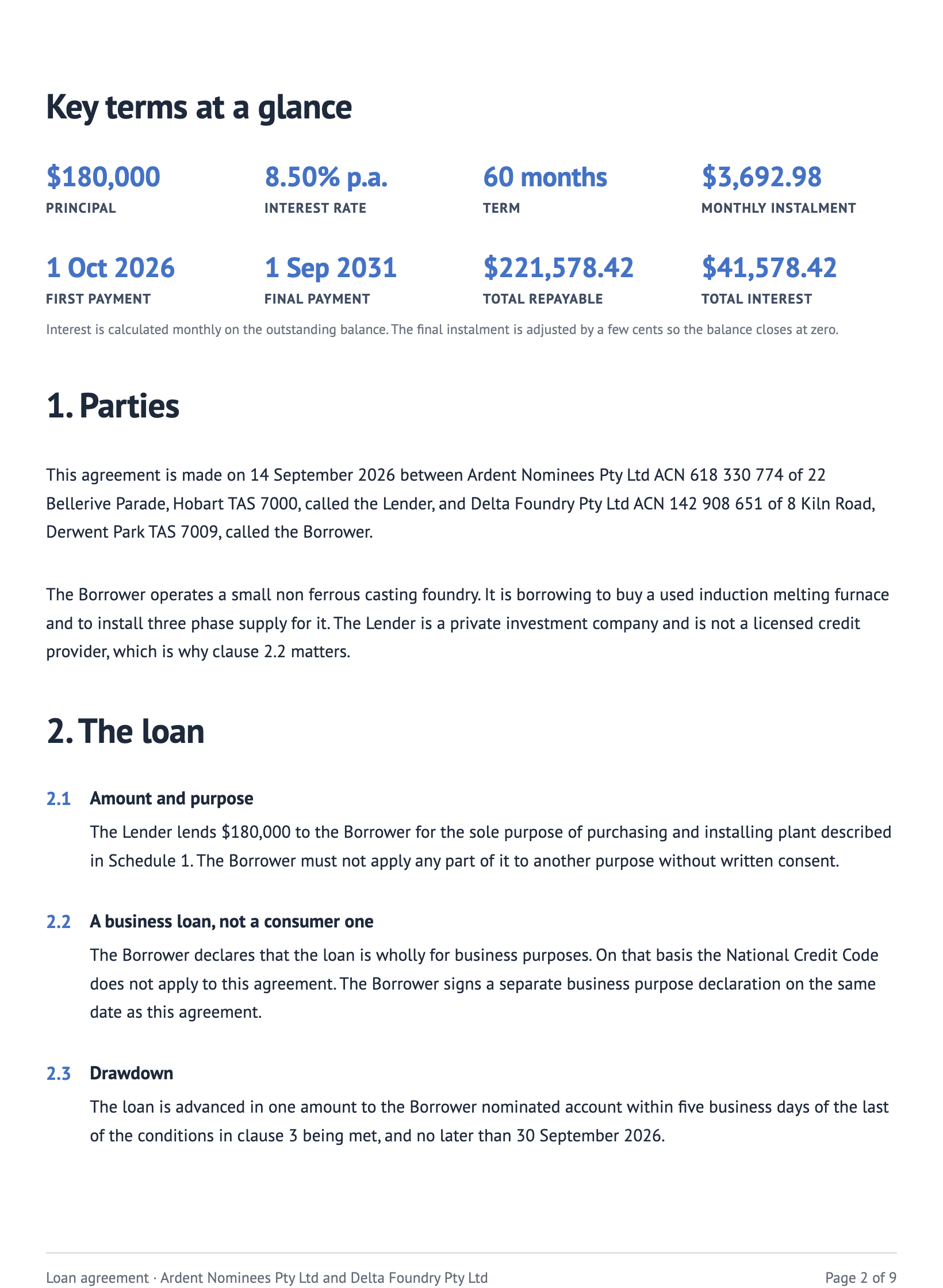 Loan agreement templateA Tasmanian foundry is borrowing $180,000 from a private investment company to buy a used induction furnace. The lender is not a bank, so everything a bank would take for granted has to be written down: what has to happen before the money moves, what is registered over what, and how long the borrower gets to fix a default.
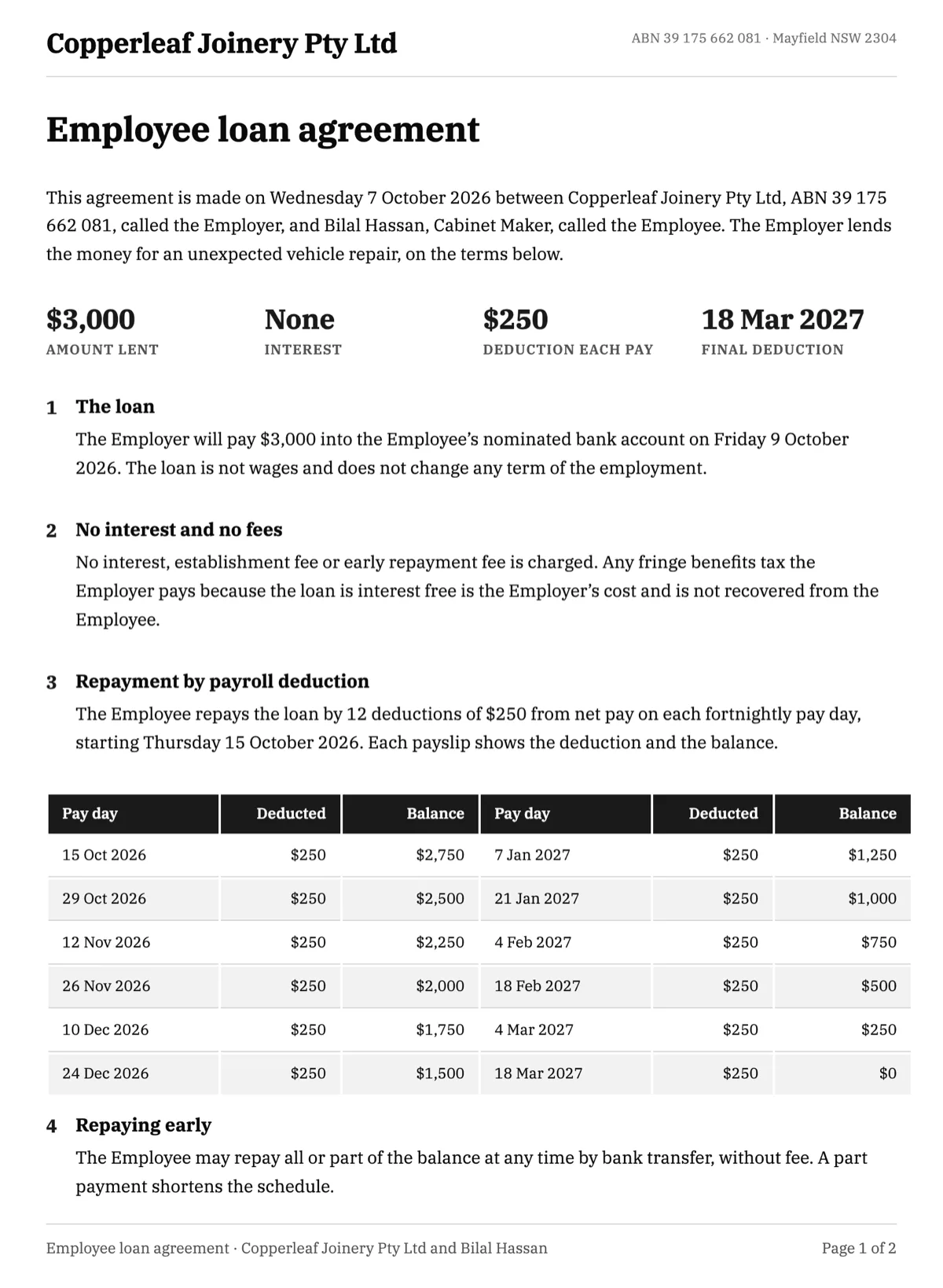 Employee loan agreement template repaid by payroll deductionAn employee loan agreement template records money an employer lends to a staff member and how it comes back. When repayment is by payroll deduction, Australian law requires the employee's written authority, and the agreement has to say what happens if they leave or withdraw that authority before the loan is repaid.
Questions people ask
What is a prepayment clause in a loan?
It is the term that says whether and how a borrower may repay the loan before it is due, including notice, minimum amounts, how part payments are applied and any fee or break cost. Without one, the right to repay early depends on the rest of the agreement and the general law.
What are break costs?
Break costs are the lender's loss when a fixed rate loan is repaid early and the lender can only relend the money at a lower rate. They are usually worked out by comparing the fixed rate with current wholesale rates over the remaining term. If rates have risen, break costs are often nil.
Is a prepayment penalty legal in Australia?
For business loans, a prepayment fee or break cost is generally enforceable if it reflects a legitimate interest and is not out of proportion. For most consumer home loans on variable rates, early termination fees have been banned since 2011. Fixed rate consumer loans can still carry break costs.
Should a part prepayment reduce the term or the instalments?
Reducing the term saves more interest, because the balance falls and stays lower for longer. Reducing the instalments helps cash flow. The clause should say which happens, or let the borrower choose at the time of the prepayment. Ask before paying.
Can I redraw a prepayment?
Only if the loan has a redraw facility. Business term loans often state that prepaid amounts cannot be redrawn, as the sample does, while many home loans allow redraw. If flexibility matters, negotiate redraw or a separate overdraft rather than prepaying.
Put the clause in a finished document
The button opens the document generator with a starting description already filled in. Change it to match your own agreement before you run it.
Create a document with OneCraftRelated clauses
- Capital contribution clause: sample for partnerships and joint venturesCapital contribution clause sample for partnerships and joint ventures: who puts in what and when, its value, further calls, interest and exit.
- Profit sharing clause: sample for partners and joint venturesProfit sharing clause sample for partnerships and joint ventures: the split, how profit is worked out, drawings, losses, and the equal sharing default rule.
- Acceleration clause: calling the whole loan after a defaultAn acceleration clause for an equipment loan: the whole balance due on notice after a default and a 14 day cure period, plus default notice rules by country.
- Negative pledge clause: no security to anyone elseA negative pledge clause for an unsecured cafe group facility: no security to other lenders, a basket for equipment finance and liens by law, and the PPSR.
For everything the document generator can do, see the document maker.
Step by step in the builder: Create a document with AI, then Document builder components.
Written and checked by the OneCraft team. Last checked .