Contract clause
Clawback clause: recovering a bonus or commission already paid
A clawback clause lets an employer recover pay it has already made, usually a bonus or commission, when a named event happens, such as a client refund, misconduct or a restatement of results. A related malus clause reduces or cancels pay that has been awarded but not yet vested.
A bonus is paid on the numbers as they stand, and sometimes the numbers change. Clawback is how an employer gets the money back when a sale unwinds or misconduct comes to light, and malus is how it avoids paying in the first place.
Nuwan Madhusanka · Co-founder
4 min read · Published
Sample clause
Written for an employment contract between Harbour Street Capital, a fictional Sydney insurance broker, and a senior account executive paid salary, sales bonus and a deferred bonus.
Clawback and Malus. (a) If a client cancels a policy, or receives a refund of premium, within 6 months after the Company paid a Sales Bonus calculated on that policy, the Employee must repay the part of the Sales Bonus attributable to the cancelled or refunded premium. (b) The Board may reduce to zero any Deferred Bonus that has not vested if, before vesting, it reasonably determines that the Employee engaged in serious misconduct or that the results on which the award was based were materially misstated. (c) The Company will give written notice of any amount due under paragraph (a), with its calculation, and the Employee must repay it within 30 days, failing which the Company may set it off against future commission or bonus, but not against base salary. (d) This clause survives the end of employment for 6 months.
Sample wording, not legal advice.
Variants
Malus before vesting
Deferred bonus plans, where the cleanest control is to reduce an award before it is paid out.
Before any Deferred Award vests, the Board may reduce it, including to nil, if it determines that the Participant committed misconduct, that the performance on which it was granted was misstated, or that the business unit suffered a material risk failure for which the Participant was responsible.
Clawback after payment
Senior roles in regulated or listed businesses, where recovery of paid amounts is expected for serious failures.
If, within three years after a Bonus is paid, the Board determines that it was paid on the basis of materially misstated results or that the Employee committed gross misconduct during the performance period, the Employee must repay the Bonus, or the part the Board specifies, net of any tax the Employee cannot recover.
Commission reversal on refunds
Sales roles paid commission on revenue that can later be refunded or cancelled.
Commission is earned on Collected Revenue. If a customer obtains a refund or chargeback of Collected Revenue within 90 days of payment, the commission paid on it will be reversed by deduction from the next commission payment, and any amount not recovered within two payment cycles is repayable on demand.
What to negotiate
Triggers
The employee's first question is what events allow recovery. Objective triggers, such as a client refund or a restatement of accounts, are easier to accept and to apply than subjective ones such as reputational damage. Employees should push for triggers tied to their own conduct or their own sales, rather than company wide events they could not influence.
Time limit
Open ended clawback leaves an employee exposed for years. Commission reversals usually run for the refund or cancellation window, often 3 to 12 months. Clawback for misconduct or misstatement runs longer, commonly two to three years outside regulated sectors and longer inside them. The clause should state the period and whether it survives the end of employment.
How recovery happens
Recovery can be by repayment, by set off against future variable pay, or by deduction from wages. Deductions from wages are restricted: in Australia they need the employee's written authorisation for a purpose that is principally for the employee's benefit and must not be unreasonable, and in the UK they need prior written agreement. Setting off against future commission, as the sample does, is usually simpler and less contentious than demanding repayment.
The risk of leaving it out
Without a clawback or malus clause, a bonus or commission once paid generally belongs to the employee, even if the sale later unwinds or misconduct is discovered, unless the employer can prove a separate legal claim. Recovering money already paid is slow and uncertain without a clear contractual right, and the employer may have to pay variable pay it knows was not deserved.
Malus and clawback compared
Malus works before payment: an awarded but unvested bonus, often a deferred portion, is reduced or cancelled. Clawback works after payment: money already received is repaid. Malus is far easier to enforce, because nothing needs to be recovered from the employee's bank account, which is why regulated remuneration regimes rely on deferral plus malus first and clawback second. The sample uses both: clawback for commission on refunded premium, and malus on the deferred bonus. Law checked on 21 October 2026. This page explains how the clause works and is not legal advice.
Trigger table
Common triggers, and how hard each is to apply. Client refund or cancellation: objective, easy to calculate, suits commission. Material misstatement of results: objective once accounts are restated, suits bonuses tied to financial targets. Gross or serious misconduct: needs an investigation and a decision, suits all variable pay. Risk management failure in the employee's area: subjective, used mainly in financial services. Reputational damage to the employer: highly subjective and the most likely to be disputed. Clauses that list triggers and say who decides, such as the Board, hold up best.
Regulators and clawback by country
In Australia, the Financial Accountability Regime, administered by APRA and ASIC, requires banks, insurers and superannuation trustees to defer part of the variable remuneration of accountable persons and to have policies for reducing it, and APRA's remuneration standard requires malus and clawback for some roles. In the UK, the Remuneration Codes in the FCA Handbook require malus and clawback for material risk takers at banks and other covered firms. In the US, listed companies must have policies to recover incentive pay awarded on results that are later restated, under rules adopted by the stock exchanges in 2023. Outside these regimes, clawback is purely a matter of contract.
Tax on clawed back pay
Bonus is taxed when paid. If it is later repaid, getting that tax back can be complicated, depending on the country and whether the repayment happens in the same tax year. That is why the second variant asks for repayment net of tax the employee cannot recover. Employers should take advice on how repayments are treated in payroll before drafting a clawback that may operate across tax years.
Documents that carry this clause
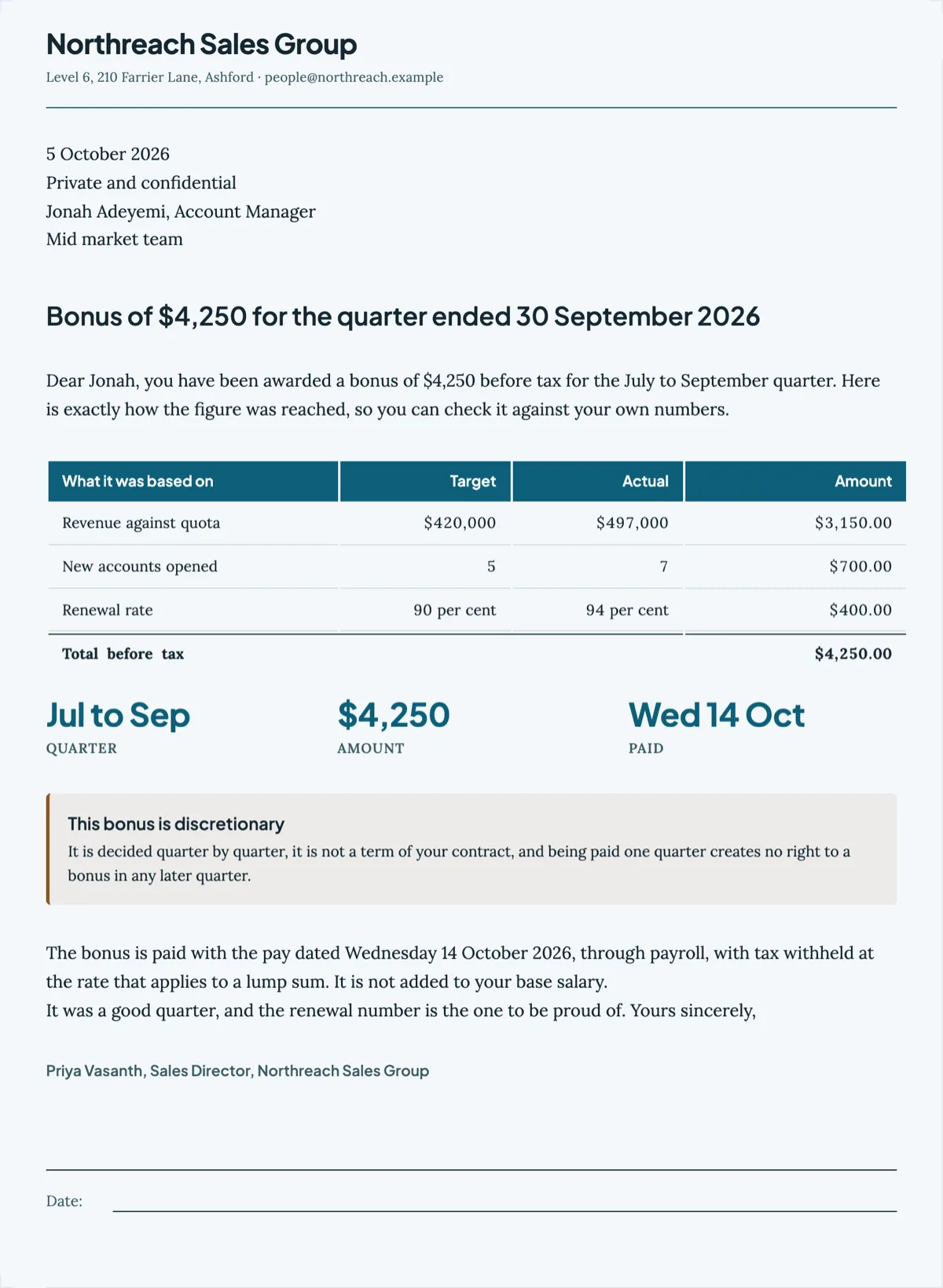 Bonus letter template that shows how the amount was calculatedA bonus letter that gives only a figure invites the one question it cannot answer, which is how that figure was reached. This one shows three components with their target, their actual and the dollars each produced, totals them to $4,250, names the pay date and says plainly that the bonus is discretionary.
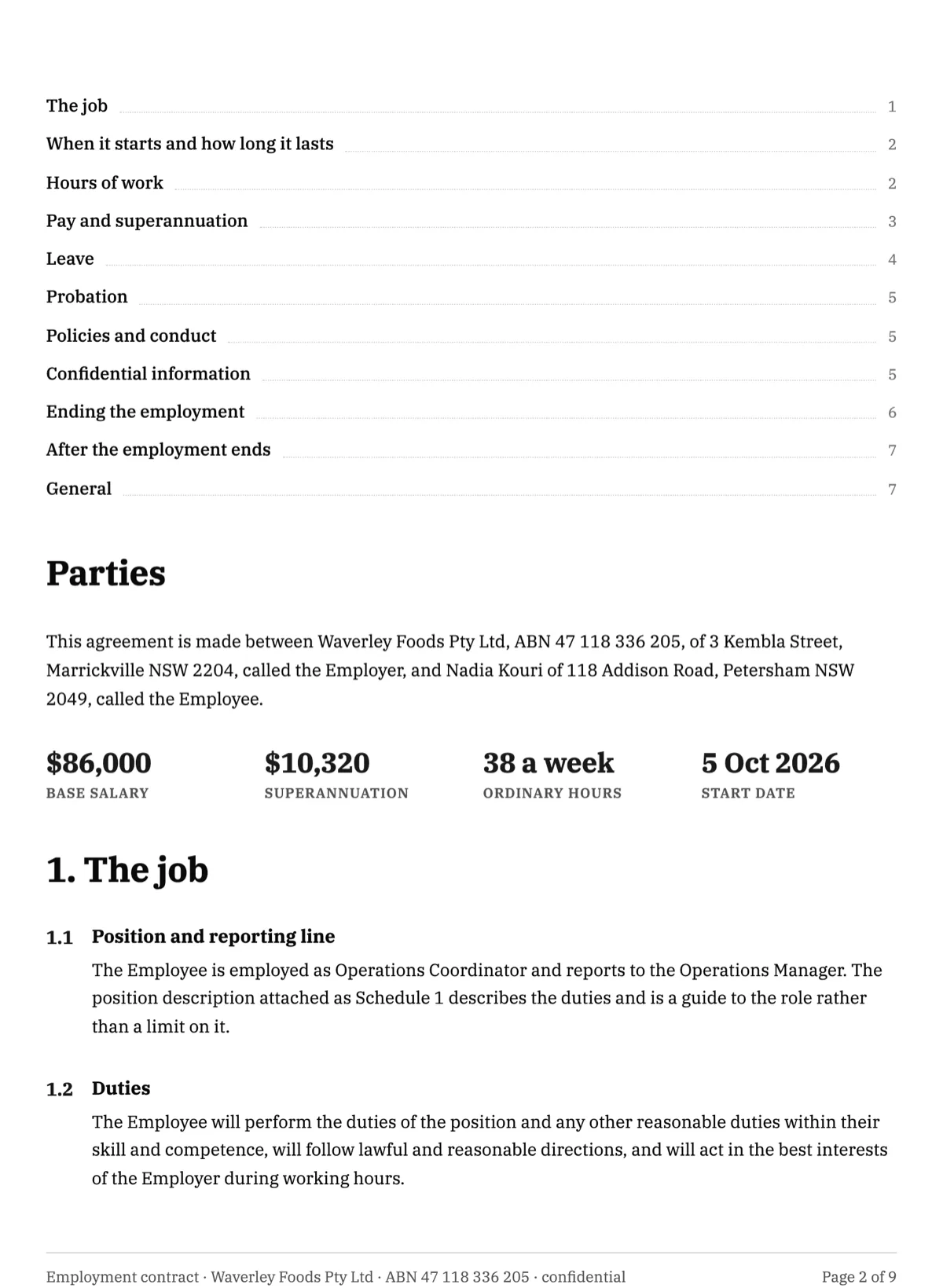 Employment contractA full time ongoing contract for an operations coordinator on $86,000 plus $10,320 of superannuation. Eleven numbered clauses, a leave table drawn from the National Employment Standards, and a notice table that scales with service.
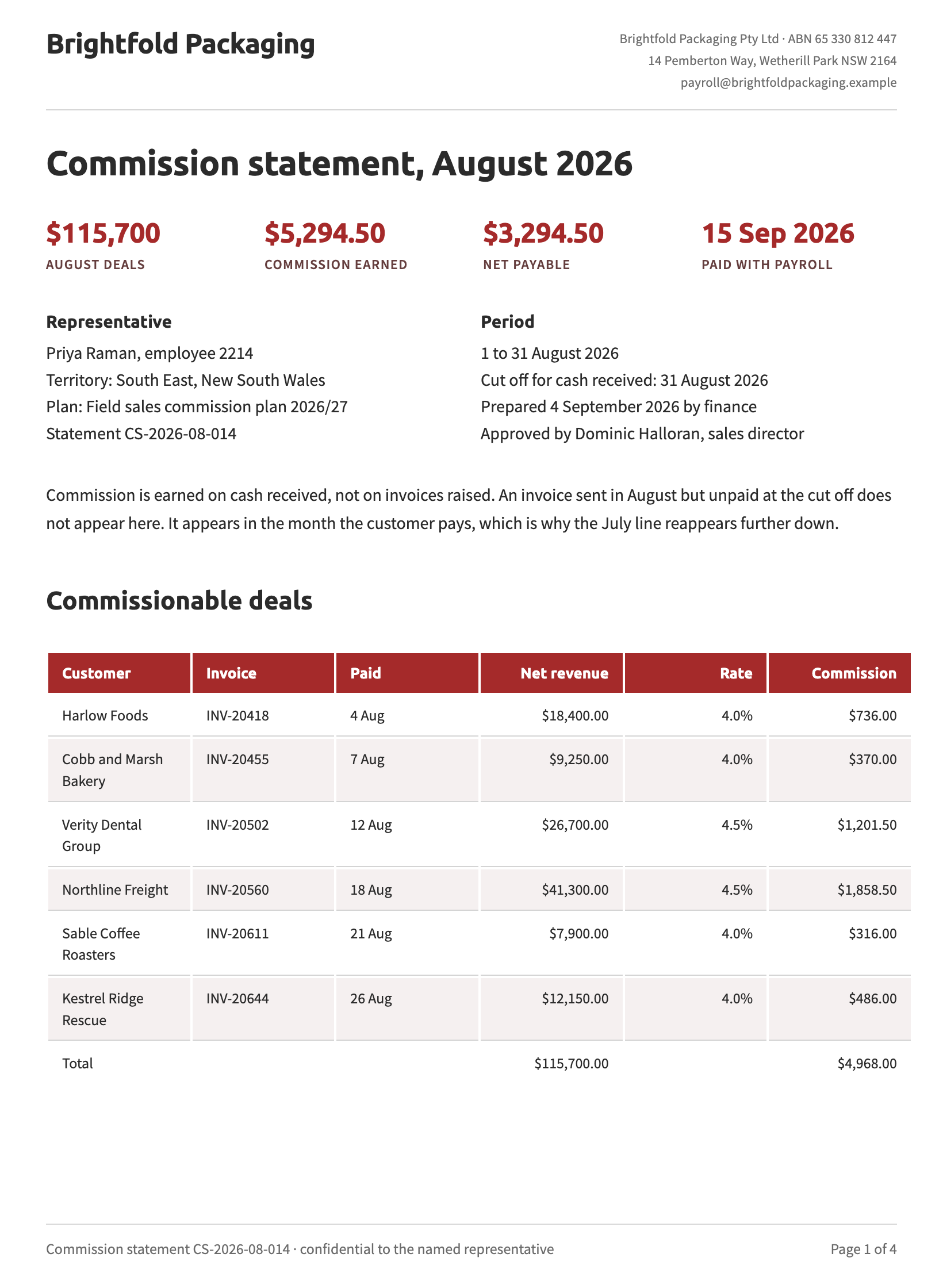 Commission statementA representative earns $5,294.50 in August and banks $3,294.50. The gap is a $2,000 draw being recovered, and the statement is built so that difference is explained on the page rather than in an email.
Questions people ask
What is the difference between malus and clawback?
Malus reduces or cancels variable pay that has been awarded but not yet paid or vested. Clawback recovers pay that has already been paid. Malus is simpler, because the employer just withholds money it still holds. Clawback requires the employee to repay, which is why it is usually reserved for serious events.
Can an employer claw back a bonus after I leave?
Only if the contract or bonus plan says so and the trigger and time period cover the situation. Many clauses state they survive the end of employment for a set period. Without such wording, a bonus already paid generally cannot be recovered just because you have left.
Are clawback clauses legal?
Yes, as contract terms, provided they are clear, agreed before the pay is earned, and operated fairly. They cannot override legal limits on deductions from wages, and a clause applied arbitrarily may breach implied duties. In financial services, regulators require them for certain roles.
Can my employer take the clawed back amount from my salary?
Generally only with your prior written agreement and within legal limits. In Australia, deductions must be authorised in writing and not unreasonable; in the UK, the Employment Rights Act requires prior written agreement. Many clauses avoid salary altogether and set off against future commission or bonus instead.
Does commission clawback apply if the client cancels after I leave?
It depends on the clause. If it survives termination and the cancellation falls within the stated window, you may have to repay the commission. If it is silent on termination, the employer may struggle to recover. Check the window and whether recovery is by set off, which will not work once there is no future pay.
Put the clause in a finished document
The button opens the document generator with a starting description already filled in. Change it to match your own agreement before you run it.
Create a document with OneCraftRelated clauses
- Bonus clause: discretionary, formula or bothA bonus clause sets how an employee earns an incentive, when it is paid and what happens on leaving. Sample wording plus discretionary and formula variants.
- Remuneration clause: the pay terms in an employment contractA remuneration clause sets what an employee is paid, how often and what the figure includes. Australian sample wording, package and hourly variants.
- Set off clause: deducting what the other side owesA set off clause lets one party deduct what the other owes it from what it owes. Australian sample wording, a no set off variant, and the insolvency position.
- Training repayment clause: UK sample with a sliding scaleA UK training repayment clause for an HGV licence course: a sliding scale over 24 months, written authority to deduct, and the minimum wage check that applies.
For everything the document generator can do, see the document maker.
Step by step in the builder: Create a document with AI, then Document builder components.
Written and checked by the OneCraft team. Last checked .