Contract clause
Training repayment clause: UK sample with a sliding scale
A training repayment clause requires an employee who leaves within a set period after paid training to repay some or all of its cost. In the UK it is usually enforceable if agreed in writing before the training, the sum reflects the genuine cost, and the amount reduces over time.
Paying for a licence or qualification is an investment an employer wants back if the employee leaves straight away. A repayment clause can do that, but only if it reflects real cost, tapers fairly and is agreed before the course starts.
Indunil Asanka · Co-founder
4 min read · Published
Sample clause
Written for an employment contract between Humber Haulage, a fictional Hull transport company, and a driver it is putting through an HGV licence course.
Training Costs. (a) The Company will pay the cost of the Employee's Category C licence training, being £3,500 for the course and tests (the Training Costs). (b) If the Employee resigns, or is dismissed for gross misconduct, within 24 months of passing the final test, the Employee must repay the Training Costs on this scale: within 6 months, 100%; 6 to 12 months, 75%; 12 to 18 months, 50%; 18 to 24 months, 25%. (c) The Employee authorises the Company to deduct any amount due from final pay, but no deduction will reduce the Employee's pay for any pay reference period below the national minimum wage, and any balance will be invoiced. (d) No repayment is due if the Employee fails the course, is made redundant, or leaves because of the Company's breach of contract.
Sample wording, not legal advice.
Variants
Sliding scale
Expensive external training where the benefit to the employer builds over a year or two.
If the Employee leaves within 24 months of completing the Training, the Employee must repay the Training Costs reduced by one twenty fourth for each complete month worked after completion.
Fixed period, then nothing
Shorter, cheaper courses where a simple rule is easier to administer.
If the Employee resigns within 12 months of completing the Training, the Employee must repay 50% of the Training Costs. After 12 months nothing is repayable.
External courses only
Employers who want to recover the cost of outside providers but not of in house training, which is part of doing the job.
This clause applies only to fees paid to external training providers and examining bodies, as listed in the Training Schedule. It does not apply to in house training, induction, or training required by law for the Employee's current role.
What to negotiate
Genuine cost, not a penalty
A repayment sum that exceeds what the training actually cost, or that does not reduce over time, risks being struck down as a penalty or as an unreasonable restraint. Listing the actual fees, and tapering repayment as the employer gets the benefit of the training, keeps the clause defensible. Employees should ask for an itemised cost and check that wages paid during the course are not included without being agreed.
Written authority to deduct
Section 13 of the Employment Rights Act 1996 forbids deductions from wages unless required by law, authorised by the contract, or agreed in writing beforehand. The authority should be in the contract or a signed training agreement before the course begins. Without it, deducting the cost from final pay is an unlawful deduction even if the money is owed, and the employer must claim it separately.
The national minimum wage floor
Deductions for training costs reduce an employee's pay for national minimum wage purposes in the pay reference period they are made. If the final payslip, after the deduction, works out below the minimum wage for the hours worked, the employer breaches the minimum wage rules. The sample deducts only down to that floor and invoices the rest, which is the safe pattern.
The risk of leaving it out
Without a repayment clause, an employer that pays for training has no claim to the money if the employee leaves the next week, and competitors effectively get trained staff at the first employer's expense. Trying to recover the cost after the event, without written agreement, usually fails, and deducting it from final pay without authority is an unlawful deduction.
The sliding scale table
In the sample, a driver who passes in March and resigns in July owes 100% of £3,500, so £3,500. Resigning at nine months, 75%, or £2,625. At fifteen months, 50%, or £1,750. At twenty months, 25%, or £875. After two years, nothing. The taper reflects the fact that the employer has had the benefit of a licensed driver for longer, which is what courts and tribunals look for. A monthly taper, as in the first variant, is smoother and avoids the cliff edges where one day changes the debt by £875. Law checked on 21 October 2026. This page explains how the clause works and is not legal advice.
The minimum wage deduction check
Before deducting, work out the employee's pay for the final pay reference period, subtract the deduction, and divide by the hours worked. If the result is below the national minimum wage rate for the employee's age, the deduction must be reduced. For example, a driver aged 21 or over on £13.50 an hour who works 80 hours in the final period earns £1,080; at the £12.71 rate in force from April 2026, the floor for 80 hours is £1,016.80, so no more than £63.20 can be deducted that period, and the rest of the debt must be invoiced and recovered separately.
When repayment should not apply
A clause that demands repayment when the employer dismisses the employee for redundancy, or when the employee resigns because of the employer's own breach, is hard to justify and likely to be challenged. The sample limits repayment to resignation and dismissal for gross misconduct. Failing the course is also excluded, because the employer chose to send the employee and takes the risk of the result.
Training agreements and contracts
The clause can sit in the employment contract or in a separate training agreement signed before each course, which is better when courses vary. Either way, the employee should receive the cost, the repayment scale and the deduction authority in writing before training starts. A document generated with the AI document generator can carry the scale as a table so the figures are clear.
Documents that carry this clause
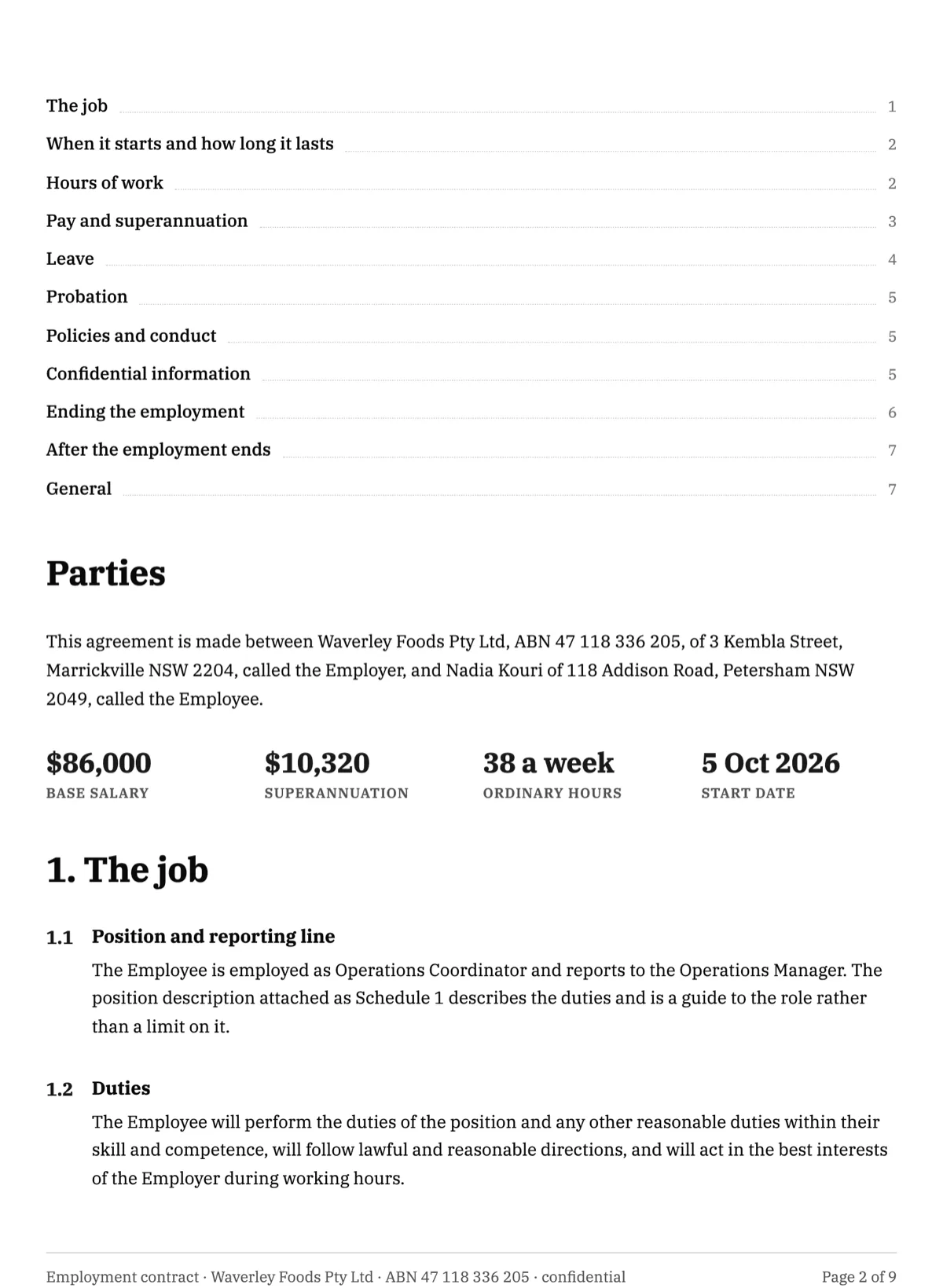 Employment contractA full time ongoing contract for an operations coordinator on $86,000 plus $10,320 of superannuation. Eleven numbered clauses, a leave table drawn from the National Employment Standards, and a notice table that scales with service.
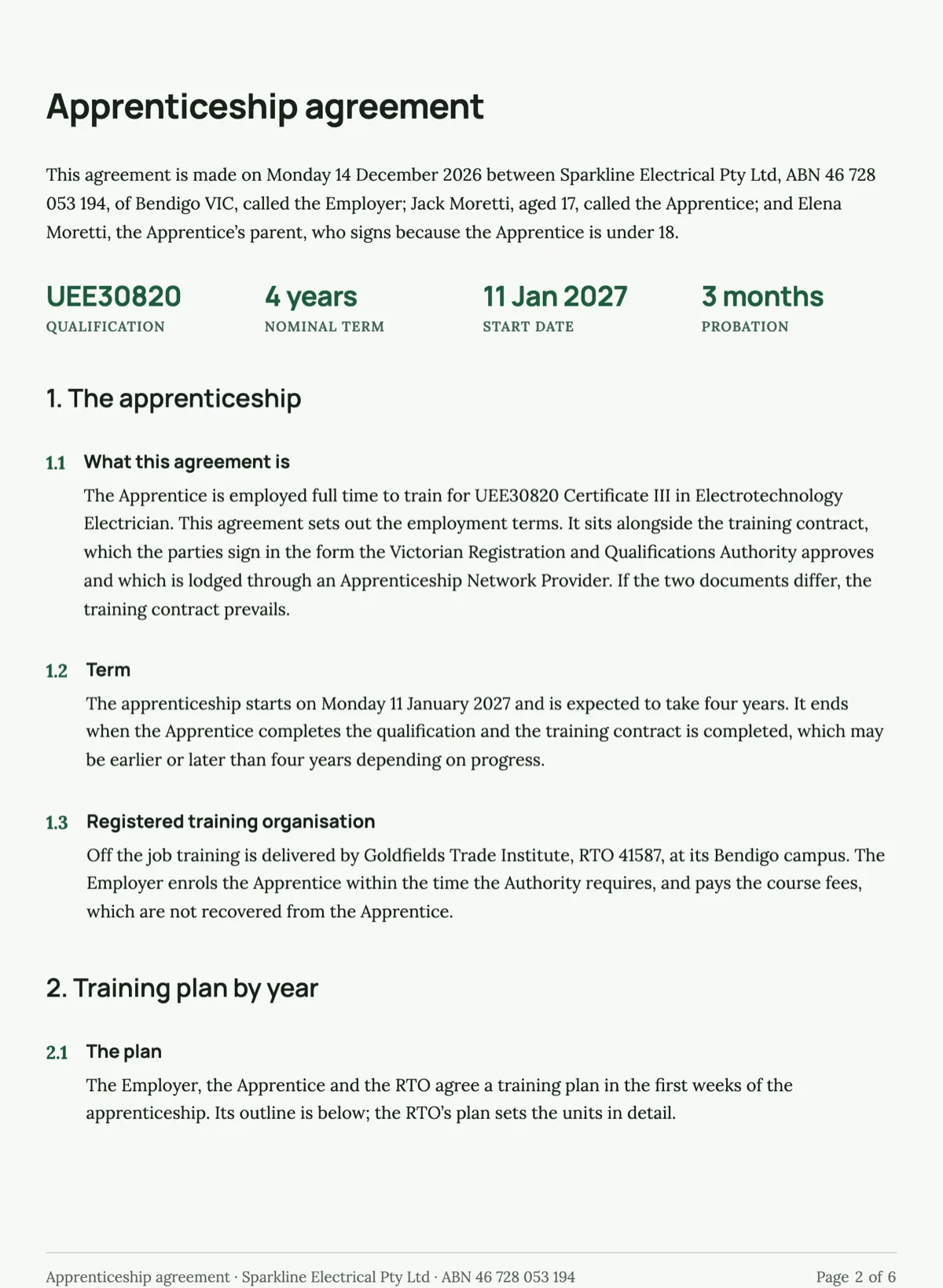 Apprenticeship agreement template with a training plan and wage progressionAn apprenticeship agreement template sets out the employment terms that sit alongside the government training contract: what the apprentice learns each year, what they are paid at each stage, who supervises them and how probation works. For an apprentice under 18 a parent signs too, so this one carries three signatures.
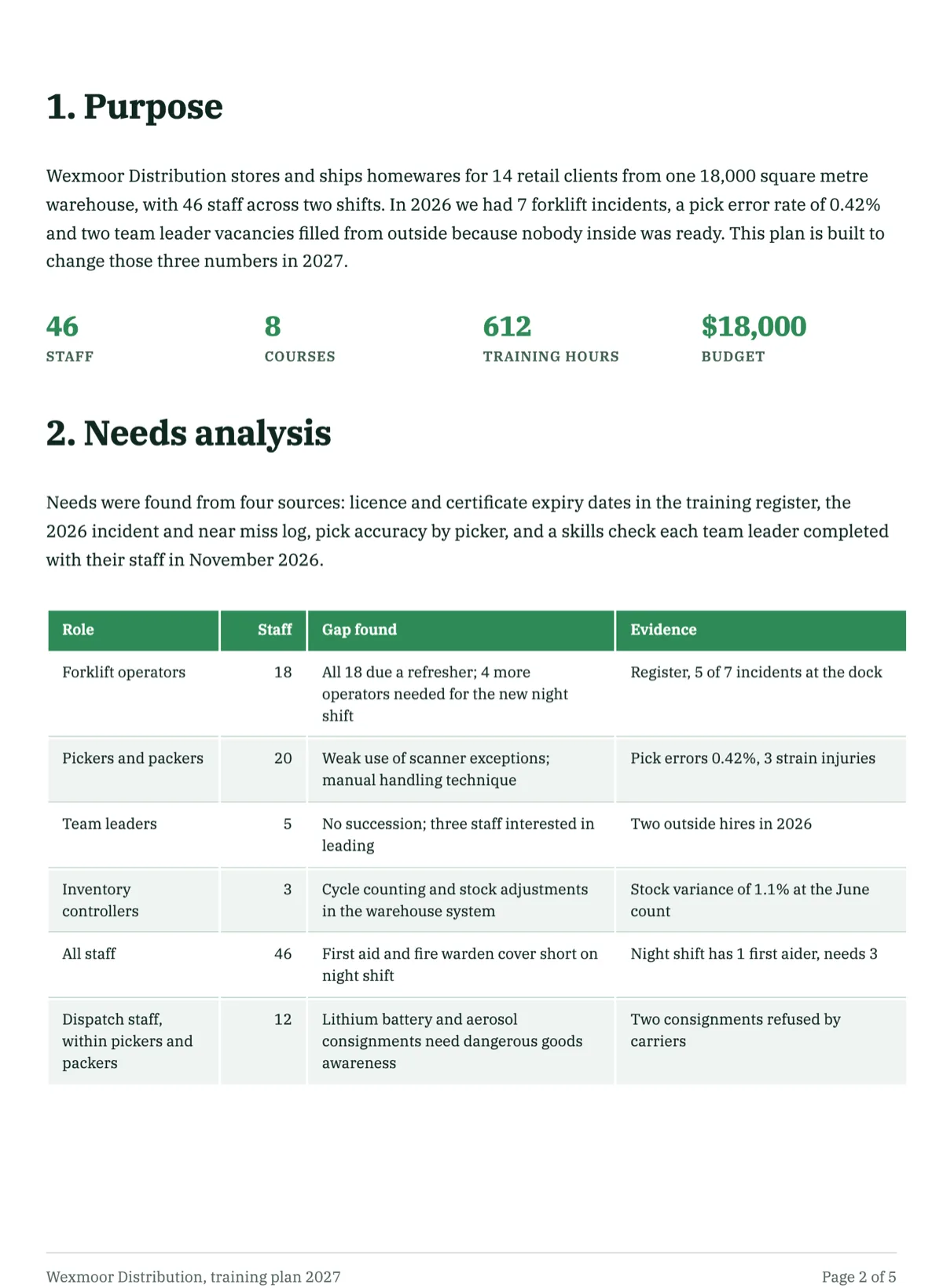 Training plan template with needs table, calendar and costA training plan has to show who needs which training and why, who will deliver it, when, what it costs and how anyone will know it changed the work. This five page plan for a 46 person warehouse links a needs analysis to eight courses, a calendar built around peak season, an $18,000 cost table and an evaluation that ends at a measurable result.
Questions people ask
Do I have to pay back training costs if I leave?
Only if you agreed to in writing, usually in your contract or a training agreement signed before the course. Even then, the amount should reflect what the training actually cost and normally reduces the longer you stay. If you never signed anything about repayment, your employer generally cannot recover the cost.
Can my employer take training costs from my last pay?
Only if you gave written authority before the deduction, and only down to the national minimum wage for that pay period. A deduction without prior written authority is unlawful under the Employment Rights Act 1996, and any amount above the minimum wage limit has to be recovered another way.
Is a training repayment clause a penalty?
Not if the amount is a genuine pre agreed cost that tapers over time. A clause demanding more than the training cost, or the full amount however long you stay, risks being an unenforceable penalty or an unreasonable restraint. Tribunals and courts look at whether the sum is proportionate to the employer's legitimate interest.
Does the clause apply if I am made redundant?
It should not, and well drafted clauses exclude redundancy expressly. If a clause demands repayment on redundancy, it is open to challenge, because the employer chose to end the employment. Check the wording and raise it before signing if redundancy is not excluded.
Can wages paid during training be included?
Only if agreed and proportionate. Many clauses cover only course fees and exam costs. Including the salary paid while training makes the sum much larger and more likely to look like a penalty, and recovering it can breach the national minimum wage rules for the period the training was done.
Put the clause in a finished document
The button opens the document generator with a starting description already filled in. Change it to match your own agreement before you run it.
Create a document with OneCraftRelated clauses
- Bond clause in a lease: amount, lodgement and returnA bond clause in a lease sets the security amount, where it is held and when it comes back. Victorian sample wording, NSW and retail lease variants.
- Clawback clause: recovering a bonus or commission already paidA clawback clause sample for a broker's sales bonus: recovery when a client refunds, malus on deferred bonus, triggers, time limits and regulator rules.
- Notice period clause in an employment contractA notice period clause sets how much notice ends employment. Australian sample wording, the National Employment Standards minimums and three variants.
- Set off clause: deducting what the other side owesA set off clause lets one party deduct what the other owes it from what it owes. Australian sample wording, a no set off variant, and the insolvency position.
For everything the document generator can do, see the document maker.
Step by step in the builder: Create a document with AI, then Document builder components.
Written and checked by the OneCraft team. Last checked .