Contract clause
Consignment clause: sample wording for Australian suppliers
A consignment clause says that goods placed with a retailer stay the supplier's property until the retailer sells them, sets the split of the sale price and when it is paid, and says what happens to unsold stock. In Australia a commercial consignment is also a security interest that should be registered on the PPSR.
A consignment clause lets a maker place stock in a shop without selling it to the shop: title stays with the maker, the shop sells on the maker's behalf, and the maker is paid its share after each sale. In Australia the Personal Property Securities Act treats a commercial consignment as a security interest, so registration decides who keeps the stock if the shop fails.
Nuwan Madhusanka · Co-founder
4 min read · Published
Sample clause
Written for agreement between Fen and Kiln Ceramics, a fictional potter, and The Paper Wren, a fictional gift shop, for a first drop of 60 pieces.
Consignment. (a) Title. The Goods remain the property of Fen and Kiln until The Paper Wren sells them to a customer, at which point title passes directly to the customer. (b) Price and split. The Paper Wren sells the Goods at the retail prices in the Schedule and keeps 35 per cent of each sale price, excluding GST. It pays Fen and Kiln the balance, with a sales report, by the 10th day of the following month. (c) Care and insurance. The Paper Wren stores and displays the Goods with reasonable care and insures them against loss and damage while they are on its premises. (d) Unsold stock. Either party may end this arrangement on 14 days' notice, and The Paper Wren returns all unsold Goods within 7 days at its cost. (e) Security interest. The Paper Wren consents to Fen and Kiln registering a financing statement on the PPSR over the Goods and their proceeds.
Sample wording, not legal advice.
Variants
Sale or return to a stockist
A supplier delivers stock that the shop may keep and pay for, or send back by a set date, rather than selling on the supplier's behalf.
The Goods are supplied on sale or return. The Retailer pays the wholesale price for Goods not returned in saleable condition by 31 March, and title passes on payment.
Gallery consignment of artwork
An artist places original works with a gallery, where each work is unique and the gallery takes a commission on a sale price agreed per work.
The Gallery sells each Work at the price in the Schedule, keeps a commission of 40 per cent, and pays the Artist within 14 days of receiving payment. No Work is discounted without the Artist's written consent.
Consignment with a stock cap
A supplier wants to limit its exposure to a single retailer by capping the value of stock on consignment at any time.
The value of Goods held on consignment at retail prices must not exceed $8,000 at any time. Fen and Kiln may decline to send more stock until sales or returns bring it under that figure.
What to negotiate
Register, or risk losing the stock
Under the Personal Property Securities Act 2009 a commercial consignment is a security interest even though the supplier owns the goods. If the shop becomes insolvent and the supplier has not registered, unperfected interests can vest in the shop, and the stock goes to the liquidator. Registering before the goods are delivered protects the supplier and its priority.
Price control and discounts
A consignor usually sets the retail price, and the shop sells as its agent. Agree whether the shop can discount, who bears a discount, and how damaged stock is handled. A supplier selling to a shop rather than consigning cannot dictate the resale price, because resale price maintenance is prohibited, which is one reason makers prefer true consignment.
Reporting and stocktakes
The supplier only knows what has sold from the shop's reports. Ask for a monthly sales report with item codes, the right to count stock on reasonable notice, and payment for any item missing at a count as if it had been sold at full price. Clear records prevent most consignment disputes.
The risk of leaving it out
Placing stock in a shop with no written consignment terms leaves the maker with no clear split, no payment date and no right to take unsold stock back on demand. If the shop fails, an unregistered supplier may find its stock treated as the shop's property and sold for the shop's creditors, and its claim reduced to an unsecured debt worth a few cents in the dollar.
Why a consignment is a security interest
Section 12 of the Personal Property Securities Act 2009 deems a commercial consignment to be a security interest, whether or not it secures payment. A commercial consignment is one where the consignor and consignee both deal in the goods in the course of business, and the consignee sells them. Registering a financing statement on the Personal Property Securities Register perfects the interest; registering as a purchase money security interest before the goods are delivered gives the strongest priority over the shop's other secured lenders. Law checked on 21 October 2026. This page explains how the law works and is not legal advice.
The split and GST
Fen and Kiln's split is 65 per cent to the maker and 35 per cent to the shop, worked on the price excluding GST. On a $66 mug including GST, the price before GST is $60, the shop keeps $21 and the maker receives $39 plus any GST it charges if it is registered. Agreeing whether the split is on the GST inclusive or exclusive price avoids a 10 per cent misunderstanding on every sale.
When consignment beats a wholesale sale
Consignment suits new makers placing stock with shops that will not risk buying it, high value one off pieces, and seasonal goods. It costs the supplier cash flow, because it is paid only after sale, and it carries the risk of slow stock. A wholesale sale gets paid sooner but loses control of price and display. Many suppliers consign a first drop and move to wholesale once a product proves itself in that shop.
Where the clause sits in a generated document
Consignment and artwork sale agreements carry this clause. When asking the AI document generator for one, give the split, the payment date, the stock cap and the return period in the prompt, and ask for a PPSR consent clause so the registration can be made before the first delivery.
Documents that carry this clause
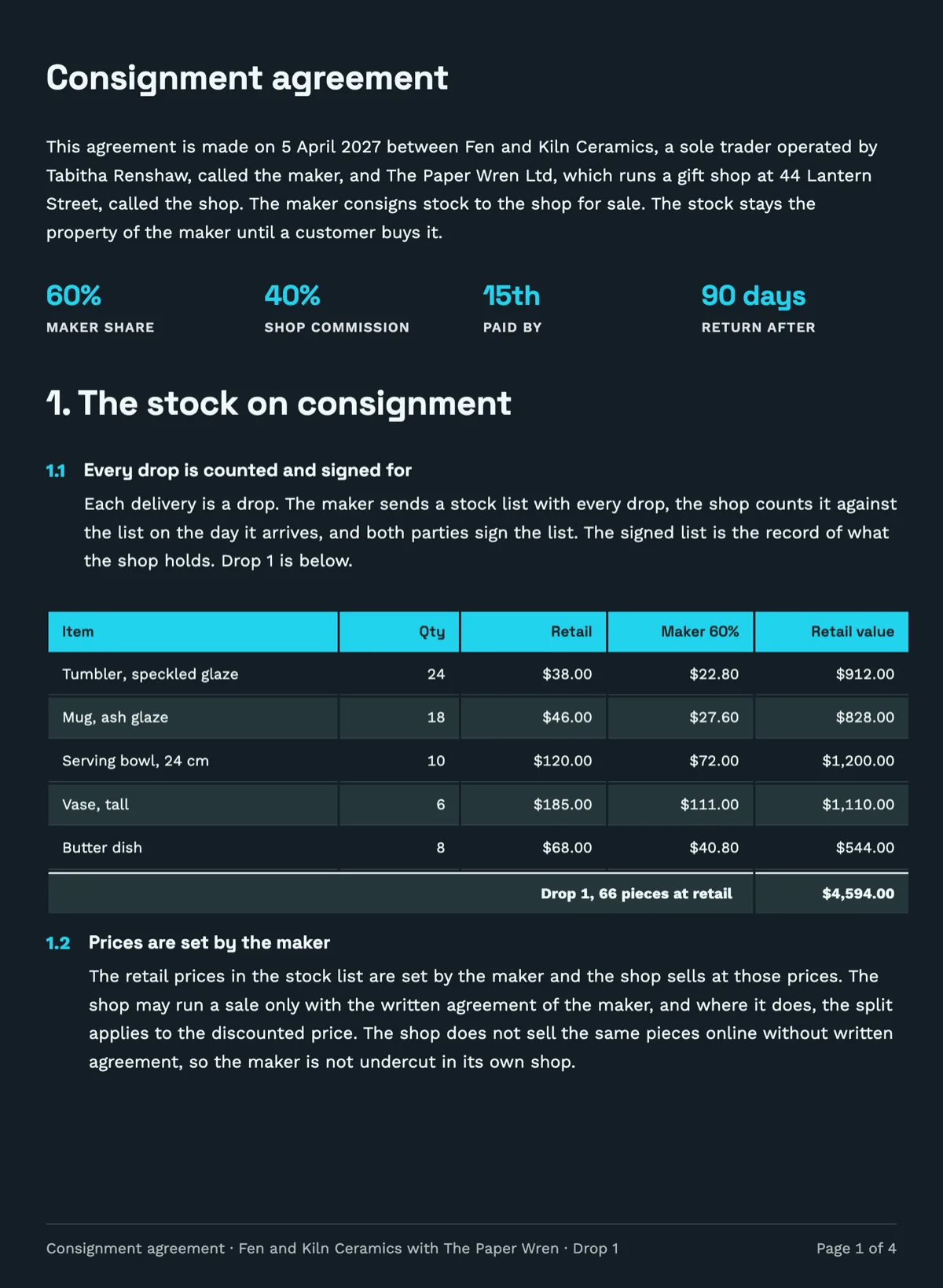 Consignment agreement template with the split and a stock listConsignment only works when both sides can agree on two things: what the shop is holding, and who carries the loss when a bowl gets knocked off a shelf. This agreement signs a stock list on every drop, fixes the split at 60 to 40, and puts breakage and theft squarely on the shop until the piece sells.
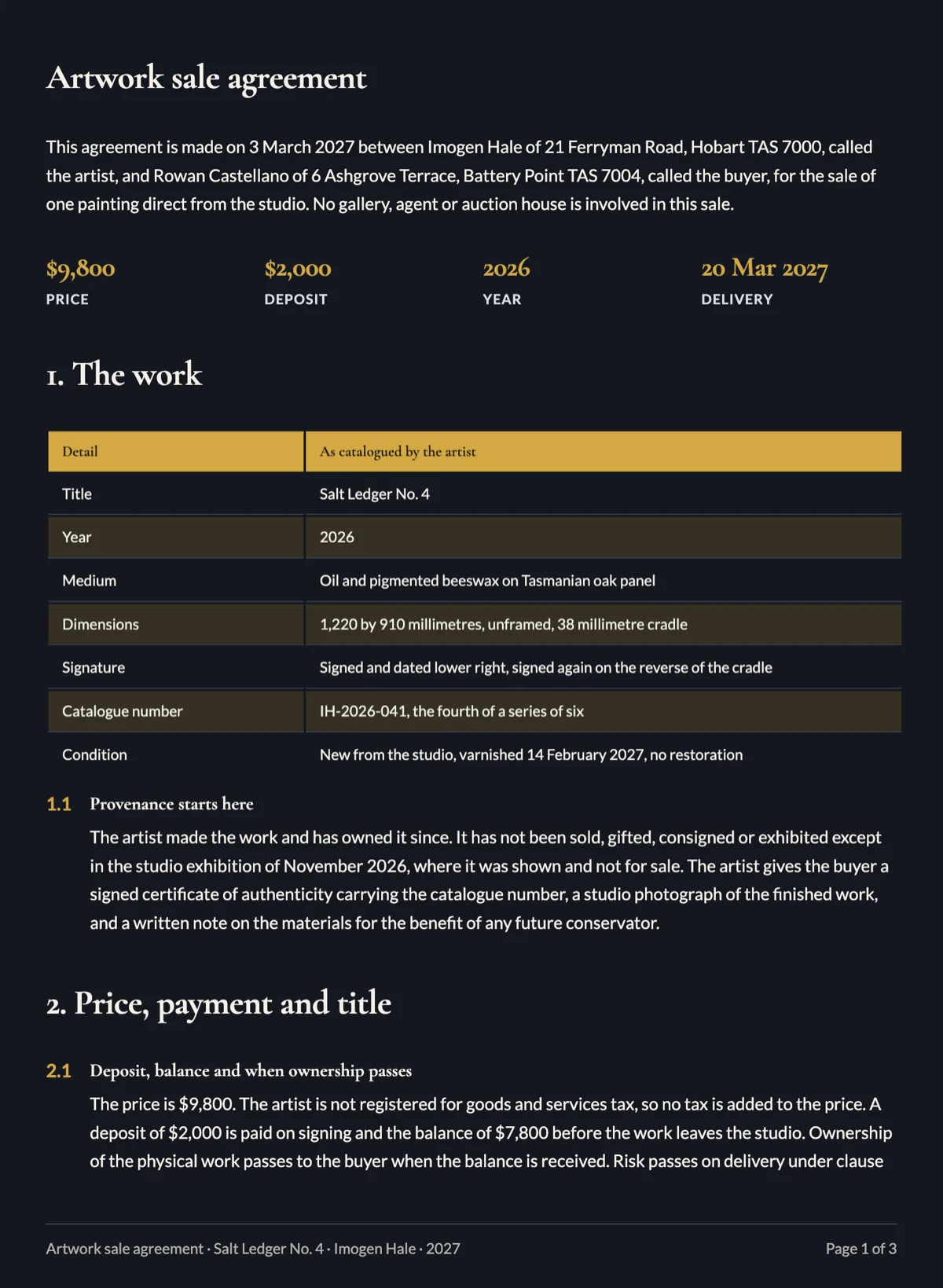 Artwork sale agreement with provenance and a resale royalty noteWhen a painting leaves a studio it takes its provenance with it, and whatever is not written down on the first sale is gone by the third. This agreement catalogues the work, keeps the copyright with the artist in plain words, and explains where the Australian resale royalty starts, which is not on this sale.
Questions people ask
Who owns consigned goods?
The consignor, usually the maker or supplier, owns them until the retailer sells them to a customer, when title passes straight to the customer. The retailer holds them as bailee and sells as the consignor's agent. In Australia that ownership is only secure against the retailer's creditors if it is registered on the PPSR.
Do I need to register a consignment on the PPSR?
If it is a commercial consignment, yes, to be safe. The PPSA treats it as a security interest, and an unregistered interest can vest in the retailer if it becomes insolvent. Registering before delivery, as a purchase money security interest, gives priority over the retailer's bank.
How do shops and makers usually split consignment sales?
Splits vary by trade. Gift shops and boutiques often keep 30 to 40 per cent, galleries commonly keep 40 to 50 per cent of an artwork's price, and second hand dealers take more on low value items. The clause should say whether the split is worked on the price including or excluding GST.
Who pays if consigned stock is stolen?
The clause should decide. A common approach makes the retailer responsible for loss while goods are on its premises and requires it to insure them, paying the consignor's share as if sold. Without a clause, liability depends on whether the retailer took reasonable care as bailee.
Is consignment the same as sale or return?
Not quite. In a consignment the retailer never owns the goods and sells as the supplier's agent. In a sale or return the retailer buys the goods with a right to return them, and ownership can pass to the retailer, which changes who bears the risk and who sets the price.
Put the clause in a finished document
The button opens the document generator with a starting description already filled in. Change it to match your own agreement before you run it.
Create a document with OneCraftRelated clauses
- Territory clause: sample wording for distribution and licencesTerritory clause sample for distribution, agency and licence deals: defining the area, exclusive or sole rights, online sales and competition law limits.
- PPSA clause: sample wording for Australian contractsPPSA clause sample for Australian contracts: granting a security interest, consent to register, the PPSR search warranty, and contracting out under s115.
- Retention of title clause and the PPSRA retention of title clause keeps ownership with the seller until goods are paid for. Australian sample wording, all monies variants and the PPSR timing rules.
- Passing of risk clause: whose loss is itA passing of risk clause fixes when a buyer becomes responsible for loss or damage to goods. Sample wording plus dispatch, acceptance and US variants.
For everything the document generator can do, see the document maker.
Step by step in the builder: Create a document with AI, then Document builder components.
Written and checked by the OneCraft team. Last checked .