Contract clause
Territory clause: sample wording for distribution and licences
A territory clause defines the geographic area in which a distributor, agent or licensee may sell or use the rights it is given, and says whether those rights are exclusive, sole or non exclusive there. It often adds what happens to sales from outside the area and to online sales.
A territory clause draws the map in a distribution, agency or licence agreement: where the other party may sell, whether anyone else may sell there, and what counts as a sale inside the area. A clear map with an exclusivity label and an online sales rule prevents the most common distribution dispute, two sellers chasing the same customer.
Indunil Asanka · Co-founder
3 min read · Published
Sample clause
Written for distribution agreement between Ferndew Botanicals, a fictional skincare maker, and Kauri Trade Supply, a fictional wholesale distributor.
Territory. (a) Appointment. Ferndew appoints Kauri as its exclusive distributor of the Products in the Territory, being the North Island of New Zealand, for the Term. (b) Exclusivity. During the Term, Ferndew will not appoint another distributor in the Territory and will not itself sell the Products to retailers there, except to the accounts listed in Schedule 3. (c) Outside the Territory. Kauri will not actively market the Products to customers outside the Territory, but may accept unsolicited orders from them. (d) Online sales. Kauri may sell through its own website to customers anywhere in New Zealand. (e) Targets. If Kauri buys less than 80 per cent of the minimum purchase target in any year, Ferndew may make the appointment non exclusive on 30 days' notice.
Sample wording, not legal advice.
Variants
Exclusive territory
The distributor is investing heavily in marketing an area and needs protection from the supplier and other distributors.
The Supplier appoints the Distributor as its exclusive distributor in the Territory and will not appoint any other distributor, agent or reseller in the Territory, or sell there itself, during the Term.
Sole territory
The supplier promises not to appoint anyone else but keeps the right to sell directly, often to its own key accounts.
The Supplier will not appoint any other distributor in the Territory during the Term but may continue to sell the Products directly to customers in the Territory.
Licence territory
A trade mark or content licence, where the territory limits where the licensee may use the rights rather than where it may sell goods.
The Licensor grants the Licensee an exclusive licence to apply the Marks to the Licensed Products and sell them in Australia. Sales from outside Australia are not licensed.
What to negotiate
Exclusivity should earn its keep
A supplier that grants exclusivity gives up other routes into the area, so it usually asks for minimum purchase targets in return, with exclusivity ending if they are missed. The distributor should ask for targets it can reach, a ramp up in the first year, and a cure period before exclusivity falls away.
Define the map precisely
A territory described as Queensland or the North Island is clear; one described as the eastern region invites argument. Use states, postcodes, local government areas or countries, and list any excluded accounts by name. For licences, say whether the territory covers where products are made, sold or both.
Online and passive sales
Websites reach everywhere, so a territory clause needs an online rule. A common split bans active marketing aimed outside the area while allowing passive sales, unsolicited orders and a website open to all. Restricting online sales too tightly can raise competition law concerns, and in some places it is prohibited outright.
The risk of leaving it out
Without a territory clause, a distributor may find the supplier appointing a competitor down the road, or selling direct to its best customers, after it has spent the money building the market. A supplier faces the reverse risk: a distributor selling outside the intended area and undercutting other partners. Both lead to disputes that the agreement could have settled with a map and a label.
Exclusive, sole and non exclusive
The three labels mean different things and are often confused. Exclusive means no one else sells in the territory, including the supplier. Sole means the supplier will appoint no other distributor but may still sell there itself. Non exclusive means the supplier can appoint as many distributors as it likes. Writing the meaning out in the clause, as the sample does, matters more than the label, because courts read the words used rather than the heading.
Competition law limits
In Australia, territorial restrictions in distribution agreements are assessed under Part IV of the Competition and Consumer Act 2010, mainly the exclusive dealing provision, which since 2017 prohibits conduct only if it has the purpose, effect or likely effect of substantially lessening competition. Most territory clauses between a supplier and its distributors are lawful on that test. Fixing the price at which a distributor resells is different: resale price maintenance is prohibited unless authorised, whatever its effect. Law checked on 21 October 2026. This page explains how the law works and is not legal advice.
Territory in a trade mark licence
In a licence, the territory limits where the licensee may use the licensed rights, often a country, because trade mark registrations are national. A licensee in Australia using a mark registered with IP Australia cannot rely on that registration overseas. The clause should match the territory to where the mark is registered, and say whether the licensee may export licensed goods.
Where the clause sits in a generated document
Distribution, agency and licence agreements carry a territory clause near the front, beside the appointment. When asking the AI document generator for one, name the territory exactly, the exclusivity level, the excluded accounts, the online sales rule and any target that affects exclusivity, so each comes out as a numbered sub clause.
Documents that carry this clause
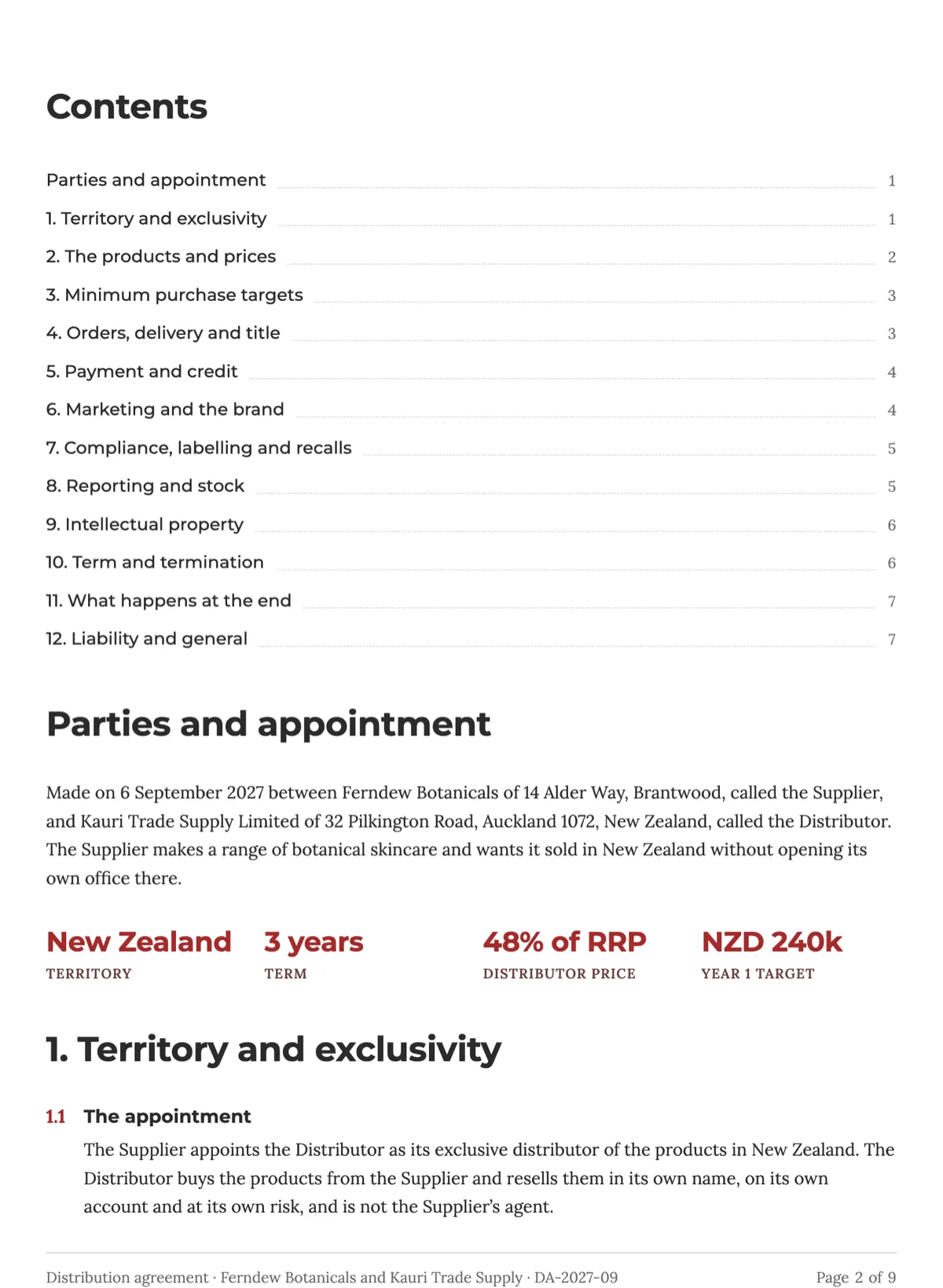 Distribution agreement template with territory and targetsAn exclusive distribution agreement is a trade: a territory in exchange for volume. This one appoints a New Zealand distributor for a skincare range at 48 per cent of recommended retail, with purchase targets rising from NZD 240,000 to NZD 420,000 across three years, and exclusivity that converts to non exclusive if a target is missed by more than 15 per cent.
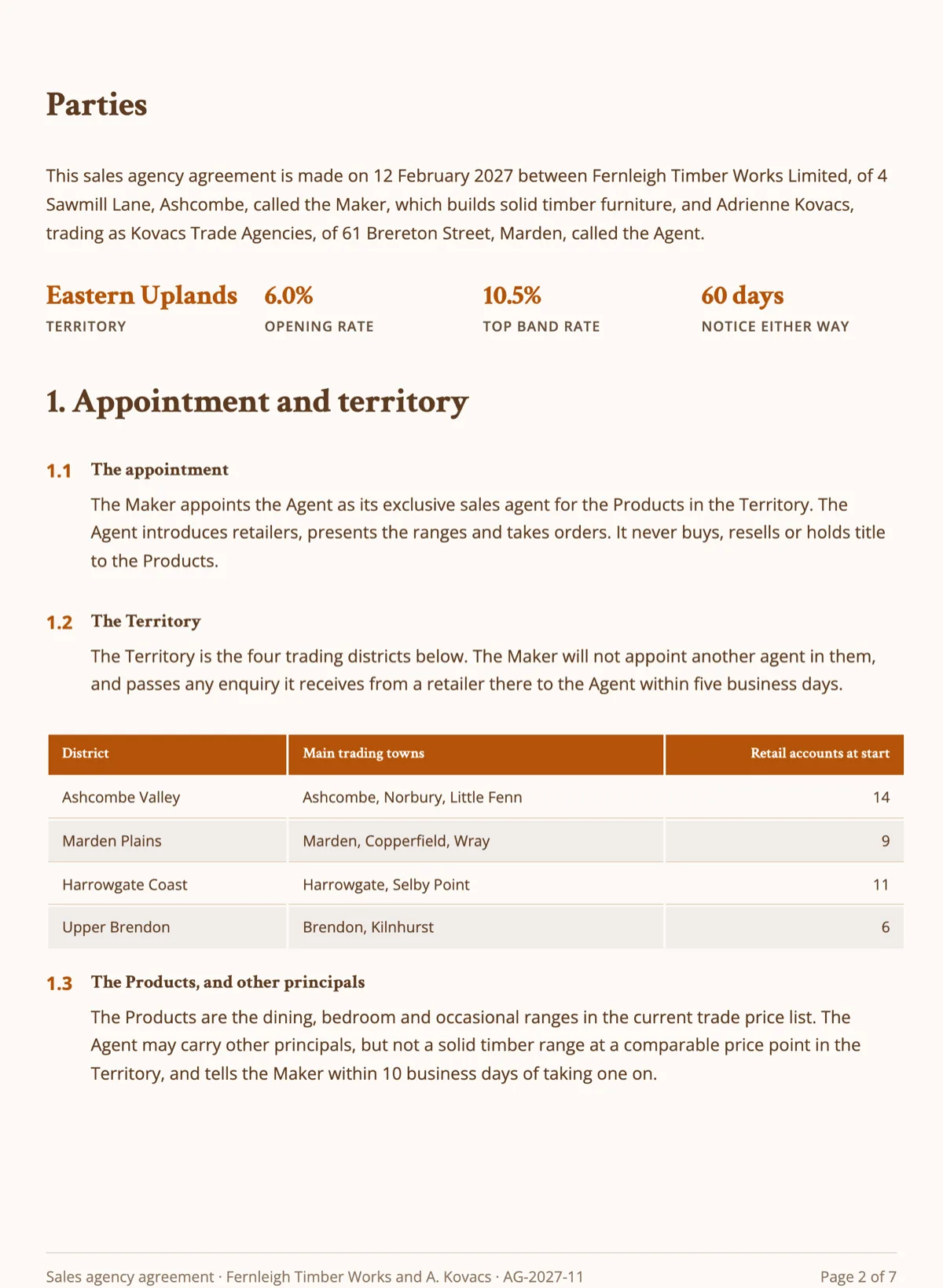 Sales agency agreement with a commission ladder and a named territoryA sales agency agreement has to answer two questions before anything else: what the agent is allowed to promise on your behalf, and exactly how the commission is worked out. This finished example answers both on the page, with a four band ladder from 6.0 to 10.5 per cent, a worked example on $520,000 of sales, and a table of six decisions the agent may and may not make.
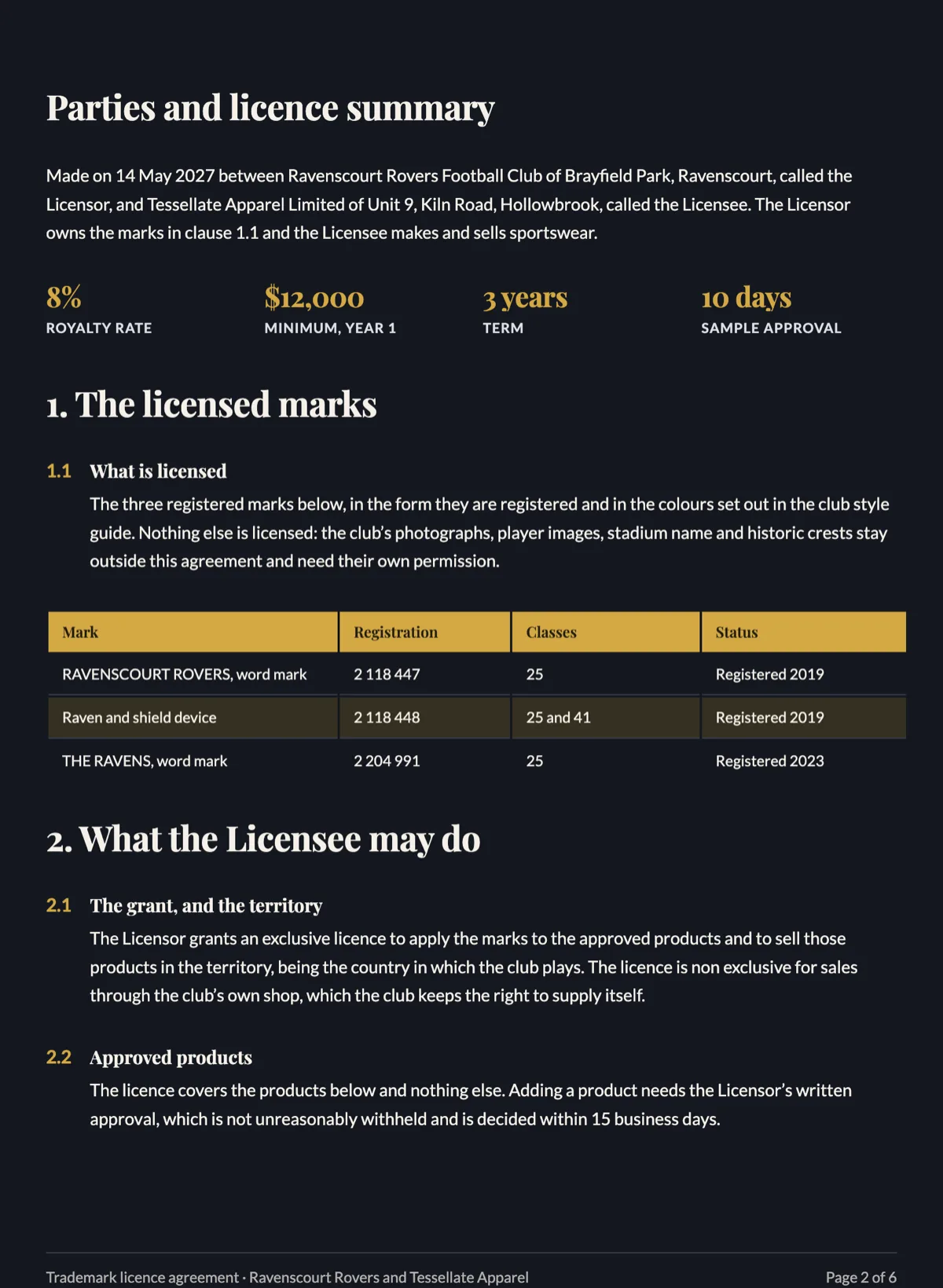 Trademark licence agreement with quality control and royaltiesA trademark licence lets someone else put your mark on their goods, and the clause that keeps it worth doing is quality control. This one licenses three registered marks from a football club to an apparel maker for three years, at 8 per cent of net wholesale sales with a rising minimum, and approval of every pre production sample in ten business days.
Questions people ask
What is a territory clause in a contract?
It is the term that sets the geographic area in which a distributor, agent or licensee may sell or use what the agreement gives it, and whether others may do the same there. It usually sits beside the appointment clause and is read with any exclusivity and target clauses.
What is the difference between exclusive and sole territory?
Exclusive means only the distributor sells in the territory, and the supplier itself stays out. Sole means the supplier appoints no other distributor but keeps the right to sell there directly. Clauses should spell out which is meant rather than rely on the label.
Can a distributor be stopped from selling online?
A supplier can usually stop a distributor from actively targeting customers outside its territory, but a total ban on online sales is more likely to raise competition concerns. The common compromise allows a website and unsolicited orders while restricting targeted marketing elsewhere.
Are territory restrictions legal in Australia?
Generally yes. Since 2017 exclusive dealing, including territorial restrictions, breaches the Competition and Consumer Act only if it substantially lessens competition, which most distribution territories do not. Fixing the resale price is a separate prohibition that applies regardless of effect.
What happens if the distributor misses its targets?
Only what the agreement says. Common remedies are converting the appointment to non exclusive, shrinking the territory or ending the agreement, usually after notice and a cure period. Without such a clause, missing a target may not affect exclusivity at all.
Put the clause in a finished document
The button opens the document generator with a starting description already filled in. Change it to match your own agreement before you run it.
Create a document with OneCraftRelated clauses
- PPSA clause: sample wording for Australian contractsPPSA clause sample for Australian contracts: granting a security interest, consent to register, the PPSR search warranty, and contracting out under s115.
- Retention of title clause in the UK: a Romalpa sampleRetention of title clause UK sample: title until paid, all monies wording, identifying goods, and why claiming proceeds makes it a registrable charge.
- Exclusive distribution clause: one territory, one distributorAn exclusive distribution clause gives one distributor a territory the supplier will not share. Sample wording, a sales target, sole and non exclusive options.
- Minimum order quantity clause: the smallest order a supplier acceptsA minimum order quantity clause sets the smallest order a supplier accepts. Sample wording with a per SKU minimum, a small order surcharge and three variants.
For everything the document generator can do, see the document maker.
Step by step in the builder: Create a document with AI, then Document builder components.
Written and checked by the OneCraft team. Last checked .