Contract clause
PPSA clause: sample wording for Australian contracts
A PPSA clause deals with the Personal Property Securities Act 2009 in a contract: it grants or denies a security interest in goods, lets the secured party register it on the PPSR, sets who searches the register, and often contracts out of PPSA provisions the parties do not want, as section 115 allows.
Any Australian contract that leaves goods with someone before they are paid for, or sells goods that might be under finance, needs a PPSA clause. On the secured side it grants the interest, consents to registration and waives notices section 115 allows the parties to waive; on the buying side it records a clear PPSR search and the seller's warranty.
Nuwan Madhusanka · Co-founder
4 min read · Published
Sample clause
Written for loan to Kerfwell Joinery Pty Ltd, a fictional joinery business, secured over its plant and equipment.
Personal Property Securities. (a) Security interest. The Borrower grants the Lender a security interest in all present and after acquired plant and equipment of the Borrower, and their proceeds, to secure the amounts owing under this agreement. (b) Registration. The Borrower consents to the Lender registering a financing statement on the Personal Property Securities Register and will promptly sign any document the Lender reasonably needs to perfect the security interest. (c) Contracting out. To the extent the PPSA allows, sections 95, 118, 121(4), 125, 130, 132(3)(d), 132(4), 142 and 143 do not apply, and the Borrower waives its right to receive a verification statement. (d) Change of details. The Borrower will give the Lender 14 days' notice before changing its name or ABN.
Sample wording, not legal advice.
Variants
Buyer's search and seller's warranty
A private or business sale of a vehicle, boat or equipment where the buyer must be sure no one else holds a security interest over the goods.
The Seller warrants that no security interest is registered against the Goods on the Personal Property Securities Register. The Buyer may search the register before paying the balance, and if a search shows a registration, the Seller must have it removed before settlement.
Retention of title supplier
A supplier selling on credit that keeps title until payment and needs the PPSA to protect it in the buyer's insolvency.
The Customer acknowledges that this agreement creates a purchase money security interest in the Goods and their proceeds, and consents to the Supplier registering it before the Goods are delivered.
No security interest
A hire or service agreement where neither party intends to create a security interest and wants to say so.
Nothing in this agreement creates a security interest under the PPSA, and neither party will register a financing statement against the other.
What to negotiate
Register on time
Priority under the PPSA generally goes to the first to register. A purchase money security interest gets super priority only if it is registered on time: before the grantor takes possession for inventory, and within 15 business days for other goods. A supplier that registers late can lose to the grantor's bank.
Only contract out of what you can
Section 115 lets the parties agree that some enforcement provisions do not apply, where the collateral is not used mainly for personal, domestic or household purposes. Listing the sections, as the sample does, is the usual practice. A grantor should read the list, because it gives up notices it would otherwise receive before the secured party sells the goods.
Searches are cheap insurance
A PPSR search by serial number, such as a vehicle identification number, costs a few dollars and shows whether anyone has registered an interest. A buyer of second hand goods who skips the search can lose the goods to the seller's financier. The clause should say who searches, when, and what happens if a registration appears.
The risk of leaving it out
Without a PPSA clause, a secured party may have no clear consent to register, a late registration that loses priority, and an unperfected interest that vests in the grantor if it becomes insolvent. A buyer without a search clause can pay full price for goods still under finance and then lose them to the lender, with only a claim against a seller who may not be found.
What the PPSA treats as a security interest
The Personal Property Securities Act 2009 looks at substance, not form. A loan secured over equipment, a retention of title supply, a commercial consignment and leases of goods for more than a year are all security interests. An interest is perfected by registration on the Personal Property Securities Register, or in some cases possession or control. If the grantor becomes insolvent, an unperfected security interest generally vests in the grantor, so the secured party loses its claim to the goods. Law checked on 21 October 2026. This page explains how the law works and is not legal advice.
Searching before you buy
The PPSR can be searched by serial number for motor vehicles, boats, aircraft and some other goods, or by the grantor's details for other property. A clean search on the day of payment, with the certificate number recorded in the contract, is the buyer's best evidence. The vehicle sale and bill of sale examples both record a search and a warranty, because a private buyer who does not search takes the risk of finance owed on the goods.
Lists of sections and why they appear
PPSA clauses often carry a list of section numbers the parties contract out of, such as sections 95, 118, 121(4), 125, 130, 132(3)(d), 132(4), 142 and 143. These deal with notices before enforcement, the order of dealing with collateral and the grantor's rights to redeem or reinstate. Contracting out simplifies enforcement for the secured party. Section 115 sets which provisions can be excluded and only where the collateral is not mainly used for personal, domestic or household purposes.
Where the clause sits in a generated document
Loan agreements, equipment and vehicle sales, supply terms and consignment agreements carry this clause. When asking the AI document generator for one, say which side the business is on, the goods covered, whether to contract out, and for a sale, who searches the register and when.
Documents that carry this clause
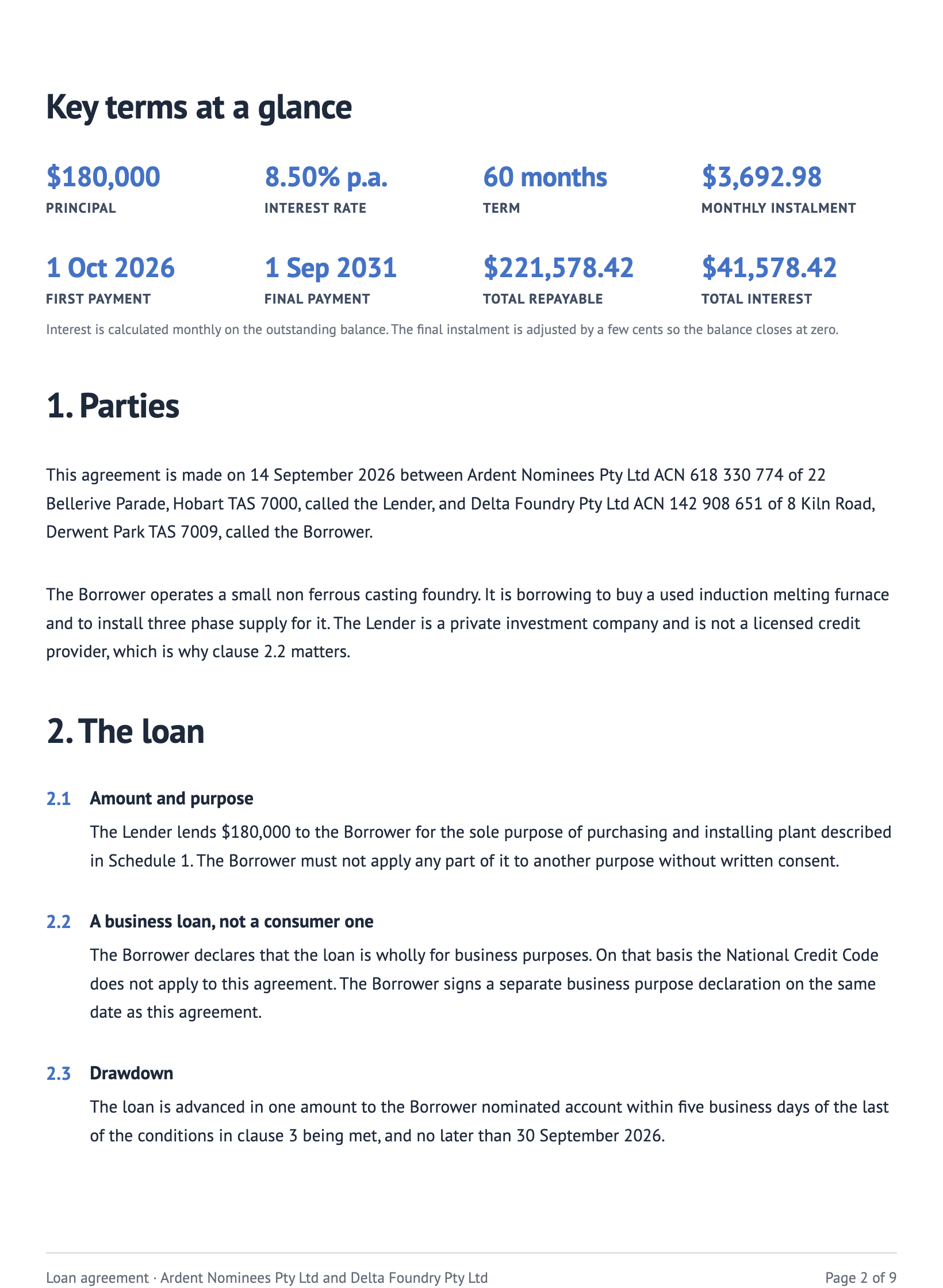 Loan agreement templateA Tasmanian foundry is borrowing $180,000 from a private investment company to buy a used induction furnace. The lender is not a bank, so everything a bank would take for granted has to be written down: what has to happen before the money moves, what is registered over what, and how long the borrower gets to fix a default.
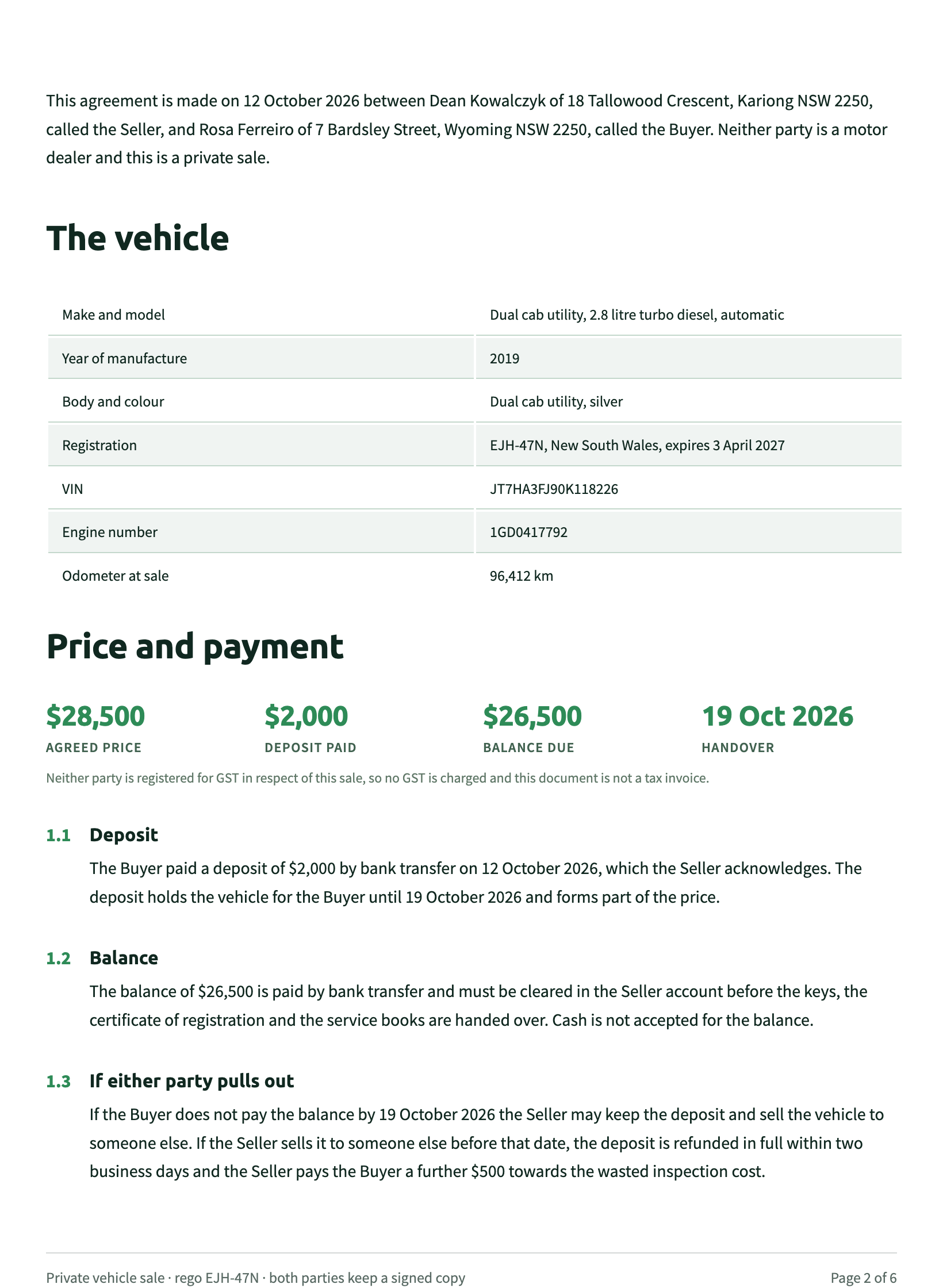 Vehicle sale agreement templateA dual cab ute is changing hands between two people on the Central Coast for $28,500. No dealer, so no statutory warranty and no guarantee of clear title. What the buyer gets instead is five written warranties, a register certificate number, and a mechanic's report obtained before the balance moves.
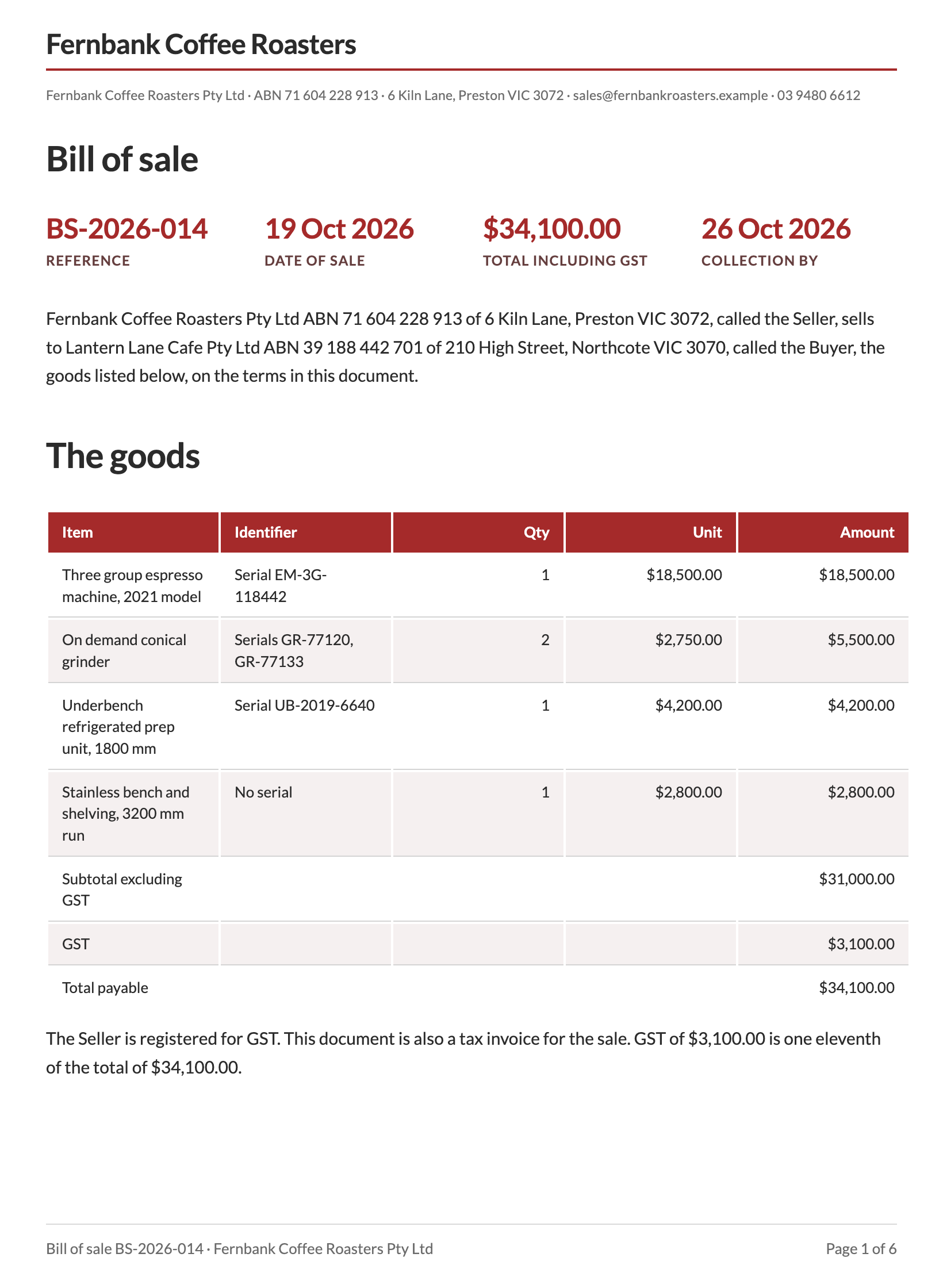 Bill of sale templateA coffee roaster is selling four pieces of used cafe equipment to a cafe down the road for $34,100. The interesting part is not the price. It is that the buyer searched the register against the serial numbers three days earlier, and the search date is written into the warranty.
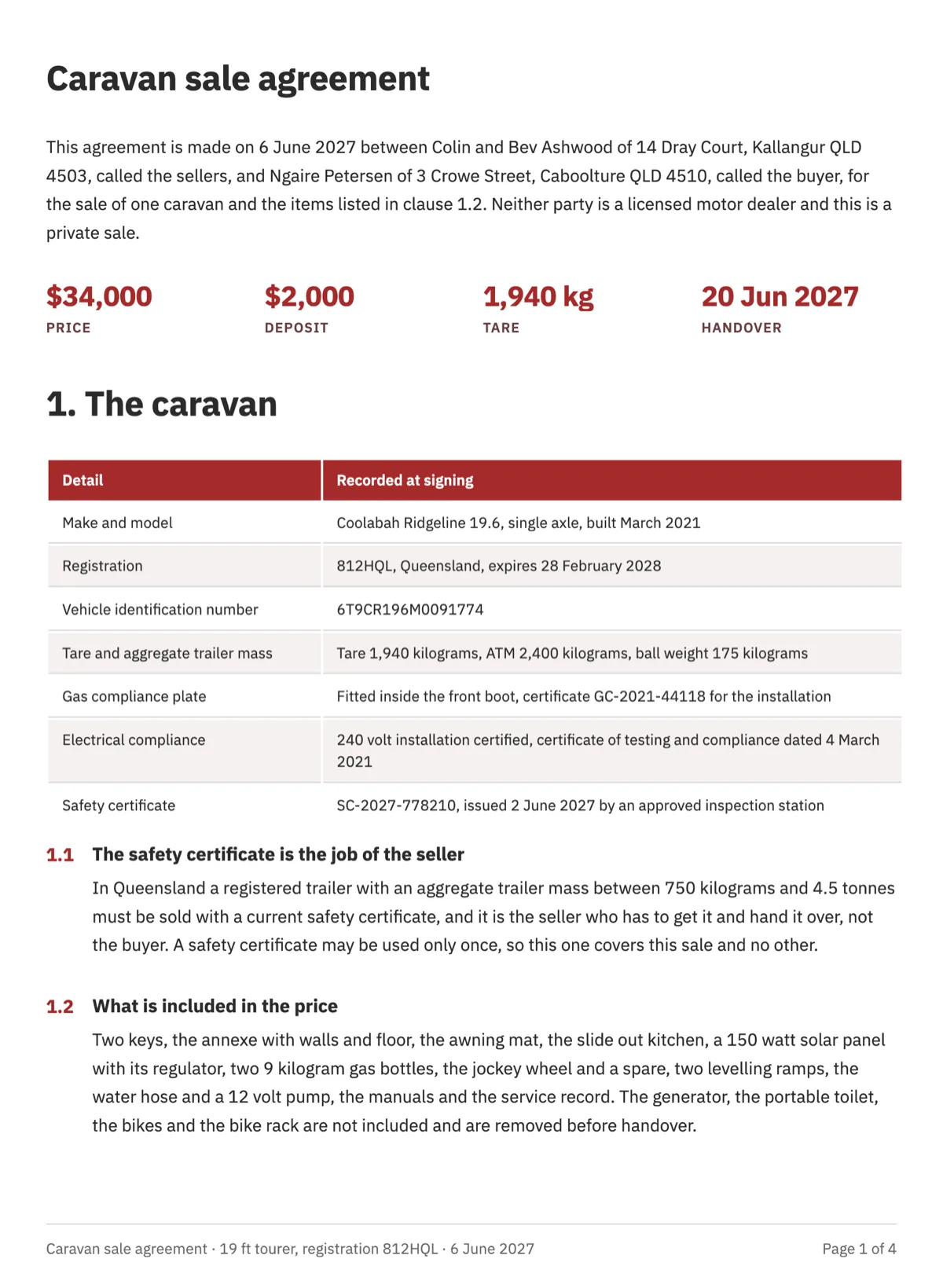 Caravan sale agreement with the compliance plates recordedA caravan is a trailer, a gas installation and a 240 volt circuit in one object, and each of those carries its own paperwork. This agreement records all three, puts the safety certificate where the law puts it, on the seller, and gives the buyer a window to have a gas fitter and an electrician look before the balance moves.
Questions people ask
What is a PPSA clause?
It is the part of a contract that deals with the Personal Property Securities Act 2009: granting or ruling out a security interest, consenting to registration on the PPSR, setting search duties and contracting out of provisions the parties do not need. Most Australian supply, finance and sale terms have one.
Do I need to register on the PPSR?
If you hold a security interest, such as a retention of title or a secured loan, registration is how you perfect it against other creditors and an insolvency administrator. If you do not register, you may lose the goods to a registered lender or to the liquidator.
What is a PMSI?
A purchase money security interest secures the price of goods the grantor buys, or a loan to buy them. Registered on time, it ranks ahead of earlier general security interests over the same goods, which is why suppliers selling on credit register as PMSIs.
Can I contract out of the PPSA?
Partly. Section 115 lists enforcement provisions the parties may agree not to apply, but only where the collateral is not used mainly for personal, domestic or household purposes. The core rules on registration and priority cannot be contracted out of.
What should a buyer do before paying for used goods?
Search the PPSR by serial number or the seller's details, keep the search certificate, and make the contract say the goods are free of security interests. If a registration shows up, the money owed should be paid out and the registration removed before or at settlement.
Put the clause in a finished document
The button opens the document generator with a starting description already filled in. Change it to match your own agreement before you run it.
Create a document with OneCraftRelated clauses
- Retention of title clause in the UK: a Romalpa sampleRetention of title clause UK sample: title until paid, all monies wording, identifying goods, and why claiming proceeds makes it a registrable charge.
- Retention of title clause in New Zealand: sample and registrationRetention of title clause NZ sample: title until paid, a security interest over goods and proceeds, PMSI priority, and registering on New Zealand's PPSR.
- Retention of title clause and the PPSRA retention of title clause keeps ownership with the seller until goods are paid for. Australian sample wording, all monies variants and the PPSR timing rules.
- Negative pledge clause: no security to anyone elseA negative pledge clause for an unsecured cafe group facility: no security to other lenders, a basket for equipment finance and liens by law, and the PPSR.
For everything the document generator can do, see the document maker.
Step by step in the builder: Create a document with AI, then Document builder components.
Written and checked by the OneCraft team. Last checked .