Contract clause
Retention of title clause in New Zealand: sample and registration
In New Zealand a retention of title clause keeps ownership of goods with the seller until payment, but the Personal Property Securities Act 1999 treats it as a security interest. To protect the seller against the buyer's other creditors it must be perfected by registering a financing statement on the Personal Property Securities Register.
A New Zealand retention of title clause works as a security interest under the Personal Property Securities Act 1999, so the clause alone is not enough: the seller must register a financing statement on the PPSR. Registered in time as a purchase money security interest, it can rank ahead of the buyer's bank over the goods supplied.
Nuwan Madhusanka · Co-founder
3 min read · Published
Sample clause
Written for account terms of Waitemata Building Supplies, a fictional Auckland building merchant selling timber and fixings to builders on credit.
Retention of Title and Security. (a) Ownership of all Goods remains with Waitemata until the Customer has paid all amounts owing on its account. (b) The Customer grants Waitemata a security interest in all Goods supplied, now or in future, and their proceeds, as security for all amounts owing. This is a purchase money security interest to the extent it secures the price of those Goods. (c) The Customer agrees that Waitemata may register a financing statement on the Personal Property Securities Register and will give any information Waitemata reasonably needs to do so. (d) The Customer waives its right to receive a verification statement and, to the extent the law allows, the rights in Part 9 of the Act that the parties may contract out of. (e) The Customer must not change its name without giving Waitemata 10 working days' notice.
Sample wording, not legal advice.
Variants
Goods only
A one off sale where the seller wants security only over the goods in that sale until it is paid.
Title to the Goods passes to the Customer on payment of their price. Until then the Customer holds them for the Supplier, and the Supplier has a purchase money security interest in them.
All monies over a running account
A trade account with frequent deliveries, where the seller wants every supply to secure the whole balance.
Each supply of Goods secures all amounts the Customer owes the Supplier from time to time on any account, and title to all Goods supplied passes only when the account is paid in full.
Proceeds and accessions
Goods that are resold or fixed to other goods, where the seller wants its security to follow the money or the item they become part of.
The security interest continues in the proceeds of any dealing with the Goods and, where the Goods become an accession to other goods, in the accession.
What to negotiate
Register before or soon after delivery
A purchase money security interest gains super priority over an earlier general security interest only if it is perfected on time: for goods other than inventory, within 10 working days after the buyer obtains possession, and for inventory, by registration before the buyer obtains possession. A supplier registering after a dispute arises is usually too late.
Contracting out of Part 9
Part 9 of the Act sets enforcement rights, such as notice before the secured party sells repossessed goods. Section 107 lets parties contract out of many of them where the goods are not used mainly for personal, domestic or household purposes. Account terms routinely do so; a buyer should know it is giving up those notices.
Proceeds keep the security alive
Building supplies are often incorporated into a building or resold. A clause that takes security over proceeds, and a financing statement that covers them, lets the supplier's interest continue in the money from a resale. Goods that become part of land, such as fixed framing, usually fall outside the personal property rules altogether.
The risk of leaving it out
Without a retention of title clause and a registration, a New Zealand supplier selling on credit is an unsecured creditor. If the buyer's bank holds a registered general security agreement, it ranks ahead over the supplier's own unpaid goods, and a receiver or liquidator can sell them for the bank, leaving the supplier to claim with the other unsecured creditors.
Why New Zealand treats it as a security interest
The Personal Property Securities Act 1999 applies to any transaction that in substance secures payment or performance, whatever the form or who holds title. A retention of title clause secures the price, so it is a security interest. It is perfected by registering a financing statement on the Personal Property Securities Register, and priority between perfected interests generally follows the order of registration, with the purchase money exception. Law checked on 21 October 2026. This page explains how the law works and is not legal advice.
Registration timing and priority checklist
Before the first supply on account, the supplier checks the buyer's legal name and company number, registers a financing statement describing the collateral, such as all goods supplied by Waitemata and their proceeds, and marks it as a purchase money security interest. It keeps the registration current, renewing it before it expires, and updates it if the buyer changes its name. Each step is cheap; missing one can cost the priority the clause was meant to give.
How this differs from Australia and the UK
New Zealand's Act came first, in 1999, and Australia's PPSA of 2009 was modelled on it, so the two work similarly, with differences in timing rules and in what happens to unperfected interests on insolvency. The UK has no general personal property register: a simple UK retention of title clause needs no registration at all, while one that claims proceeds is treated as a company charge. The companion pages cover the Australian and UK positions.
Where the clause sits in a generated document
Trade account applications, terms of sale and equipment sale agreements carry the clause. When asking the AI document generator for New Zealand terms, ask for retention of title, a purchase money security interest over goods and proceeds, consent to register on the PPSR and a name change notice, under New Zealand law.
Documents that carry this clause
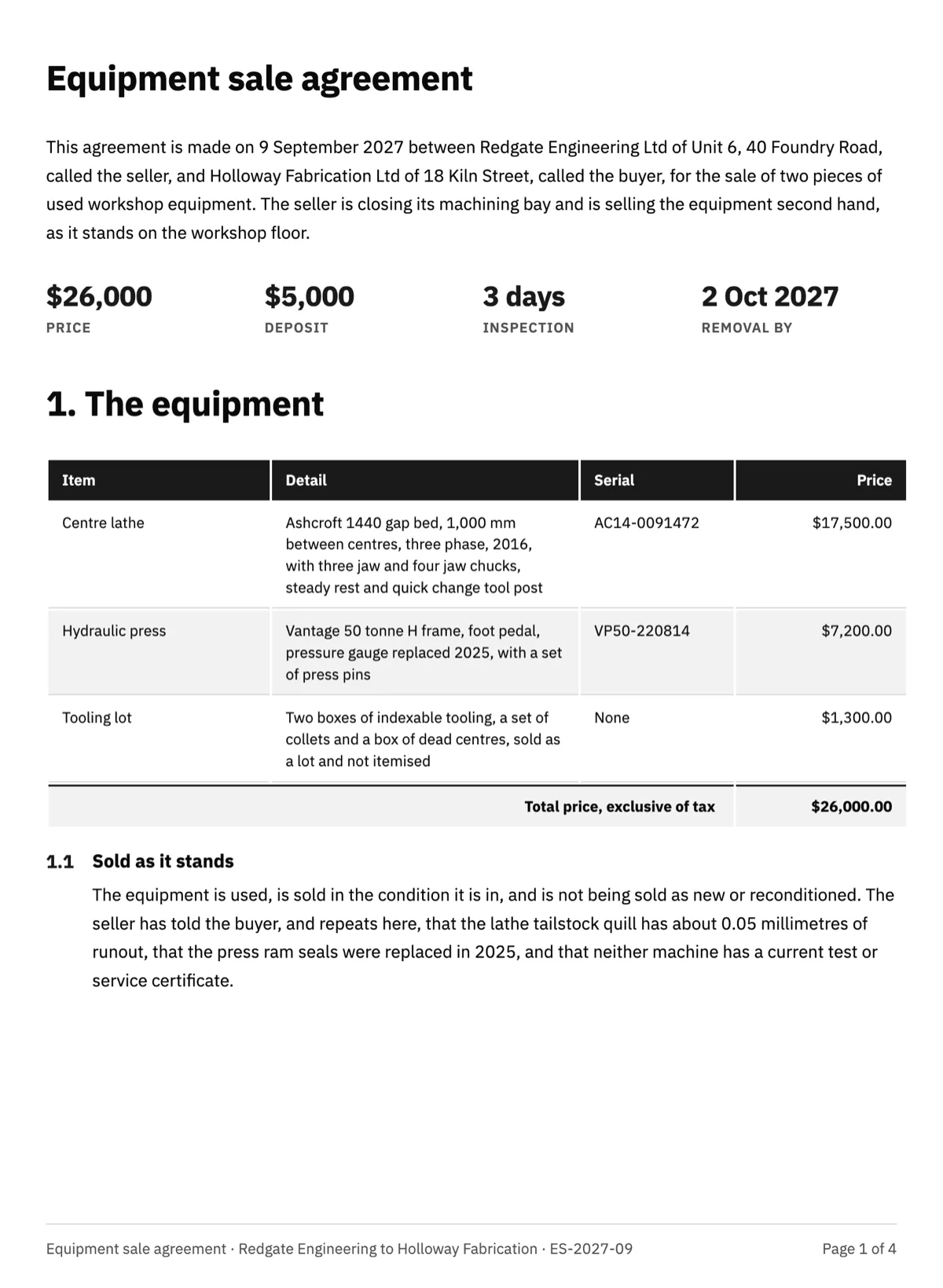 Equipment sale agreement with serial numbers and an inspection windowUsed machinery changes hands on a workshop floor, and the argument afterwards is always about condition or about who damaged the door frame on the way out. This agreement records the serial numbers and the known faults, gives the buyer two days to power the machines up, and puts the rigging, the making good and the storage charge in writing.
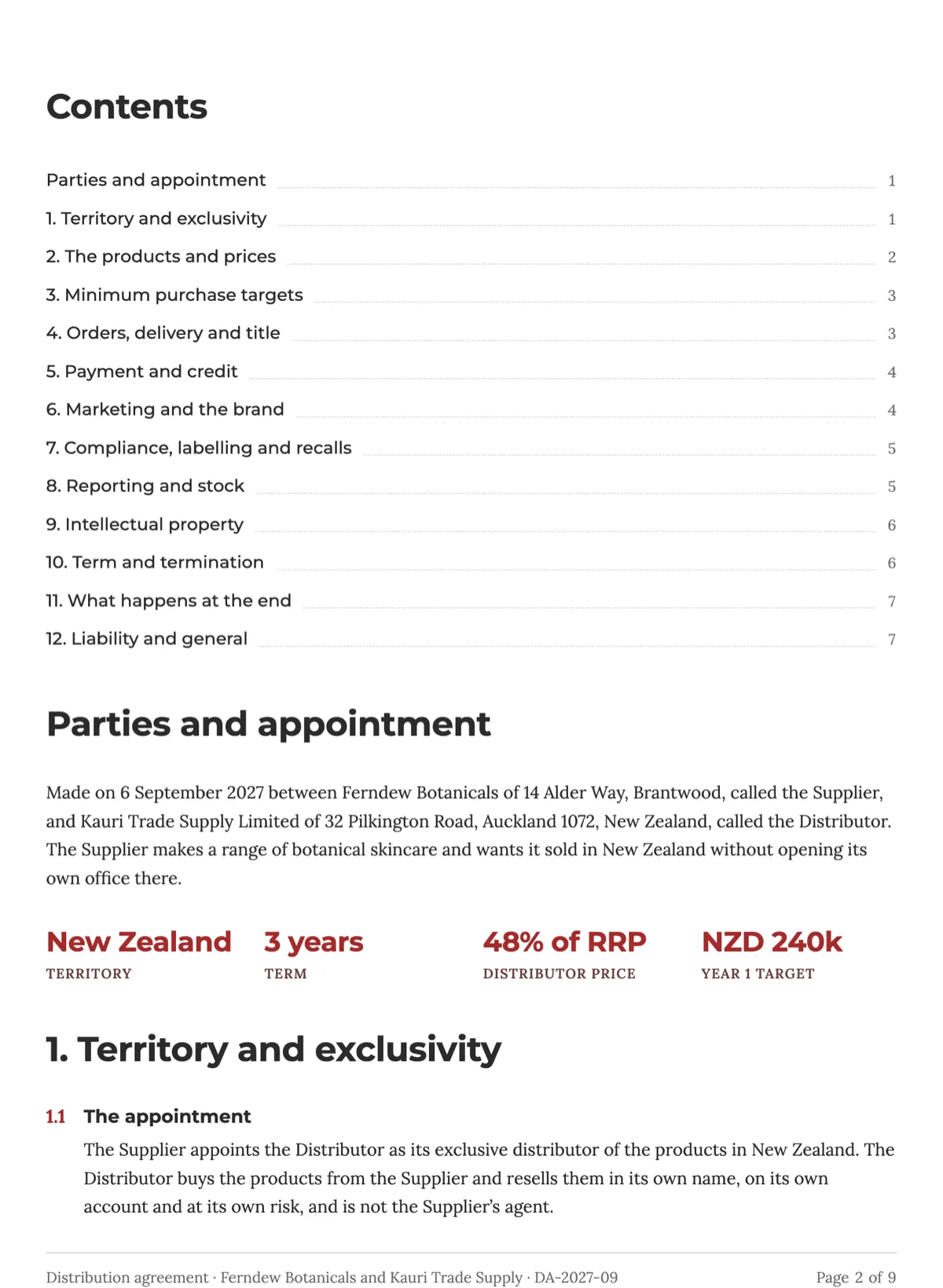 Distribution agreement template with territory and targetsAn exclusive distribution agreement is a trade: a territory in exchange for volume. This one appoints a New Zealand distributor for a skincare range at 48 per cent of recommended retail, with purchase targets rising from NZD 240,000 to NZD 420,000 across three years, and exclusivity that converts to non exclusive if a target is missed by more than 15 per cent.
Questions people ask
Do I need to register a retention of title clause in NZ?
Yes, to protect it against other creditors. The Personal Property Securities Act 1999 treats retention of title as a security interest, and it is perfected by registering a financing statement on the PPSR. An unregistered clause is unlikely to help if the buyer fails.
What is a PMSI in New Zealand?
A purchase money security interest secures the price of goods supplied or a loan used to buy them. If perfected on time, it ranks ahead of an earlier general security interest over the same goods, which is why suppliers on credit register their retention of title as one.
What happens if I do not register?
Your interest stays unperfected, so a registered secured creditor, usually the buyer's bank, ranks ahead of you over the goods, and in an insolvency you are likely to recover them only if no one else claims. You are left with the contract claim for the price.
How long does a PPSR registration last in NZ?
A financing statement lasts for the period chosen when registering, up to five years, and can be renewed before it expires. A supplier with a long running trade account should diarise renewals so its registration does not lapse while goods are still being supplied.
Does a retention of title clause cover goods built into a house?
Usually not. Once materials are fixed to land, such as framing in a house, they generally stop being personal property under the Act, and the security interest over them ends. The clause can still cover unused stock and the proceeds of resale.
Put the clause in a finished document
The button opens the document generator with a starting description already filled in. Change it to match your own agreement before you run it.
Create a document with OneCraftRelated clauses
- Unfair contract terms in Australia: the test and three rewritesUnfair contract terms in Australia: the three part test in the Australian Consumer Law, penalties since November 2023, and three gym clauses rewritten.
- Unfair contract terms in New Zealand: the Fair Trading Act testUnfair contract terms in NZ: section 26A of the Fair Trading Act, small trade contracts since August 2022, the court declaration step and three rewrites.
- Retention of title clause and the PPSRA retention of title clause keeps ownership with the seller until goods are paid for. Australian sample wording, all monies variants and the PPSR timing rules.
- Passing of risk clause: whose loss is itA passing of risk clause fixes when a buyer becomes responsible for loss or damage to goods. Sample wording plus dispatch, acceptance and US variants.
For everything the document generator can do, see the document maker.
Step by step in the builder: Create a document with AI, then Document builder components.
Written and checked by the OneCraft team. Last checked .