Contract clause
Unfair contract terms in New Zealand: the Fair Trading Act test
In New Zealand an unfair contract term is a term in a standard form consumer or small trade contract that a court has declared unfair under the Fair Trading Act 1986: it causes a significant imbalance, is not reasonably necessary to protect the advantaged party's legitimate interests, and would cause detriment if relied on.
New Zealand's unfair terms law works in two steps. The Commerce Commission must first ask a court to declare a term unfair; once declared, a business must not include it in a standard form contract or rely on it. Since 16 August 2022 the protection reaches small trade contracts as well as consumer ones.
Indunil Asanka · Co-founder
4 min read · Published
Sample clause
Written for hire terms of Port Hills Hire, a fictional Christchurch equipment rental firm, rewritten after a review against section 46L of the Fair Trading Act.
Hire Terms. (a) Ending the hire. Either party may end a hire on 24 hours' notice. If Port Hills Hire ends it early for a reason other than the Hirer's breach, it refunds the hire charge for the unused days. (b) Damage. The Hirer pays the reasonable cost of repairing damage beyond fair wear and tear, shown on an itemised invoice with photographs taken at return, up to the replacement value of the item. (c) Changes. Port Hills Hire may change these terms for future hires only, by giving at least 14 days' notice on its website and by email to account customers. A hire already booked runs on the terms in force when it was booked. (d) Nothing in these terms limits the Hirer's rights under the Consumer Guarantees Act 1993 or the Fair Trading Act 1986.
Sample wording, not legal advice.
Variants
Consumer contract
Standard terms offered to people hiring or buying for personal, domestic or household use.
The Hirer may cancel a booking up to 48 hours before collection for a full refund, and within 48 hours for a refund less one day's hire.
Small trade contract
Standard terms with a business where the total value of the trading relationship is no more than $250,000 a year, including GST, and the contract is not otherwise excluded.
Either party may end this account agreement on 30 days' written notice. Amounts owed for hires already completed remain payable on the usual terms.
Terms the Act excludes
Terms that define the main subject matter, or set the upfront price, if they are transparent, and terms required by law.
The daily hire charge for each item is shown on the booking confirmation and includes GST and delivery within the Christchurch City Council area.
What to negotiate
Legitimate interest is the business's to prove
A term is presumed not to be reasonably necessary to protect the business's legitimate interests unless the business proves otherwise. A hire firm can show why it needs damage costs covered; it will struggle to justify a flat charge that bears no relation to the repair. Keep the reasoning for each one sided term on file.
Transparency and the whole contract
The court considers how transparent the term is and the contract as a whole. A damage clause in plain words, with photographs at return and an itemised invoice, reads very differently from a clause letting the firm charge whatever it decides. Small changes to process often fix a term without removing the right.
The declaration is the trigger
Until a court declares a term unfair, the term can operate; after it does, including or relying on it in a standard form contract is an offence. Businesses whose terms resemble one the courts have declared unfair should change them before the Commission turns to them, because the declaration process is public.
The risk of leaving it out
Skipping a fairness review leaves terms in place that the Commerce Commission can take to court. A declaration that a term is unfair stops the business using it in every contract of that kind, and including or relying on it afterwards is an offence with fines of up to $600,000 for a company, so the cost of rewriting falls at the worst moment.
Section 26A and the declaration process
Section 26A of the Fair Trading Act 1986 prohibits a person from including in a standard form consumer contract or small trade contract a term that a court has declared unfair under section 46I, or applying or relying on such a term. Only the Commerce Commission can apply for the declaration. The court applies the test in section 46L: significant imbalance, not reasonably necessary to protect legitimate interests, and detriment, taking transparency and the whole contract into account. Law checked on 21 October 2026. This page explains how the law works and is not legal advice.
The small trade contract test
Since 16 August 2022 the protection extends to small trade contracts: standard form contracts between businesses where the total value of the trading relationship, including all contracts between them, is no more than $250,000 in any 12 month period, GST included. A contract above that value, or one between businesses that negotiated their terms, is outside the regime. The figure is counted across the relationship, so several small contracts with one supplier can push it over.
Three hire terms tested
Port Hills Hire's old terms let the firm end any hire at once with no refund, charged a flat $500 for any damage however small, and let it change the terms without notice, even for hires already booked. The termination right was one sided and caused clear detriment. The flat charge bore no relation to the repair. The silent variation upset bookings customers had already relied on. The sample keeps the firm's legitimate interests, getting damaged equipment fixed and updating its terms, while adding refunds, itemised costs and notice.
Where the clause sits in a generated document
Equipment hire, service and supply agreements all carry termination, damage and variation terms. Asking the AI document generator for standard terms with these limits written into the prompt, such as notice periods, itemised damage costs and a statement that statutory rights are not limited, gives numbered clauses that start from a fairer position.
Documents that carry this clause
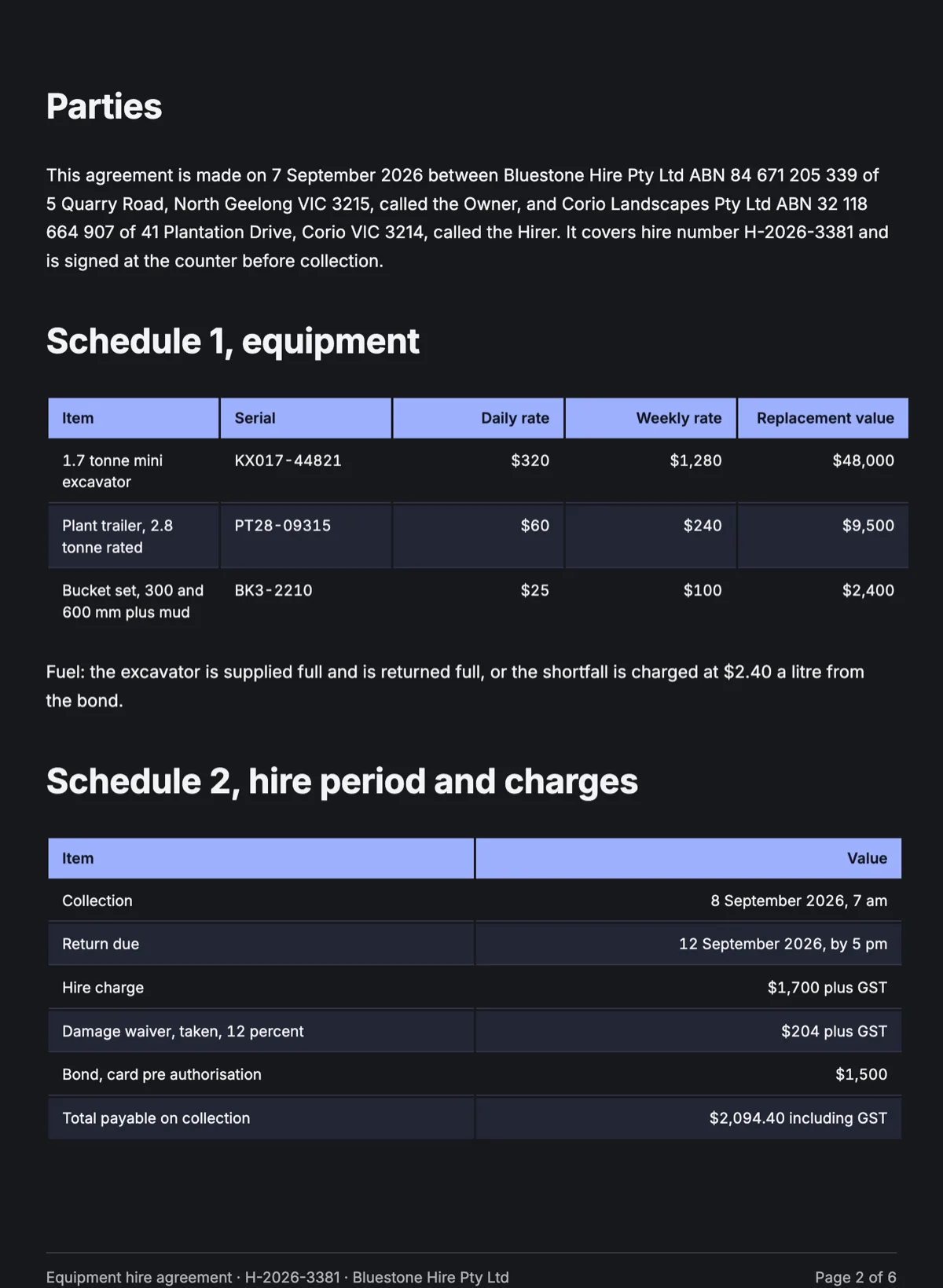 Equipment hire agreement template with the rates in a scheduleA hire agreement is a price list, an insurance decision and a return date, and the argument is always about the day it came back. This one puts the equipment and rates in a schedule, makes the damage waiver a choice with its price, and defines late return in hours so there is nothing to interpret.
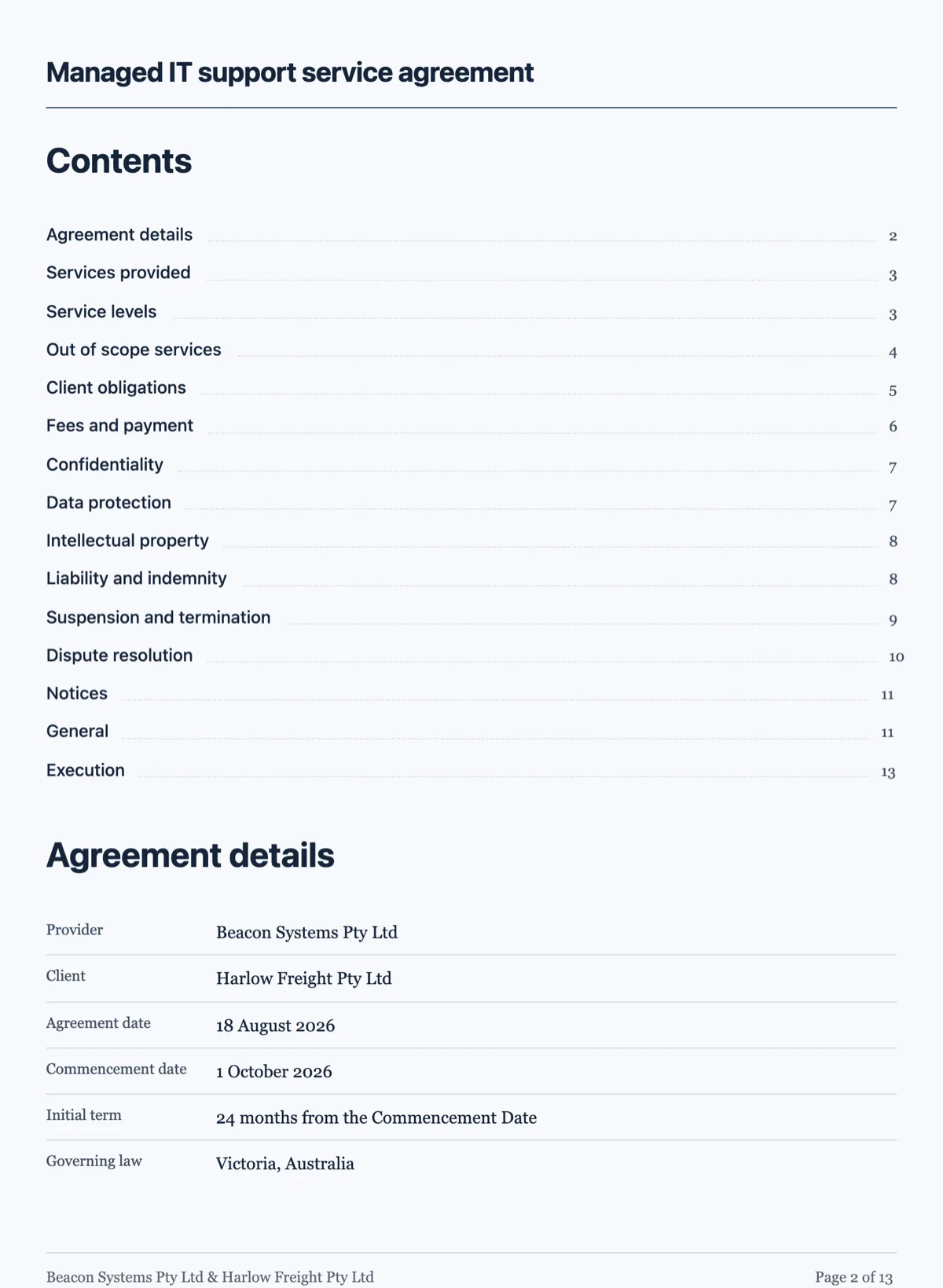 Service agreement template with scope, service levels and an exitA service agreement template has to say what is supplied, how well, for what fee, who is liable for what, and how either side gets out. This one is filled in for Beacon Systems supporting Harlow Freight's IT for an initial 24 months from 1 October 2026 at $8,400 a month plus GST, with 40 hours included and $220 an hour beyond them. Twelve numbered clauses cover the services, a four level severity table, client duties, fees with a CPI adjustment, confidentiality, privacy, IP, a liability cap, termination and a three step dispute ladder under Victorian law.
Questions people ask
What is an unfair contract term in NZ?
A term in a standard form consumer or small trade contract that would cause a significant imbalance in the parties' rights, is not reasonably necessary to protect the legitimate interests of the party it favours, and would cause detriment if relied on. A court decides, on an application by the Commerce Commission.
What is a small trade contract?
A standard form contract between businesses where the total value of their trading relationship is no more than $250,000 in any 12 month period, including GST. Since 16 August 2022, terms in these contracts can be declared unfair in the same way as consumer contract terms.
Who can challenge an unfair term in NZ?
Only the Commerce Commission can apply to the court for a declaration that a term is unfair. A customer who thinks a term is unfair can complain to the Commission, and can rely on other laws, such as the Consumer Guarantees Act, in the meantime.
What happens after a term is declared unfair?
The business must not include that term in standard form contracts or apply, enforce or rely on it. Doing so is an offence under the Fair Trading Act, and the court can also order compensation or other remedies for people affected.
Does the price count as an unfair term?
Terms that define the main subject matter or set the upfront price are excluded, provided they are transparent, so a court will not judge whether a price is too high. A term allowing the price to change later is not excluded and can be tested.
Put the clause in a finished document
The button opens the document generator with a starting description already filled in. Change it to match your own agreement before you run it.
Create a document with OneCraftRelated clauses
- Unfair contract terms in the UK: the Consumer Rights Act testUnfair contract terms in the UK: the Consumer Rights Act 2015 fairness test, the Schedule 2 grey list, core term exemptions and three course terms rewritten.
- Unfair contract terms in South Africa under the Consumer Protection ActUnfair contract terms in South Africa: Consumer Protection Act sections 48, 49 and 51, plain language under section 22, and three gym clauses rewritten.
- Unfair contract terms in Australia: the test and three rewritesUnfair contract terms in Australia: the three part test in the Australian Consumer Law, penalties since November 2023, and three gym clauses rewritten.
- Consumer guarantees clause under the Australian Consumer LawA consumer guarantees clause tells customers the Australian Consumer Law guarantees apply and cannot be excluded. Sample warranty wording and what it must say.
For everything the document generator can do, see the document maker.
Step by step in the builder: Create a document with AI, then Document builder components.
Written and checked by the OneCraft team. Last checked .