Contract clause
Unfair contract terms in the UK: the Consumer Rights Act test
Under Part 2 of the Consumer Rights Act 2015, a term in a consumer contract is unfair if, contrary to the requirement of good faith, it causes a significant imbalance in the parties' rights and obligations to the detriment of the consumer. An unfair term is not binding on the consumer, though the rest of the contract continues.
In the UK, consumer contract terms are judged by good faith and significant imbalance under the Consumer Rights Act 2015, and a term that fails is not binding on the consumer. The Act's grey list in Schedule 2 shows the kinds of term regulators look at first, and core terms escape the test only when they are transparent and prominent.
Nuwan Madhusanka · Co-founder
4 min read · Published
Sample clause
Written for booking terms of Northern Code School, a fictional Leeds provider of online coding courses for adults.
Course Terms. 1. Cancellation. The Student may cancel within 14 days of booking for a full refund. After that, the Student may cancel at any time before the course starts and receive a refund of the fee less the cost of any materials already sent, up to 10 per cent of the fee. 2. Changes to the course. The School may change a tutor, a session time or the order of topics where needed, and will tell the Student at least 7 days before. If a change materially reduces what was booked, the Student may cancel and receive a refund for the unused part. 3. Renewal. A monthly membership renews only after a reminder at least 7 days before each renewal and can be cancelled online at any time.
Sample wording, not legal advice.
Variants
Consumer contract under the CRA
Terms between a trader and an individual acting for purposes wholly or mainly outside their trade, business, craft or profession.
Nothing in these terms limits the Student's statutory rights, including the right to have the course provided with reasonable care and skill.
Business contract under UCTA
Terms between businesses, where the Unfair Contract Terms Act 1977 tests exclusions and limits of liability for reasonableness instead.
The Provider's total liability for any course booked by the Customer is limited to the fees paid for that course, except for liability that cannot be limited by law.
Core terms, transparent and prominent
Terms setting the main subject matter or the price, which are not assessed for fairness if they are transparent and prominent.
The Evening Web Development course is 12 weekly live sessions with recordings, for a fee of £480 paid at booking.
What to negotiate
Use the grey list as a checklist
Schedule 2 Part 1 lists terms that may be regarded as unfair, such as terms letting the trader change the characteristics of the service without a valid reason, keep sums paid when the consumer cancels without equivalent compensation the other way, or bind the consumer while the trader can end freely. A grey list term is not automatically unfair, but it is where scrutiny starts.
Transparent and prominent, both
A core term is exempt only if it is transparent, in plain and intelligible language and legible, and prominent, brought to the consumer's attention so an average consumer would be aware of it. A fee buried in small print loses the exemption and can be tested for fairness. Put the price and what is included at the top.
Fix by adding balance
Many terms become fair when the consumer gets something matching the trader's right: notice before a change, a right to cancel if the change hurts, a refund that reflects real costs. The CMA's guidance, CMA37, gives examples of terms revised this way. Removing the trader's flexibility entirely is rarely necessary.
The risk of leaving it out
A trader that relies on an unfair term finds it not binding at the moment it matters, such as when a consumer cancels or complains about a change. Regulators, including the CMA and trading standards, can also seek undertakings or court orders against unfair terms used across a business's contracts, which costs far more than a review of the standard terms.
The fairness test in section 62
Section 62 of the Consumer Rights Act 2015 says a term is unfair if, contrary to good faith, it causes a significant imbalance in the parties' rights and obligations to the consumer's detriment. Fairness is judged at the time the contract is made, considering the nature of the subject matter and all the circumstances and other terms. The court must consider fairness even if neither party raises it. Section 65 adds that a trader cannot exclude or restrict liability for death or personal injury caused by negligence. Law checked on 21 October 2026. This page explains how the law works and is not legal advice.
Grey list items against the rewrites
Northern Code School's old terms kept the whole fee on any cancellation, let the school change course content at will, and rolled memberships over without a reminder. Keeping the fee mirrors the grey list item on consumers paying a disproportionately high sum or losing sums paid on cancellation. Changing content at will mirrors the item on altering the service without a valid reason. A silent rollover mirrors the item on automatic extension with an unreasonably early deadline to object. The sample answers each with a refund tied to real cost, notice and an exit, and a reminder.
UCTA for business contracts
Business to business contracts are outside Part 2 of the 2015 Act. There, the Unfair Contract Terms Act 1977 controls exclusion and limitation clauses: some exclusions are void, and others are valid only if reasonable, judged by factors in Schedule 2 of that Act such as bargaining strength and whether the customer could have bought elsewhere without the term. The exclusion clause page covers that test in detail; this page is about consumer terms.
Where the clause sits in a generated document
Service agreements, course terms and privacy notices are the documents where consumer terms live. When asking the AI document generator for consumer terms, state the cancellation refund, the notice for changes and the renewal reminder in the prompt, and ask for a line that the consumer's statutory rights are not affected.
Documents that carry this clause
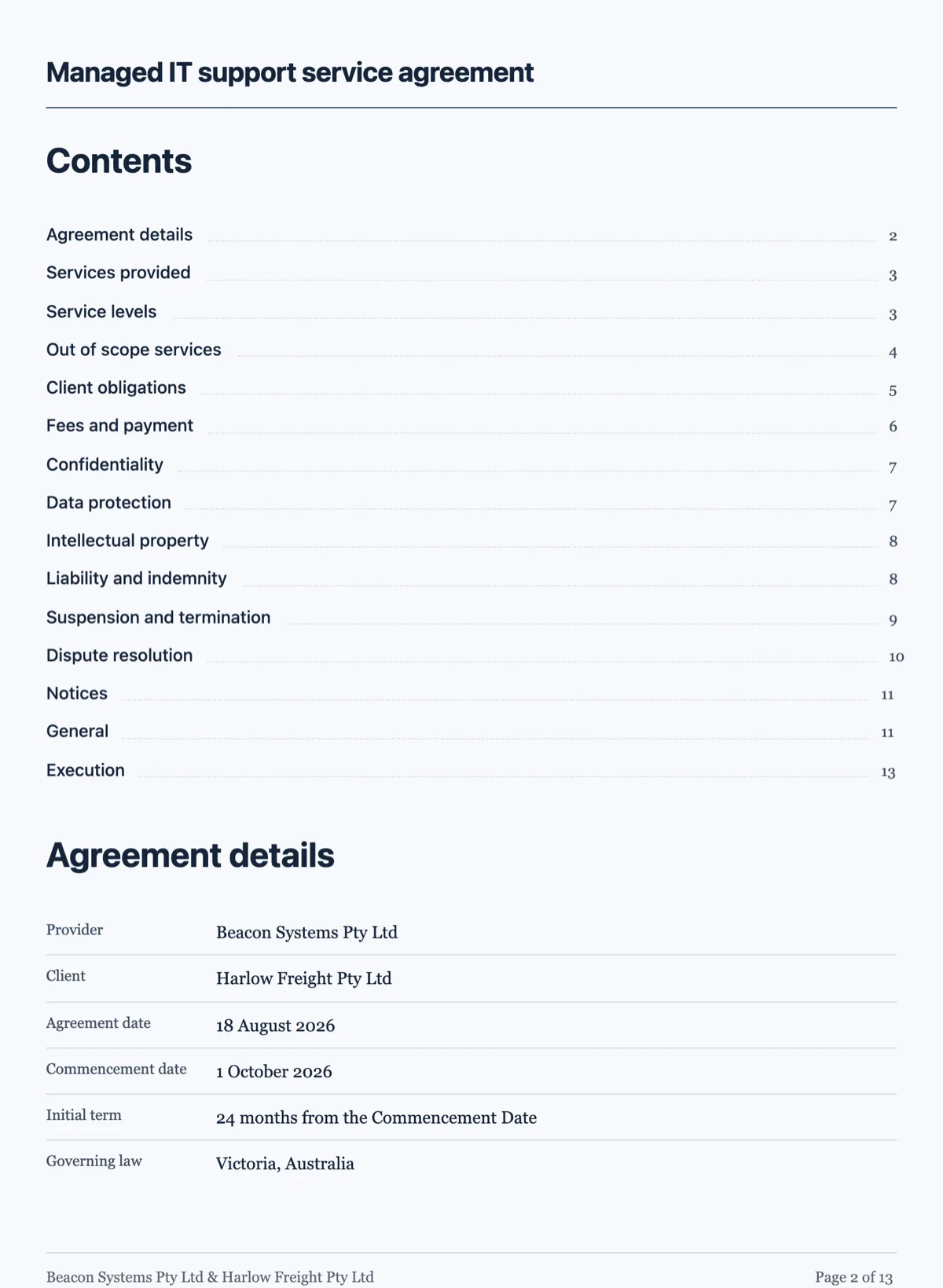 Service agreement template with scope, service levels and an exitA service agreement template has to say what is supplied, how well, for what fee, who is liable for what, and how either side gets out. This one is filled in for Beacon Systems supporting Harlow Freight's IT for an initial 24 months from 1 October 2026 at $8,400 a month plus GST, with 40 hours included and $220 an hour beyond them. Twelve numbered clauses cover the services, a four level severity table, client duties, fees with a CPI adjustment, confidentiality, privacy, IP, a liability cap, termination and a three step dispute ladder under Victorian law.
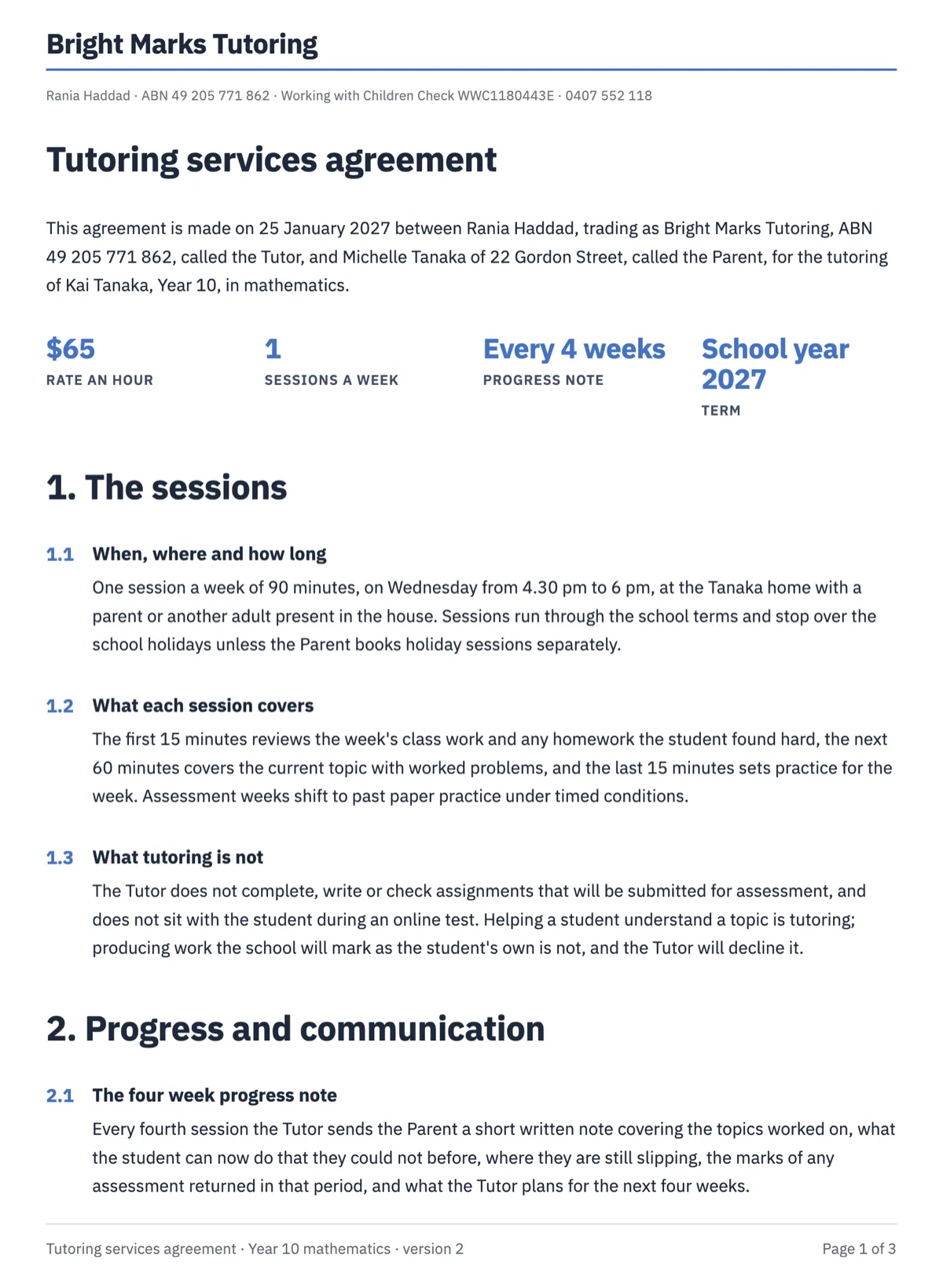 Tutoring agreement template with weekly sessions and progress notesParents pay for tutoring and then wait months to find out whether it is working. This agreement puts a written progress note every four weeks, prices the whole school year term by term, and carries the tutor's working with children check number so a parent can verify it in a minute.
Questions people ask
What makes a term unfair under the Consumer Rights Act?
A term is unfair if, contrary to good faith, it causes a significant imbalance in the parties' rights and obligations to the consumer's detriment. Courts look at the subject matter, the circumstances when the contract was made and the other terms, and must consider fairness even if nobody raises it.
Does UCTA apply to consumers?
Not any more for most purposes. Since 1 October 2015, consumer contracts are governed by the Consumer Rights Act 2015, and the Unfair Contract Terms Act 1977 deals with exclusions and limits between businesses and some non contractual notices. Non contractual notices to consumers are covered by the 2015 Act too.
What is the grey list?
Part 1 of Schedule 2 to the Consumer Rights Act lists 20 kinds of term that may be regarded as unfair, such as terms letting the trader change the price or service without reason, or making the consumer pay a disproportionate sum on breach. They are examples, not automatic findings.
Is a no refund policy unfair in the UK?
A blanket no refunds term is very likely unfair if it keeps money for services not provided and does not compensate the consumer equally when the trader cancels. It also cannot remove statutory rights, such as the 14 day cancellation right for many online and distance contracts.
Is the price ever assessed for fairness?
Not if the price term is transparent and prominent: the court will not judge whether a price is good value. But hidden or ancillary charges that are not prominent, and terms letting the price change later, can be assessed like any other term.
Put the clause in a finished document
The button opens the document generator with a starting description already filled in. Change it to match your own agreement before you run it.
Create a document with OneCraftRelated clauses
- Unfair contract terms in South Africa under the Consumer Protection ActUnfair contract terms in South Africa: Consumer Protection Act sections 48, 49 and 51, plain language under section 22, and three gym clauses rewritten.
- Unfair contract terms in Ireland under the Consumer Rights Act 2022Unfair contract terms in Ireland: Part 4 of the Consumer Rights Act 2022, the Schedule 5 blacklist and grey list, and three broadband terms rewritten.
- Exclusion clause: UK sample wording and the statutory limitsHow a UK exclusion clause works under the Unfair Contract Terms Act 1977 and the Consumer Rights Act 2015, with a sample for an IT support firm and the bans.
- Cooling off period clause: statutory and contractual versionsA cooling off period clause gives a party time to cancel after signing. Sample wording, the statutory periods in Australia and the UK, and contractual versions.
For everything the document generator can do, see the document maker.
Step by step in the builder: Create a document with AI, then Document builder components.
Written and checked by the OneCraft team. Last checked .