Contract clause
Unfair contract terms in Ireland under the Consumer Rights Act 2022
Under Part 4 of Ireland's Consumer Rights Act 2022, a term in a consumer contract is unfair if, contrary to good faith, it causes a significant imbalance in the parties' rights and obligations to the consumer's detriment. An unfair term does not bind the consumer, and the Act adds a list of terms that are always unfair.
Ireland rewrote its unfair terms law in the Consumer Rights Act 2022, which took effect on 29 November 2022. It keeps the good faith and significant imbalance test, extends it to negotiated terms as well as standard ones, and adds a blacklist of terms that are always unfair alongside a grey list presumed to be. The CCPC enforces it.
Nuwan Madhusanka · Co-founder
4 min read · Published
Sample clause
Written for contract terms of Corrib Fibre, a fictional Galway broadband provider, revised under Part 4 of the 2022 Act.
Your Broadband Agreement. 1. Price during the minimum term. The monthly charge of €45 is fixed for the 12 month minimum term. Any price change after the minimum term is notified at least one month in advance, and the Customer may leave without charge before it applies. 2. Ending the contract. After the minimum term the Customer may end the contract on 30 days' notice by phone, email or the online account. 3. Outages. If the service is unavailable for more than 24 consecutive hours because of a fault on the Corrib Fibre network, the Customer receives a credit for each full day of outage, without needing to claim it. This does not limit the Customer's statutory rights.
Sample wording, not legal advice.
Variants
Consumer contract
Terms between a trader and an individual acting outside their trade, whether standard form or individually negotiated, since the 2022 Act covers both.
Nothing in these terms affects the Customer's rights under the Consumer Rights Act 2022 or any other law that protects consumers.
Blacklisted term removed
A term on the list in Schedule 5 that is always unfair, such as one excluding liability for death or personal injury caused by the trader's act or omission.
Corrib Fibre is responsible for loss caused by its negligence in installing or maintaining equipment at the Customer's premises.
Grey listed term rebalanced
A term on the grey list presumed unfair, such as one letting the trader change the price without a right for the consumer to cancel, rewritten with notice and an exit.
Corrib Fibre may change the monthly charge after the minimum term by giving at least one month's notice, and the Customer may cancel without charge before the change applies.
What to negotiate
The trader bears the burden on grey list terms
A grey listed term is presumed unfair unless the trader shows it is fair, which turns the old position around. A provider that wants to keep a price variation term should be ready to show why it is needed and what the consumer gets in return, such as notice and a free exit.
Negotiated terms are covered too
Unlike the 1995 regulations it replaced, Part 4 applies to individually negotiated consumer terms, not only standard form ones. A trader cannot avoid the test by pointing to a negotiation; the question is still whether the term causes a significant imbalance contrary to good faith.
Transparency means more than plain words
A written term must be in plain and intelligible language, legible and prominent, and a term that is not transparent can be found unfair for that reason. Where the meaning is unclear, the interpretation most favourable to the consumer prevails, so vague wording rarely helps the trader.
The risk of leaving it out
Leaving older terms in place after the 2022 Act means relying on terms that may now be blacklisted, and therefore always unfair, or grey listed with the burden on the trader. Those terms do not bind consumers, and the CCPC can seek court orders and use its enforcement powers against a practice that affects every customer on the same terms.
Part 4 of the Consumer Rights Act 2022
Ireland's Consumer Rights Act 2022 rebuilt the old 1995 regime in its Part 4. A consumer is not bound by a term that, measured against good faith, tilts the bargain heavily against them, and a court weighs what is being supplied, how the deal was made and the other terms of the contract. Price and main subject matter terms escape that review only when they are transparent and prominent. If a term falls away, the rest of the agreement keeps running where it can.
Blacklist and grey list against the rewrites
Corrib Fibre's old terms let it raise the price during the fixed term, required 90 days' notice by registered post to cancel, and excluded liability for any outage. The price rise during the term mirrors a grey list item on altering the price without a right to cancel. The notice rule mirrors terms imposing disproportionate formalities on the consumer. The blanket outage exclusion limits the consumer's remedies for the trader's failure, another grey list concern, and could not exclude liability for injury at all. The sample fixes the price for the term, simplifies cancellation and adds automatic credits. Law checked on 21 October 2026. This page explains how the law works and is not legal advice.
Who enforces it
The Competition and Consumer Protection Commission enforces Part 4 and can apply to court for orders, while the Commission for Communications Regulation oversees telecoms providers' customer terms alongside it. Consumers can rely on the Act directly in a dispute, including in the Small Claims procedure for lower value claims. The CCPC's guidance for businesses explains the lists with examples.
Where the clause sits in a generated document
Service agreements, subscription terms and privacy notices are where consumer terms appear. When asking the AI document generator for consumer terms, give it the minimum term, the price rule, the cancellation method and any service credits, and ask for a line that statutory rights are not affected, so the document starts from a fair position.
Documents that carry this clause
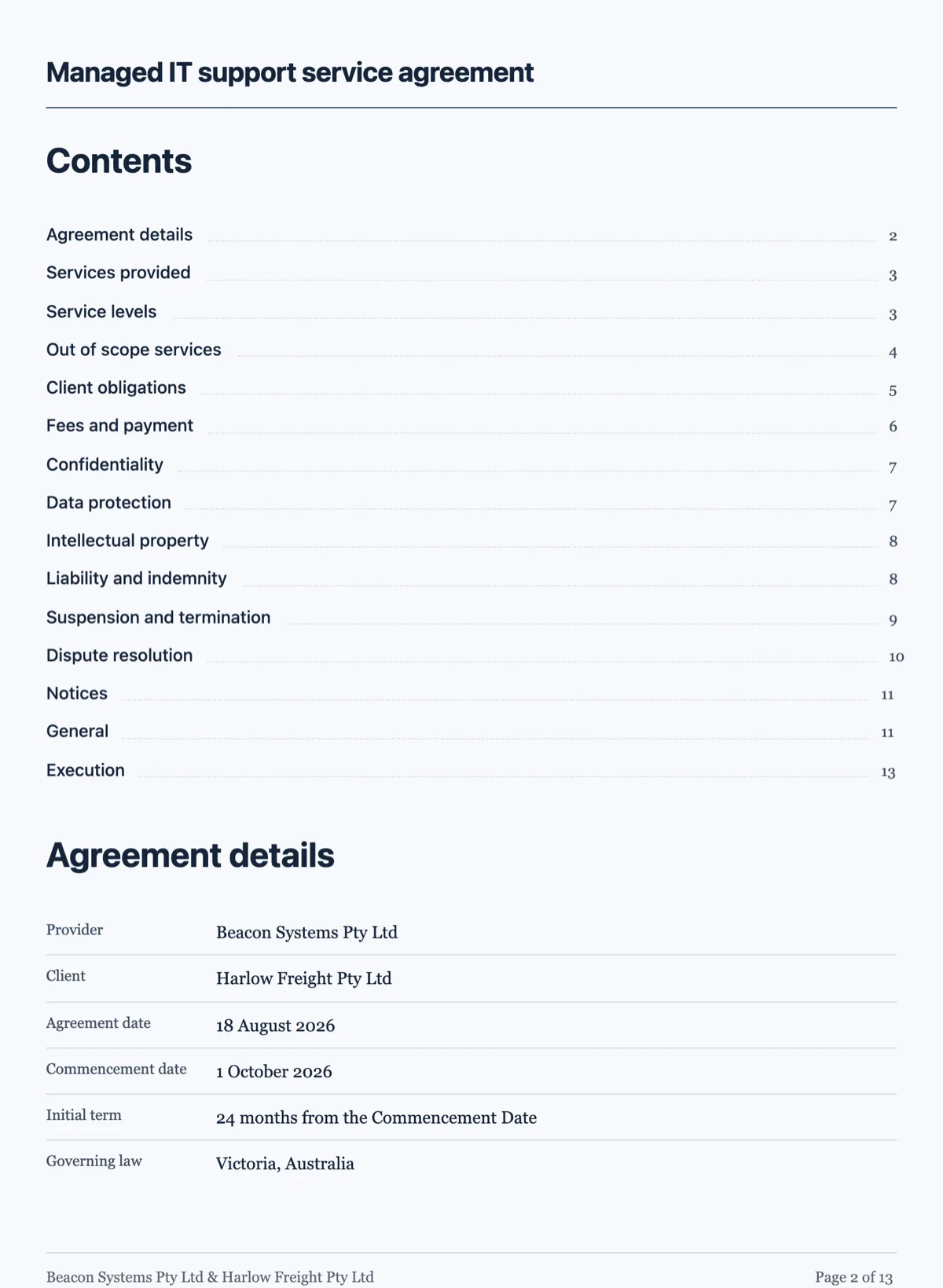 Service agreement template with scope, service levels and an exitA service agreement template has to say what is supplied, how well, for what fee, who is liable for what, and how either side gets out. This one is filled in for Beacon Systems supporting Harlow Freight's IT for an initial 24 months from 1 October 2026 at $8,400 a month plus GST, with 40 hours included and $220 an hour beyond them. Twelve numbered clauses cover the services, a four level severity table, client duties, fees with a CPI adjustment, confidentiality, privacy, IP, a liability cap, termination and a three step dispute ladder under Victorian law.
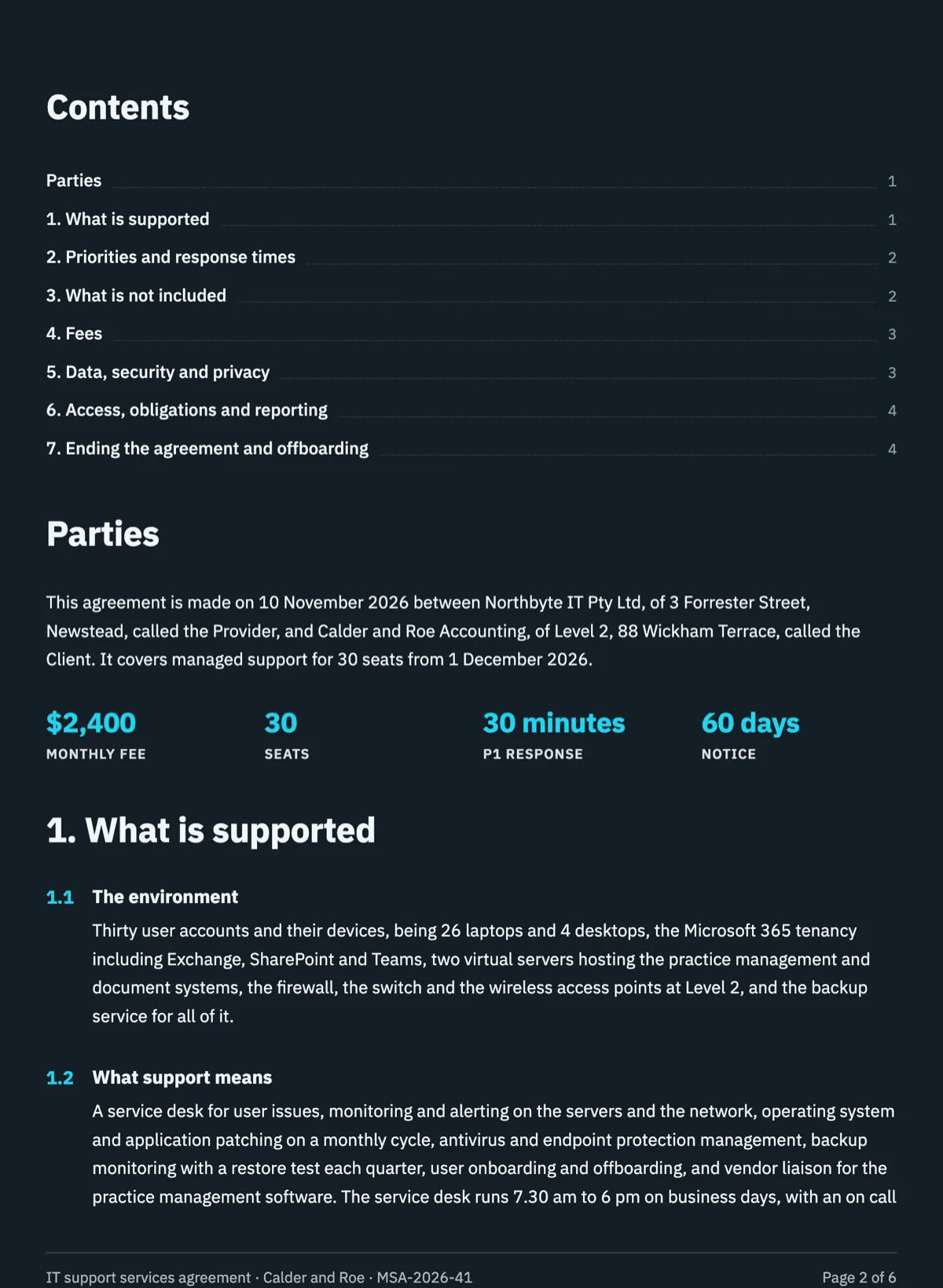 IT support services agreement with response times by priorityManaged support is sold on a monthly fee and judged on how fast the phone gets answered when nobody can work. This agreement grades every ticket into four priorities with a published response and resolution target, credits the fee when the target is missed, and writes down exactly what the provider hands back on the way out.
Questions people ask
What is an unfair term in Irish consumer law?
A term that, contrary to good faith, causes a significant imbalance in the parties' rights and obligations to the consumer's detriment, judged under Part 4 of the Consumer Rights Act 2022. It applies to standard and negotiated consumer terms, and an unfair term does not bind the consumer.
What is the blacklist?
A list in Schedule 5 to the 2022 Act of terms that are always unfair, whatever the circumstances. A separate grey list sets out terms presumed unfair unless the trader shows otherwise. Before 2022 Ireland had only an indicative list, so the blacklist was a significant change.
Can a provider raise prices mid contract in Ireland?
A term letting the trader increase the price without giving the consumer a right to cancel is on the grey list and presumed unfair. Telecoms contracts also have sector rules on notice and the right to exit. Fixing the price for the minimum term avoids the problem.
When did the Consumer Rights Act 2022 start?
Most of the Act, including Part 4 on unfair terms, took effect on 29 November 2022. It replaced the European Communities (Unfair Terms in Consumer Contracts) Regulations 1995 for contracts made from that date, and it applies to terms in contracts made after it commenced.
Does the Act cover business to business contracts?
No. Part 4 protects consumers dealing with traders. Contracts between businesses are governed by general contract law and, for exclusions of liability in some sales of goods, the Sale of Goods and Supply of Services Act 1980. This page is about consumer terms only.
Put the clause in a finished document
The button opens the document generator with a starting description already filled in. Change it to match your own agreement before you run it.
Create a document with OneCraftRelated clauses
- Consignment clause: sample wording for Australian suppliersConsignment clause sample for Australian suppliers: title stays with the maker, the sale split and payment date, unsold stock, and PPSR registration.
- Territory clause: sample wording for distribution and licencesTerritory clause sample for distribution, agency and licence deals: defining the area, exclusive or sole rights, online sales and competition law limits.
- Unfair contract terms in the UK: the Consumer Rights Act testUnfair contract terms in the UK: the Consumer Rights Act 2015 fairness test, the Schedule 2 grey list, core term exemptions and three course terms rewritten.
- Auto renewal clauseAn auto renewal clause rolls a contract over unless someone opts out in time. Sample wording, fairer versions, and the Australian unfair contract terms risk.
For everything the document generator can do, see the document maker.
Step by step in the builder: Create a document with AI, then Document builder components.
Sources
Written and checked by the OneCraft team. Last checked .