Contract clause
Unfair contract terms in South Africa under the Consumer Protection Act
Under South Africa's Consumer Protection Act 68 of 2008, a supplier must not offer or enforce a term that is unfair, unreasonable or unjust, risky terms must be drawn to the consumer's attention in plain language before the agreement, and some terms are prohibited outright. A court can strike out or sever such a term.
South Africa's Consumer Protection Act controls contract terms in three layers: section 48 bans unfair, unreasonable or unjust terms, section 49 requires risky terms such as waivers to be drawn to the consumer's attention, and section 51 makes some terms void whatever their wording. Plain language under section 22 runs through all three.
Indunil Asanka · Co-founder
4 min read · Published
Sample clause
Written for membership terms of Braamfontein Fit, a fictional Johannesburg gym, rewritten for the Consumer Protection Act.
IMPORTANT: PLEASE READ AND INITIAL. 1. Risk of injury. Exercise carries a risk of injury. Braamfontein Fit is not responsible for injury caused by the Member's own actions or a medical condition the Member did not disclose. Braamfontein Fit remains responsible for injury caused by its gross negligence or faulty equipment it should have repaired. Member's initials: ____ 2. Term and renewal. The membership runs for 12 months. Braamfontein Fit will notify the Member between 40 and 80 business days before it ends; it then continues month to month unless the Member cancels. 3. Cancellation. The Member may cancel on 20 business days' written notice. A cancellation fee may be charged only to cover the reasonable cost of the remaining joining discount, and never more than one month's fee.
Sample wording, not legal advice.
Variants
Consumer agreement
Standard terms with individuals, and with businesses whose asset value or annual turnover is below the threshold set under the Act.
The Member may cancel this fixed term membership at any time on 20 business days' written notice, subject only to a reasonable cancellation charge.
Franchise agreement
Franchise agreements, which the Act brings into its consumer protections and which must meet its disclosure and cooling off requirements.
The Franchisee may cancel this agreement without cost or penalty within 10 business days after signing, by written notice to the Franchisor.
Business contract outside the Act
Agreements with larger juristic persons above the threshold, governed by the common law of contract and public policy.
Neither party is liable to the other for indirect or consequential loss, except loss caused by gross negligence, fraud or wilful misconduct.
What to negotiate
Notice of risky terms is a form requirement
Section 49 says a term that limits the supplier's risk, makes the consumer assume a risk or acknowledge a fact must be written in plain language, drawn to the consumer's attention in a conspicuous way, and the consumer must have had an adequate opportunity to understand it. Bold headings and an initial block are how most suppliers show that.
Fixed terms are capped
Section 14 limits fixed term consumer agreements to 24 months unless a longer period is to the consumer's demonstrable financial benefit, lets the consumer cancel on 20 business days' notice, and requires the supplier to remind the consumer 40 to 80 business days before the term expires. A gym contract that ignores these rules is exposed whatever its other wording says.
Some terms are simply void
Section 51 lists terms a supplier must not include, such as terms that defeat the purposes of the Act, waive the consumer's rights, or exclude liability for the supplier's gross negligence. A term on that list is void even if the consumer initialled it. Regulation 44 adds a grey list of terms presumed to be unfair.
The risk of leaving it out
A supplier that keeps old standard terms after the Consumer Protection Act faces two problems. The risky terms it relies on, such as liability waivers, fail if they were not drawn to the consumer's attention, and prohibited terms are void outright. The National Consumer Commission and the consumer courts can also act against the supplier's practices, not just the single contract.
Sections 48, 49 and 51 as a checklist
Section 48 prohibits offering goods or services on terms that are unfair, unreasonable or unjust, including terms excessively one sided in the supplier's favour or so adverse to the consumer as to be inequitable. Section 49 sets the notice rules for terms that limit the supplier's risk or put a risk on the consumer. Section 51 lists prohibited terms that are void. Read together they make a three question checklist: is the term fair, was the consumer told about it properly, and is it on the prohibited list. Law checked on 21 October 2026. This page explains how the law works and is not legal advice.
Three gym clauses tested
Braamfontein Fit's old terms waived all liability for injury, including the gym's own negligence, renewed the 24 month contract automatically for another 24 months, and charged three months' fees as a cancellation penalty. The blanket waiver fails section 51 to the extent it covers gross negligence and section 49 if it was not drawn to the member's attention. The automatic renewal ignores section 14's notice and month to month rule. The penalty is far beyond a reasonable charge. The sample keeps the gym's protection for risks the member controls and adds the notices the Act requires.
Plain language under section 22
Section 22 requires notices, documents and visual representations to be in plain language, meaning an ordinary consumer of the class it is meant for, with average literacy and minimal experience, could understand the content, significance and import of the document without undue effort. Long sentences, legal jargon and cross references to other documents count against a term. Short numbered clauses with headings help both plain language and the section 49 notice.
Where the clause sits in a generated document
Liability waivers, membership terms and service agreements are where these terms appear. When asking the AI document generator for one, ask for a bold notice heading above the risk terms, an initials line beside each, and the cancellation and renewal rules from section 14, and keep the language short.
Documents that carry this clause
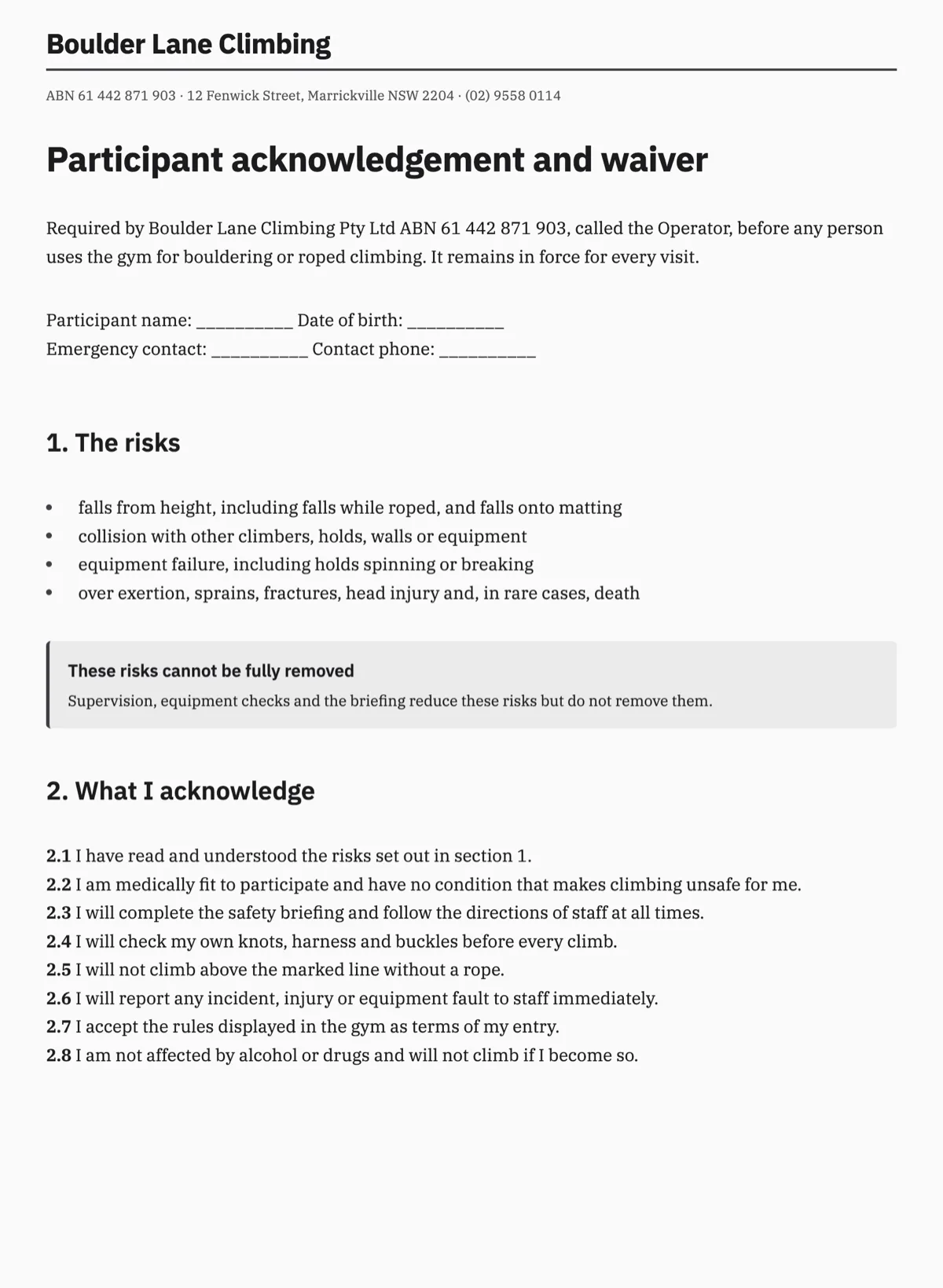 Liability waiver template written for Australian recreational servicesMost waivers in Australia are copies of American forms and exclude things that cannot be excluded, which makes the whole document weaker. This one names the real risks, takes the acknowledgements one by one, and uses the recreational services exclusion the way the consumer law actually permits, with a guardian block for minors.
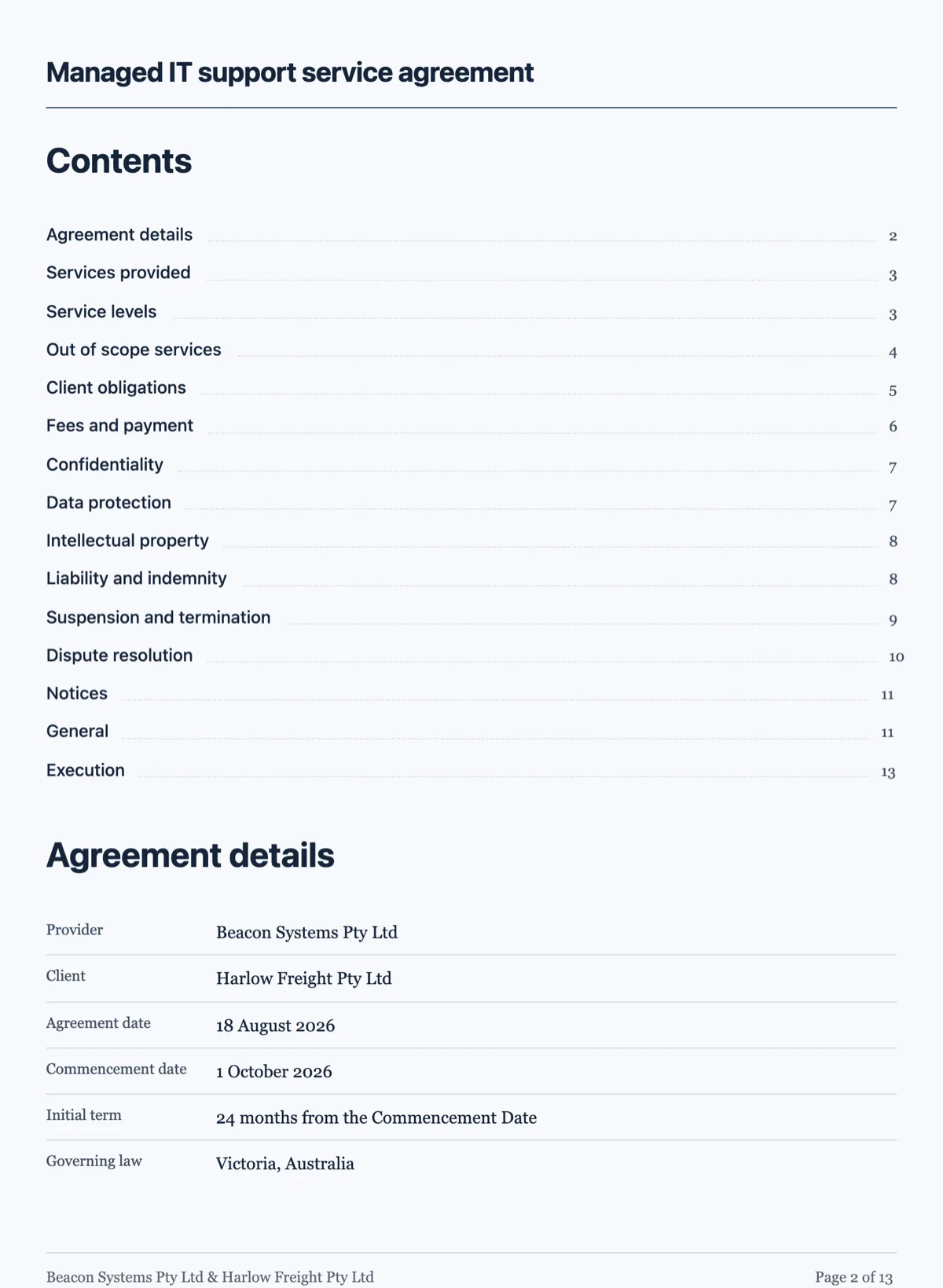 Service agreement template with scope, service levels and an exitA service agreement template has to say what is supplied, how well, for what fee, who is liable for what, and how either side gets out. This one is filled in for Beacon Systems supporting Harlow Freight's IT for an initial 24 months from 1 October 2026 at $8,400 a month plus GST, with 40 hours included and $220 an hour beyond them. Twelve numbered clauses cover the services, a four level severity table, client duties, fees with a CPI adjustment, confidentiality, privacy, IP, a liability cap, termination and a three step dispute ladder under Victorian law.
Questions people ask
What is an unfair term under the CPA?
A term that is excessively one sided in favour of the supplier, or so adverse to the consumer as to be inequitable, or otherwise unfair, unreasonable or unjust under section 48. Terms obtained through misleading statements, or not properly drawn to the consumer's attention, can also be unfair.
Do I have to initial a waiver clause?
The Act does not demand initials as such, but section 49 requires a risky term to be drawn to the consumer's attention conspicuously and the consumer to have an adequate chance to understand it. Initialling beside the term is the usual way suppliers prove that happened.
Can a gym charge a cancellation penalty in South Africa?
Only a reasonable one. Under section 14 a consumer may cancel a fixed term agreement on 20 business days' notice, and the supplier may charge a reasonable cancellation penalty, judged by factors such as the time left on the contract and the supplier's real costs. Several months' fees is unlikely to qualify.
Does the CPA apply to business customers?
It protects natural persons and juristic persons whose asset value or annual turnover is below the threshold the Minister sets, so many small businesses are covered. Larger businesses are not, and their contracts are judged under the common law of contract instead.
Where can a consumer complain about an unfair term?
To the supplier first, then to the relevant ombud where one exists, a provincial consumer protector or consumer court, or the National Consumer Commission. The Commission can investigate and refer matters to the National Consumer Tribunal, which can declare conduct prohibited and impose fines.
Put the clause in a finished document
The button opens the document generator with a starting description already filled in. Change it to match your own agreement before you run it.
Create a document with OneCraftRelated clauses
- Unfair contract terms in Ireland under the Consumer Rights Act 2022Unfair contract terms in Ireland: Part 4 of the Consumer Rights Act 2022, the Schedule 5 blacklist and grey list, and three broadband terms rewritten.
- Consignment clause: sample wording for Australian suppliersConsignment clause sample for Australian suppliers: title stays with the maker, the sale split and payment date, unsold stock, and PPSR registration.
- Unfair contract terms in the UK: the Consumer Rights Act testUnfair contract terms in the UK: the Consumer Rights Act 2015 fairness test, the Schedule 2 grey list, core term exemptions and three course terms rewritten.
- Release clause: giving up claims for goodA release clause gives up claims one party has against another. Australian sample wording for a building settlement and the unknown claims problem.
For everything the document generator can do, see the document maker.
Step by step in the builder: Create a document with AI, then Document builder components.
Sources
Written and checked by the OneCraft team. Last checked .