Contract clause
Unfair contract terms in Australia: the test and three rewrites
An unfair contract term is a term in a standard form consumer or small business contract that causes a significant imbalance in the parties' rights, is not reasonably necessary to protect the business's legitimate interests, and would cause detriment if relied on. Under the Australian Consumer Law such a term is void.
Australian law voids unfair terms in standard form contracts with consumers and small businesses, and since 9 November 2023 it is also illegal to propose, use or rely on one. The test asks about imbalance, legitimate interest and detriment, and a term's transparency weighs heavily in the answer.
Nuwan Madhusanka · Co-founder
4 min read · Published
Sample clause
Written for membership terms of Swan River Fitness, a fictional Perth gym, rewritten after a review found three terms likely to be unfair.
Membership Terms. (a) Renewal. The membership runs for 12 months. The Gym will remind the Member in writing at least 30 days before it ends; if the Member does nothing it continues month to month, and the Member may cancel at any time on 30 days' notice without a fee. (b) Price changes. The Gym may change the monthly fee once a year by giving at least 30 days' written notice. A Member who does not accept the new fee may cancel before it applies and pay nothing more. (c) Responsibility. The Gym is responsible for loss or injury caused by its negligence or by equipment it failed to maintain. It is not responsible for loss caused by the Member's failure to follow staff instructions or posted safety rules. (d) This clause does not limit any right the Member has under the Australian Consumer Law.
Sample wording, not legal advice.
Variants
Consumer contract
Standard terms offered to individuals buying goods or services for personal use, such as gym, phone or streaming memberships.
Either party may end this agreement on 30 days' written notice. If the Supplier ends it for a reason other than the Customer's breach, the Supplier refunds any fees paid for the period after it ends.
Small business contract
Standard terms offered to a business with fewer than 100 employees or turnover under $10 million, such as software, equipment hire or franchise supply terms.
The Supplier may vary these terms only to reflect a change in law or a change in its costs, by giving at least 30 days' written notice describing the change. If the change is to the Customer's detriment, the Customer may end this agreement before it takes effect without any charge.
Terms the law excludes
The terms that define the main subject matter of the contract, or set the upfront price disclosed before signing, which are not tested for fairness.
The membership gives access to the gym floor and group classes listed in Schedule 1 for $39 a week, payable fortnightly in advance by direct debit.
What to negotiate
Transparency changes the answer
A term that is expressed in plain language, legible, presented clearly and readily available is less likely to be found unfair. A renewal that runs on silently, hidden on page nine, is a different term from one with a written reminder and a free exit. Rewriting often means adding notice and an exit, not deleting the right.
Show the legitimate interest
The business must show why a term is reasonably necessary to protect its legitimate interests. A gym can explain why it needs notice before a member leaves; it will struggle to explain why it can change the price at will with no exit. Write down the interest each one sided term protects before relying on it.
Penalties now attach to proposing the term
Since 9 November 2023, putting an unfair term in a standard form contract can attract civil penalties, for a company the greater of $50 million, three times the benefit obtained, or 30% of turnover during the breach period. Reviewing standard terms is cheaper than defending one in court.
The risk of leaving it out
A business that never reviews its standard terms for fairness runs two risks at once. A court can declare a term void, so the business loses the right it thought it had, such as the price change or the liability limit. Since November 2023 it can also face civil penalties for having proposed the term at all, and every customer who signed the same form is affected.
The three part test
Section 24 of the Australian Consumer Law, in Schedule 2 to the Competition and Consumer Act 2010, says a term is unfair if it would cause a significant imbalance in the parties' rights and obligations, is not reasonably necessary to protect the legitimate interests of the party advantaged by it, and would cause detriment to a party if applied or relied on. All three must be met. A court looks at the contract as a whole and at transparency. The business has to prove the legitimate interest; the other two elements fall on the person challenging the term. Law checked on 21 October 2026. This page explains how the law works and is not legal advice.
Three gym clauses tested
Swan River Fitness's old terms rolled the membership over for another 12 months with no reminder, let the gym raise the fee whenever it chose, and excluded liability for injury however caused. The silent rollover traps members into a second year: imbalance and detriment are plain, and no interest needs it. The open price change gives the gym all the flexibility and the member none. The blanket exclusion removes rights the law gives and would cause detriment the first time equipment failed. The sample keeps the gym's real interests, a predictable term and the ability to pass on costs, while adding notice and a free exit.
Which contracts are covered
The regime applies to standard form contracts, ones prepared by one party with little or no chance to negotiate, for consumers and for small businesses. Since November 2023 a small business is one with fewer than 100 employees or turnover under $10 million, and there is no longer a cap on the contract's value. Section 25 lists examples of terms that may be unfair, including one sided rights to vary, renew or terminate, penalties on one party only, and limits on one party's right to sue. Insurance contracts follow their own rules, and financial products are covered under the ASIC Act.
Where the clause sits in a generated document
Service agreements, membership terms and price lists all carry terms of this kind. When asking the AI document generator for standard terms, describe the notice period, the price change rule and the exit right in the prompt, so the clauses come out with them, and keep a short liability clause that does not exclude rights the Australian Consumer Law gives.
Documents that carry this clause
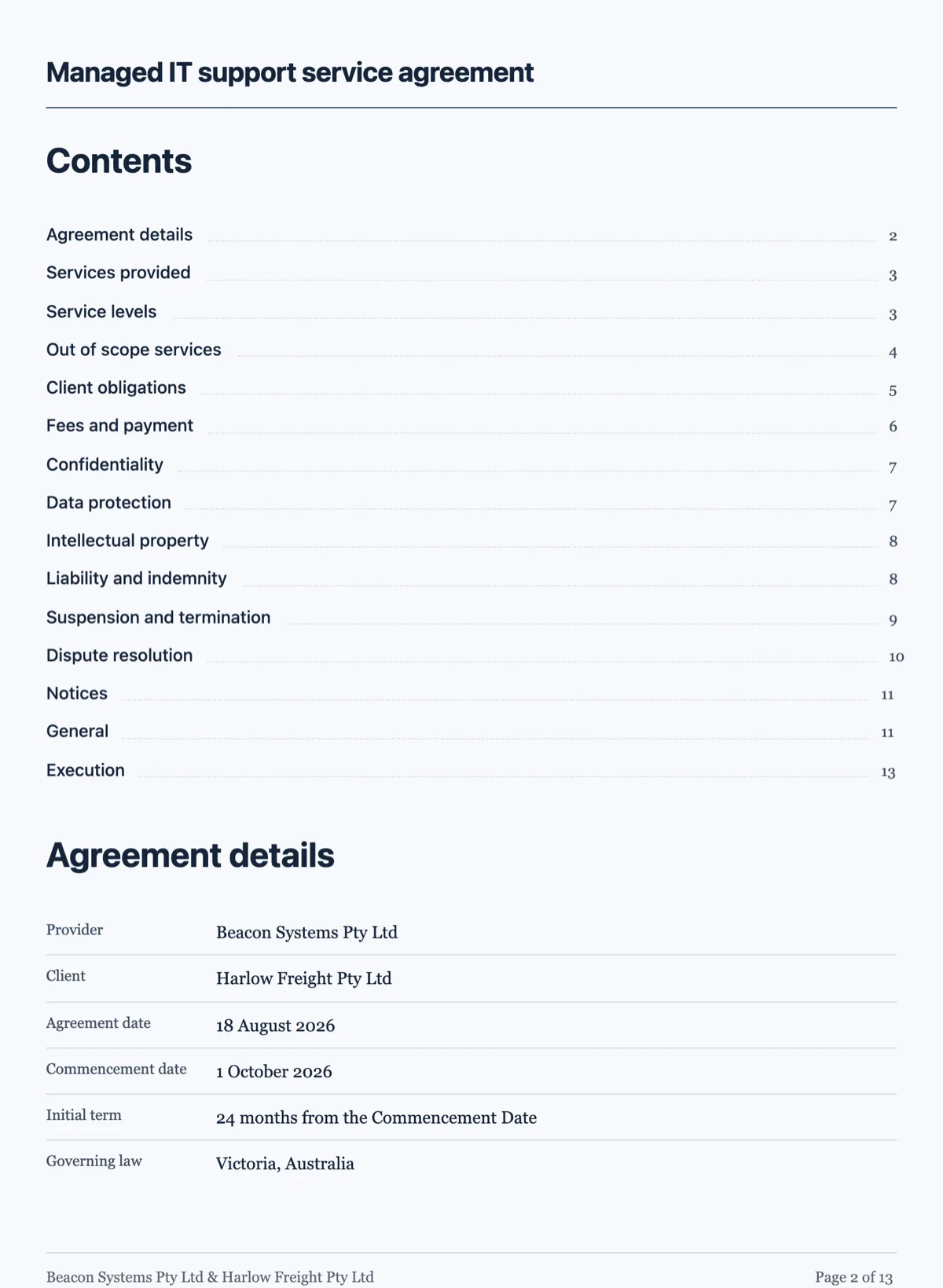 Service agreement template with scope, service levels and an exitA service agreement template has to say what is supplied, how well, for what fee, who is liable for what, and how either side gets out. This one is filled in for Beacon Systems supporting Harlow Freight's IT for an initial 24 months from 1 October 2026 at $8,400 a month plus GST, with 40 hours included and $220 an hour beyond them. Twelve numbered clauses cover the services, a four level severity table, client duties, fees with a CPI adjustment, confidentiality, privacy, IP, a liability cap, termination and a three step dispute ladder under Victorian law.
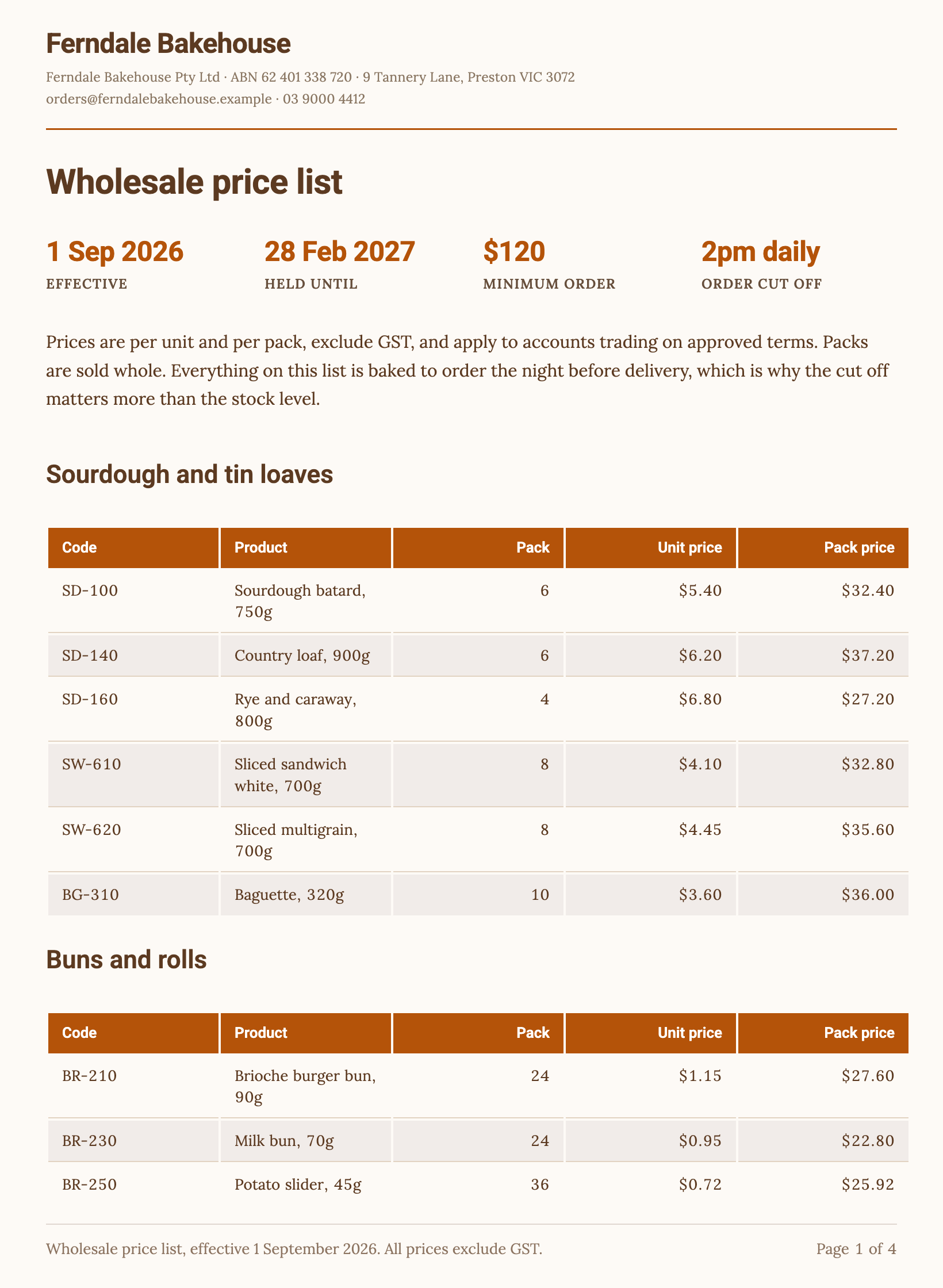 Wholesale price listA bakehouse sells to cafes, so the price that matters is the pack price, not the unit price. This list shows both for seventeen products, then the four things that decide what a cafe actually pays: volume, zone, cut off and terms.
Questions people ask
What makes a contract term unfair in Australia?
It must cause a significant imbalance in the parties' rights, not be reasonably necessary to protect the legitimate interests of the business that benefits, and cause detriment if relied on. Courts also weigh transparency. The test applies only to standard form contracts with consumers or small businesses.
Does the law cover small business contracts?
Yes. Since 9 November 2023 it covers standard form contracts where at least one party has fewer than 100 employees or annual turnover under $10 million, whatever the value of the contract. Before then the thresholds were narrower and depended on the contract value.
What are the penalties for unfair terms?
Since November 2023 a company that proposes, uses or relies on an unfair term in a standard form contract can face a civil penalty of up to the greater of $50 million, three times the benefit gained, or 30% of adjusted turnover during the breach period. Individuals face lower maximums.
Can a business still have a cancellation fee?
Yes, if it reflects a legitimate interest such as the real cost of an early exit, is transparent, and applies fairly. A fee that is out of proportion to the loss, or charged only to the customer while the business can cancel freely, is the kind of term section 25 flags.
Is the price an unfair term?
The upfront price disclosed before the contract is made, and the terms that define the main subject matter, are excluded from the fairness test. A term letting the business change the price later is not excluded, which is why price variation clauses are a common target of the regulators.
Put the clause in a finished document
The button opens the document generator with a starting description already filled in. Change it to match your own agreement before you run it.
Create a document with OneCraftRelated clauses
- Unfair contract terms in New Zealand: the Fair Trading Act testUnfair contract terms in NZ: section 26A of the Fair Trading Act, small trade contracts since August 2022, the court declaration step and three rewrites.
- Unfair contract terms in the UK: the Consumer Rights Act testUnfair contract terms in the UK: the Consumer Rights Act 2015 fairness test, the Schedule 2 grey list, core term exemptions and three course terms rewritten.
- Consumer guarantees clause under the Australian Consumer LawA consumer guarantees clause tells customers the Australian Consumer Law guarantees apply and cannot be excluded. Sample warranty wording and what it must say.
- Auto renewal clauseAn auto renewal clause rolls a contract over unless someone opts out in time. Sample wording, fairer versions, and the Australian unfair contract terms risk.
For everything the document generator can do, see the document maker.
Step by step in the builder: Create a document with AI, then Document builder components.
Written and checked by the OneCraft team. Last checked .