Contract clause
Retention of title clause in the UK: a Romalpa sample
A UK retention of title clause, often called a Romalpa clause, keeps ownership of goods with the seller until the buyer has paid. The Sale of Goods Act 1979 allows it, and a simple clause over the goods themselves needs no registration, unlike an Australian or New Zealand one.
In the UK a seller can keep title to goods until it is paid, under section 19 of the Sale of Goods Act 1979, and a clause that keeps title to the goods themselves does not need registering at Companies House. Stretch it to the proceeds of resale or to new products made from the goods and the courts treat it as a charge, which fails if unregistered.
Indunil Asanka · Co-founder
4 min read · Published
Sample clause
Written for terms of sale of Don Steel Stockholders, a fictional Sheffield steel supplier selling to fabrication workshops on 30 day credit.
Retention of Title. (a) Title to the Goods remains with the Seller until the Buyer has paid in full for the Goods and all other sums then due from the Buyer to the Seller on any account. (b) Until title passes, the Buyer holds the Goods as the Seller's bailee, stores them separately from other goods, keeps them marked as the Seller's property and insures them for their full price. (c) The Buyer may use or resell the Goods in the ordinary course of its business before title passes, but the Seller's right to recover unsold Goods continues. (d) If the Buyer fails to pay when due or becomes subject to an insolvency event, the Seller may enter the Buyer's premises on notice to recover any Goods still in the Buyer's possession that have not been resold or incorporated into other products.
Sample wording, not legal advice.
Variants
Simple clause, goods only
The usual starting point: title to each delivery stays with the seller until that delivery is paid for.
Title to the Goods in each delivery passes to the Buyer only when the price of that delivery has been paid in full.
All monies clause
A supplier with a running account who wants title to stay until every invoice is paid, not just the invoice for those goods.
Title to all Goods supplied remains with the Seller until the Buyer has paid all sums owing to the Seller on any account, whether or not due.
Extended clause, and why it fails
A clause claiming the proceeds of resale or new products made with the goods, which courts usually treat as a charge needing registration.
The Buyer holds the proceeds of any resale of the Goods on trust for the Seller up to the amount owing. (Unless registered as a charge, a clause like this is likely to be void against an administrator or liquidator.)
What to negotiate
Identification decides recovery
A seller can only recover goods it can identify as its own and that are still in the buyer's hands in their original form. Steel cut into brackets or mixed with other stock is hard to claim. Requiring separate storage and marking, and keeping delivery records with batch numbers, is what turns a retention clause into recovered goods.
The administration moratorium
When a buyer goes into administration, Schedule B1 to the Insolvency Act 1986 stops a supplier repossessing goods under a retention of title agreement without the administrator's consent or the court's permission. The clause still matters, because the administrator must deal with the goods knowing they belong to the seller, but recovery is not immediate.
All monies wording
An all monies clause keeps title until the whole account is clear, which protects suppliers on running accounts where deliveries cannot be matched to invoices. The House of Lords upheld all monies retention in Armour v Thyssen, a Scottish appeal. Buyers often push back and ask for title to pass on payment for each delivery.
The risk of leaving it out
A UK supplier with no retention of title clause owns nothing once goods are delivered, even if unpaid. If the buyer fails, the supplier ranks as an unsecured creditor and usually recovers a small fraction of the debt, while its unpaid goods are sold for the benefit of the buyer's secured lenders and the costs of the insolvency.
Why the UK needs no registration for a simple clause
Under section 19 of the Sale of Goods Act 1979 a seller may reserve the right of disposal of goods until conditions, such as payment, are met, and property does not pass until they are. Because the buyer never owns the goods, it has created no charge over its own property, so the Companies Act 2006 registration regime for company charges in Part 25 does not apply. That is the key difference from Australia's PPSR and New Zealand's PPSR, where retention of title is a security interest that must be registered. Law checked on 21 October 2026. This page explains how the law works and is not legal advice.
Simple, all monies and extended clauses compared
A simple clause over the goods themselves is generally enforceable without registration. An all monies clause is also generally enforceable, following Armour v Thyssen. An extended clause claiming the proceeds of resale or products made with the goods is usually treated as a charge created by the buyer, because the buyer is giving the seller rights over property that became the buyer's. An unregistered charge is void against an administrator, liquidator or creditor, so extended clauses rarely help.
The cases behind the name
Aluminium Industrie Vaassen BV v Romalpa Aluminium Ltd, decided by the Court of Appeal in 1976, gave the clause its nickname by allowing a supplier to trace into resale proceeds on the facts. Later cases narrowed it: Re Bond Worth and Clough Mill v Martin show that rights over new products and proceeds are usually charges, while title to the original goods survives. Drafting today aims for the narrow, enforceable core.
Where the clause sits in a generated document
Terms of sale, distribution agreements and equipment sale agreements carry a retention of title clause. When asking the AI document generator for UK terms, ask for title to pass on full payment, storage and marking duties, a right of entry on notice and an all monies option, and leave out a claim to proceeds.
Documents that carry this clause
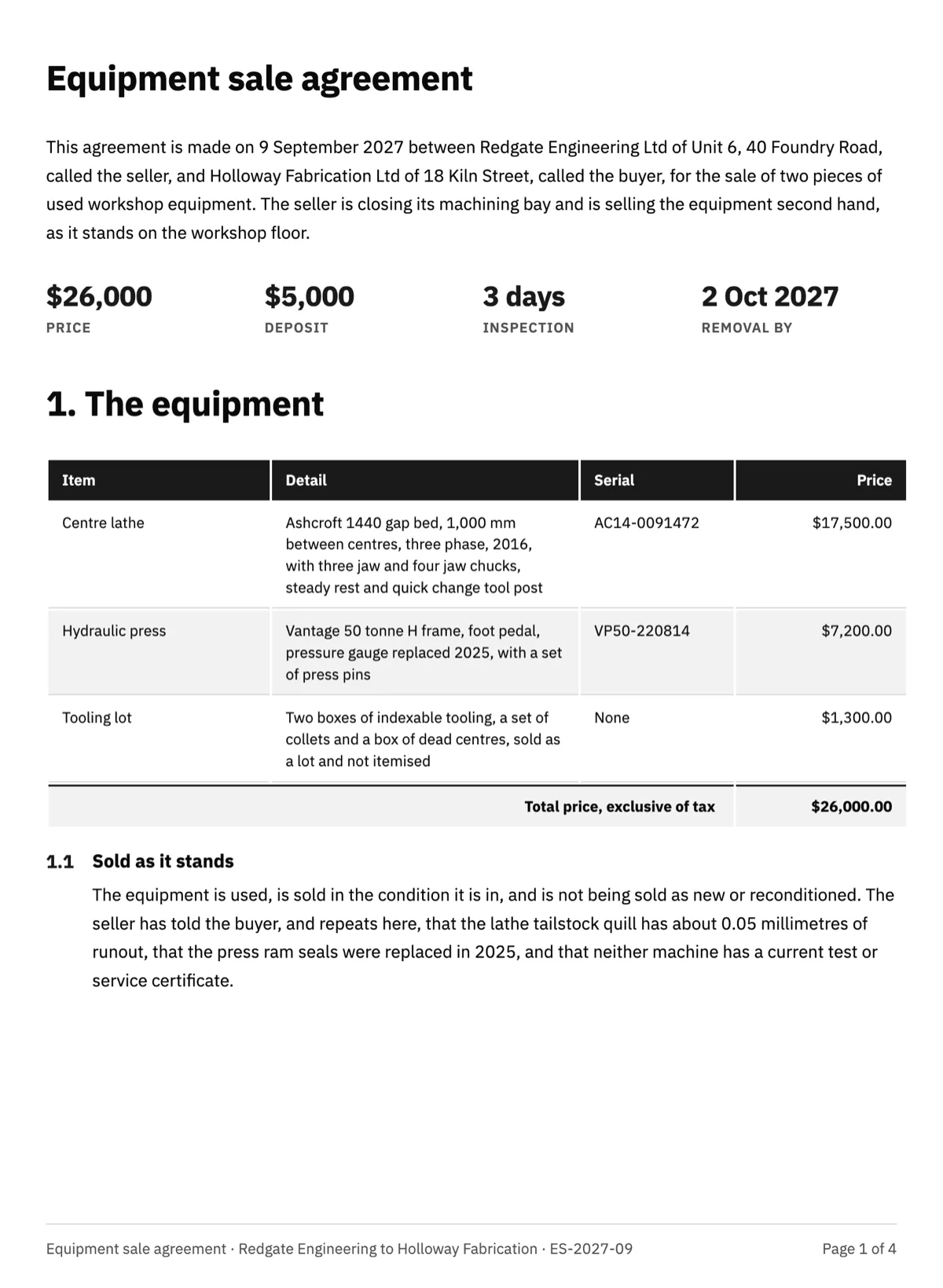 Equipment sale agreement with serial numbers and an inspection windowUsed machinery changes hands on a workshop floor, and the argument afterwards is always about condition or about who damaged the door frame on the way out. This agreement records the serial numbers and the known faults, gives the buyer two days to power the machines up, and puts the rigging, the making good and the storage charge in writing.
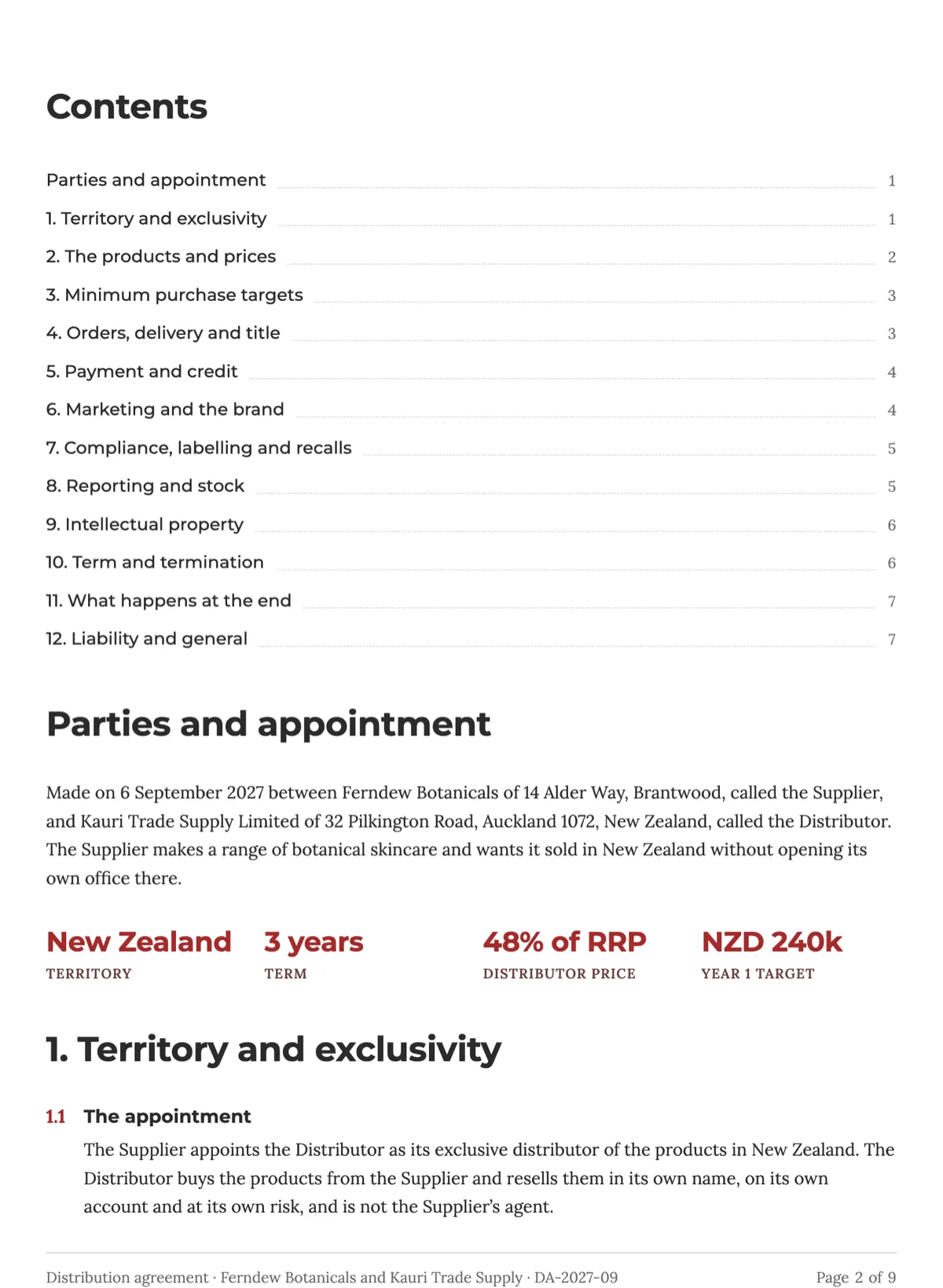 Distribution agreement template with territory and targetsAn exclusive distribution agreement is a trade: a territory in exchange for volume. This one appoints a New Zealand distributor for a skincare range at 48 per cent of recommended retail, with purchase targets rising from NZD 240,000 to NZD 420,000 across three years, and exclusivity that converts to non exclusive if a target is missed by more than 15 per cent.
Questions people ask
Does a retention of title clause need to be registered in the UK?
Not if it simply keeps title to the goods themselves, because the buyer has granted no charge over its own property. A clause that claims resale proceeds or products made from the goods is usually a charge and must be registered at Companies House to be valid against an insolvency office holder.
Can I recover goods from a company in administration?
Not without the administrator's consent or the court's permission, because of the moratorium in Schedule B1 to the Insolvency Act 1986. Notify the administrator of your claim promptly with the contract, invoices and evidence identifying the goods, and agree how they will be returned or paid for.
What is an all monies clause?
A retention of title clause that keeps ownership of all goods supplied until the buyer has paid everything owed on the account, not just the price of those goods. It protects suppliers with running accounts and was upheld by the House of Lords in Armour v Thyssen.
What happens if the goods have been used?
If goods have been mixed or incorporated into something else so they lose their identity, the seller's title to them usually ends, and a claim to the new product is treated as a charge. Goods still in their original form and identifiable as the seller's can be recovered.
Is a retention of title clause in my terms enough?
Only if the terms were incorporated into the contract, for example by being accepted before the first order or printed on order acknowledgements the buyer accepted. Terms first seen on an invoice after delivery may come too late. Keep evidence that the buyer received them.
Put the clause in a finished document
The button opens the document generator with a starting description already filled in. Change it to match your own agreement before you run it.
Create a document with OneCraftRelated clauses
- Retention of title clause in New Zealand: sample and registrationRetention of title clause NZ sample: title until paid, a security interest over goods and proceeds, PMSI priority, and registering on New Zealand's PPSR.
- Unfair contract terms in Australia: the test and three rewritesUnfair contract terms in Australia: the three part test in the Australian Consumer Law, penalties since November 2023, and three gym clauses rewritten.
- Retention of title clause and the PPSRA retention of title clause keeps ownership with the seller until goods are paid for. Australian sample wording, all monies variants and the PPSR timing rules.
- Passing of risk clause: whose loss is itA passing of risk clause fixes when a buyer becomes responsible for loss or damage to goods. Sample wording plus dispatch, acceptance and US variants.
For everything the document generator can do, see the document maker.
Step by step in the builder: Create a document with AI, then Document builder components.
Written and checked by the OneCraft team. Last checked .