Contract clause
Exclusive remedy clause: sample and the UCC 2-719 test
An exclusive remedy clause limits a buyer to one stated remedy, such as repair or replacement, instead of the full range of damages the law would otherwise allow. Under Uniform Commercial Code section 2-719 it is enforceable in US sales of goods, but falls away if the remedy fails of its essential purpose.
Sellers of equipment like to promise one thing when goods are faulty: the seller will fix it. Section 2-719 of the Uniform Commercial Code lets them make that the buyer's only remedy, as long as the fix actually works.
Nuwan Madhusanka · Co-founder
4 min read · Published
Sample clause
Written for equipment sale terms of Prairie Ag Equipment, a fictional Iowa dealer selling grain handling machinery to farms.
Exclusive Remedy. (a) If any Equipment does not conform to the warranty in clause 9 and the Buyer notifies the Seller in writing within the warranty period, the Seller will, at its option, repair or replace the nonconforming part within 30 days of receiving notice. (b) If the Seller is unable to repair or replace the part within 30 days, or the same defect recurs after two repair attempts, the Seller will refund the price paid for the nonconforming Equipment on its return. (c) The remedies in this clause are the Buyer's sole and exclusive remedies for breach of warranty. (d) This clause does not limit any remedy for personal injury.
Sample wording, not legal advice.
Variants
Repair or replace
Machinery and electronics, where a seller can fix most faults and wants the chance to do so before any money claim.
The Seller's sole obligation, and the Buyer's exclusive remedy, for any breach of warranty is to repair or replace the defective part, at the Seller's option, within a reasonable time after written notice.
Refund of the price
Low value goods, or goods that cannot practically be repaired, where a refund is simpler for both sides.
If any Goods fail to conform to the warranty, the Buyer's exclusive remedy is the return of the nonconforming Goods and a refund of the price paid for them, together with reasonable return shipping costs.
Service credits as the only remedy
Hosted software or managed services, where downtime is measured and compensated through credits against future fees.
If the Service fails to meet the Availability Target in any month, the Customer is entitled to the Service Credits in Schedule 3, which are the Customer's sole and exclusive remedy for that failure, except where the failure continues for three consecutive months.
What to negotiate
Failure of essential purpose
Section 2-719(2) says that where an exclusive or limited remedy fails of its essential purpose, the buyer may use the other remedies the UCC provides. Courts apply it when a seller cannot or will not make the goods work within a reasonable time, after repeated failed repairs, or unreasonably delays. Buyers should insist on a time limit and a refund fallback; sellers should build both in so the clause does not collapse.
Interaction with a consequential loss exclusion
Section 2-719(3) allows consequential damages to be limited or excluded unless that is unconscionable, and a limitation of consequential damages for personal injury from consumer goods is prima facie unconscionable. Courts are divided on whether a consequential damages exclusion survives when the exclusive remedy fails, so the two should be drafted as independent clauses that say each stands alone.
Saying the remedy is exclusive
A stated remedy is optional unless the contract says it is exclusive. The words sole and exclusive remedy, or equivalent, are what turn repair or replace from one option into the only option. Buyers who see a remedy clause without those words keep their other remedies; sellers should make the exclusivity express and conspicuous.
The risk of leaving it out
Without an exclusive remedy clause, a buyer of faulty equipment can claim damages for the difference in value and, in many cases, for lost production while the machine was down, which can far exceed the price of the machine. With the clause, the seller's exposure is the cost of a repair or a refund, which is what most equipment pricing assumes.
How section 2-719 works
Article 2 of the UCC, adopted with variations in every US state except Louisiana, governs sales of goods. Section 2-719 lets the parties limit or alter the buyer's remedies, for example to return and refund or repair and replacement, and makes the stated remedy exclusive if the contract expressly says so. If the remedy fails of its essential purpose, the buyer regains the general remedies of Article 2. The clause sits alongside the warranty itself, and any disclaimer of implied warranties must separately meet section 2-316. Law checked on 21 October 2026. This page explains how the clause works and is not legal advice.
A failure test with repair attempts
Consider how a court might see Prairie Ag's clause after a grain auger fails in harvest. First repair within 10 days, auger works: remedy working. Same fault two weeks later, second repair within 7 days: still likely working, because the seller is responding promptly. Third failure, seller says parts are on back order for 60 days: the remedy is probably failing of its essential purpose, because the buyer is deprived of the machine through the season the remedy was meant to protect. The sample's refund after two failed attempts or 30 days avoids reaching that point.
Services and software
Article 2 applies to goods, not services, so exclusive remedy clauses in services contracts are governed by general contract law. Courts usually enforce clear exclusive remedy terms between businesses, such as service credits as the only remedy for missed availability targets, but a remedy that leaves the customer with nothing meaningful can be attacked as illusory. Allowing termination if service failures persist gives the clause a backstop.
Outside the US
The UK and Australia have no direct equivalent of section 2-719. A clause limiting a buyer to repair or replacement is treated as a limitation or exclusion clause, tested under the Unfair Contract Terms Act 1977 in the UK, and limited by the consumer guarantees in the Australian Consumer Law, which allow a consumer to reject goods with a major failure regardless of what the contract says.
Documents that carry this clause
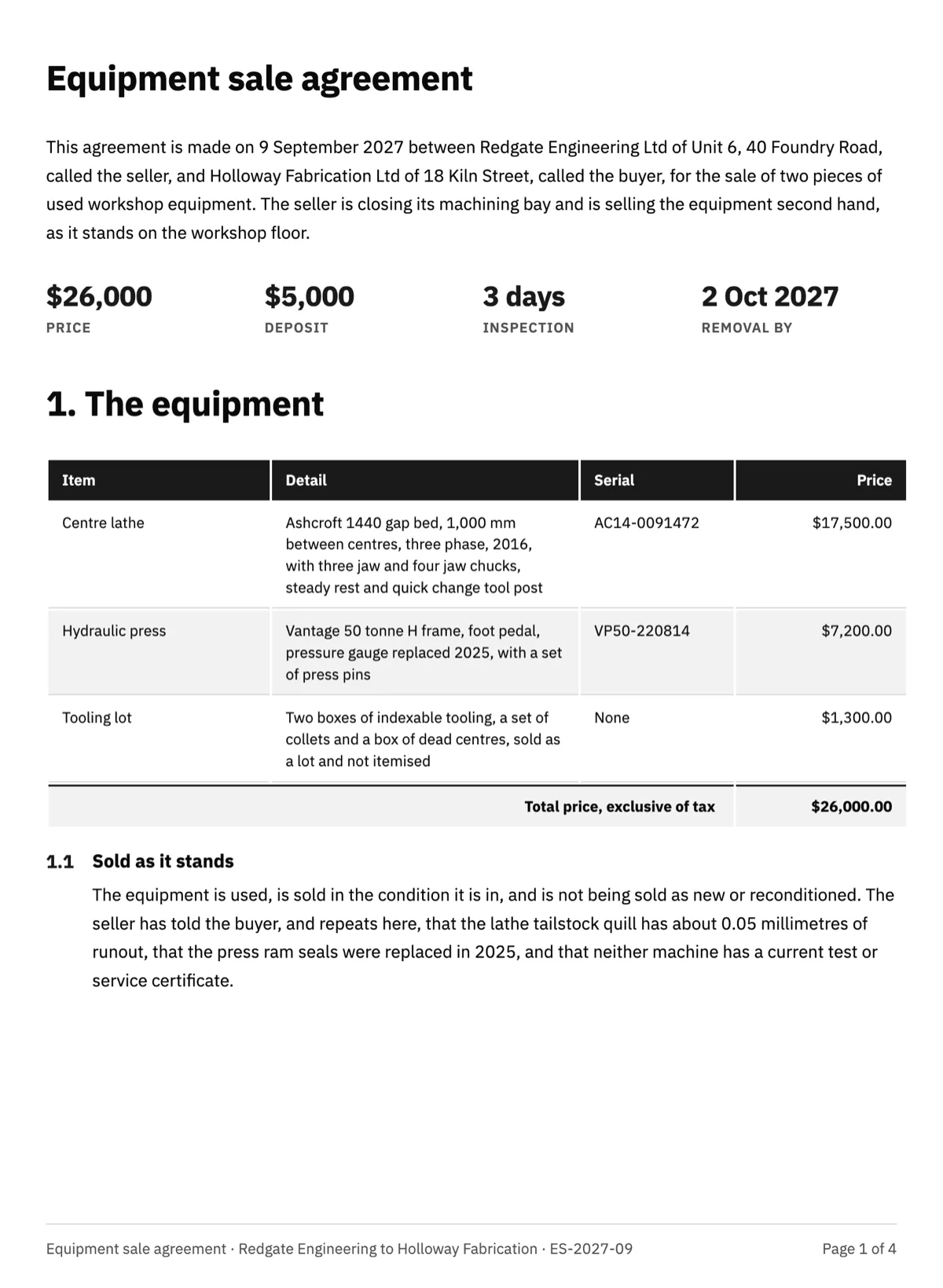 Equipment sale agreement with serial numbers and an inspection windowUsed machinery changes hands on a workshop floor, and the argument afterwards is always about condition or about who damaged the door frame on the way out. This agreement records the serial numbers and the known faults, gives the buyer two days to power the machines up, and puts the rigging, the making good and the storage charge in writing.
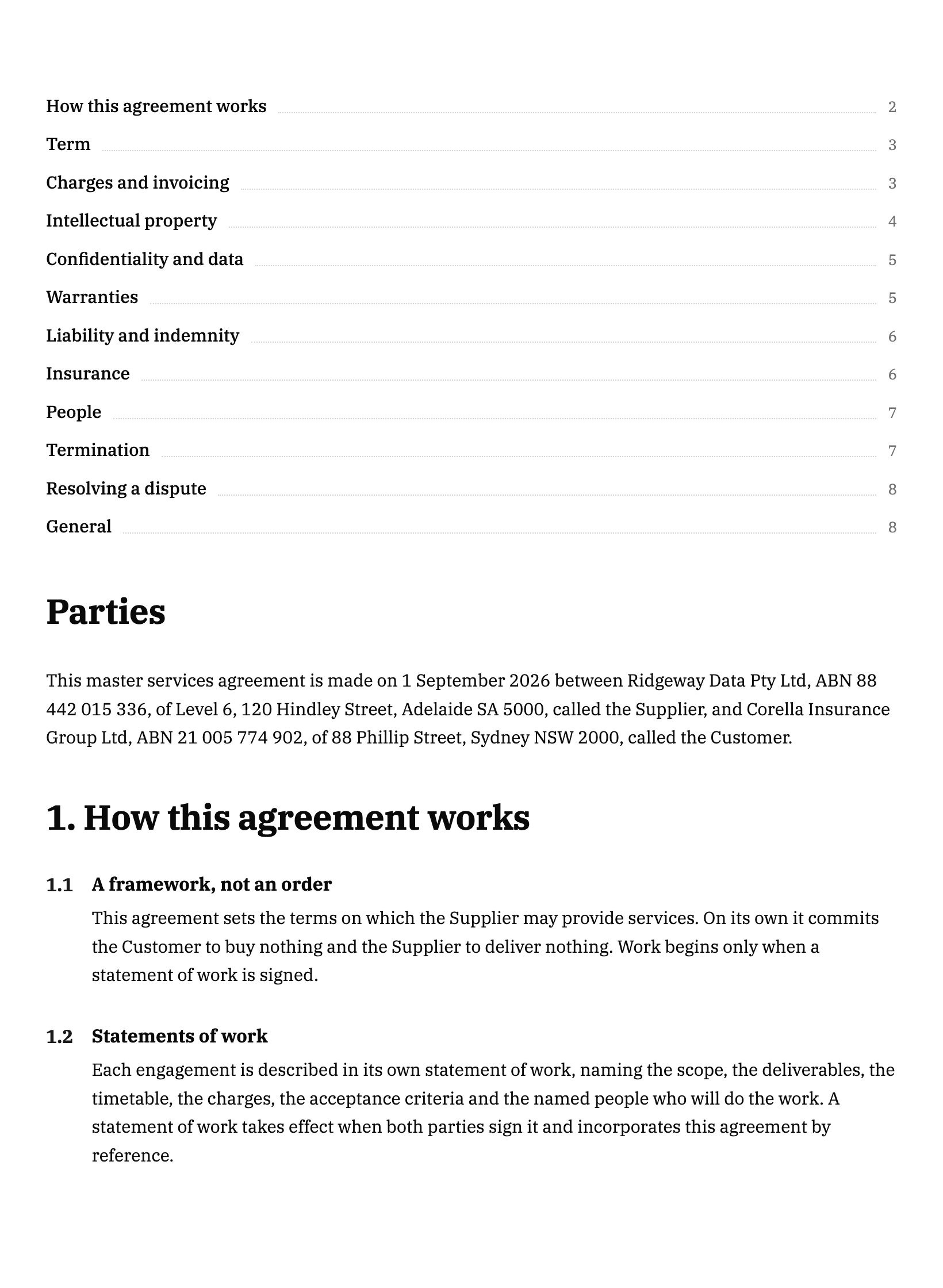 Master services agreementA data consultancy and an insurer sign this once and then buy work under it for three years. It is the rare contract whose whole purpose is to make the next twenty contracts short.
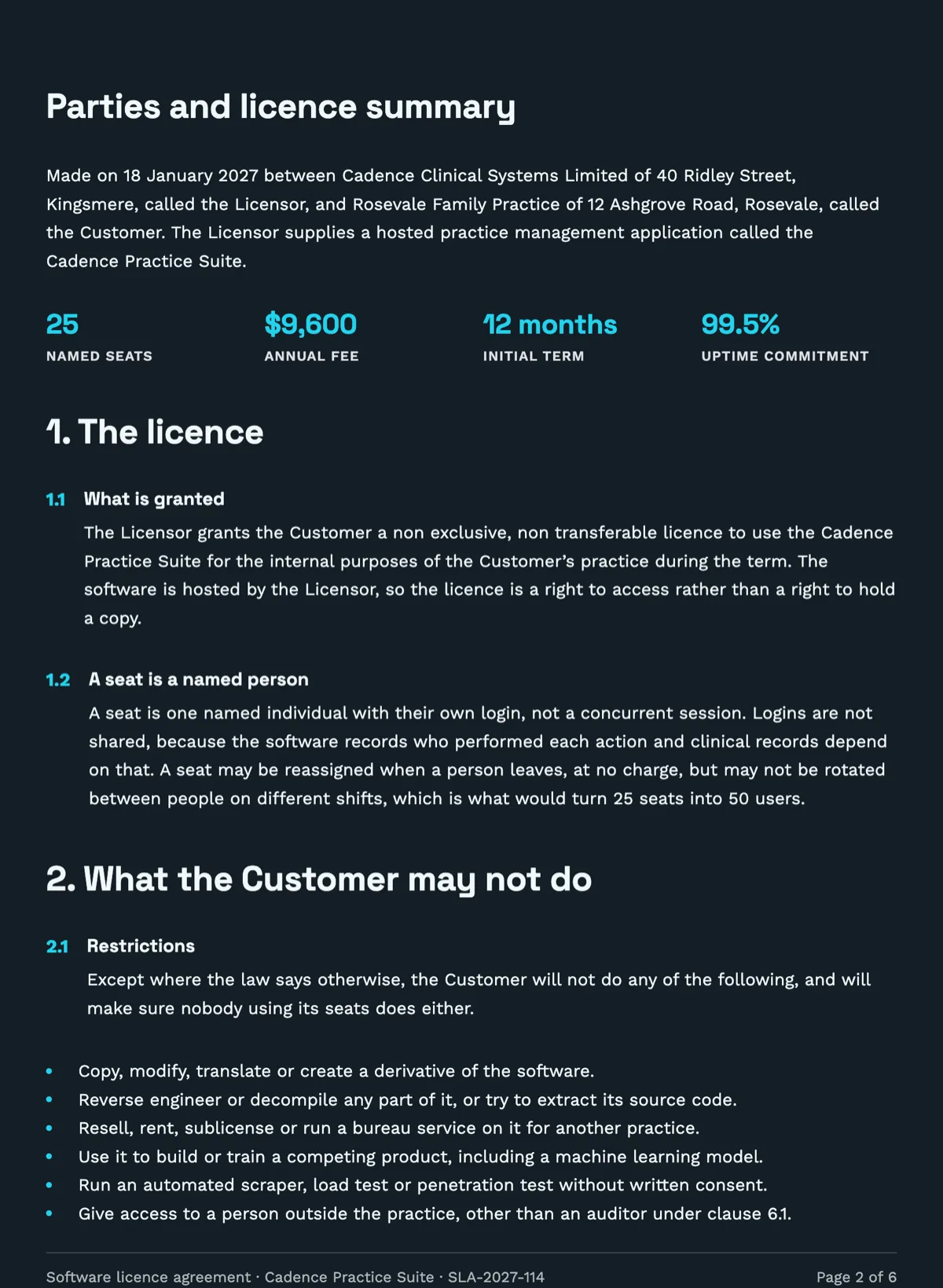 Software licence agreement template with seats, term and supportA software licence agreement has to answer three questions before anything else: what a seat is, what happens when the software is down, and who gets the data at the end. This one licenses a hosted practice management suite to a medical practice for 25 named users at $9,600 a year, with a support table, uptime credits and a 30 day export.
Questions people ask
What does sole and exclusive remedy mean?
It means the remedy named in the clause is the only one available for that breach. If a contract says repair or replacement is the buyer's sole and exclusive remedy, the buyer cannot sue for damages instead, unless the remedy fails of its essential purpose or the clause is unenforceable for another reason.
What is failure of essential purpose?
A limited remedy fails of its essential purpose when it no longer gives the buyer what it was meant to: working goods within a reasonable time. Repeated unsuccessful repairs, refusal to repair, or long delays are typical examples. When that happens, UCC section 2-719(2) restores the buyer's ordinary remedies under Article 2.
Does an exclusive remedy stop a claim for lost profits?
It stops damages claims for breach of warranty while the remedy works. Lost profits are consequential damages, which are usually addressed by a separate exclusion. If the exclusive remedy fails, some courts still enforce the consequential damages exclusion and others do not, so the drafting of both clauses matters.
Can a consumer be limited to repair or replacement?
In the US, yes, subject to the Magnuson Moss Warranty Act and state consumer laws, which restrict how written warranties to consumers can limit implied warranties. A limitation of consequential damages for personal injury from consumer goods is treated as prima facie unconscionable under section 2-719(3).
Is a refund fallback necessary?
It is not required, but it is the simplest way to stop the remedy failing of its essential purpose. If the seller cannot fix the goods within the time set, the buyer gets its money back, which most courts accept as a remedy that still fulfils its purpose. Without it, a failed repair can reopen full damages.
Put the clause in a finished document
The button opens the document generator with a starting description already filled in. Change it to match your own agreement before you run it.
Create a document with OneCraftRelated clauses
- Warranty clause: promising a standard and backing itA warranty clause promises a fact is true or that work meets a standard. Australian sample wording for a ninety day defects warranty, variants and remedies.
- Service credits clause: what a missed service level costs the supplierA service credits clause sets the fee reduction a customer receives when a service level is missed. Sample credit table, percentage and fixed amount variants.
- Limitation of liability clause: putting a ceiling on exposureA limitation of liability clause caps what one party can recover. Australian sample wording, cap formulas, variants, the carve outs and the UK test.
- Exclusion clause: UK sample wording and the statutory limitsHow a UK exclusion clause works under the Unfair Contract Terms Act 1977 and the Consumer Rights Act 2015, with a sample for an IT support firm and the bans.
For everything the document generator can do, see the document maker.
Step by step in the builder: Create a document with AI, then Document builder components.
Written and checked by the OneCraft team. Last checked .