Contract clause
Hours of work clause for an Australian employment contract
An hours of work clause sets an employee's ordinary hours, the days and times they are worked, how rosters change, when additional hours may be required, and whether hours are averaged. In Australia the National Employment Standards cap ordinary hours at 38 a week for full time employees, plus reasonable additional hours.
An hours of work clause fixes the ordinary hours an employee is paid for and the pattern they are worked in. In Australia the National Employment Standards limit a full time employee to 38 hours a week plus reasonable additional hours, and since 2024 employees also have a right to disconnect outside working hours.
Nuwan Madhusanka · Co-founder
3 min read · Published
Sample clause
Written for full time employment contract for a client services coordinator at Riverbend Physiotherapy Pty Ltd, a fictional Brisbane clinic.
Hours of Work. (a) The Employee's ordinary hours are 38 a week, worked Monday to Friday between 7.00 am and 6.00 pm on a roster set by the Practice Manager, with an unpaid 30 minute meal break each day. (b) The Employer may change the roster by giving at least 7 days' notice, or less by agreement. (c) The Employer may ask the Employee to work reasonable additional hours. The Employee may refuse if they are unreasonable, having regard to the factors in section 62 of the Fair Work Act 2009. (d) The Employee's salary compensates for reasonable additional hours worked, except where the Award requires overtime to be paid. (e) The Employee may refuse to monitor, read or respond to contact from the Employer outside working hours unless the refusal is unreasonable.
Sample wording, not legal advice.
Variants
Part time pattern
Part time employees under awards that require a regular pattern of hours to be agreed in writing.
The parties agree a regular pattern of 24 ordinary hours a week, worked Wednesday to Friday from 9.00 am to 5.30 pm with an unpaid 30 minute meal break. The pattern may be changed by written agreement.
Averaging for award free employees
Employees not covered by an award or agreement, where hours vary seasonally and the parties agree to average them.
The Employee's ordinary hours are 38 a week averaged over a 13 week period, as agreed in writing under section 64 of the Fair Work Act 2009.
Annualised salary with a reconciliation
Salaried staff under an award that allows annualised wage arrangements, where overtime is built into the salary.
The salary is an annualised wage that covers the award entitlements listed in Schedule 1 for up to 6 additional hours a week. The Employer will reconcile hours worked against the award at least every 12 months and pay any shortfall.
What to negotiate
What makes extra hours reasonable
Section 62 lists factors for deciding whether additional hours are reasonable, including risk to health and safety, the employee's personal circumstances and family responsibilities, the needs of the workplace, whether the employee is paid for them, notice given, and the usual patterns in the industry. A clause that mirrors these helps both sides judge a request.
Salary that absorbs hours
A salary that is said to cover reasonable additional hours only works if it actually does. If an award applies, the employer must still pay at least what the award would have paid for the hours worked, including overtime, which is why annualised salary clauses need regular reconciliations.
The right to disconnect
Since 26 August 2024, and since 26 August 2025 for small business employers, employees may refuse to monitor, read or respond to contact from their employer or a third party outside working hours unless the refusal is unreasonable. A clause can acknowledge it and set expectations for genuine emergencies or on call periods.
The risk of leaving it out
A contract without an hours clause leaves ordinary hours, rosters and additional hours to argument and to the award. Employers risk underpaying overtime that an award requires, and employees have no fixed point to measure unreasonable demands against. Both make wage underpayment claims and disputes about rosters more likely.
The 38 hour maximum
Section 62 of the Fair Work Act 2009 says an employer must not request or require a full time employee to work more than 38 hours a week unless the additional hours are reasonable. For part time employees the limit is the lesser of 38 hours and their ordinary hours. Awards and agreements can allow ordinary hours to be averaged over a longer period, and for award free employees section 64 allows averaging by written agreement over up to 26 weeks. Law checked on 21 October 2026. This page explains how the law works and is not legal advice.
Rosters and breaks
The contract usually sets the span of hours and refers to a roster; the award sets minimum notice for roster changes, meal breaks and rest breaks. The part time employment example records a regular pattern of 24 ordinary hours a week, with start and finish times and unpaid meal breaks for each day, because the relevant award requires the pattern to be agreed in writing. Full time contracts often leave the days to the roster within a span.
Additional hours and overtime
Additional hours beyond ordinary hours may attract overtime rates under an award. A salaried employee not covered by an award, or paid well above it, may have a salary that compensates for reasonable additional hours, but only if the contract says so and the salary covers it. The Fair Work Ombudsman's hours of work guidance explains how the NES and awards fit together.
Where the clause sits in a generated document
Employment contracts, part time agreements and offer letters carry this clause early, after the role and start date. When asking the AI document generator for one, give the ordinary hours, the days and span, the roster notice, the additional hours rule, whether salary absorbs them, and the award that applies.
Documents that carry this clause
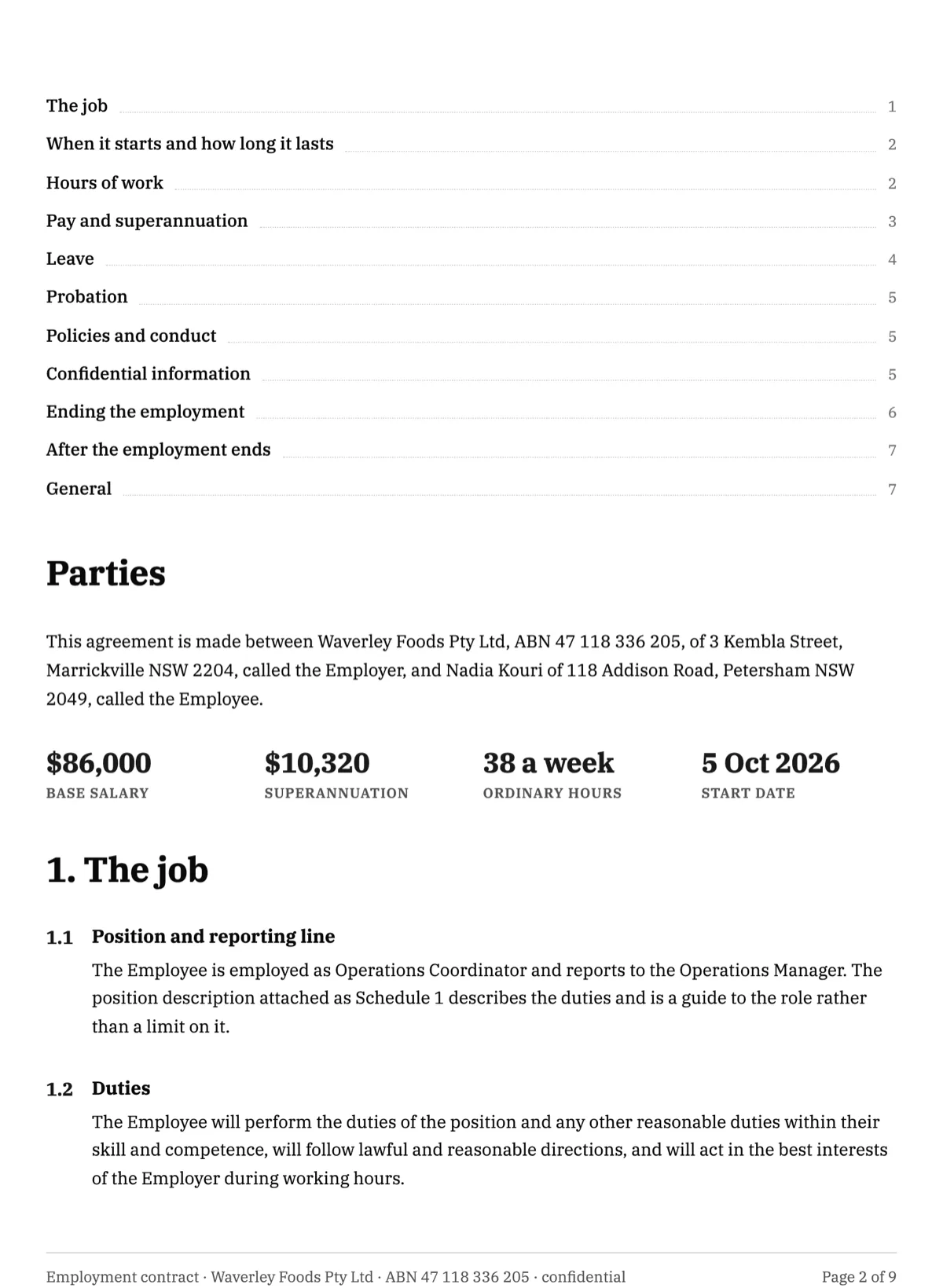 Employment contractA full time ongoing contract for an operations coordinator on $86,000 plus $10,320 of superannuation. Eleven numbered clauses, a leave table drawn from the National Employment Standards, and a notice table that scales with service.
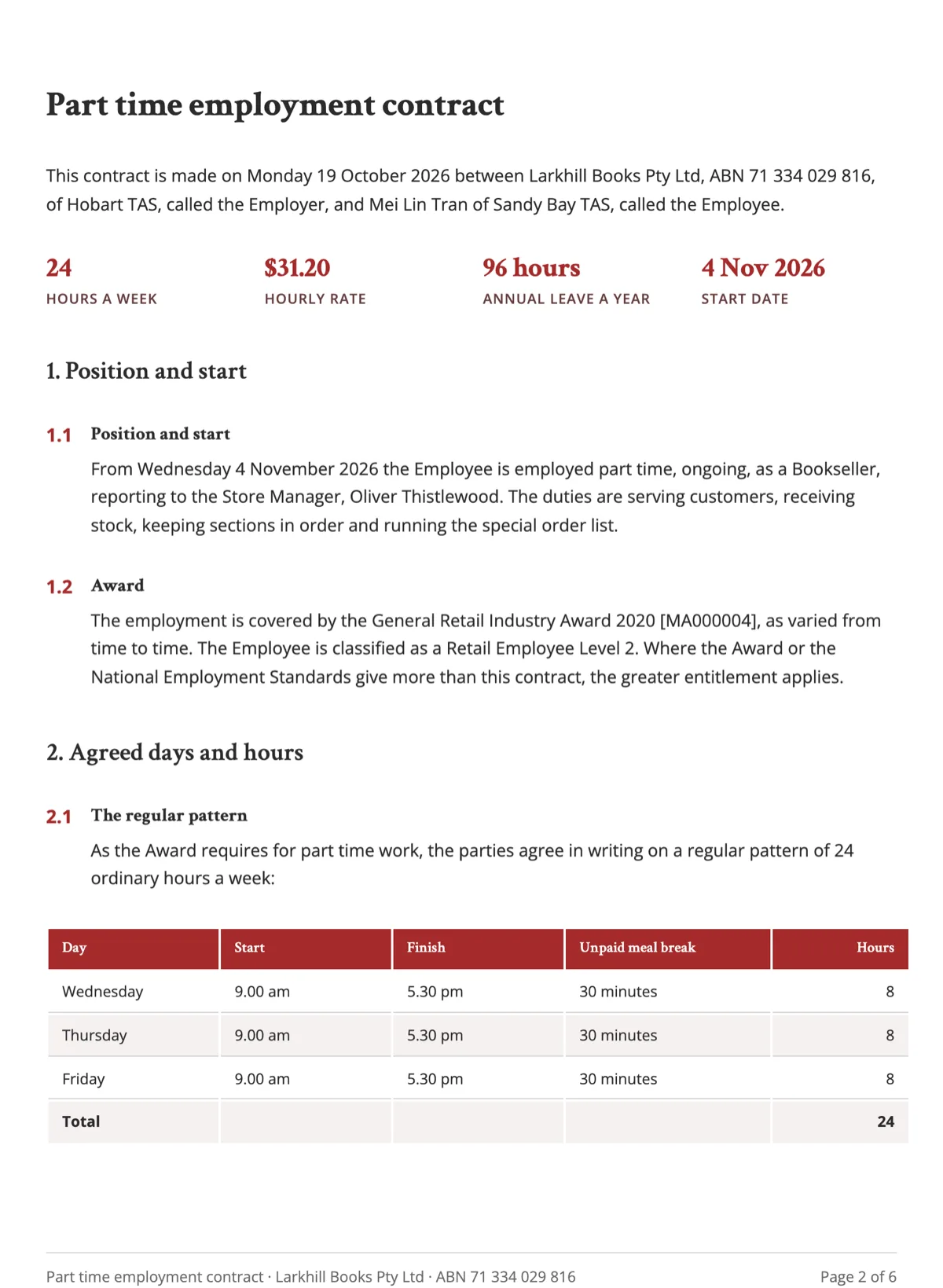 Part time employment contract template with set hours and pro rata leaveA part time employment contract template has to do something a full time contract does not: fix the regular days and hours in writing, because Australian awards require it for part time staff, and show how every leave entitlement is scaled to those hours. This one does both for a bookseller working 24 hours over three days.
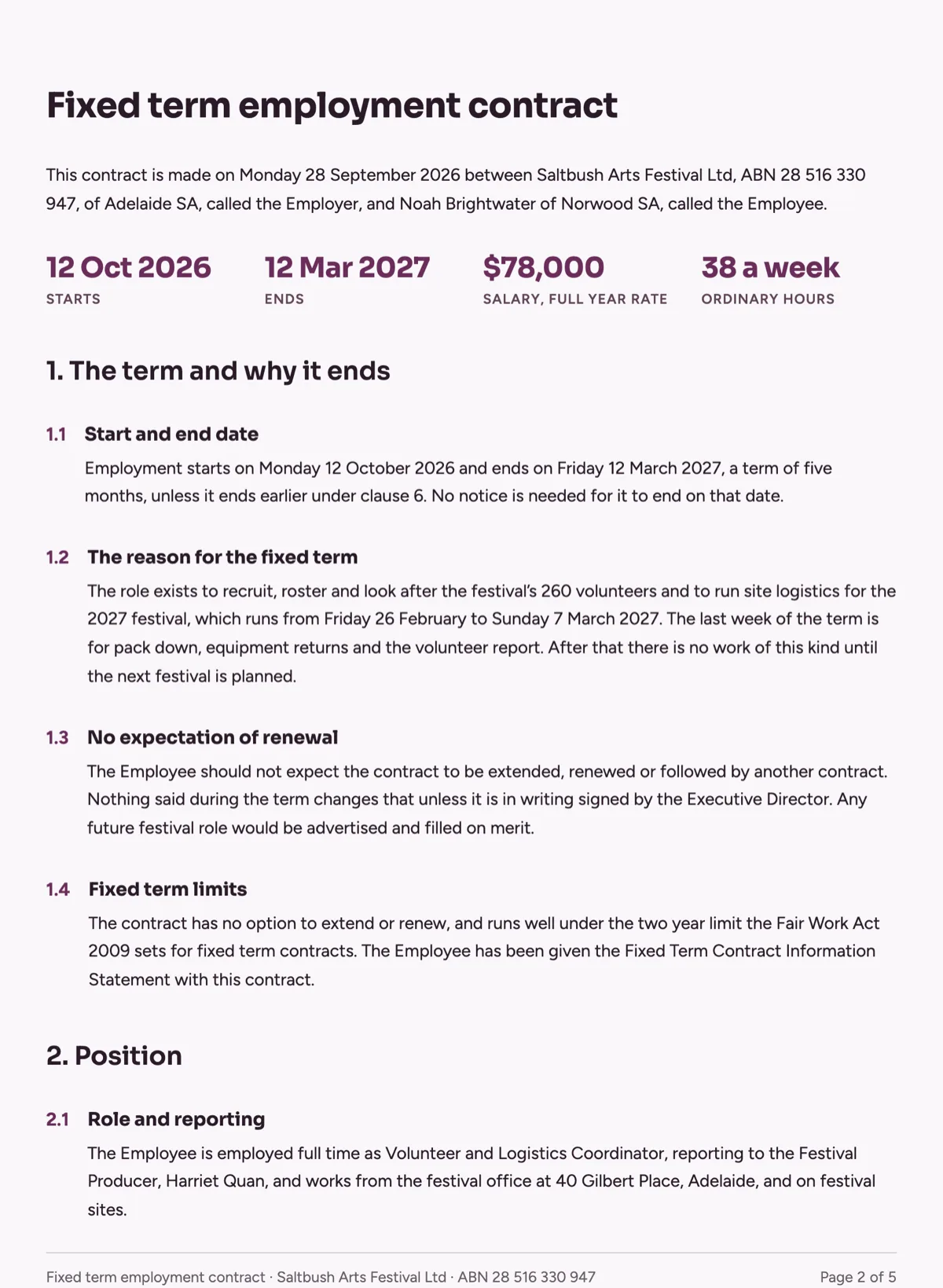 Fixed term employment contract template with the end date and its reasonA fixed term employment contract template sets a real end date and the reason the job ends then, so both sides know the employment stops without a dismissal. Since December 2023 an Australian contract also has to stay inside the Fair Work Act limits on length and renewal, and the employee must be given the Fixed Term Contract Information Statement.
Questions people ask
How many hours can a full time employee work in Australia?
The National Employment Standards set a maximum of 38 ordinary hours a week for a full time employee, plus additional hours only if they are reasonable. Awards and agreements may allow the 38 hours to be averaged over a longer period, such as a roster cycle.
Can I refuse to work overtime?
You can refuse additional hours that are unreasonable. Whether they are reasonable depends on factors in section 62 of the Fair Work Act, including health and safety, your personal and family circumstances, the workplace's needs, notice given and whether you are paid for them.
What is the right to disconnect?
A right for employees to refuse to monitor, read or respond to contact from their employer, or work related contact from others, outside working hours unless the refusal is unreasonable. It started on 26 August 2024, and for small business employees on 26 August 2025.
Can a salary absorb additional hours in Australia?
Only if the contract says so and, where an award applies, the salary is enough to cover what the award would pay for the hours worked. Many awards require annualised salaries to be reconciled against actual hours at least every 12 months, with any shortfall paid.
Do part time employees need an agreed pattern of hours?
Under many modern awards, yes. The employer and the part time employee must agree in writing on a regular pattern of work, including the hours each day and start and finish times. Changes are usually made by written agreement as well.
Put the clause in a finished document
The button opens the document generator with a starting description already filled in. Change it to match your own agreement before you run it.
Create a document with OneCraftRelated clauses
- Public holiday clause for an Australian employment contractPublic holiday clause sample for Australian employment contracts: paid days off, requests to work, the right to refuse, penalty rates and part time patterns.
- Casual conversion clause under the employee choice pathwayCasual conversion clause for Australian casual contracts: the employee choice pathway since August 2024, the 6 and 12 month rules and the 21 day reply.
- Overtime clause: paid, time off or built into salaryAn overtime clause says whether extra hours are paid, given as time off or absorbed in salary. Australian sample wording with an annual reconciliation.
- Remote work clause: hybrid, fully remote or by requestA remote work clause sets where an employee works, on which days and on what conditions. Sample hybrid wording, fully remote and UK variants, and what to agree.
For everything the document generator can do, see the document maker.
Step by step in the builder: Create a document with AI, then Document builder components.
Written and checked by the OneCraft team. Last checked .