Contract clause
Invention assignment clause: sample and the state limits
An invention assignment clause transfers to the employer the rights in inventions an employee makes in the course of the job or with the employer's resources. Several US states make such a clause void for inventions developed entirely on the employee's own time without the employer's equipment or information, and some require the employee to be told.
Who owns what an engineer invents? For work done in the job, almost everywhere the answer is the employer. For the side project built on a weekend laptop, several US states say it stays with the employee whatever the contract says, and the clause has to respect that.
Indunil Asanka · Co-founder
4 min read · Published
Sample clause
Written for an employment agreement between Bayshore Robotics, a fictional Oakland, California robotics company, and a mechanical engineer.
Inventions. (a) The Employee assigns to the Company all rights in every invention, improvement, design and discovery the Employee makes, alone or with others, during employment that results from work for the Company or uses the Company's equipment, supplies, facilities or trade secret information (Company Inventions). (b) This clause does not apply to an invention that qualifies fully for protection under California Labor Code section 2870, a notice of which is attached as Exhibit B. (c) The Employee has listed in Exhibit A every invention made before employment that the Employee owns and wishes to exclude (Prior Inventions). If none are listed, the Employee confirms there are none. (d) The Employee will promptly disclose each Company Invention and sign any document reasonably needed to record or protect the Company's rights, at the Company's expense.
Sample wording, not legal advice.
Variants
California style with the notice
Employers in California and other states that require written notice of the statutory exception.
This assignment does not apply to any invention that qualifies fully under California Labor Code section 2870. The Employee acknowledges receiving written notice of that section, attached as Exhibit B.
General US clause
Employers in states without an invention assignment statute, which still want to respect the same boundary.
The Employee assigns to the Company all inventions conceived or reduced to practice during employment that relate to the Company's business or actual or anticipated research, or that result from work performed for the Company, but not inventions developed entirely on the Employee's own time without Company resources that have no such relationship.
Contractor version
Contractors and consultants, who are not employees and are not covered by the statutes or by employer ownership rules.
The Contractor assigns to the Client all intellectual property rights in the Deliverables and in any invention made in performing the Services, on creation. The Contractor retains its pre existing materials listed in Schedule 2 and grants the Client a perpetual licence to use any of them incorporated in the Deliverables.
What to negotiate
What is excluded
Statutes such as California's exclude inventions developed entirely on the employee's own time without the employer's equipment, supplies, facilities or trade secrets, unless they relate to the employer's business or anticipated research, or result from work for the employer. Employees in fields close to their hobby projects should know that relating to the employer's business can bring a side project back within the clause.
The prior inventions list
Listing what you already own before you start protects it from being mistaken for something made during employment. Describe each item enough to identify it, without disclosing confidential details. Employers should ask for the list at signing, and treat a blank list as a statement that there is nothing to exclude.
State notice duties
California Labor Code section 2872 requires an employer that uses an invention assignment agreement to give the employee written notice that it does not apply to inventions covered by section 2870. Minnesota and other states have similar notice requirements. Attaching the statute as an exhibit, as the sample does, is the usual way to comply.
The risk of leaving it out
Without an invention assignment clause, US employers may have to rely on the hired to invent doctrine or a shop right licence, which give less certain ownership, and patent filings can stall if an employee who has left will not sign. A clause that overreaches, ignoring state limits, risks being void to that extent, which can also undermine trust with engineering staff.
States with invention assignment statutes
Several states limit invention assignment clauses for inventions made on the employee's own time without employer resources. Those commonly listed are California (Labor Code sections 2870 to 2872), Delaware (title 19, section 805), Illinois (765 ILCS 1060), Kansas (section 44-130), Minnesota (section 181.78), New Jersey (since 2019), New York (Labor Law section 203-f, since 2023), North Carolina (section 66-57.1), Utah (section 34-39-3) and Washington (RCW 49.44.140). They differ in detail, including whether notice is required, so check the state where the employee works. Law checked on 21 October 2026. This page explains how the clause works and is not legal advice.
The UK and Australia
In the UK, section 39 of the Patents Act 1977 decides ownership of employee inventions: an invention belongs to the employer if made in the course of normal duties, or duties specifically assigned, where an invention might reasonably be expected to result, or where the employee had a special obligation to further the employer's interests. Otherwise it belongs to the employee, and section 42 makes contract terms that diminish the employee's rights unenforceable to that extent. In Australia there is no equivalent statute, and ownership turns on the employment relationship and the contract, as the courts have explained in disputes over academic inventions.
Employees and contractors
Employment statutes and default rules apply to employees. Contractors usually own what they create unless a written agreement assigns it, so a contractor agreement needs an express assignment covering inventions and other IP, as in the third variant. Treating a contractor's work as automatically owned is one of the most common gaps found in technology company due diligence.
Disclosure and further assurance
The clause should require prompt disclosure of company inventions, so the employer can decide whether to file for a patent before any public disclosure destroys novelty, and should oblige the employee to sign the papers needed to record the assignment, even after leaving. The employer usually bears the cost of that paperwork.
Documents that carry this clause
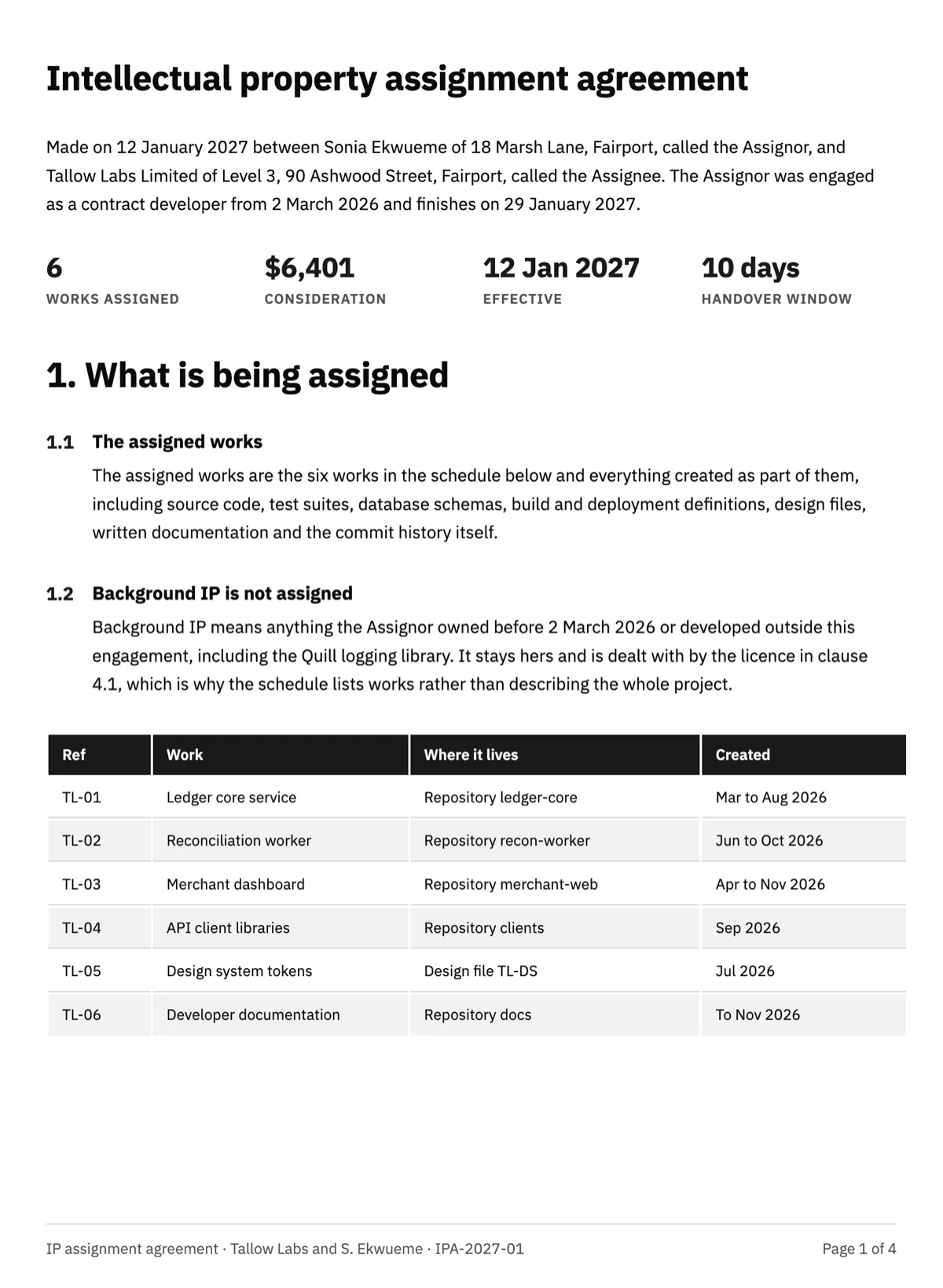 IP assignment agreement template with a schedule and moral rightsAn IP assignment transfers ownership of work that already exists, which is why the schedule matters more than the wording around it. This one moves six named works from a departing contract developer to the startup that paid for them, licenses back her own library, and lists what gets handed over in the ten days after signing.
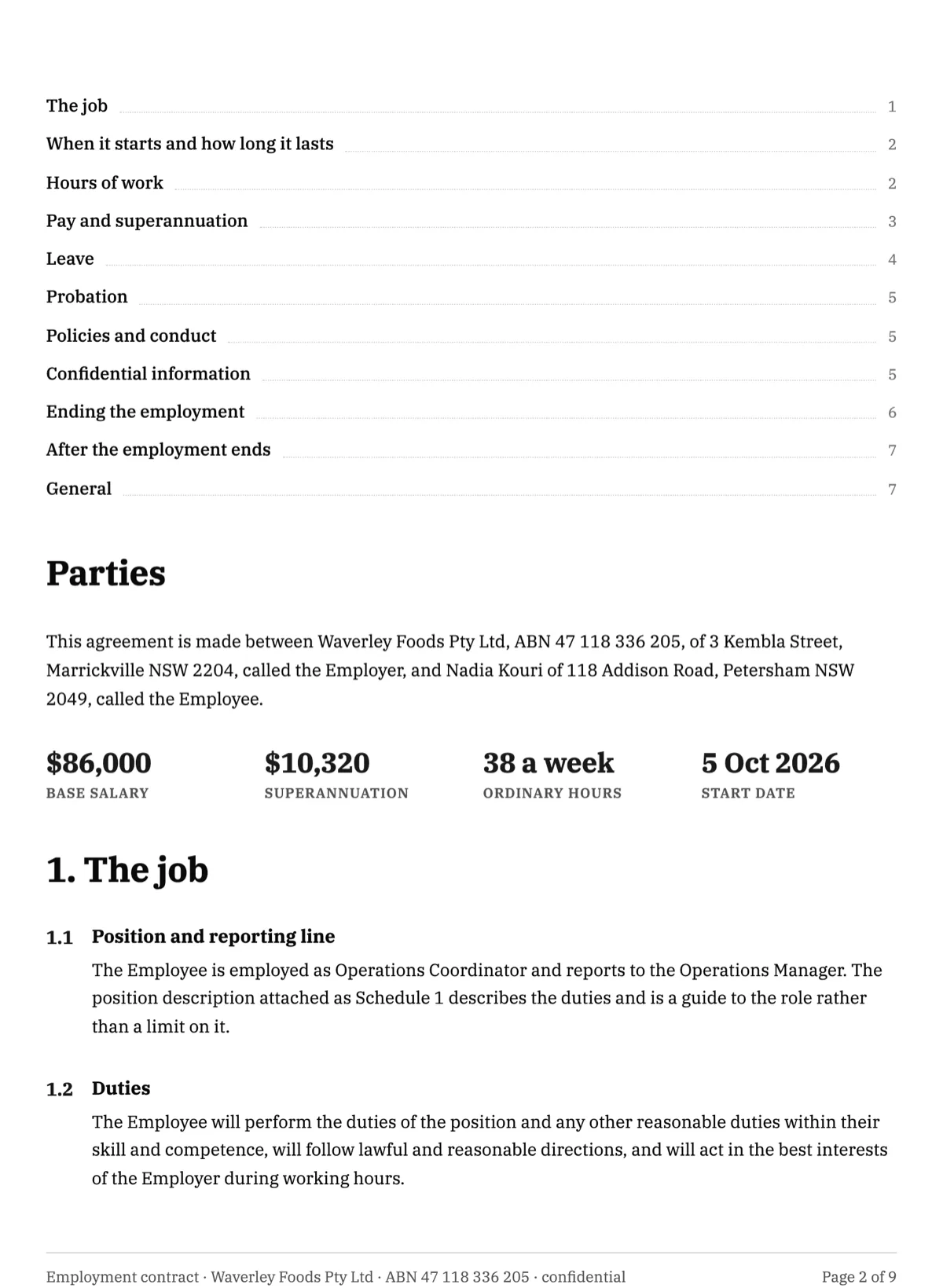 Employment contractA full time ongoing contract for an operations coordinator on $86,000 plus $10,320 of superannuation. Eleven numbered clauses, a leave table drawn from the National Employment Standards, and a notice table that scales with service.
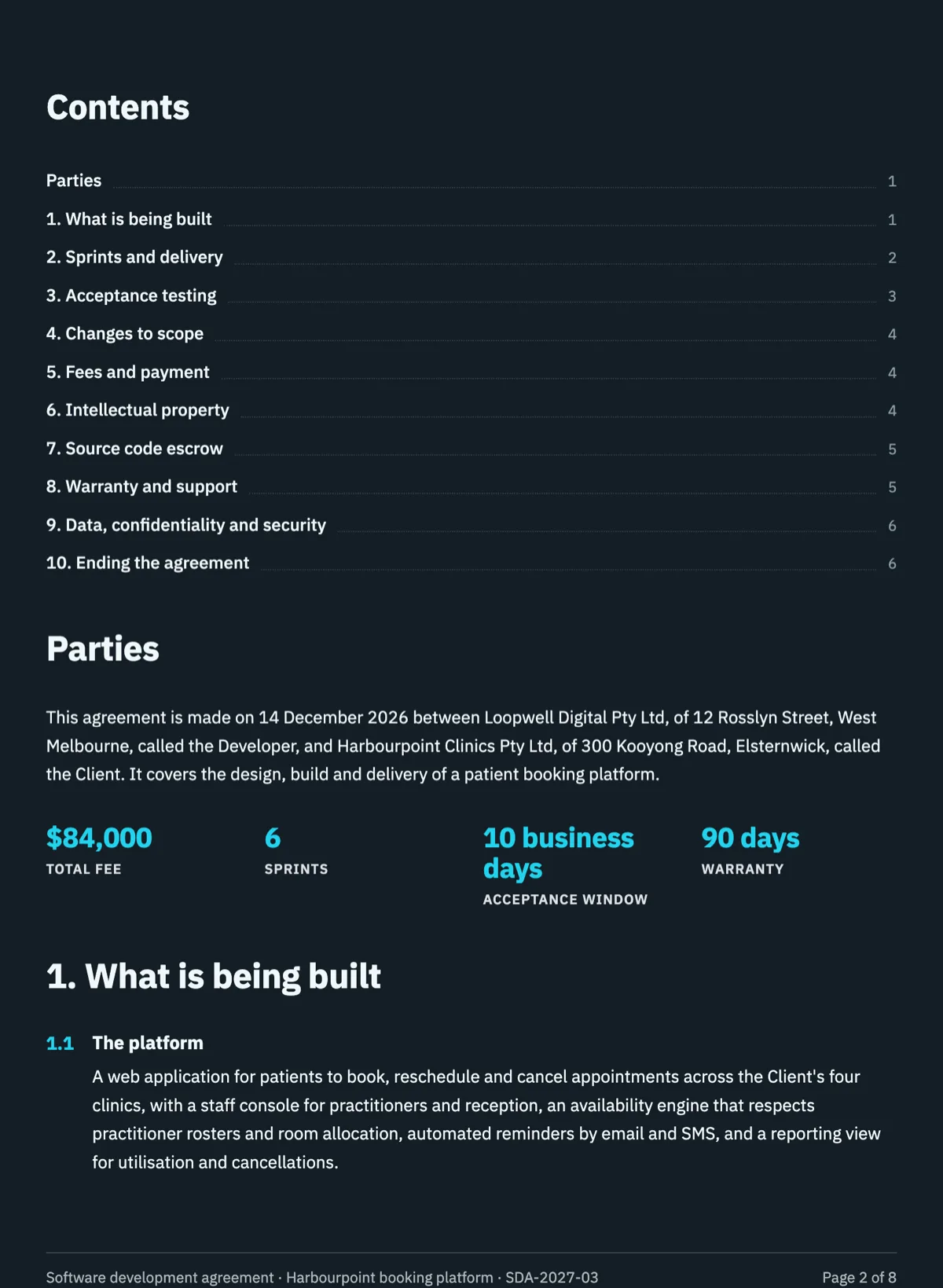 Software development agreement with sprints and an acceptance testCustom software goes wrong in the space between delivered and accepted, where one side thinks a sprint is finished and the other is still writing a list. This agreement fixes a ten business day acceptance window against criteria written before the sprint started, and assigns the intellectual property sprint by sprint as each invoice is paid.
Questions people ask
Does my employer own what I invent at home?
It depends on the contract and the law where you work. In states like California and Minnesota, an invention developed entirely on your own time, without the employer's equipment or trade secrets, belongs to you unless it relates to the employer's business or results from your work there. Elsewhere, the contract wording decides more.
What is a prior inventions list?
It is a schedule you complete when you start, listing inventions and projects you made before joining that you want to keep. It prevents later arguments that something you already owned was created during employment. Describe each item enough to identify it without revealing confidential details.
What does California Labor Code 2870 say?
It makes an employment agreement unenforceable to the extent it requires assignment of an invention the employee developed entirely on their own time without the employer's equipment, supplies, facilities or trade secret information, except inventions that relate to the employer's business or actual or anticipated research, or result from work performed for the employer.
Do invention assignment clauses cover software?
Yes. Most clauses cover inventions, improvements, designs, works of authorship and software. Copyright in code written by an employee in the course of employment usually belongs to the employer anyway, but the clause makes ownership clear and covers patentable inventions and work at the edges of the job.
Can a contractor be bound by an invention assignment clause?
Yes, by contract. Contractors are not covered by employer ownership rules, so a contractor agreement must expressly assign inventions and IP to the client. The state employee statutes generally do not apply to independent contractors, but the contract should still list the contractor's pre existing materials.
Put the clause in a finished document
The button opens the document generator with a starting description already filled in. Change it to match your own agreement before you run it.
Create a document with OneCraftRelated clauses
- Intellectual property assignment clauseAn intellectual property assignment clause transfers ownership of created work to the client. Sample wording, assign on payment or creation, and moral rights.
- Background IP clauseA background IP clause separates what each party brought from what was built for the project. Sample software wording, the schedule and the licence back.
- Work made for hire clauseA work made for hire clause makes the commissioning party the author under US law. Sample wording, the nine statutory categories, and the assignment fallback.
- Moral rights consent clauseIn Australia moral rights cannot be assigned, only consented to. Sample consent wording for a copywriter, the three rights, and the UK waiver and US position.
For everything the document generator can do, see the document maker.
Step by step in the builder: Create a document with AI, then Document builder components.
Written and checked by the OneCraft team. Last checked .