Contract clause
Kill fee clause: what a freelancer is paid when work is cancelled
A kill fee clause sets what a client pays a freelancer if it cancels commissioned work before publication or use, usually a percentage of the agreed fee that rises with the stage the work has reached. It often also says who owns the rights in the unused work.
Editors cancel stories for reasons that have nothing to do with the writer: a change of plan, a cut budget, a story that went stale. A kill fee clause decides how much of the fee the freelancer keeps when that happens, and whether they can take the work elsewhere.
Indunil Asanka · Co-founder
4 min read · Published
Sample clause
Written for a commission between a fictional travel magazine and Nora Achebe, a fictional freelance writer, for a 2,500 word feature on the Kimberley.
Cancellation. (a) The Publisher may cancel the commission at any time by written notice. If it does, it must pay the Writer: (i) 25% of the Fee, if notice is given before the Publisher accepts the outline; (ii) 50% of the Fee, if notice is given after accepting the outline but before delivery; (iii) 100% of the Fee, if notice is given after the Writer delivers the article in accordance with the brief. (b) The Publisher must also reimburse expenses approved in writing and incurred before notice. (c) On payment of a cancellation fee under paragraph (a)(i) or (ii), all rights in the work revert to the Writer, who may offer it to another publication. If the Publisher pays the full Fee under (a)(iii), it keeps the rights granted in clause 6. (d) A cancellation fee is not payable if the Publisher cancels because the Writer has materially failed to follow the brief and has not remedied it within 7 days of notice.
Sample wording, not legal advice.
Variants
Stepped kill fee
Commissions with clear stages, such as outline, draft and final, where the freelancer's effort rises over time.
If the Client cancels this commission, it will pay a cancellation fee of 25% of the Fee before the concept is approved, 50% after approval of the concept, and 100% after delivery of the final work.
Flat percentage
Shorter pieces where a single rule is simpler to administer.
If the Client decides not to publish or use the commissioned work for any reason other than the Contributor's breach, it will pay a kill fee of 50% of the agreed Fee, and the rights in the work will revert to the Contributor.
Kill fee plus expenses
Work involving travel or production costs that the freelancer has already spent.
In addition to any kill fee, the Client will reimburse all expenses incurred by the Photographer before cancellation, including travel, accommodation and equipment hire, on presentation of receipts.
What to negotiate
The stage based scale
A scale linked to clear milestones, such as an accepted outline and delivery of the work, avoids arguments about how much was done. Freelancers should push for full payment once work is delivered as briefed, because rejecting delivered work for editorial reasons is the client's choice. Clients should define what counts as delivery according to the brief.
Rights reversion
If the client pays only a kill fee and does not use the work, the freelancer will want to sell it elsewhere. The clause should say rights revert on payment of the kill fee. In Australia, a transfer of copyright must be in writing signed by the owner, so a freelancer generally keeps copyright unless they have assigned it, but the client may hold a licence the clause should end.
Who decides cancellation
Cancellation is usually the client's right, but the reason matters. A kill fee should apply when the client cancels for its own reasons. Where the freelancer did not deliver what was briefed, the clause can deny the fee after a chance to fix the problem, as the sample's paragraph (d) does. Clear briefs make that distinction easier.
The risk of leaving it out
Without a kill fee clause, a freelancer whose commission is cancelled may have to argue that the contract was breached and claim damages, a costly route for a small fee. Clients may assume they owe nothing for unused work. Freelance unions and associations encourage written agreements with cancellation terms precisely because these disputes are common.
Kill fees stage by stage
In the sample, a commission of $2,000 for the Kimberley feature pays: $500 if cancelled before the outline is accepted; $1,000 after the outline is accepted but before delivery; and $2,000 after the article is delivered according to the brief, plus approved expenses in every case. Below full payment, rights revert to the writer, who can offer the piece elsewhere. Kill fee percentages vary across publications and creative fields, so the right figures are the ones agreed in writing before work starts. Law checked on 21 October 2026. This page explains how the clause works and is not legal advice.
Kill fees across creative work
Writers, photographers, illustrators and designers all face cancelled commissions. Photographers often add a cancellation fee for shoots called off at short notice, because the day cannot be rebooked. Designers commonly bill for work done to date at an hourly rate. The principle is the same: the client pays for the freelancer's committed time and lost opportunity. Organisations such as the Media, Entertainment and Arts Alliance and the Arts Law Centre of Australia support freelancers on these terms.
Is a kill fee a penalty
A kill fee is usually the price of the client's right to cancel, a primary obligation, rather than a sum payable for breach, so it is not normally tested as a penalty. If a clause instead called the fee damages for a breach and set it far above any loss, a penalty argument could arise. Drafting the client's cancellation as a right, with the fee as its price, avoids the issue.
Copyright and the unused work
In Australia, the Copyright Act 1968 generally makes the author of a literary or artistic work its first owner, subject to exceptions such as works made by employees, and requires an assignment of copyright to be in writing and signed. A freelancer therefore usually owns the article unless the commission assigned it. The kill fee clause should still say clearly that any licence to the client ends if only a kill fee is paid.
Documents that carry this clause
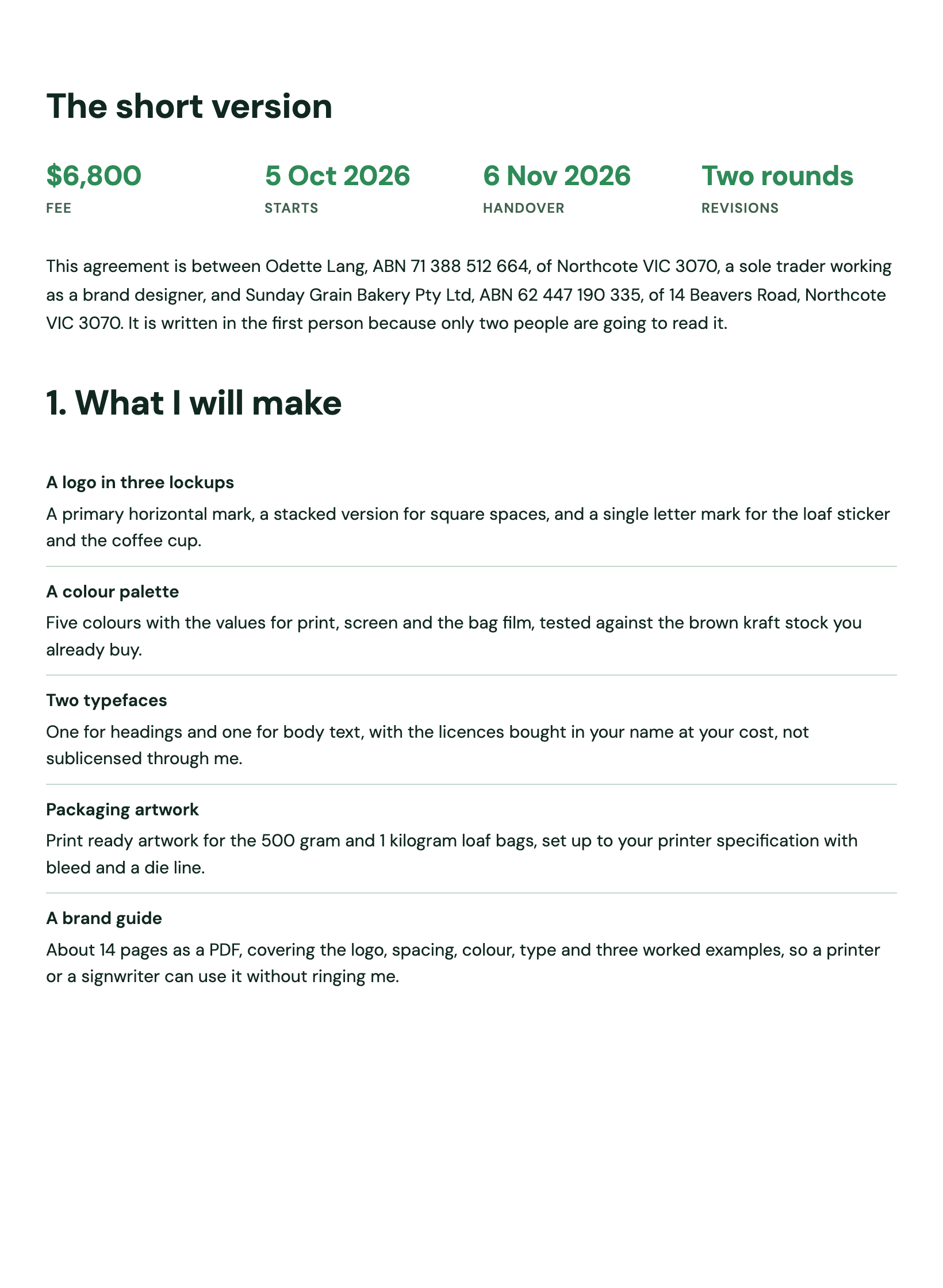 Freelance contractA brand designer and a bakery owner agree five weeks of work in language they can both read. It covers everything a longer contract would, and it never once says party of the first part.
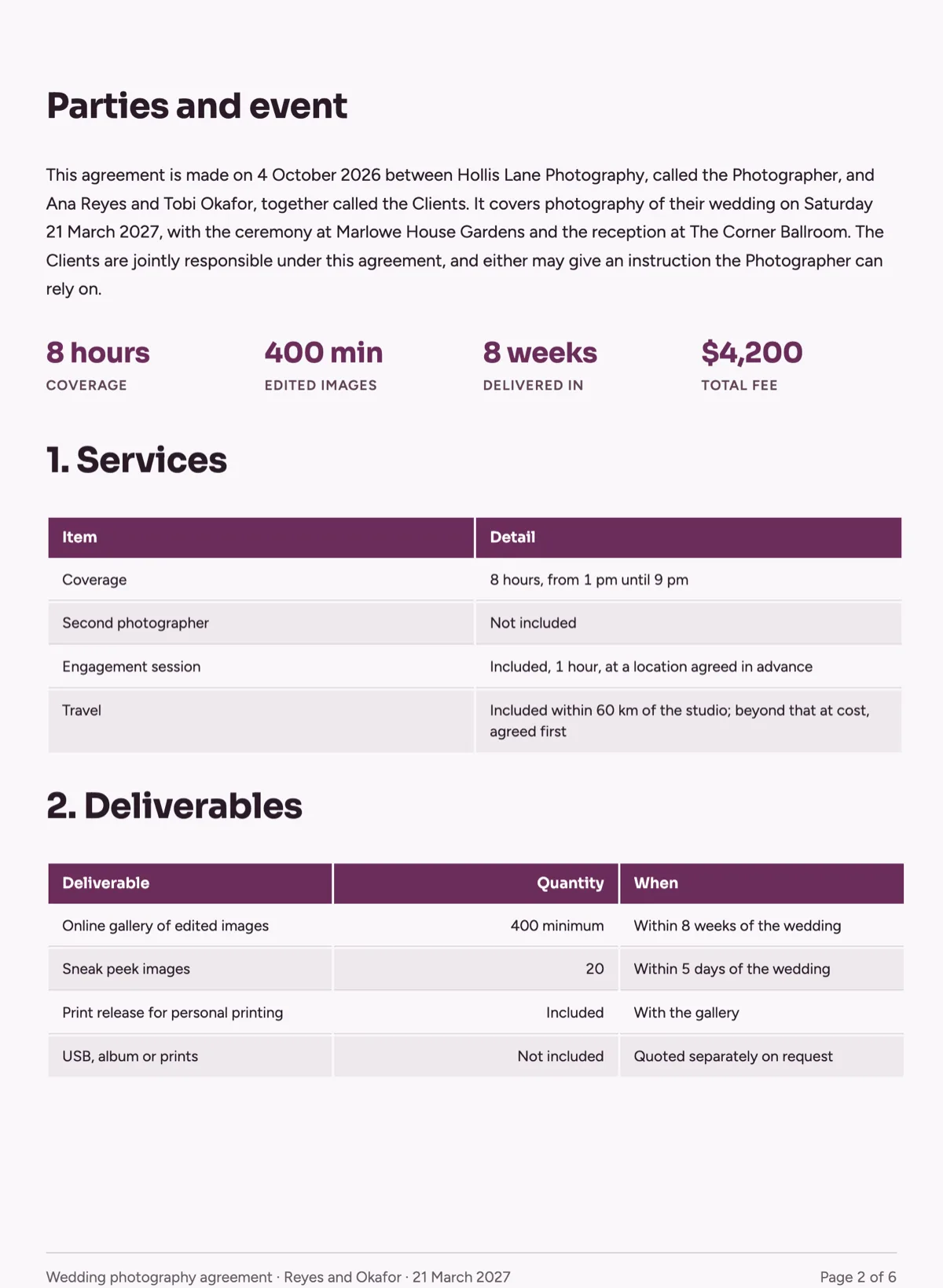 Photography contract template with deliverables you can countA photography contract is mostly a list of numbers: hours, images, weeks, dollars and the date after which the deposit is gone. This one writes every number down, then handles the three things that go wrong with weddings, a postponement, a sick photographer and an argument over who owns the photos.
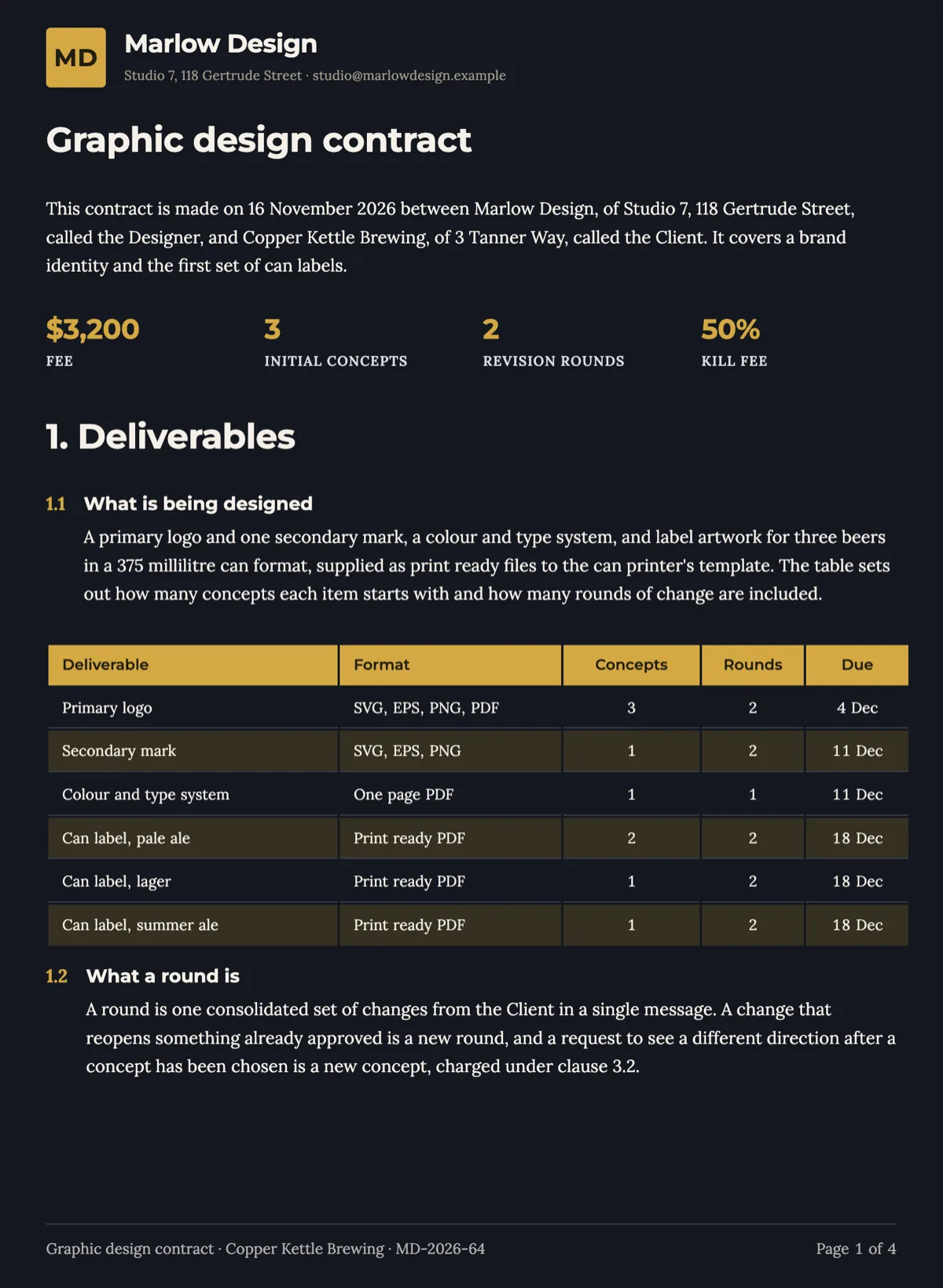 Graphic design contract template with concepts, rounds and usage rightsTwo things end design relationships: an endless run of revisions nobody priced, and a client who does not know whether they can put the logo on a shirt they sell. This contract counts the concepts and rounds for every deliverable and sets out the usage rights medium by medium.
Questions people ask
What is a normal kill fee?
There is no fixed rate; it varies by publication, field and stage. Many contracts pay a fraction of the fee if work is cancelled before delivery and the full fee once it is delivered as briefed. The figure that counts is the one agreed in writing before work begins.
Do I keep the rights if the client pays a kill fee?
You should, and a good clause says so. If you have not assigned copyright in writing, you usually still own it, but the client may hold a licence. The clause should end that licence when only a kill fee is paid, so you can sell the work elsewhere.
Can a kill fee be a penalty?
Usually not, because it is normally the agreed price of the client's right to cancel, not compensation for a breach. Penalty rules apply to sums payable on breach. If a clause frames the fee as damages and sets it far above any real loss, a penalty argument becomes possible.
Is a kill fee payable if the client rejects my work?
It depends on why. If the client simply decides not to use work delivered as briefed, many clauses pay the full fee. If the work did not meet the brief and you did not fix it after notice, the clause may deny the fee. Clear briefs and milestones prevent this dispute.
Do kill fees apply to expenses?
Not automatically. Expenses already incurred, such as travel, are usually reimbursed separately on top of any kill fee, if they were approved. Make sure the clause says so, because a kill fee calculated as a percentage of the fee may not cover costs you have already paid.
Put the clause in a finished document
The button opens the document generator with a starting description already filled in. Change it to match your own agreement before you run it.
Create a document with OneCraftRelated clauses
- Termination for convenience clause: exiting on notice at a known priceA termination for convenience clause lets a party end a contract on notice with no breach. Sample retainer wording, mutual and one sided versions, exit costs.
- Early termination fee clauseAn early termination fee clause charges for ending a contract before the term ends. Sample wording, sliding scales, the penalty test and unfair terms limits.
- Intellectual property assignment clauseAn intellectual property assignment clause transfers ownership of created work to the client. Sample wording, assign on payment or creation, and moral rights.
For everything the document generator can do, see the document maker.
Step by step in the builder: Create a document with AI, then Document builder components.
Written and checked by the OneCraft team. Last checked .