Contract clause
Liquidated damages clause in Singapore: a sample and the Denka test
A liquidated damages clause fixes in advance the sum a party pays for a particular breach, usually late completion. In Singapore the clause is enforceable if the sum was a genuine pre estimate of loss when the contract was made; if it is extravagant compared with the greatest loss that could follow, it is an unenforceable penalty.
Singapore takes a different line from the UK on liquidated damages. In Denka Advantech v Seraya Energy in 2020, the Court of Appeal kept the traditional test from Dunlop, asking whether the sum was a genuine pre estimate of loss, and declined to adopt the UK Supreme Court's legitimate interest test from Cavendish. It also held the penalty rule applies only to sums payable on breach.
Indunil Asanka · Co-founder
4 min read · Published
Sample clause
Written for fit out contract between Jurong Bay Interiors, a fictional Singapore contractor, and a fictional retailer opening a shop in a mall.
Liquidated Damages for Delay. (a) If the Contractor does not achieve Completion by the Date for Completion, as extended under clause 12, the Contractor must pay the Employer liquidated damages of S$1,800 for each day from the Date for Completion until Completion. (b) The parties agree the daily rate is a genuine pre estimate of the Employer's loss, worked out in Schedule 6 from the rent and service charge payable for the unit, lost gross margin on forecast sales and staff costs for the delayed opening. (c) The total liquidated damages under this clause will not exceed 10 per cent of the Contract Sum. (d) Liquidated damages are the Employer's sole remedy for delay in Completion, but do not affect its rights for any other breach. (e) The Employer may deduct liquidated damages from any amount due to the Contractor, after giving written notice.
Sample wording, not legal advice.
Variants
Daily rate with a cap
Construction and fit out, where delay causes a steady daily loss and the contractor needs a ceiling on its exposure.
The Contractor pays liquidated damages of S$1,800 for each day of delay, up to a maximum of 10 per cent of the Contract Sum.
Sectional completion rates
Projects handed over in sections, such as floors or units, where each section has its own date and rate.
For each Section, the Contractor pays liquidated damages at the rate in the Schedule for each day by which Completion of that Section is late, and the rate for a Section reduces in proportion once part of it is taken into use.
Bonus for early completion
Projects where the employer gains from an early handover and wants to reward it, which also helps the clause look balanced.
If the Contractor achieves Completion before the Date for Completion, the Employer pays a bonus of S$900 for each day early, up to S$18,000.
What to negotiate
Keep the working
Because Singapore asks whether the sum was a genuine pre estimate when the contract was made, the calculation behind the rate is the best evidence. Attaching it as a schedule, as the sample does, shows the rate was worked out from real figures such as rent, margin and staff costs, not picked to frighten the contractor.
Cap and sole remedy
Contractors seek a cap, often 5 to 10 per cent of the contract sum, and a statement that liquidated damages are the only remedy for delay. Employers accept a cap in return for a realistic daily rate. Both should check what happens once the cap is reached, because the employer may then want a right to terminate.
Extensions of time
Liquidated damages run from a date that must move when the employer causes delay or a listed event occurs. Without a working extension of time mechanism, the prevention principle can leave time at large and the liquidated damages clause unusable. The clause should refer to the extension procedure, as sub clause (a) does.
The risk of leaving it out
Without a liquidated damages clause, an employer delayed by a contractor must prove its actual loss, which for a retail opening means arguing about lost sales and margin after the event. With an oversized rate, the risk is that the clause is struck down as a penalty, leaving the employer to prove its loss anyway.
Denka and the Dunlop test
In Denka Advantech Pte Ltd v Seraya Energy Pte Ltd, decided in 2020, the Singapore Court of Appeal reviewed the Australian decision in Andrews and the UK decision in Cavendish, and chose to keep the test from Dunlop Pneumatic Tyre v New Garage: a sum is a penalty if it is extravagant and unconscionable compared with the greatest loss that could conceivably follow from the breach, judged when the contract is made. The court also held the penalty rule applies only to sums payable on breach of contract. Law checked on 21 October 2026. This page explains how the law works and is not legal advice.
Singapore and the UK compared
Test: Singapore asks whether the sum is a genuine pre estimate, or extravagant against the greatest possible loss; the UK, since Cavendish in 2015, asks whether it is out of all proportion to any legitimate interest of the innocent party. Scope: both apply the rule only to secondary obligations triggered by breach. Practical effect: a charge protecting interests beyond compensation, such as reputation, is easier to defend in the UK than in Singapore, where the comparison with loss remains central.
The sample in numbers
The retailer's unit costs S$420 a day in rent and service charge, it forecasts S$1,050 a day of gross margin and has S$330 a day of staff costs it cannot avoid, which totals the S$1,800 daily rate. On a contract sum of S$480,000 the 10 per cent cap is S$48,000, reached after about 27 days of delay. Those figures, kept in a schedule, are what the employer would point to if the rate were challenged.
Where the clause sits in a generated document
Subcontracts, statements of work and fit out contracts carry this clause beside completion and extension of time. When asking the AI document generator for one, give the daily rate and how it was calculated, the cap, the sole remedy wording, the deduction right and the extension of time clause it depends on.
Documents that carry this clause
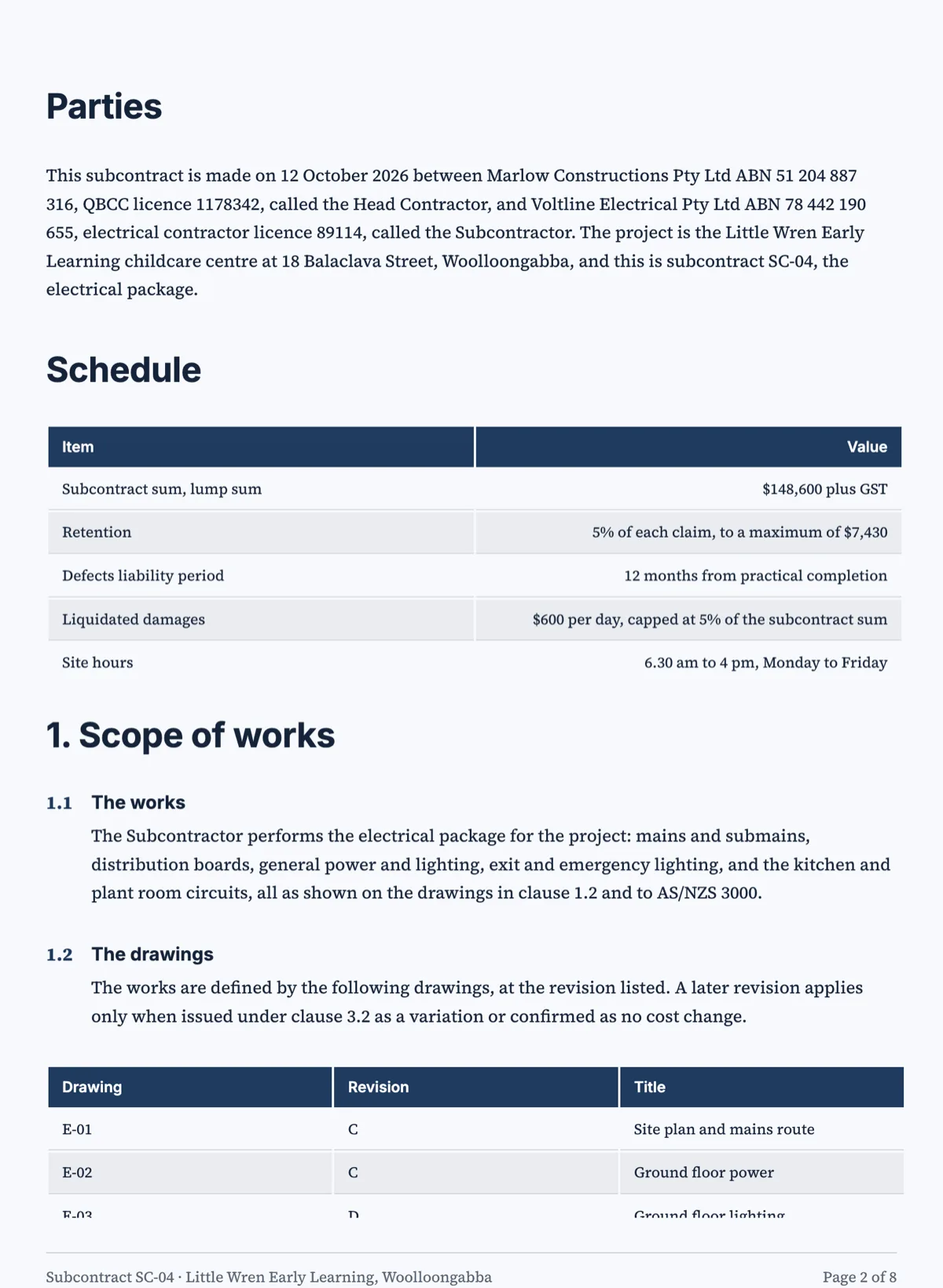 Subcontractor agreement template that flows the head contract downA subcontract exists to pass the head contract's obligations down one level and move the money back up on time. This one names the scope by drawing, sets the progress claim dates against the security of payment rules, holds retention and states the insurances, so the trade knows exactly when it is paid and for what.
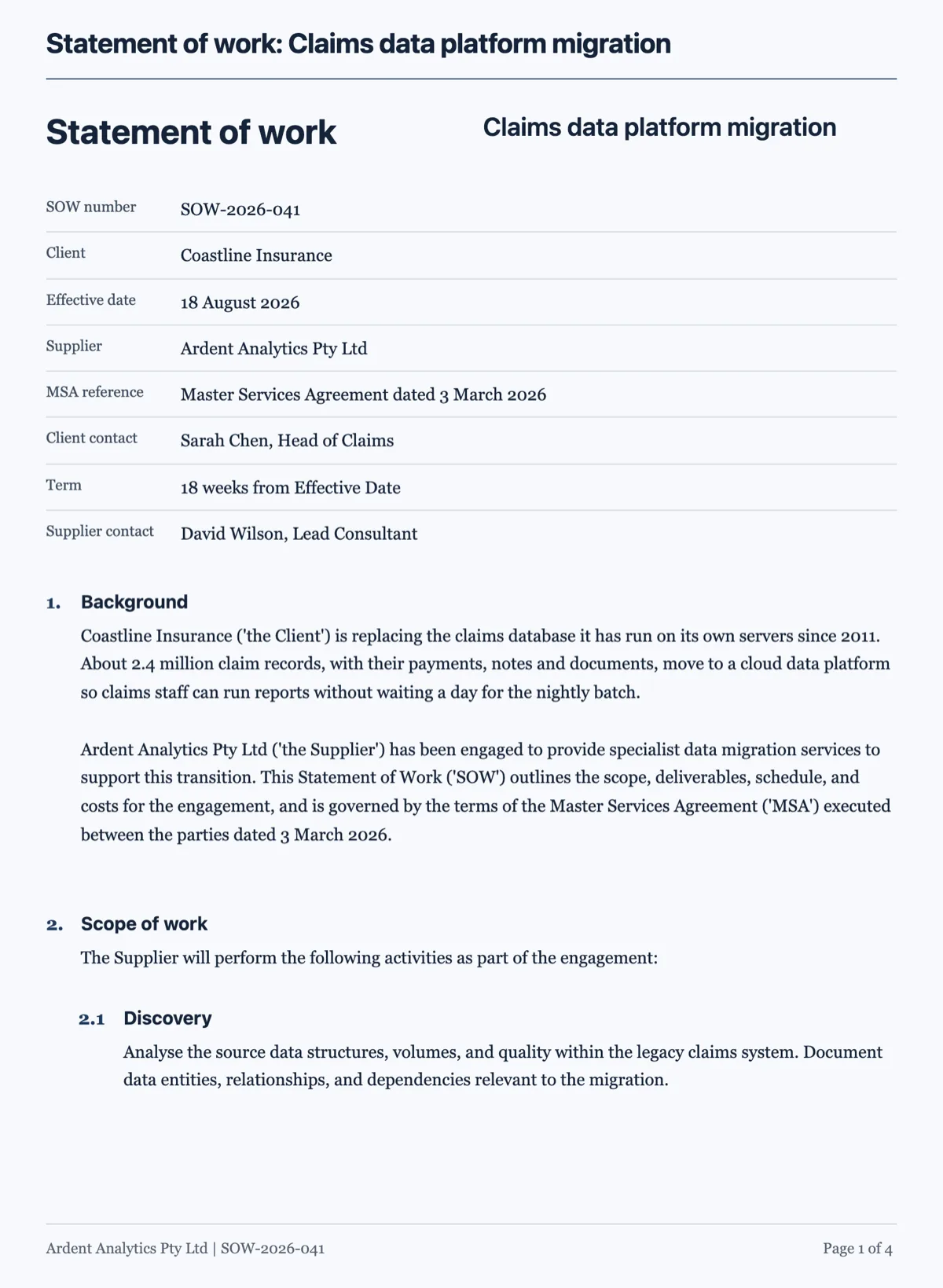 Statement of work template under a master agreementArdent Analytics migrates Coastline Insurance’s claims database to a cloud platform over 18 weeks under SOW-2026-041, governed by a master services agreement dated 3 March 2026. The work is time and materials with four roles priced by the day and a $394,000 estimate before GST, five dated deliverables, ten business days to accept each one, and five assumptions written down before anyone starts.
Questions people ask
Does Singapore follow the UK penalty test?
No. In Denka Advantech v Seraya Energy in 2020, the Court of Appeal declined to follow Cavendish and kept the Dunlop test, which asks whether the sum was a genuine pre estimate of loss rather than whether it protects a legitimate interest.
Is a liquidated damages clause enforceable in Singapore?
Yes, if the sum was a genuine pre estimate of the loss likely to result from the breach when the contract was made, and not extravagant compared with the greatest loss that could follow. Courts look at the figures available to the parties when they signed.
Does the penalty rule apply to termination fees in Singapore?
The Court of Appeal in Denka held the penalty rule applies only to sums payable upon breach of contract. A fee payable on a lawful termination, or as the price of an option the contract gives, is generally outside the rule, though it may be challenged on other grounds.
Do I have to prove my loss to claim liquidated damages?
No. If the clause is valid, the agreed sum is payable without proof of actual loss, even if the actual loss turns out smaller or larger. That certainty is the main reason parties agree liquidated damages instead of leaving loss to be proved.
What cap on liquidated damages is usual in Singapore?
Caps of 5 to 10 per cent of the contract sum are common in construction and fit out contracts, though they are negotiated. Standard forms used in Singapore set their own approaches. The cap should be read with any termination right that applies once it is reached.
Put the clause in a finished document
The button opens the document generator with a starting description already filled in. Change it to match your own agreement before you run it.
Create a document with OneCraftRelated clauses
- Liquidated damages clauseA liquidated damages clause fixes what delay costs before it happens. Sample fit out wording, the Australian penalty test, caps, and what each side negotiates.
- Penalty clause: the UK test and three worked samplesWhat makes a penalty clause unenforceable in the UK after Cavendish v Makdessi, with three sample charges tested and one redrafted so it holds.
- Extension of time clause: moving the completion date fairlyAn extension of time clause gives a contractor more time for delay it did not cause. Australian shop fit out sample, qualifying delay events and notice rules.
- Limitation of liability clause: putting a ceiling on exposureA limitation of liability clause caps what one party can recover. Australian sample wording, cap formulas, variants, the carve outs and the UK test.
For everything the document generator can do, see the document maker.
Step by step in the builder: Create a document with AI, then Document builder components.
Written and checked by the OneCraft team. Last checked .