Contract clause
Morality clause: when conduct can end a sponsorship
A morality clause, or morals clause, lets a brand suspend or end an endorsement, sponsorship or talent deal if the other party's conduct brings them into public disrepute or damages the brand's reputation. A reverse morality clause gives the talent the same right if the brand behaves badly.
A brand that pays an athlete or creator is buying their reputation as much as their time. A morality clause decides what conduct lets the brand walk away, and the closer its triggers are to objective facts, the fewer arguments it causes.
Nuwan Madhusanka · Co-founder
3 min read · Published
Sample clause
Written for a sponsorship agreement between Swell Line, a fictional Australian surfwear brand, and a professional surfer.
Conduct. (a) Swell Line may terminate this agreement by written notice if the Athlete: (i) is charged with a criminal offence punishable by imprisonment, other than a traffic offence; (ii) is found to have breached the anti doping rules of the Athlete's sport; or (iii) makes a public statement or post that is discriminatory or that a reasonable person would consider brings the Athlete into serious public disrepute, and does not remove it and apologise within 48 hours after Swell Line's written request. (b) Before terminating under paragraph (a)(iii), Swell Line must give the Athlete a reasonable opportunity to respond. (c) On termination under this clause, Swell Line need not pay any fee for periods after termination, and the Athlete must repay any fee paid in advance for those periods. (d) The Athlete may terminate this agreement on the same basis if Swell Line or its senior executives engage in conduct that brings Swell Line into serious public disrepute.
Sample wording, not legal advice.
Variants
Brand side morals clause
Most sponsorship and endorsement deals, where the brand needs an exit for reputational damage.
The Brand may terminate this agreement immediately by notice if the Talent commits any act that, in the Brand's reasonable opinion, brings the Talent into public disrepute, contempt or scandal, or that is likely to adversely affect the Brand's reputation.
Reverse morals clause
Talent with bargaining power, who do not want their name tied to a brand that becomes toxic.
The Talent may terminate this agreement by notice if the Brand, or any of its officers, engages in conduct that brings the Brand into public disrepute or would reasonably be expected to damage the Talent's reputation by association, and the Talent will retain all fees paid.
Suspension instead of termination
Situations under investigation, where facts are unclear and the brand wants to pause rather than end the deal.
If the Talent is the subject of a credible allegation of conduct described in this clause, the Brand may suspend all campaigns featuring the Talent and all payments for up to 60 days while the matter is investigated, after which the Brand must either reinstate or terminate.
What to negotiate
Objective triggers
Vague triggers such as anything the brand considers embarrassing give the brand broad discretion and the talent little security. Objective triggers, such as a criminal charge, a doping finding, or a specified kind of post that is not removed after a request, are easier to apply and harder to dispute. Most negotiated clauses mix a few objective triggers with a reasonableness standard for the rest.
Notice and a chance to respond
Talent should ask for notice and a short opportunity to respond or correct, especially for social media posts, which can be removed and apologised for. Brands may accept that for lesser matters while keeping an immediate right for serious events such as criminal charges. A chance to respond also reduces the risk of acting on a false allegation.
Repayment of fees
The money question is often the real dispute. A brand terminating for conduct usually stops future payments and may seek repayment of fees paid for future periods, and sometimes damages. Talent should resist repayment of fees for work already delivered, and of fees for periods before the conduct.
The risk of leaving it out
Without a morality clause, a brand may be stuck paying and featuring talent whose conduct is damaging the brand, unless the conduct also breaches another term. Termination for general breach may be hard to justify, and the talent may claim the remaining fees. Talent without a reverse clause may be locked into promoting a brand that has become harmful to their own reputation.
Triggers from vague to objective
Most vague: any conduct the brand considers may damage its reputation. Vague but tested: conduct that brings the talent into public disrepute, contempt or scandal, judged by a reasonable person. More specific: discriminatory statements, or conduct that breaches the brand's published values, with a chance to remove and apologise. Objective: being charged with or convicted of a serious criminal offence; a doping finding by a sports authority; a breach of advertising rules. The further down the list a clause sits, the more predictable it is. Law checked on 21 October 2026. This page explains how the clause works and is not legal advice.
Disclosure of paid content
Many sponsorships now include social media content, and advertising rules require paid promotions to be clearly identified. In the UK, the Advertising Standards Authority enforces the advertising codes on influencer marketing, and Australian advertising codes and the Australian Consumer Law prohibit misleading conduct, including undisclosed paid endorsements. Some morality clauses add a breach of those rules as a trigger, since it damages the brand directly.
Reverse morality clauses
Talent increasingly ask for the same protection against the brand: if the company or its leaders become associated with scandal, the talent can leave and keep fees already paid. It reflects the reality that association with a damaged brand can hurt a personal brand built over years. Brands often accept a reverse clause limited to serious conduct by the company or its senior executives.
Speakers and creators
Morality clauses also appear in speaker agreements, influencer agreements and creative collaborations. For speakers, a clause may let the organiser cancel an appearance; for creators, it may require removal of sponsored content and stop future posts. The sponsorship and influencer agreement examples show the clause in the context of a full agreement.
Documents that carry this clause
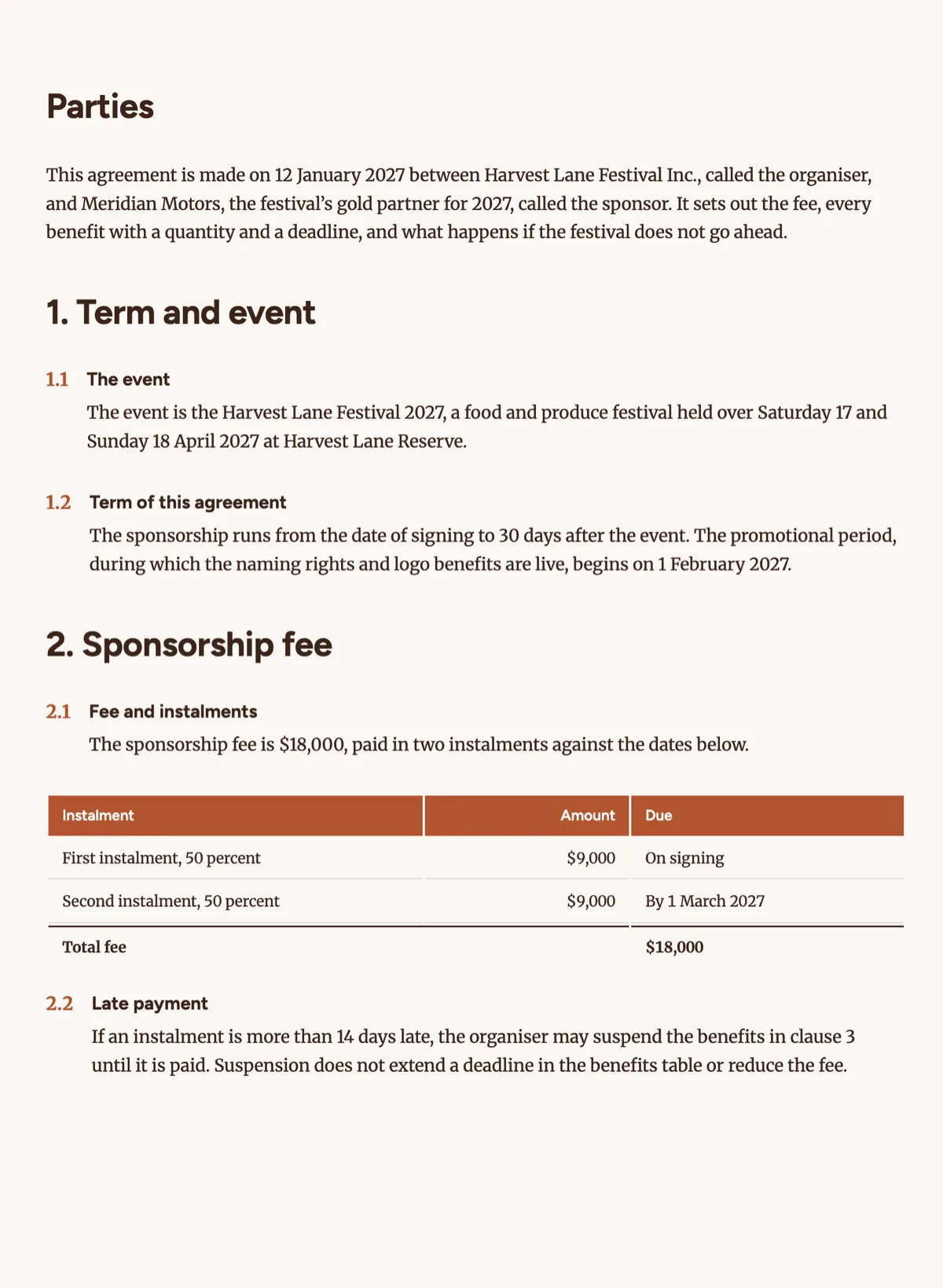 Sponsorship agreement template that lists every benefit with a numberSponsorship falls apart in the delivery, when nobody can find the email that said how many banners and which stage. This agreement is the benefits list as a table with quantities and dates, the $18,000 fee in instalments tied to those dates, and the two clauses sponsors care about most: exclusivity, and what happens if the event does not go ahead.
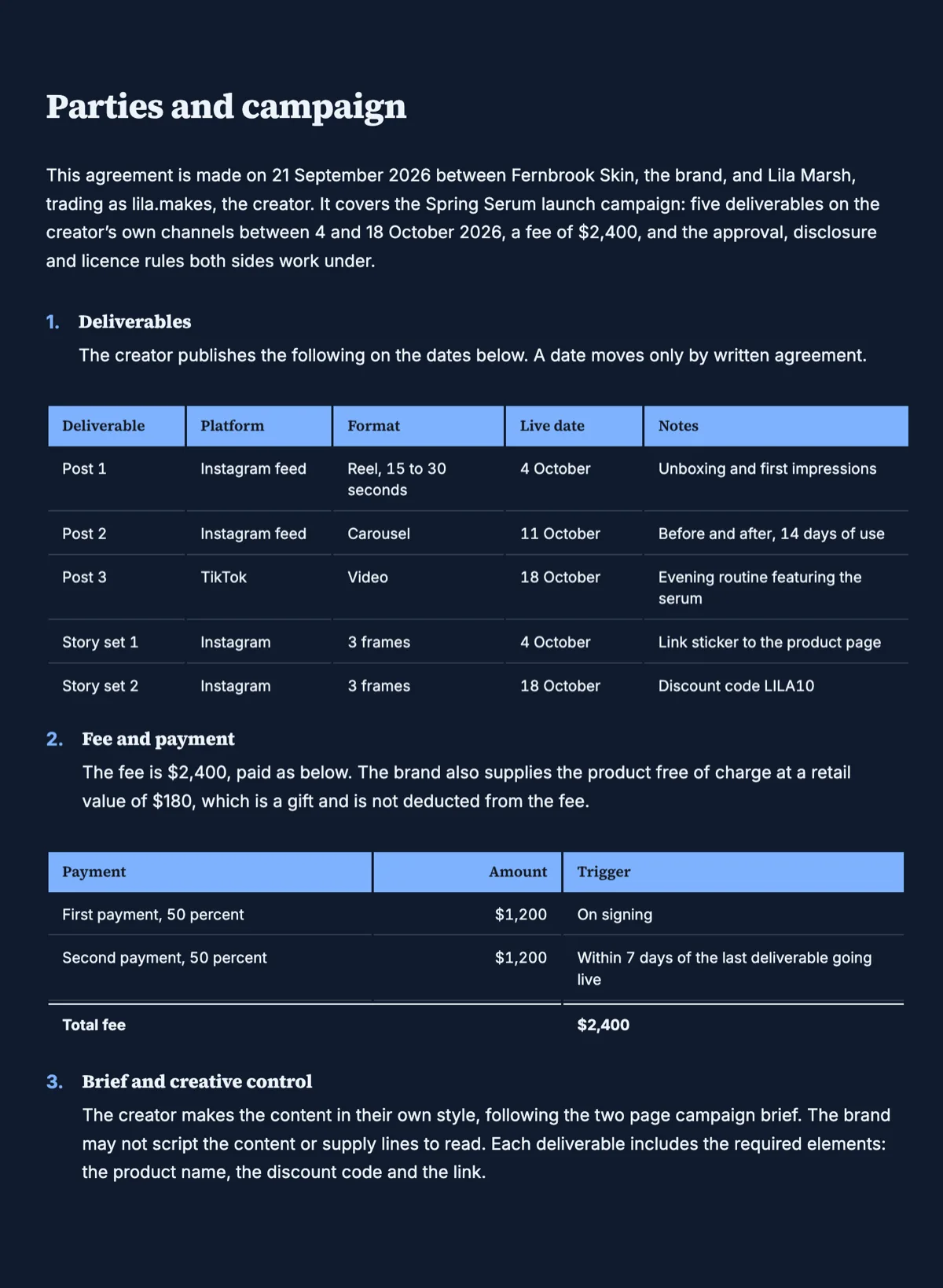 Influencer agreement template with the posts, dates and rights in one tableA creator deal is a schedule of posts and a set of permissions, and the disputes are about the reuse and the disclosure, not the fee. This agreement lists each deliverable with its platform and live date, splits the $2,400 fee across delivery, gives the brand a 12 month licence rather than ownership, and puts the ad label rule in the creator's obligations.
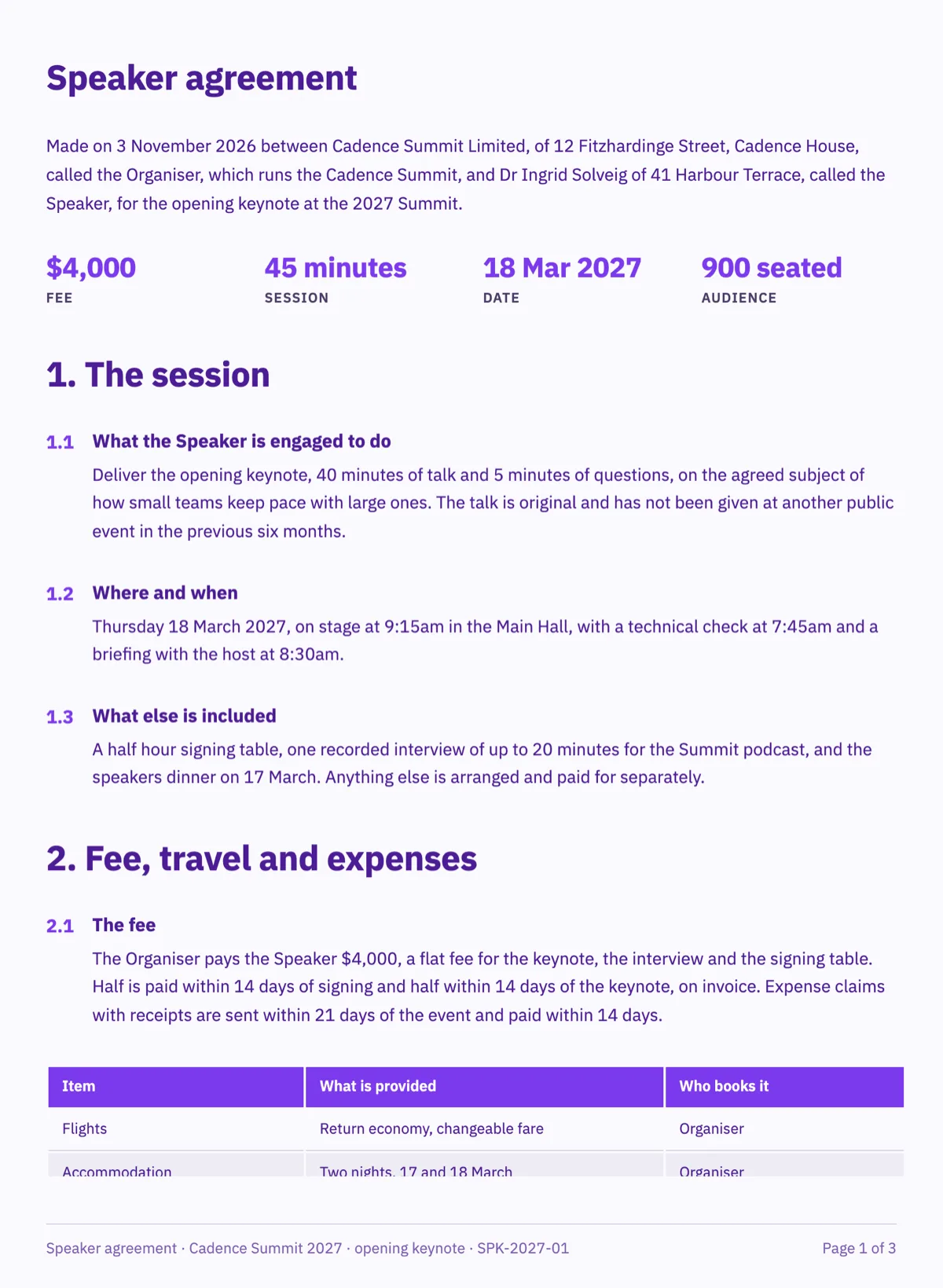 Speaker agreement template covering the fee, travel and the recordingMost speaker agreements fall over on two things nobody wrote down: who books the flight, and what happens to the video afterwards. This three page example answers both, with a table that names the payer for every travel line and a clause that lets the organiser keep clips of up to 90 seconds while copyright in the talk stays with the speaker.
Questions people ask
What is a morality clause?
It is a term in an endorsement, sponsorship or talent agreement allowing one party to suspend or end the deal if the other's conduct brings them into public disrepute or damages the brand's reputation. It is common in sport, entertainment and influencer marketing.
Can a brand end a sponsorship over a social media post?
If the morality clause covers it, yes. Clauses often cover offensive or discriminatory public statements. Well drafted clauses require the post to meet a reasonable person test, and may give the talent a chance to remove it and apologise before termination.
What is a reverse morals clause?
It is a morality clause in favour of the talent, allowing them to end the deal if the brand or its leaders engage in conduct that brings the brand into disrepute. It protects the talent's reputation from being tied to a damaged company, and usually lets them keep fees already paid.
Does the talent have to repay fees after a morals termination?
It depends on the clause. Many require repayment of fees paid in advance for periods after termination, but not fees for work already done. Some brands also seek damages. Talent should negotiate limits on repayment before signing, since the money question causes most disputes.
Is an accusation enough to trigger a morality clause?
Under a vague clause, a brand may argue a public accusation alone causes disrepute. Talent should negotiate triggers based on charges, findings or conduct the brand can show, and a suspension period while allegations are investigated, rather than immediate termination on allegations alone.
Put the clause in a finished document
The button opens the document generator with a starting description already filled in. Change it to match your own agreement before you run it.
Create a document with OneCraftRelated clauses
- Publicity clauseA publicity clause says whether a supplier can name a client, use its logo or issue a release. Sample agency wording, consent variants and what to negotiate.
- Termination for cause clause: defining material breach before you need itA termination for cause clause ends a contract for serious breach. Sample wording, what counts as material, cure periods and immediate termination events.
- Non disparagement clause: wording for settlement deeds and exitsA non disparagement clause stops a party making negative statements about the other. Sample settlement wording, mutual versions and review site carve outs.
For everything the document generator can do, see the document maker.
Step by step in the builder: Create a document with AI, then Document builder components.
Written and checked by the OneCraft team. Last checked .