Contract clause
Payment in lieu of notice clause (PILON): UK sample and effects
A payment in lieu of notice clause, or PILON, gives an employer the right to end employment immediately by paying the employee for the notice period instead of having them work it. With the clause, the payment is a contractual entitlement; without it, ending employment early is a breach and the payment is damages.
Sometimes an employer wants someone gone today, not in three months. A PILON clause makes that lawful under the contract, and the difference it makes to restrictive covenants is often worth more than the money.
Nuwan Madhusanka · Co-founder
4 min read · Published
Sample clause
Written for an employment contract between Castlegate Studios, a fictional York design agency, and a senior designer on three months' notice.
Payment in Lieu of Notice. (a) The Company may, at its sole discretion, terminate the Employee's employment with immediate effect at any time by giving written notice and paying the Employee a sum equal to the basic salary the Employee would have received during the notice period required by clause 18, or any part of that period that remains (the PILON). (b) The PILON will not include any bonus, commission, holiday that would have accrued, or benefits, except as required by law. (c) The Company may pay the PILON in one sum within 28 days of termination, or in equal monthly instalments over the unexpired notice period, in which case each instalment is reduced by any earnings the Employee receives from new work during that month, and the Employee must report such earnings promptly. (d) The PILON is subject to deductions for tax and National Insurance.
Sample wording, not legal advice.
Variants
Basic salary only
Most employments, where the employer wants a clear, limited payment without arguments about benefits.
The Company may terminate the Employee's employment with immediate effect by paying a sum equal to the Employee's basic salary, at the rate applying on the termination date, for the notice period or the remainder of it, less tax and National Insurance.
Salary plus the value of benefits
Senior roles with significant benefits, where the employee negotiates to be no worse off than if they had worked the notice.
The PILON will be equal to the basic salary and the cost to the Company of providing the Employee's contractual benefits, including pension contributions, for the notice period or the remainder of it.
Phased PILON with mitigation
Long notice periods, where the employer wants payments to stop if the employee quickly finds a new job.
The PILON will be paid in monthly instalments over the unexpired notice period. Each instalment is reduced by the gross earnings the Employee receives from any new employment or engagement in that month. The Employee must seek alternative work and tell the Company of any earnings within seven days.
What to negotiate
Tax since April 2018
From 6 April 2018, all post employment notice pay has been taxable as earnings, whether or not the contract has a PILON clause. Before then, a payment made where there was no PILON clause could sometimes be paid free of tax as damages up to £30,000. The tax advantage of leaving PILON out has largely gone, which removes one of the main reasons employees used to resist the clause.
Whether restrictive covenants survive
If an employer ends employment without notice and without a contractual right to pay in lieu, it is in repudiatory breach, and an employee who accepts that breach may be released from post termination restrictions such as non solicitation covenants. Exercising a PILON clause is not a breach, so the covenants stay in force. For employers who rely on covenants, that is often the most valuable part of the clause.
Bonus and holiday during notice
Employees often want the PILON to cover bonus or commission they would have earned over the notice period, and holiday that would have accrued. Employers usually limit it to basic salary. The contract should say clearly, because if it is silent, arguments follow about whether a bonus was earned. Accrued but untaken holiday up to termination must be paid anyway.
The risk of leaving it out
Without a PILON clause, an employer that wants someone out immediately either keeps paying them to stay home on garden leave, or dismisses them without notice and pays a sum as damages. The second route is a breach of contract, which can release the employee from restrictive covenants and invite a claim if the payment falls short of what they would have earned.
PILON against no PILON
With a PILON clause, the employer ends employment lawfully, the payment is a contractual debt, it is taxed as earnings, and restrictive covenants remain enforceable. Without one, paying in lieu is a breach, the payment is damages for that breach, the tax treatment is the same since 2018 under the post employment notice pay rules, but the employee may argue that the breach freed them from their covenants, and can claim the shortfall if the payment does not match what the notice period was worth. The clause therefore matters most where covenants matter. Law checked on 21 October 2026. This page explains how the clause works and is not legal advice.
Statutory notice and contractual notice
Section 86 of the Employment Rights Act 1996 sets minimum notice: one week after a month's service, then one week for each complete year up to twelve weeks. A contract can give more, and senior roles often carry three or six months. The PILON should refer to the notice in the contract, which can never be less than the statutory minimum. ACAS guidance explains that an employee can agree to take pay instead of working notice even without a clause, but agreement is not guaranteed.
Garden leave as the alternative
Garden leave keeps the person employed but at home for the notice period, so they cannot start with a competitor during it and remain bound by the duties of an employee. PILON ends the employment immediately. Employers wanting to keep someone off the market often prefer garden leave; those wanting a clean break prefer PILON. A contract can contain both and let the employer choose when notice is given.
Using the clause in practice
When exercising a PILON clause, the termination letter should say the employer is using its right under the clause, give the termination date and set out the payment and how it will be made. In a contract drafted with the AI document generator, ask for the clause next to the notice clause so the two refer to each other, and include whether the payment is basic salary only.
Documents that carry this clause
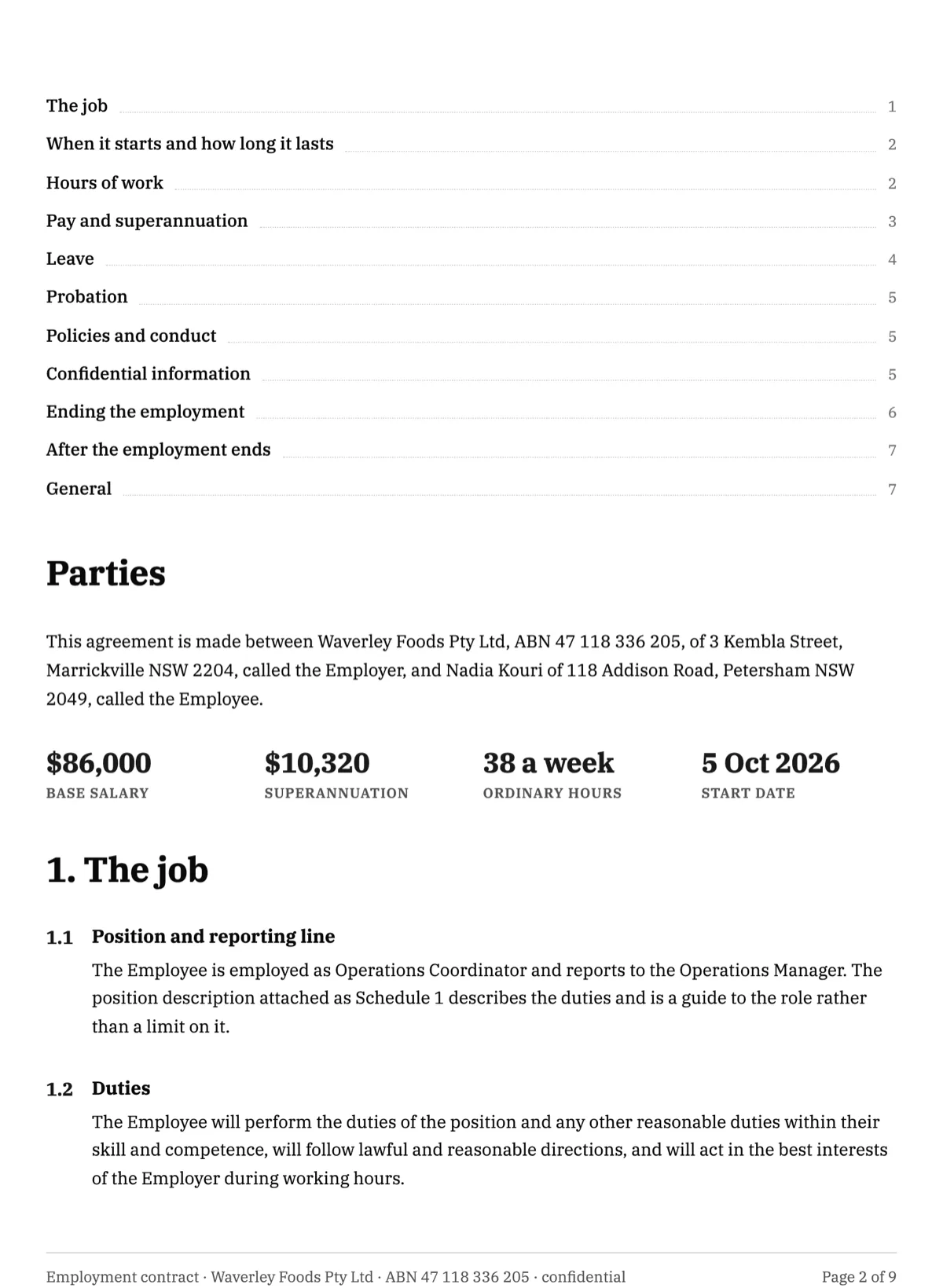 Employment contractA full time ongoing contract for an operations coordinator on $86,000 plus $10,320 of superannuation. Eleven numbered clauses, a leave table drawn from the National Employment Standards, and a notice table that scales with service.
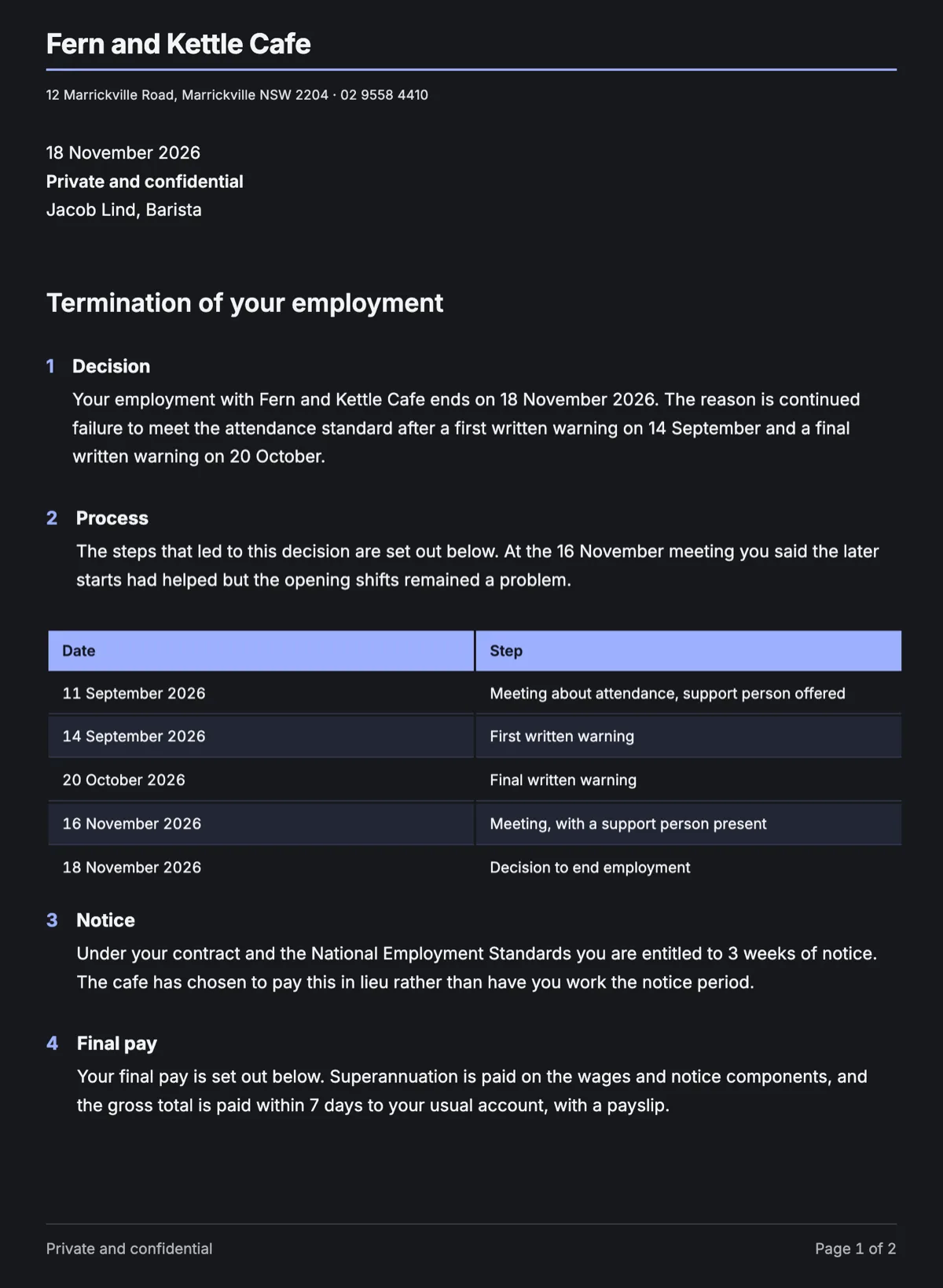 Termination letter template that shows the final payA termination letter is read twice, once by the employee in the meeting and once by a lawyer or a tribunal months later, and both need the same facts. This one states the reason and the process in dates, shows the final pay as a table with each component, and says what happens next, so there is nothing to ask afterwards.
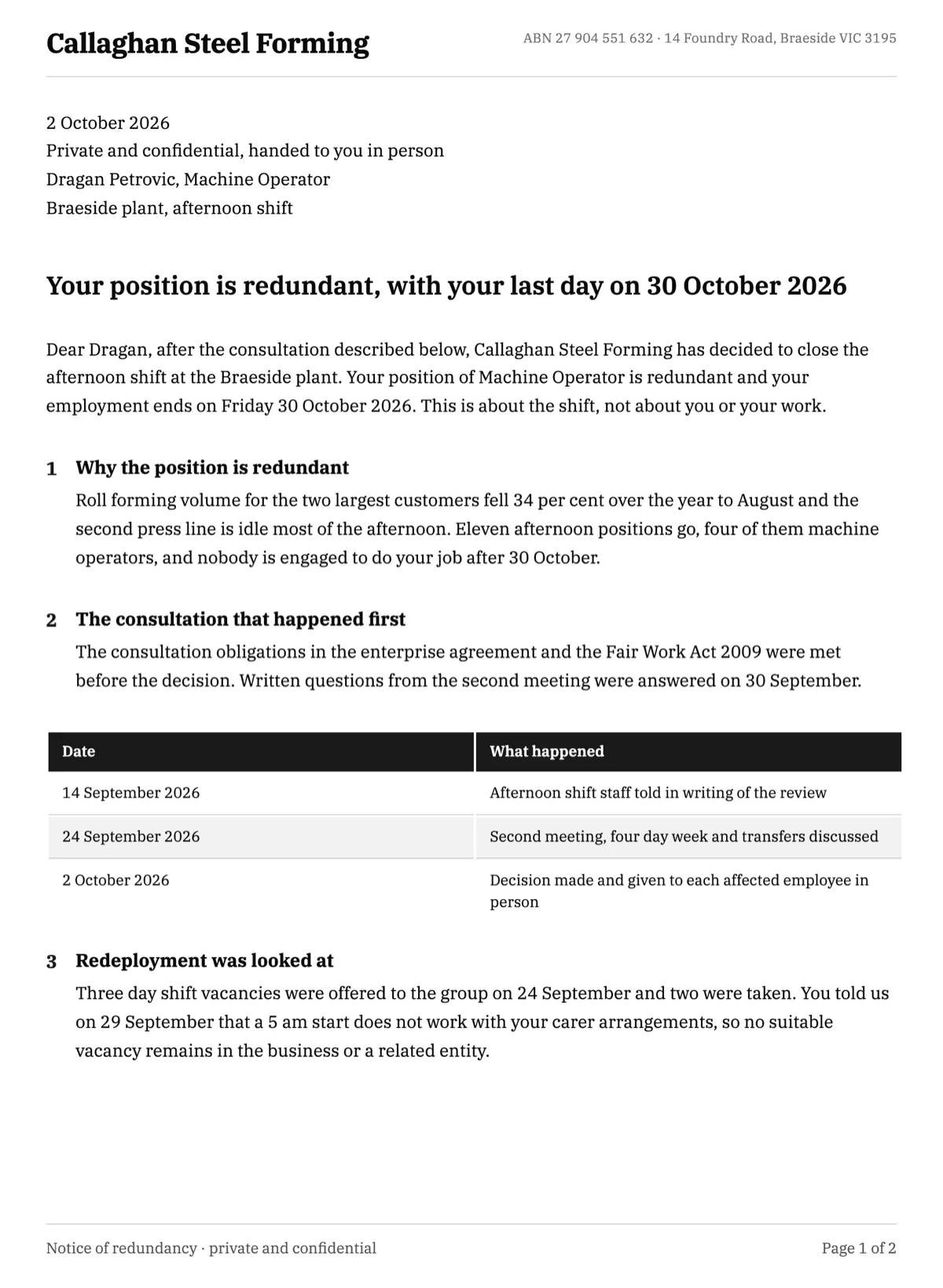 Redundancy letter template with the pay calculated line by lineA redundancy letter has to prove three things at once: that the job has gone, that the employee was consulted before the decision, and that the money is right. This one names the volume fall, dates the consultation, sets four weeks notice, and shows the $24,168.75 worked out line by line.
Questions people ask
Is payment in lieu of notice taxable?
Yes. Since 6 April 2018, post employment notice pay is taxed as earnings and subject to National Insurance in the UK, whether or not the contract contains a PILON clause. Only amounts above the notice pay, such as some genuine compensation for loss of employment, may qualify for the £30,000 exemption.
Does PILON include holiday and bonus?
Only if the clause says so. Most PILON clauses cover basic salary only, leaving out bonus, commission, benefits and holiday that would have accrued during the notice period. Holiday accrued up to the termination date must still be paid. Read the clause, because a promise to pay salary and benefits is more valuable.
Do my restrictive covenants still apply after PILON?
Generally yes, if the employer used a contractual PILON clause, because ending employment that way is not a breach. Covenants can still fail for being wider than reasonably necessary. Where an employer dismisses without notice and has no PILON clause, the employee may argue the breach released them from the covenants.
Can my employer pay me in lieu of notice without a clause?
It can offer to, and you can agree. If you do not agree and there is no clause, ending your employment without notice is a breach of contract, and you can claim damages equal to the pay and benefits you would have received during the notice, reduced by what you earn elsewhere in that time.
Does PILON affect my right to claim unfair dismissal?
No. A PILON clause governs how the employment ends, not whether the dismissal was fair. If you have two years' service and the reason or process for dismissal was unfair, you can still bring a claim, and the effective date of termination is usually the date the PILON was exercised.
Put the clause in a finished document
The button opens the document generator with a starting description already filled in. Change it to match your own agreement before you run it.
Create a document with OneCraftRelated clauses
- Notice period clause in an employment contractA notice period clause sets how much notice ends employment. Australian sample wording, the National Employment Standards minimums and three variants.
- Garden leave clause: paid notice away from the businessA garden leave clause keeps an employee paid but away from work during notice. Australian sample wording, restraint set off and three variants compared.
- Summary dismissal clause: serious misconduct in AustraliaA summary dismissal clause for an Australian hotel group: dismissal without notice for serious misconduct, the regulation 1.07 list, and the chance to respond.
- Non solicitation clause for clients and staffA non solicitation clause stops a former employee approaching clients or staff. Australian sample wording for clients and staff, with three variants.
For everything the document generator can do, see the document maker.
Step by step in the builder: Create a document with AI, then Document builder components.
Written and checked by the OneCraft team. Last checked .