Contract clause
Summary dismissal clause: serious misconduct in Australia
A summary dismissal clause lets an employer end employment immediately, without notice or pay in lieu, for serious misconduct. In Australia, serious misconduct is defined in regulation 1.07 of the Fair Work Regulations 2009, and an employer that relies on the clause still needs a valid reason and a fair process.
Notice is the price of ending employment in Australia, except where the employee's own conduct is serious enough to forfeit it. The clause names that exception; the Fair Work Regulations and the unfair dismissal rules decide whether it was properly used.
Nuwan Madhusanka · Co-founder
4 min read · Published
Sample clause
Written for an employment contract between Wattlebird Hospitality, a fictional Adelaide hotel group, and a front office supervisor.
Summary Dismissal. (a) The Company may end the Employee's employment without notice, or payment in lieu of notice, if the Employee engages in serious misconduct. (b) Serious misconduct has the meaning in regulation 1.07 of the Fair Work Regulations 2009 and includes, for example, theft, fraud, assault, sexual harassment, being intoxicated at work, refusing a lawful and reasonable instruction, and conduct causing a serious and imminent risk to health or safety. (c) The examples in paragraph (b) are a guide and do not limit what may amount to serious misconduct. (d) Before deciding to dismiss, the Company will tell the Employee of the allegations and give the Employee a reasonable opportunity to respond, and may suspend the Employee on full pay while it investigates. (e) On summary dismissal, the Company will pay all amounts accrued to the termination date.
Sample wording, not legal advice.
Variants
Listed examples
Most employers, where examples help managers and staff understand the standard without limiting it.
Serious misconduct includes theft, fraud, assault, sexual harassment, wilful damage to Company property, serious breach of safety procedures, being under the influence of alcohol or drugs at work, and disclosing confidential information without authority.
General definition only
Contracts that prefer to rely on the regulation and the general law rather than a list that may be read narrowly.
The Company may terminate the Employee's employment without notice if the Employee engages in serious misconduct, as defined in the Fair Work Regulations 2009, or in conduct that would justify summary dismissal at common law.
Small business version
Employers with fewer than 15 employees who want to follow the Small Business Fair Dismissal Code.
If the Company believes on reasonable grounds that the Employee's conduct is sufficiently serious to justify immediate dismissal, it may dismiss the Employee without notice or warning, consistently with the Small Business Fair Dismissal Code.
What to negotiate
Procedural fairness
A clause cannot authorise an unfair process. For employees protected from unfair dismissal, the Fair Work Commission considers whether there was a valid reason, whether the employee was told of it and given an opportunity to respond, and whether a support person was refused. Summary dismissal without hearing the employee's side is a common reason dismissals are found harsh or unjust, even where misconduct occurred.
Examples as a guide, not a limit
A list of examples helps, but if it is written as exhaustive, conduct not on the list may be argued to fall outside the clause. The sample says the examples do not limit serious misconduct. Employees should check whether the list includes vague items such as conduct damaging the Company's reputation, which can be stretched to cover minor matters.
The small business code
Employers with fewer than 15 employees can follow the Small Business Fair Dismissal Code, which allows summary dismissal where the employer believes on reasonable grounds that the conduct is serious enough. Following the code, and keeping a record of why the belief was reasonable, is a strong defence to an unfair dismissal claim for a small business.
The risk of leaving it out
Even without a summary dismissal clause, the Fair Work Act allows dismissal without notice for serious misconduct, so the clause is not strictly required. Leaving it out removes a clear statement of the standard, which makes it harder to show the employee knew what conduct could end the job immediately, and leaves managers without guidance in the moment.
What the regulation counts as serious misconduct
Regulation 1.07 of the Fair Work Regulations 2009 defines serious misconduct for the Fair Work Act. Checklist: wilful or deliberate behaviour inconsistent with the continuation of employment; conduct that causes serious and imminent risk to the health or safety of a person, or to the reputation, viability or profitability of the business; and, in the course of employment, theft, fraud, assault, sexual harassment, being intoxicated at work, or refusing to carry out a lawful and reasonable instruction consistent with the contract. The listed examples do not count if the employee shows that, in the circumstances, the conduct did not make it unreasonable to continue the employment during the notice period. Law checked on 21 October 2026. This page explains how the clause works and is not legal advice.
Notice and entitlements on summary dismissal
Section 123 of the Fair Work Act removes the National Employment Standards notice requirement where the employee is dismissed for serious misconduct. The employee still receives everything accrued: wages to the termination date, accrued annual leave, and long service leave as the relevant state law provides. Some state long service leave laws reduce entitlements on summary dismissal, so check the state rules. The sample's last paragraph confirms accrued amounts are paid.
Investigating before deciding
Suspension on full pay while the facts are gathered keeps the employee away from the workplace without pre judging the outcome. The employer should put each allegation to the employee in writing, allow a support person at any meeting, consider the response, and decide on the evidence. A show cause letter is the usual way to put allegations and ask for a response before dismissal.
Summary dismissal and commercial termination
Summary dismissal is about employment. Ending a commercial contract immediately for a serious breach is a different question, governed by a termination for cause clause and the general law on repudiation. The two are sometimes confused when a contractor is treated as an employee, so getting the worker's status right comes first.
Documents that carry this clause
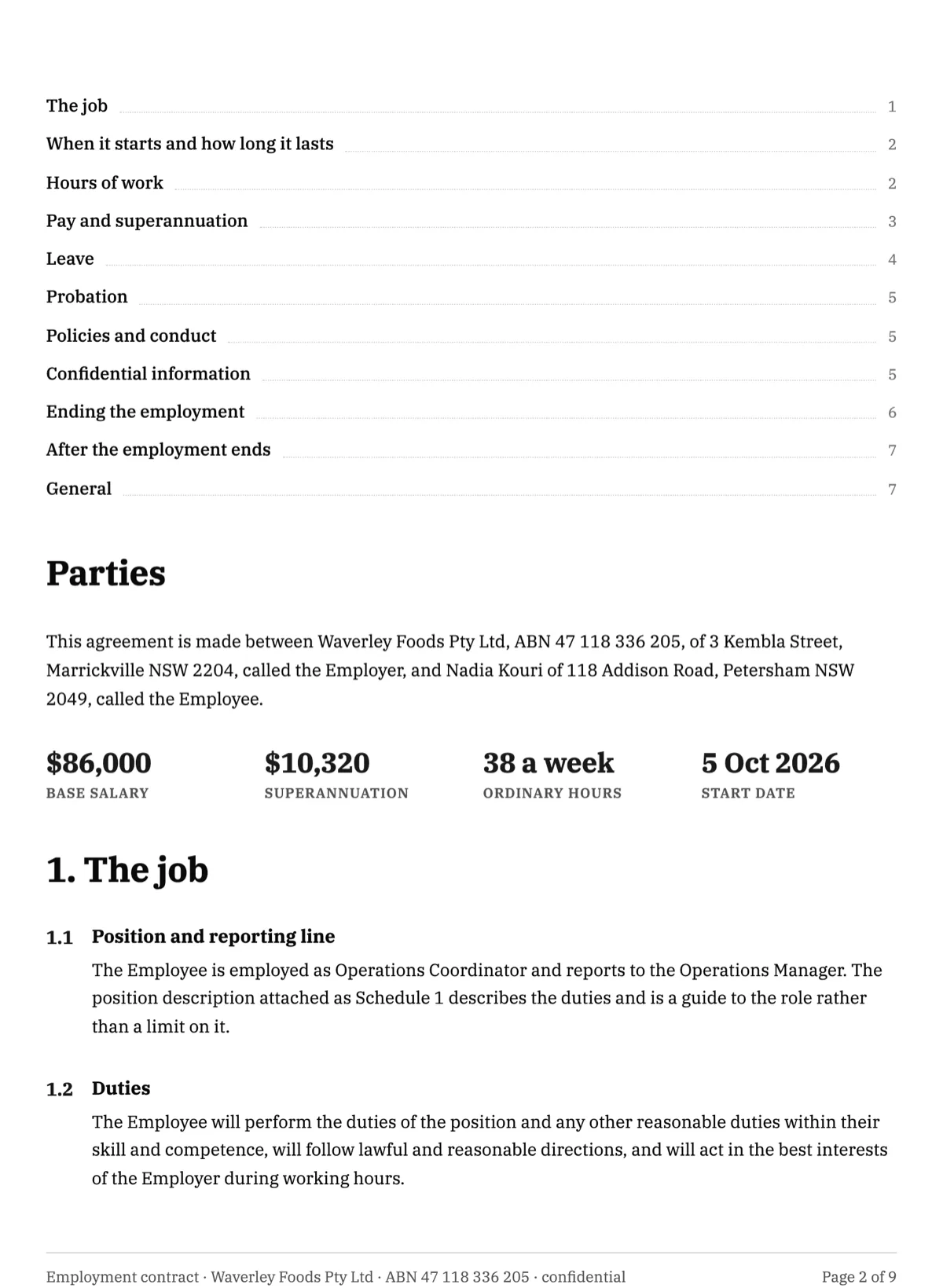 Employment contractA full time ongoing contract for an operations coordinator on $86,000 plus $10,320 of superannuation. Eleven numbered clauses, a leave table drawn from the National Employment Standards, and a notice table that scales with service.
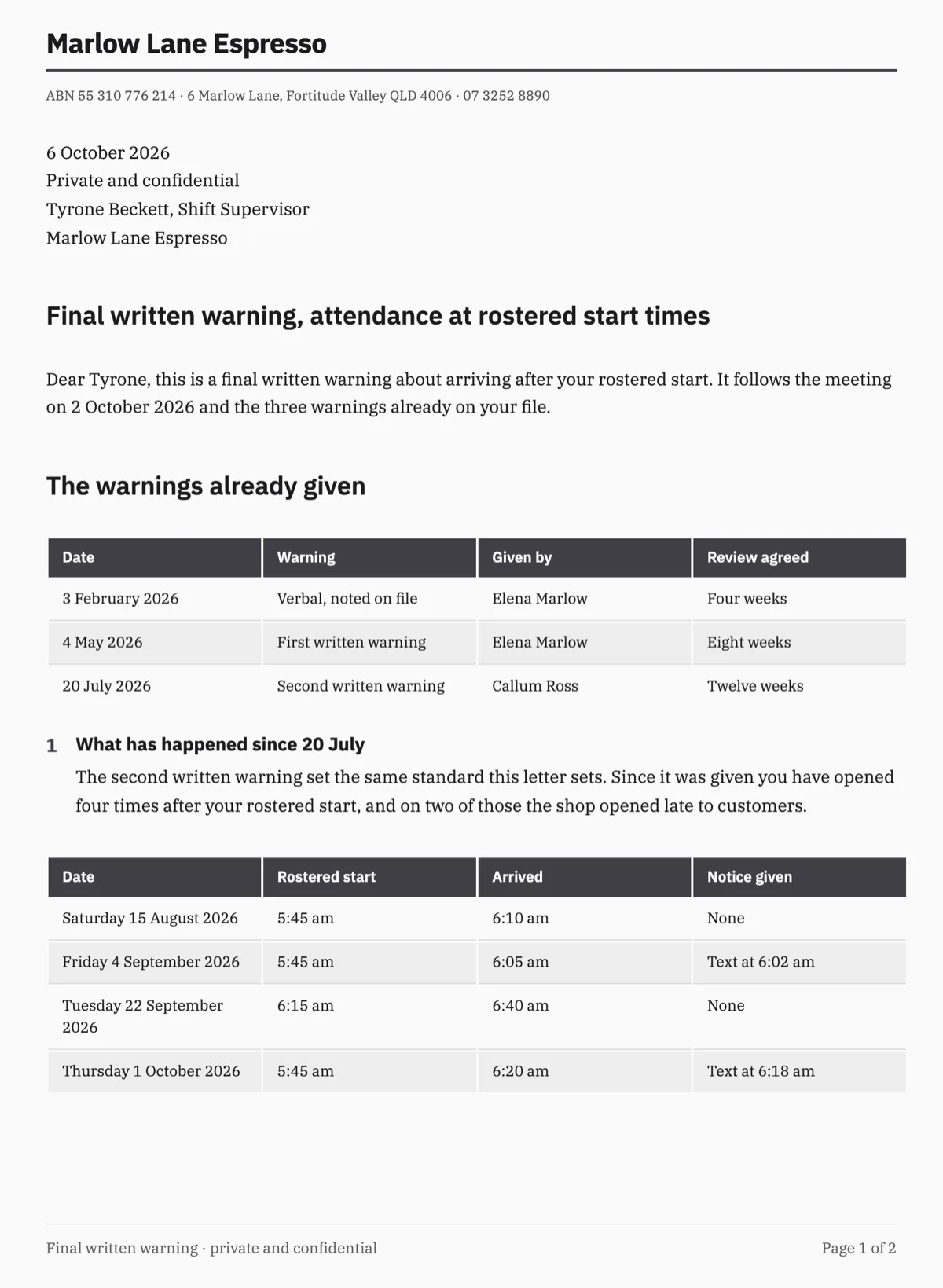 Final written warning template that lists every warning already givenA final warning is only final if the record shows what came before it, and most fail because the earlier steps were verbal and undated. This one lists three prior warnings with dates and who gave them, four dated late starts since the last one, the response given at the meeting, and the consequence in a single sentence.
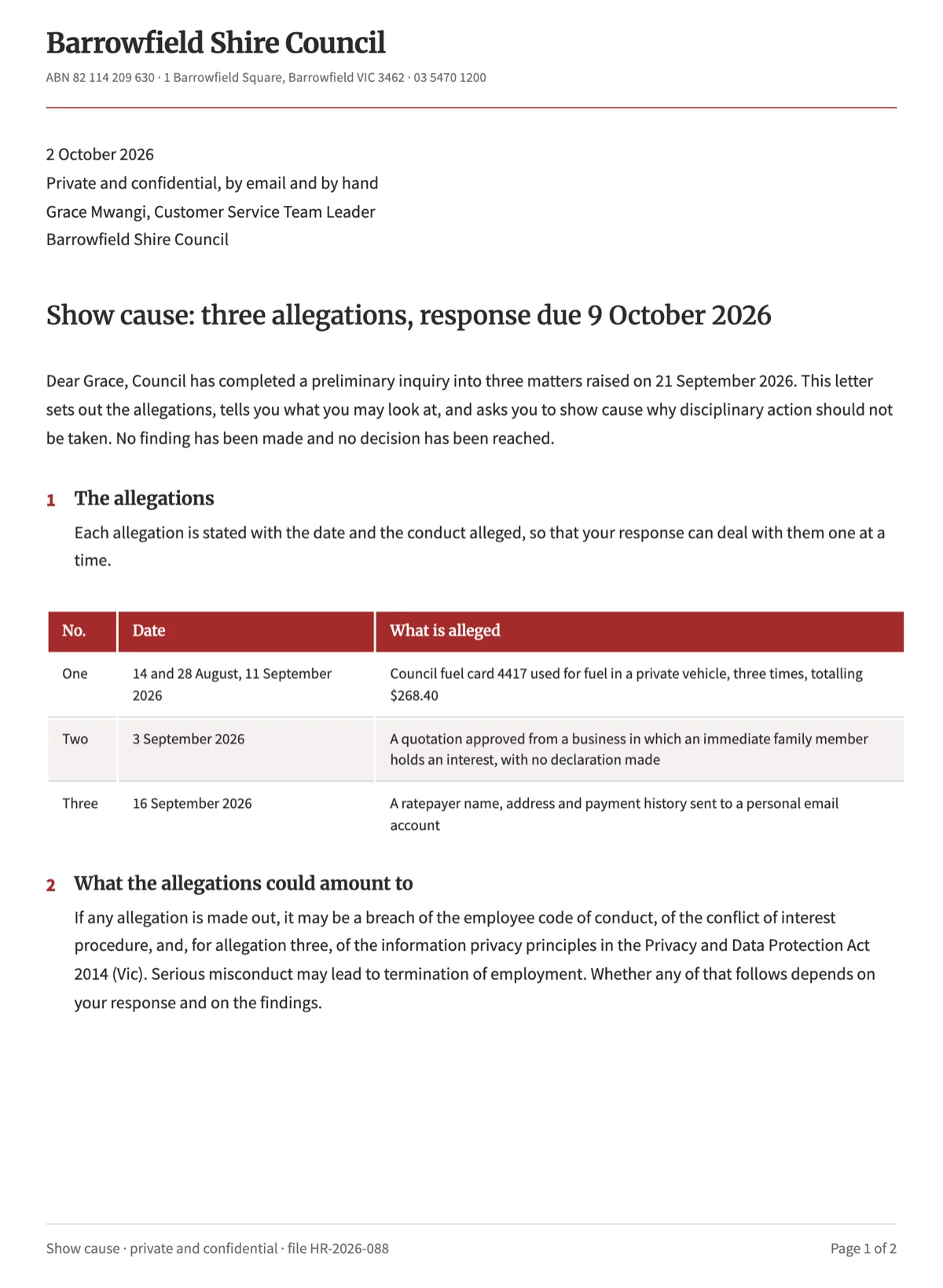 Show cause letter template with three dated allegations and a deadlineA show cause letter asks someone to answer before anything is decided, so it has to state what is alleged precisely enough to answer and say clearly that no finding has been made. This one numbers three allegations with their dates, lists the four documents relied on, and gives five business days to respond.
Questions people ask
What counts as serious misconduct in Australia?
The Fair Work Regulations define it to include wilful conduct inconsistent with continuing employment, conduct causing serious and imminent risk to health, safety or the business, and theft, fraud, assault, sexual harassment, intoxication at work and refusing lawful and reasonable instructions. Whether conduct meets the standard depends on the facts.
Do I get notice pay if I am summarily dismissed?
No. The Fair Work Act does not require notice or pay in lieu where the dismissal is for serious misconduct. You must still be paid wages up to the termination date and accrued entitlements such as annual leave. If the misconduct is not established, you may claim the notice you should have received.
Does the employer have to give me a chance to respond?
For a fair dismissal, yes. If you are protected from unfair dismissal, the Fair Work Commission asks whether you were told the reason and given an opportunity to respond. Dismissing without hearing your side is a frequent reason dismissals are found unfair, even when misconduct happened.
Can I be summarily dismissed during probation?
Yes, for serious misconduct. Employees still in their minimum employment period, six months, or twelve months with a small business employer, cannot bring an unfair dismissal claim. Other protections still apply, such as the general protections against dismissal for a prohibited reason like making a complaint or taking leave.
Can I challenge a summary dismissal?
If you have completed the minimum employment period and meet the other conditions, you can apply to the Fair Work Commission for unfair dismissal within 21 days of the dismissal taking effect. You may also have a general protections claim if the dismissal was for a prohibited reason.
Put the clause in a finished document
The button opens the document generator with a starting description already filled in. Change it to match your own agreement before you run it.
Create a document with OneCraftRelated clauses
- Termination for cause clause: defining material breach before you need itA termination for cause clause ends a contract for serious breach. Sample wording, what counts as material, cure periods and immediate termination events.
- Payment in lieu of notice clause (PILON): UK sample and effectsA payment in lieu of notice clause for a UK employer: end employment at once by paying the notice, phased payments, tax since 2018 and restrictive covenants.
- Notice period clause in an employment contractA notice period clause sets how much notice ends employment. Australian sample wording, the National Employment Standards minimums and three variants.
- Probation period clause in an employment contractA probation period clause sets a trial period, a review and the notice during it. Australian sample wording, extension rules and the minimum employment period.
For everything the document generator can do, see the document maker.
Step by step in the builder: Create a document with AI, then Document builder components.
Written and checked by the OneCraft team. Last checked .