Contract clause
Rent increase clause for an Australian residential lease
A rent increase clause says whether and how the rent under a residential tenancy can rise: whether it can change during a fixed term, by how much or by what method, how often, and the written notice the landlord must give. State tenancy laws set limits the clause cannot go below.
In an Australian residential tenancy, a landlord generally cannot raise the rent during a fixed term unless the lease says so and states how the increase is worked out. Across the larger states, rent can now rise no more than once every 12 months, and in Victoria the written notice must be given at least 90 days ahead from 25 November 2025.
Nuwan Madhusanka · Co-founder
3 min read · Published
Sample clause
Written for residential tenancy agreement for a unit in Footscray, Victoria, let by a fictional owner through Westgate Rentals, a fictional agency.
Rent Increases. (a) The rent is $520 a week and does not change during the 12 month fixed term. (b) If the tenancy continues after the fixed term, the Rental Provider may increase the rent no more than once in any 12 month period, by giving the Renter a Notice of Rent Increase in the approved form at least 90 days before the increase starts. (c) The notice will state the new rent, the date it starts and how the increase was calculated. (d) The Renter may ask Consumer Affairs Victoria to inspect the property and assess the increase, and may apply to VCAT if it remains concerned that the increase is excessive. (e) Any rent increase not made in accordance with this clause and the Residential Tenancies Act 1997 is invalid.
Sample wording, not legal advice.
Variants
Fixed increase during a long lease
A fixed term of more than 12 months, where the parties agree a set increase at each anniversary and the method must be stated.
On each anniversary of the start date during the 3 year fixed term, the rent increases by $15 a week. No other increase is permitted during the fixed term.
CPI linked increase
A long fixed term where the increase follows inflation, with the index and the calculation stated so the renter can check it.
On each anniversary, the rent increases by the percentage change in the Consumer Price Index (All Groups, Melbourne) over the 12 months to the most recent quarter published before the anniversary.
Room in a share house
A room rental covered by the state's rooming house or occupancy rules, where the agreement still states how rent can change.
The rent for the room is $260 a week and may be increased no more than once every 12 months, with at least the notice required by law.
What to negotiate
No clause, no increase during the term
In Victoria, a rental provider cannot increase the rent during a fixed term unless the agreement allows it and says how the increase is calculated. Consumer Affairs Victoria gives examples of valid wording, such as a set dollar amount each year. A vague clause, such as rent may be reviewed, does not allow an increase.
Frequency and notice
Victoria allows increases no more than once every 12 months in most cases, with 90 days' notice on the approved form from 25 November 2025. New South Wales and Queensland also limit increases to once a year and set their own notice periods. A clause should say the law's minimum applies rather than restate figures that change.
Challenging an excessive increase
In Victoria, a renter who thinks an increase is above the market range can ask Consumer Affairs Victoria for a rent assessment, and then apply to VCAT. Other states have similar tribunal processes. The clause in the sample tells the renter so, which costs the landlord nothing and builds trust.
The risk of leaving it out
A lease with no rent increase clause leaves the rent fixed for the whole fixed term, which on a long lease can cost a landlord real money. A clause that does not follow the state's rules is worse for a landlord: the increase is invalid, the renter can recover the extra rent paid, and the landlord may face a penalty.
Victoria's rules
Consumer Affairs Victoria explains that a rental provider must give the renter a Notice of Rent Increase in the approved form, by the method agreed in the rental agreement, at least 90 days before the increase starts, a period that changed from 60 to 90 days from 25 November 2025. The rental provider must give information about how the increase was calculated, and in most cases rent cannot be increased more than once every 12 months. Law checked on 21 October 2026. This page explains how the law works and is not legal advice.
Other states
New South Wales and Queensland also cap increases at once in any 12 month period for most residential tenancies, and each state sets a notice period and a form or content for the notice. The rules have changed several times since 2023, so the notice section of a lease is best written as at least the notice required by law, with the state's regulator checked before each increase is sent. The residential lease example states that rent does not change during its 12 month fixed term.
Writing the notice
A rent increase notice states the current rent, the new rent, the date it starts and how it was calculated, and is given by the agreed method early enough to meet the notice period even with postal delays. The notice of rent increase example sets out the current and new rent, the notice period and how to dispute the increase, in plain language.
Where the clause sits in a generated document
Residential tenancy agreements and room rental agreements carry this clause beside the rent clause. When asking the AI document generator for one, say the state, the fixed term, whether rent changes during it and by what method, and that increases afterwards follow the state's notice and frequency rules.
Documents that carry this clause
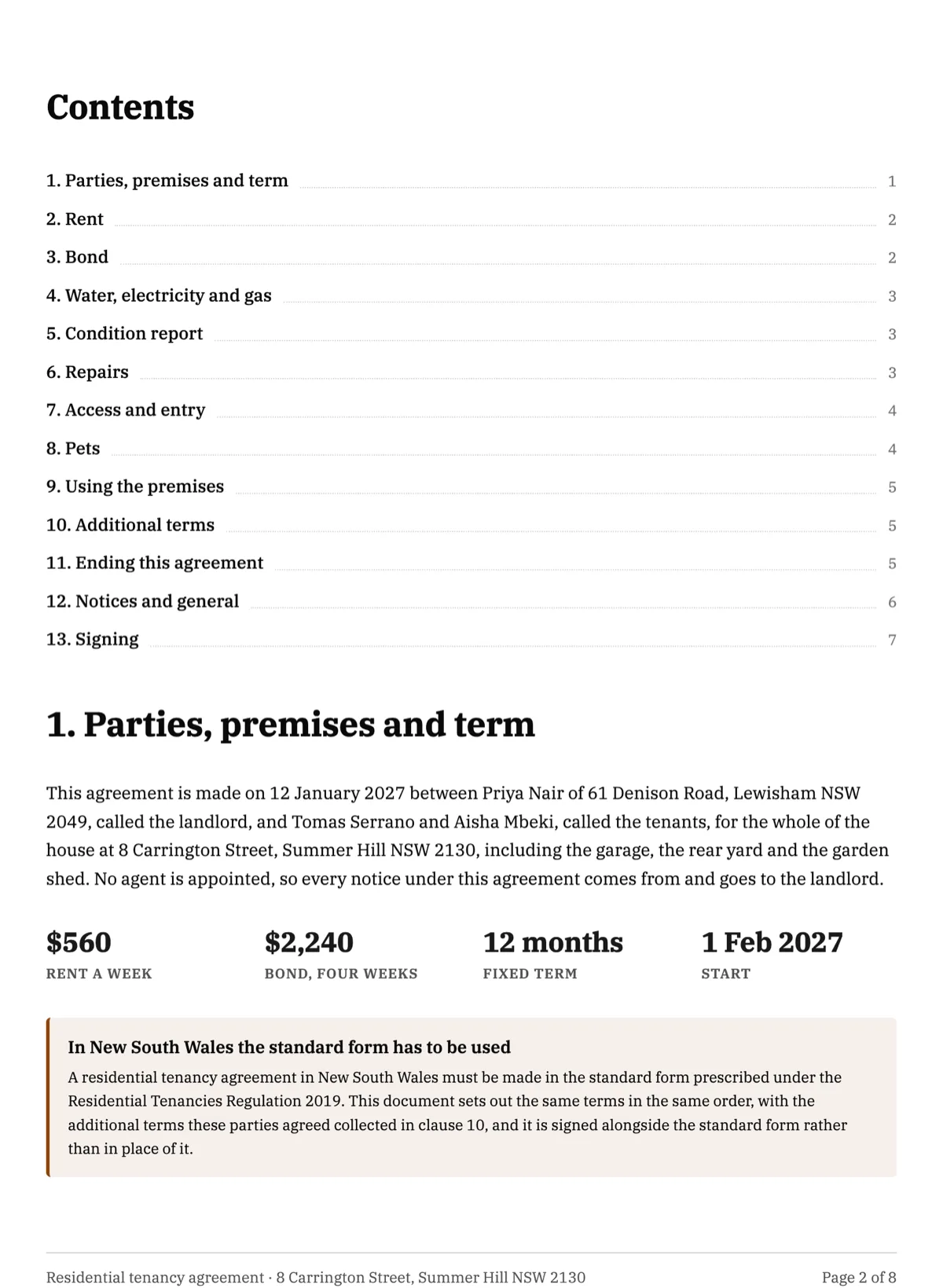 Residential lease agreement template for a New South Wales fixed termA residential tenancy is the one agreement where most of the terms are set by statute rather than by the parties, so the useful part of a template is the additional terms and the numbers. This one is a 12 month New South Wales fixed term at $560 a week, with the bond, the entry notice periods and the break fee written out exactly as the Act sets them.
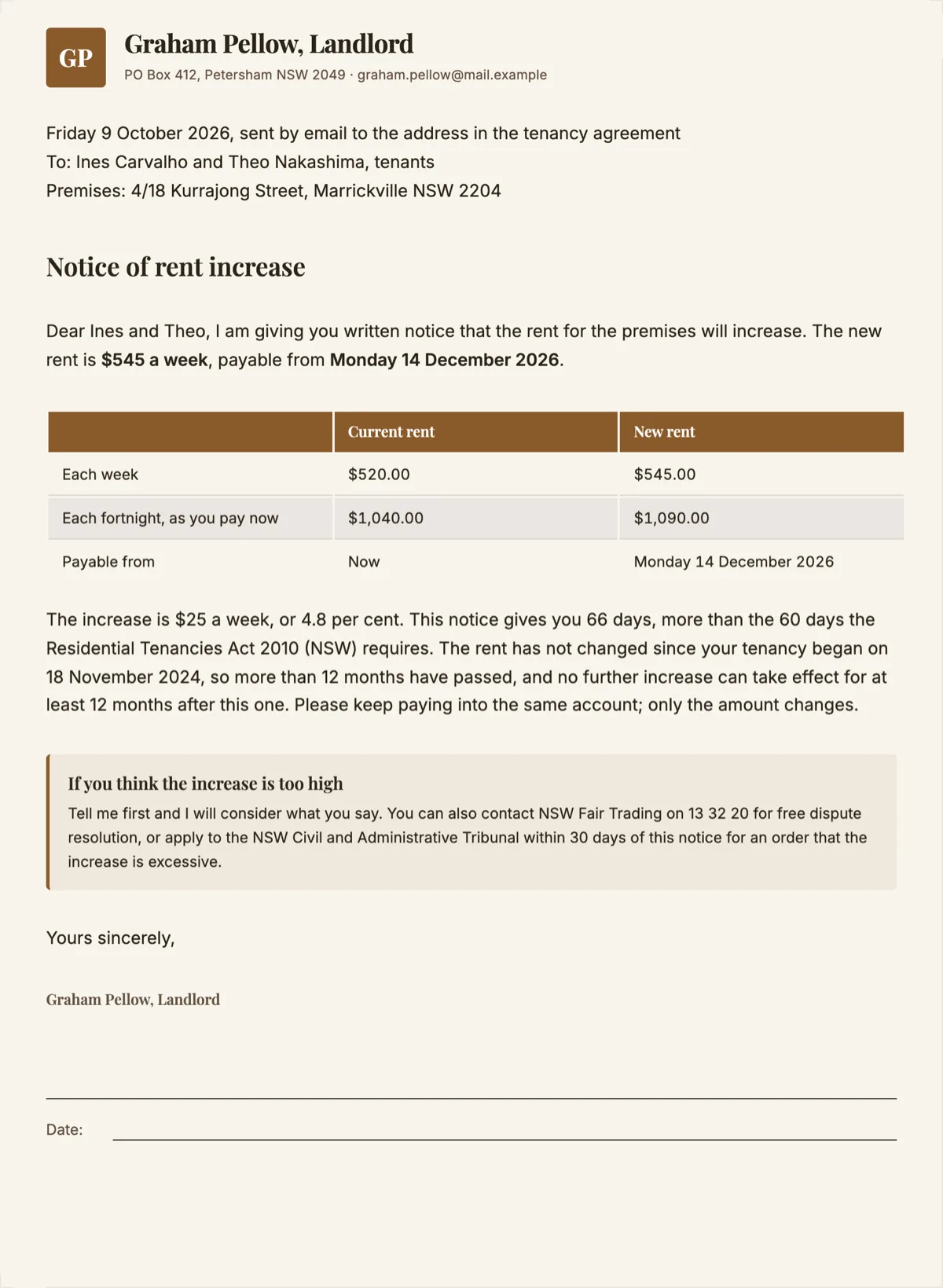 Rent increase notice template with the new amount and 60 days noticeA rent increase notice template tells a tenant the new rent and the date it starts, in writing, with at least the notice the law requires. In New South Wales that is 60 days, the notice must state the new amount rather than only the increase, and rent can go up only once in 12 months, so the notice has to show all three.
Questions people ask
Can a landlord increase rent during a fixed term lease?
In Victoria, only if the lease allows it and states how the increase is calculated, such as a set amount each year. Other states have similar rules. Without such a clause, the rent stays the same until the fixed term ends.
How often can rent be increased in Australia?
In Victoria, New South Wales and Queensland, generally no more than once in any 12 month period for residential tenancies, with exceptions in some states for certain agreement types. Other states and territories set their own limits, so check the regulator for the property's location.
How much notice is needed for a rent increase in Victoria?
At least 90 days, using the Notice of Rent Increase form, for notices from 25 November 2025. Before that the minimum was 60 days. The notice must be served by the method agreed in the rental agreement and explain how the increase was calculated.
Is there a limit on how much rent can increase?
Victoria does not set a percentage cap, but a renter can challenge an increase as excessive, and Consumer Affairs Victoria can assess it against the market. The ACT links its test to CPI. Other states rely on tribunal review of excessive increases.
What makes a rent increase invalid?
Common reasons are increasing during a fixed term without a valid clause, increasing more often than the law allows, giving too little notice, or not using the required form. An invalid increase need not be paid, and rent overpaid can usually be recovered.
Put the clause in a finished document
The button opens the document generator with a starting description already filled in. Change it to match your own agreement before you run it.
Create a document with OneCraftRelated clauses
- Option to purchase clause: sample, option fee and exerciseOption to purchase clause sample for Australian land: the option fee, exercise period and notice, the price, the contract that follows, caveats and lapse.
- Vacant possession clause: sample for sales and leasesVacant possession clause sample for property sales and leases: what vacant means, chattels and rubbish, tenants who must leave, and the buyer's remedies.
- Rent review clause: fixed, CPI or marketA rent review clause sets when lease rent changes and how. Victorian retail lease sample wording, fixed, CPI and market review variants, and the ratchet rule.
- CPI escalation clause: the formula and the sample wordingA CPI escalation clause raises a price automatically with the consumer price index. Australian sample wording, the formula worked through, and four variants.
For everything the document generator can do, see the document maker.
Step by step in the builder: Create a document with AI, then Document builder components.
Written and checked by the OneCraft team. Last checked .