Contract clause
Service charge clause in a UK commercial lease
A service charge clause makes a tenant of a building pay a share of the landlord's costs of running, maintaining and managing the common parts and shared services. It sets which costs can be recovered, how they are shared, how the budget and year end accounts work, and what is excluded.
In a multi let office building, the rent covers the space, and the service charge covers everything around it: cleaning, security, lifts, repairs to the roof. The clause decides how much of those costs land on each tenant, and which ones never should.
Nuwan Madhusanka · Co-founder
4 min read · Published
Sample clause
Written for a lease of the third floor of Temple Quay House, a fictional office building in Bristol, to Avonside Analytics, a fictional data consultancy.
Service Charge. (a) The Tenant must pay the Service Charge, being a fair proportion of the Service Costs, which is the ratio of the net internal area of the Premises to the total lettable area of the Building, currently 18%. (b) The Service Costs are the reasonable and proper costs the Landlord incurs in providing the Services listed in Schedule 5. (c) Before each Service Charge Year, the Landlord must give the Tenant a budget, and the Tenant must pay one quarter of its share on each quarter day. (d) Within 4 months after each Service Charge Year, the Landlord must give the Tenant a statement of actual Service Costs with supporting invoices available for inspection, and the difference must be paid or credited within 30 days. (e) For the first 3 Service Charge Years, the Tenant's Service Charge will not exceed £14.50 per square foot of the Premises a year. (f) Service Costs do not include the costs of improvements, of remedying defects in the initial construction of the Building, or of letting vacant units.
Sample wording, not legal advice.
Variants
Capped service charge
Tenants that need cost certainty, especially in older buildings or for short leases.
The Service Charge payable by the Tenant for any Service Charge Year will not exceed £15 per square foot, increased each year by the percentage change in the Consumer Prices Index, and the Landlord will bear any excess.
Uncapped with a sinking fund
Long leases of buildings with major plant, where a fund smooths the cost of replacing it.
The Service Costs include reasonable contributions to a sinking fund for the future replacement of the lifts, roof and heating plant, held by the Landlord in a separate interest bearing account on trust for the tenants and used only for that purpose.
Fixed service charge
Serviced or small units, where the landlord prefers to set a fixed fee and carry the risk of cost changes.
The Tenant must pay a fixed service charge of £9,600 a year, payable quarterly in advance, which will not be adjusted by reference to the Landlord's actual costs.
What to negotiate
Excluded costs
Tenants should exclude: improvements and upgrades beyond repair; the cost of remedying defects in the original construction; costs of letting or marketing empty units; costs relating to other tenants' breaches; landlord's financing and ownership costs; and service charge on vacant units, which the landlord should bear. A clear exclusions list prevents arguments when a large bill arrives.
The cap
A cap gives cost certainty, but landlords often carve out insurance, utilities and costs of complying with new law. Tenants should check what sits outside the cap, and whether it is indexed. A cap for the first few years, as in the sample, is a common compromise for a new building where costs are uncertain.
Audit and transparency
Tenants should be able to inspect invoices and challenge items, and the landlord should provide a timely year end reconciliation. The RICS professional statement on service charges in commercial property sets expectations for transparency, budgets and reconciliation, and many leases now refer to it. A long delay in producing the year end statement makes challenges harder and should be limited.
The risk of leaving it out
Without a service charge clause, a landlord of a multi let building has no right to recover its costs of running the shared parts, so it bears them itself and prices that into the rent. With a vague clause, tenants can face large, unexpected bills for improvements or construction defects. The clause is unavoidable in shared buildings; its detail is what matters.
Recoverable and excluded costs
Usually recoverable: cleaning, lighting and heating common parts; security and reception; lift maintenance; repair and maintenance of the structure and common parts; building insurance where not charged separately; managing agent's reasonable fees; and compliance testing. Usually excluded or negotiated out: improvements and upgrades; initial construction defects; costs of empty units; landlord's financing; marketing and letting costs; and costs caused by another tenant. Where an item is borderline, such as replacing old plant with more efficient plant, the lease should say how it is treated. Law checked on 21 October 2026. This page explains how the clause works and is not legal advice.
The RICS professional statement
The Royal Institution of Chartered Surveyors publishes a professional statement on service charges in commercial property, which its members must follow when managing service charges. It covers budgets, the year end reconciliation, transparency, how costs are apportioned and how disputes are handled. Tenants can ask for the lease to require service charges to be managed in line with it, which gives a benchmark when challenging the landlord's accounts.
Residential service charges are different
Service charges paid by residential leaseholders in England and Wales are governed by statute, including sections 18 to 30 of the Landlord and Tenant Act 1985, which require costs to be reasonably incurred and works of a reasonable standard, and impose consultation duties for major works. Those protections do not apply to commercial tenants, whose rights depend on the lease, which is why the drafting of a commercial service charge clause matters so much.
Apportionment
Costs are usually shared by floor area, but some services benefit only some tenants, such as a lift serving upper floors, and a fair proportion clause allows the landlord to use different bases for different costs. Tenants should check the percentage stated, ask how it would change if the building is extended, and make sure the landlord bears the share for vacant space.
Documents that carry this clause
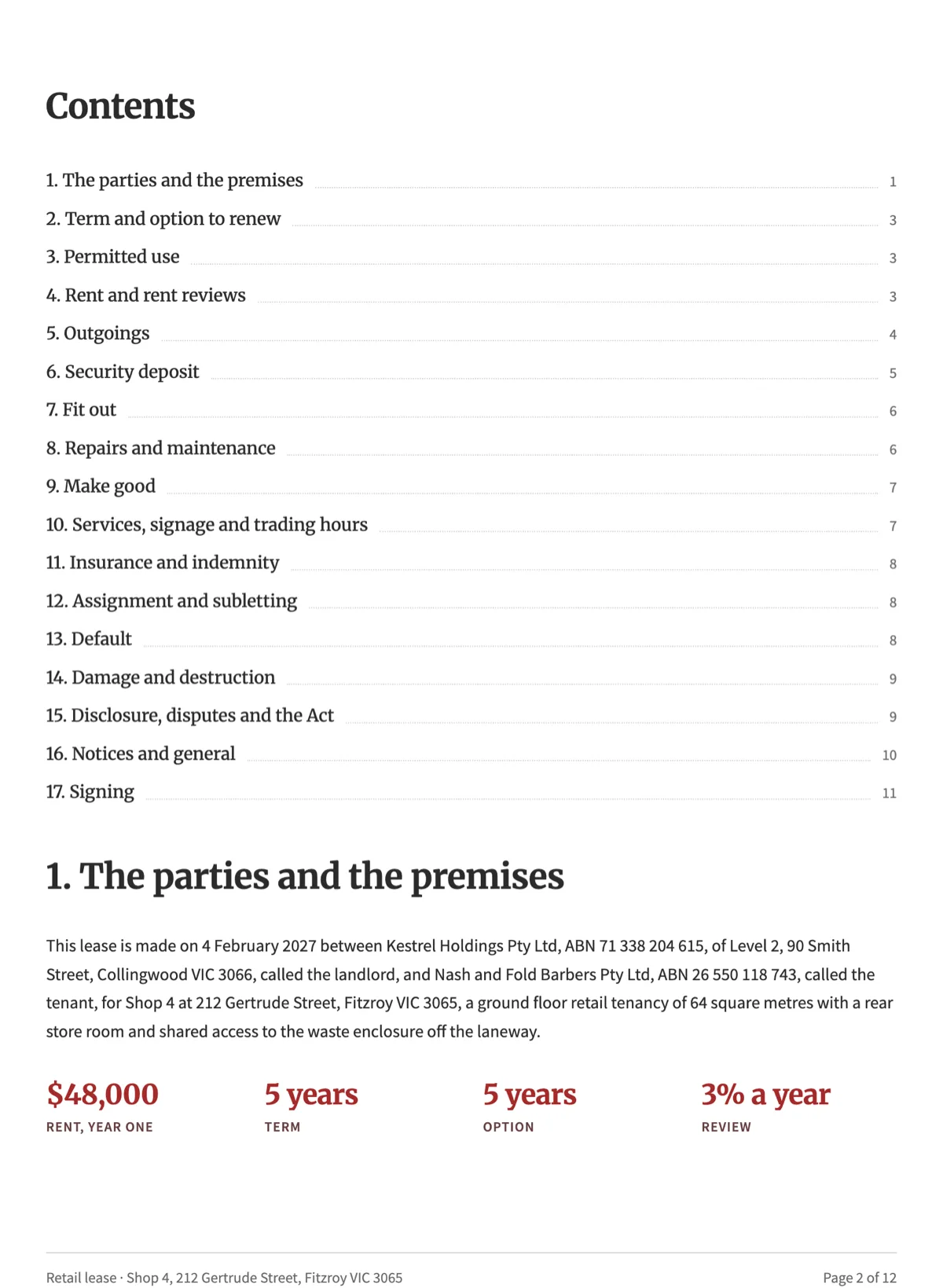 Commercial lease agreement template with outgoings and fit out termsA retail lease is decided by three numbers and two clauses: the rent, the review, the outgoings, the fit out contribution and the make good. This 12 page Victorian lease sets all five out in the open, including the outgoings the landlord is not allowed to recover at all.
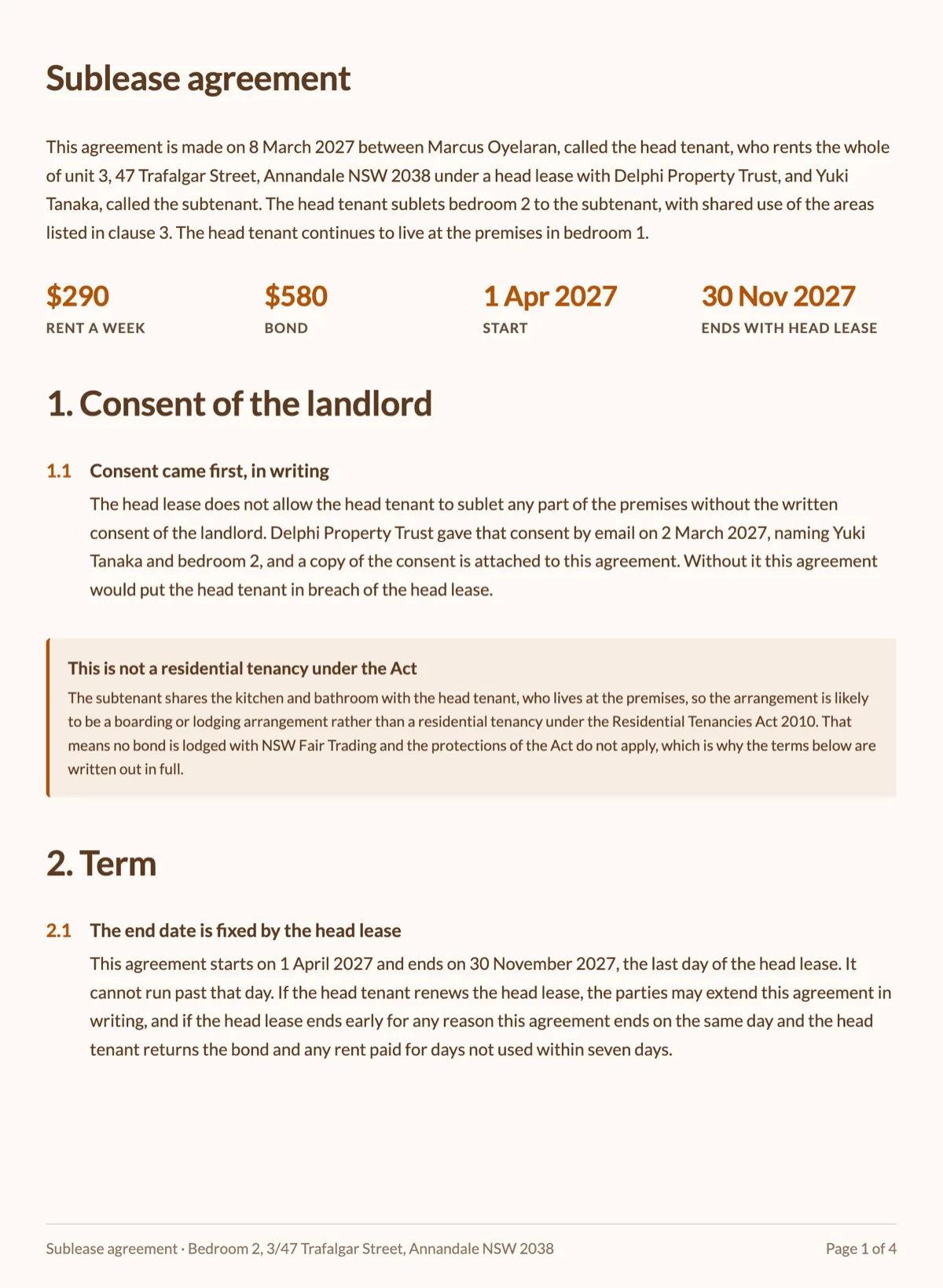 Sublease agreement template with the head lease consent recordedSubletting a room goes wrong in two places: the landlord never consented, and nobody wrote down what the occupant is actually renting. This agreement fixes the consent on the first page with a date and an email, then sets out the room, the shared areas and who keeps each one in order.
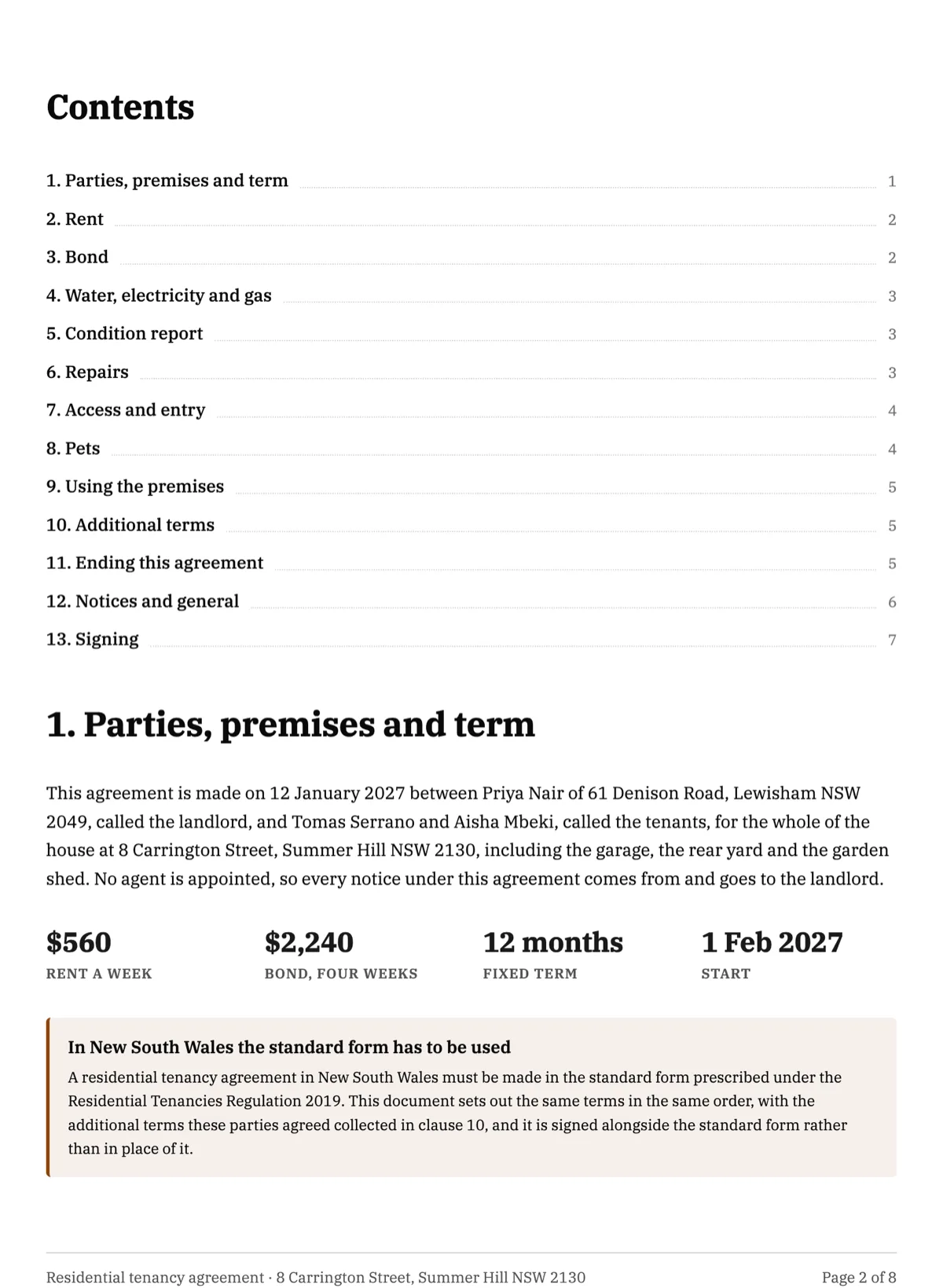 Residential lease agreement template for a New South Wales fixed termA residential tenancy is the one agreement where most of the terms are set by statute rather than by the parties, so the useful part of a template is the additional terms and the numbers. This one is a 12 month New South Wales fixed term at $560 a week, with the bond, the entry notice periods and the break fee written out exactly as the Act sets them.
Questions people ask
What costs can a landlord recover through the service charge?
Whatever the lease allows, which usually means the reasonable costs of providing the services listed: cleaning, security, maintenance and repair of common parts and structure, insurance and management fees. Improvements, initial defects and the cost of empty units are often excluded, but only if the lease says so.
Can a service charge be capped?
Yes, if the landlord agrees. A cap sets a maximum service charge per year, often per square foot and often indexed. Landlords commonly exclude some costs from the cap, such as insurance and utilities. Caps are more common for short leases and new buildings where costs are uncertain.
What is a service charge reconciliation?
It is the year end statement comparing the budget the tenant paid against the landlord's actual costs. If actual costs were lower, the tenant receives a credit; if higher, it pays the balance. The lease should set a deadline for the statement and give the tenant a right to inspect invoices.
Can I challenge my service charge?
Yes, under the terms of the lease. Ask for the supporting invoices, check each cost is within the services listed and not excluded, and raise disputes in writing. Many leases have an expert determination process. The RICS professional statement gives a benchmark for how charges should be managed.
Do commercial tenants have statutory protection on service charges?
Not in the way residential leaseholders do. The Landlord and Tenant Act 1985 protections, such as the reasonableness test and consultation for major works, apply to residential service charges. Commercial tenants rely on the lease and, where it refers to it, the RICS professional statement.
Put the clause in a finished document
The button opens the document generator with a starting description already filled in. Change it to match your own agreement before you run it.
Create a document with OneCraftRelated clauses
- Outgoings clause: the building costs on top of rentAn outgoings clause sets which building costs a tenant pays on top of rent. Victorian retail sample wording, what is recoverable and gross lease variants.
- Repairs and maintenance clause: who fixes what in a leaseA repairs and maintenance clause splits who fixes what in a lease. Victorian retail sample wording, residential urgent repairs rules and a tenant heavy variant.
- Rent review clause: fixed, CPI or marketA rent review clause sets when lease rent changes and how. Victorian retail lease sample wording, fixed, CPI and market review variants, and the ratchet rule.
- Audit rights clauseAn audit rights clause lets a customer inspect a supplier's records or systems to check compliance. Sample with a yearly audit on 20 days notice, and variants.
For everything the document generator can do, see the document maker.
Step by step in the builder: Create a document with AI, then Document builder components.
Written and checked by the OneCraft team. Last checked .