Contract clause
Time bar clause: claims notices in construction contracts
A time bar clause makes giving notice within a set time a condition of a claim for more time or money. If the contractor does not notify the event in time, it loses the right to the extension or payment. UK courts enforce time bars that are clearly drafted as conditions precedent.
Construction contracts give contractors rights to more time and money when something outside their control happens. Time bar clauses add a catch: say so promptly, or lose the right. Courts in England have repeatedly held contractors to clear ones.
Nuwan Madhusanka · Co-founder
4 min read · Published
Sample clause
Written for a civil engineering subcontract between a main contractor and Tamar Civil Engineering, a fictional Plymouth contractor, on a flood defence scheme.
Notice of Claims. (a) If the Subcontractor considers that an event entitles it to an extension of time or additional payment, it must notify the Contractor in writing within 8 weeks after it became aware, or should reasonably have become aware, of the event. (b) The notice must describe the event, state the date it occurred or began, identify the clause under which the claim is made, and give the Subcontractor's initial estimate of its effect on time and cost. (c) Giving notice in accordance with paragraphs (a) and (b) is a condition precedent to the Subcontractor's entitlement. If notice is not given in time, the Subcontractor is not entitled to any extension of time or additional payment for the event. (d) Paragraph (c) does not apply where the event arises from an instruction of the Contractor for which the Contractor was required to notify the Subcontractor and did not.
Sample wording, not legal advice.
Variants
Strict condition precedent
Contracts where the employer needs early warning of every claim to manage its own budget and programme.
Notice within the period in clause 20.1 is a condition precedent to any entitlement to an extension of time or additional payment, and if notice is not given the Contract Sum and the Date for Completion will not be adjusted for that event.
Notice with a reduction for lateness
A softer approach where late notice reduces, rather than removes, the entitlement.
If the Subcontractor gives notice after the period in clause 20.1, it remains entitled to an extension or payment, reduced to the extent that the late notice prevented the Contractor from avoiding or reducing the delay or cost.
No time bar
Smaller contracts, or contractors with bargaining power, where notice is required but late notice does not defeat the claim.
The Subcontractor must notify the Contractor of any event it considers entitles it to more time or money as soon as reasonably practicable. Failure to give notice does not deprive it of the entitlement, but is a breach for which the Contractor may recover its resulting loss.
What to negotiate
Clear condition precedent wording
English courts enforce time bars only if the contract makes notice a condition precedent clearly, by stating the deadline and that failing to meet it removes the entitlement. Phrases like condition precedent or shall not be entitled do that. A clause that only requires notice, without saying what happens if it is late, is usually treated as an ordinary obligation, so late notice does not defeat the claim.
The awareness trigger
Time usually runs from when the contractor became aware, or should have become aware, of the event. In Obrascon Huarte Lain v Gibraltar, decided in 2014, the court applied a 28 day notice requirement under a FIDIC contract strictly but read the trigger sensibly, as running from when the contractor was aware, or should have been, that the event was causing delay. Contractors should argue for awareness of the effect, not just the event.
The prevention principle
An employer cannot benefit from its own act of prevention, such as late instructions, and some arguments have tried to use that principle to avoid time bars. English courts have held that a clear time bar for employer caused delay can still apply, so contractors should not rely on prevention to rescue a missed notice. The sample's paragraph (d) protects the subcontractor where the contractor itself failed to notify.
The risk of leaving it out
Without a time bar, a contractor can raise claims long after the event, when records are thin and the employer has lost the chance to mitigate. Employers lose budget certainty and face end of project claims. Contractors gain flexibility, but disputes over old events are slower and more expensive for everyone, which is why most standard forms now include some notice regime.
Notice contents checklist
A notice that protects the claim should: be in writing and sent to the address and person the contract names; identify itself as a notice under the relevant clause; describe the event and when it began; say whether it is continuing; state the entitlement claimed, time, money or both; give an initial estimate of the effect, marked as provisional; and refer to supporting records such as site diaries and instructions. A short notice sent in time is far better than a detailed one sent late, and a further update can follow. Law checked on 21 October 2026. This page explains how the clause works and is not legal advice.
Time bars in common UK forms
NEC4 Engineering and Construction Contract: the contractor must notify a compensation event within 8 weeks of becoming aware of it, or loses its entitlement to a change in the prices, completion date or key dates, unless the project manager should have notified it. FIDIC 2017 contracts: notice of a claim within 28 days of becoming aware, as a condition of entitlement. JCT design and build and standard building contracts: notice of delay is required, but a late notice does not, of itself, remove the right to an extension. The sample follows the NEC style.
Keeping records that support notices
Time bars reward contractors who notice problems early. A simple routine helps: a weekly review of instructions, site conditions and delays against the contract's notice clauses, with a register of notices sent. Programme updates showing the effect of events make it easier to give a credible initial estimate within the period.
Australia
Australian courts also enforce clear time bars, and standard forms such as AS 4000 contain notice requirements for extension of time claims. Security of payment legislation operates separately and its timeframes cannot be contracted out of. The parent extension of time clause page covers Australian drafting.
Documents that carry this clause
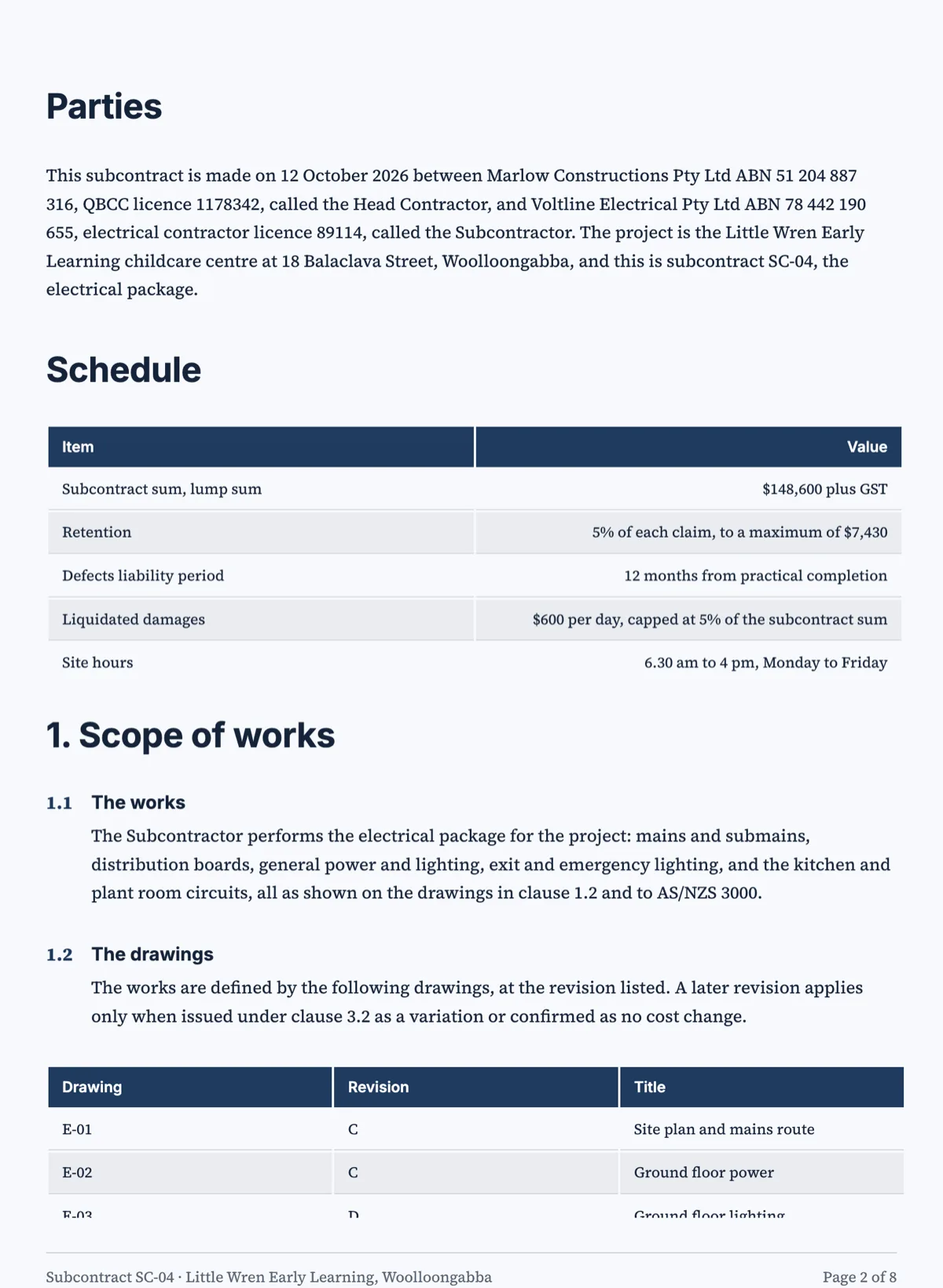 Subcontractor agreement template that flows the head contract downA subcontract exists to pass the head contract's obligations down one level and move the money back up on time. This one names the scope by drawing, sets the progress claim dates against the security of payment rules, holds retention and states the insurances, so the trade knows exactly when it is paid and for what.
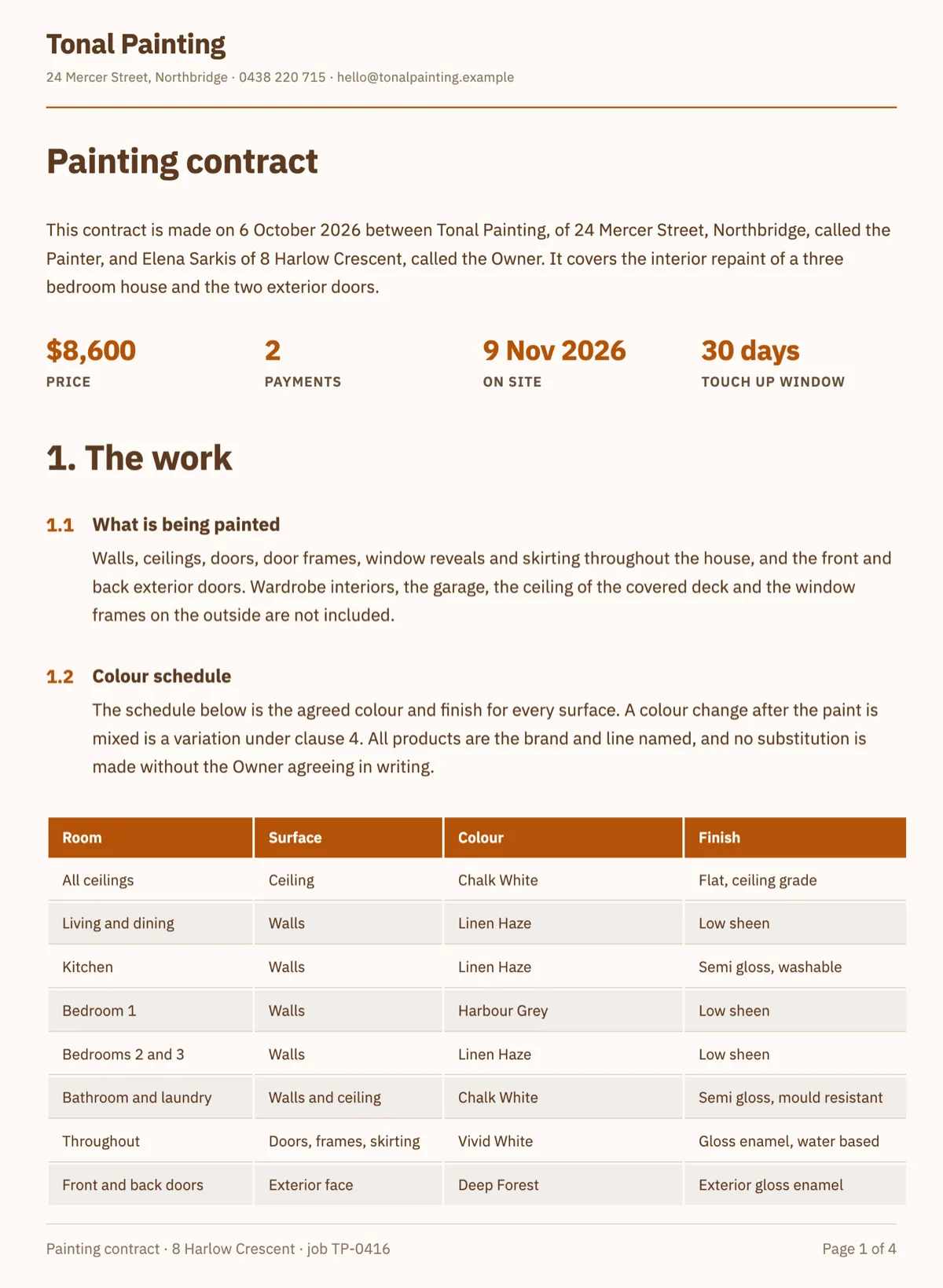 Painting contract template with a colour schedule and a coats standardMost painting disputes are really arguments about how many coats went on and what counts as preparation. This contract writes both down before the first drop sheet comes out, puts every room, colour and finish in a schedule, and leaves a touch up window open for 30 days after the furniture goes back.
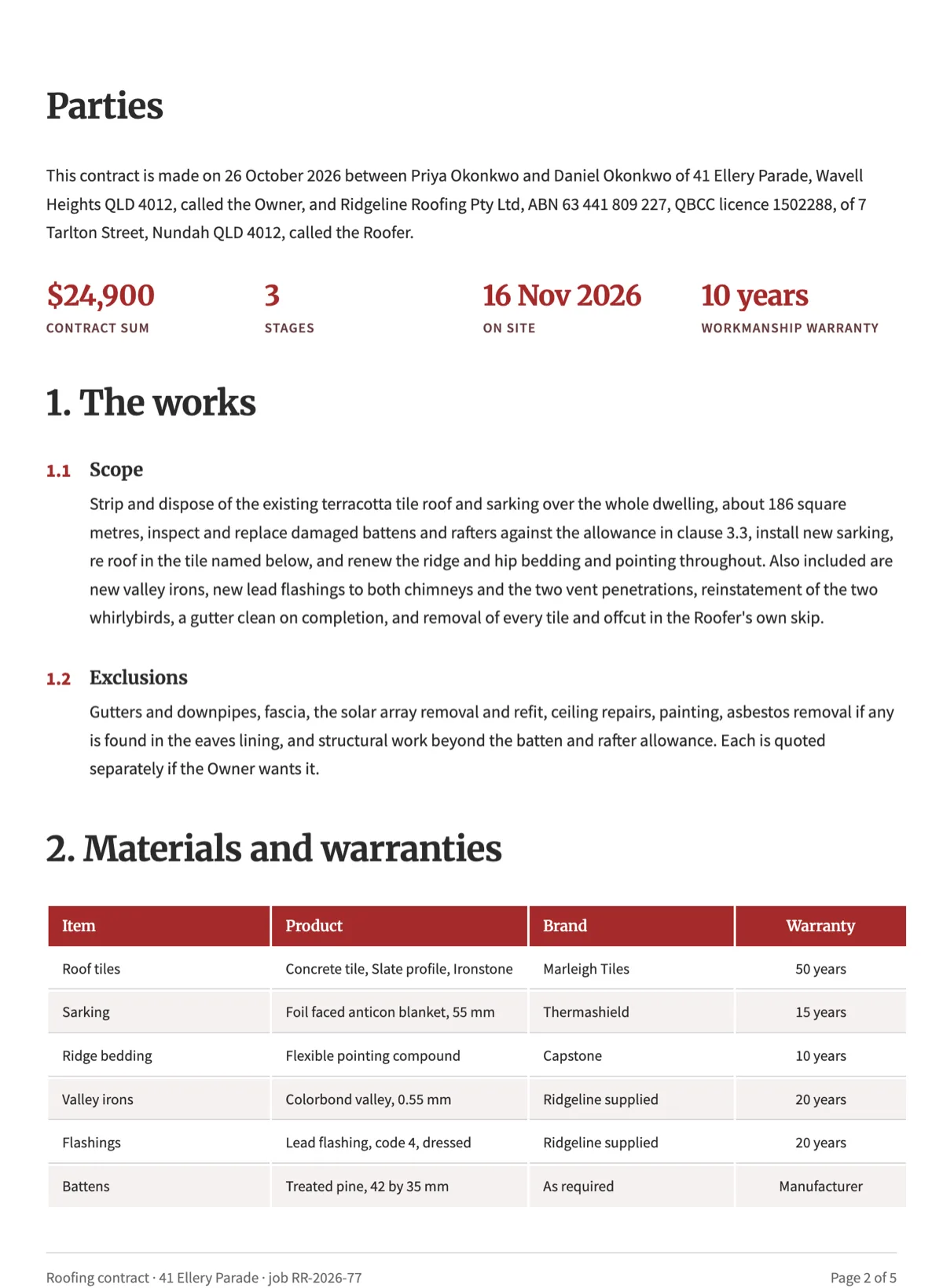 Roofing contract template with a materials table and a weather ruleA roof replacement is the one job where the house is open to the sky at the end of the day, so the clause that matters most is the one about closing it. This contract limits how much roof can be stripped at once, names every product with its warranty years, and says who pays when water gets in.
Questions people ask
What is a time bar clause?
It is a clause that requires notice of a claim within a set time and says the claim is lost if notice is late. It is common in construction contracts for extensions of time and extra payment. Its purpose is to make claims known early, while they can still be managed.
Are time bars enforceable in the UK?
Yes, if clearly drafted as conditions precedent. English courts have enforced time bars in FIDIC and NEC contracts, while reading the trigger for when time starts sensibly. A clause that requires notice but does not say late notice defeats the claim is usually not treated as a time bar.
What should a claim notice include?
The event, when it started, the clause relied on, whether it is continuing, the entitlement claimed and an initial estimate of the effect on time and cost. It should be sent in the form and to the person the contract specifies. Brief and on time is better than detailed and late.
When does the time limit start?
Usually when the contractor became aware, or should reasonably have become aware, of the event, depending on the wording. Some clauses run from awareness of the effect, which is later and better for the contractor. Read the trigger carefully and assume the earlier date if in doubt.
Can a late notice be saved?
Sometimes. The employer may waive the time bar by its conduct, the clause may have an exception, as in the sample, or the claim may be put on another basis. These are uncertain, so the safer course is to give notice promptly whenever an event might lead to a claim.
Put the clause in a finished document
The button opens the document generator with a starting description already filled in. Change it to match your own agreement before you run it.
Create a document with OneCraftRelated clauses
- Extension of time clause: moving the completion date fairlyAn extension of time clause gives a contractor more time for delay it did not cause. Australian shop fit out sample, qualifying delay events and notice rules.
- Construction variations clause: directing and pricing changed workA construction variations clause sets how changes to building work are directed and priced. Australian sample wording with schedule rates, cost plus and quotes.
- Latent conditions clause: when the ground is not as expectedA latent conditions clause decides who pays when the site is not what anyone expected. Australian sample wording with notice, time and cost, and three variants.
- Notices clause: how a formal notice is sent and when it landsA notices clause sets how formal notices under a contract are sent and when they count as received. Sample email wording, a deemed receipt table and variants.
For everything the document generator can do, see the document maker.
Step by step in the builder: Create a document with AI, then Document builder components.
Written and checked by the OneCraft team. Last checked .