Classic form
Customer complaint form that asks what outcome you want
A customer complaint form identifies the customer, sorts the complaint by type, records what happened and when, whether this is a repeat contact, any evidence, and the outcome the customer wants. This water utility version also states the response time and the right to go to the ombudsman before the customer starts typing.
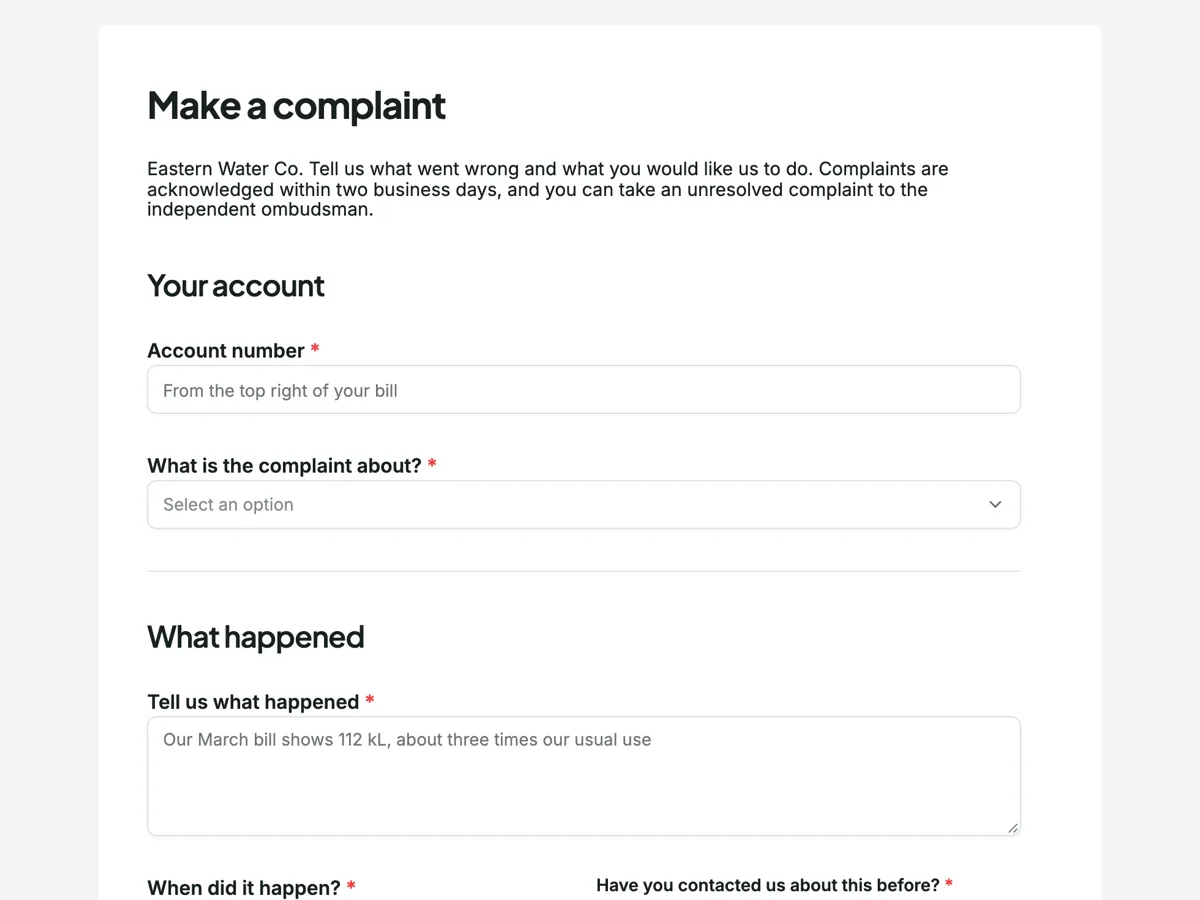
The form itself
A static copy of the finished form, exactly as it renders. Nothing here can be filled in or submitted, so read it as a reference and build your own from the button above.
Every field, and what it collects
The complete field list, in the order respondents meet it.
- Account numberShort textRequired
- What is the complaint about?DropdownRequired
- Options: A bill I think is wrong · Supply interruption · Water quality, taste or colour · Low pressure · A leak or burst main · Damage from works · How I was treated by staff · Payment plan or hardship
- Tell us what happenedLong textRequired
- When did it happen?DateRequired
- Have you contacted us about this before?Single choiceRequired
- Options: No, this is the first time · Yes, once · Yes, more than once
- EvidenceFile upload
- Up to five photos or PDFs: a bill, a photo of discoloured water, a receipt for a plumber.
- What outcome are you looking for?Single choiceRequired
- Options: Review and correct my bill · Fix the problem at my property · Compensation for loss or damage · An apology and an explanation · Something else
- How should we reply?Single choiceRequired
- Options: Phone · Email · Letter
Your account
What happened
What you want
What each field on this form collects
The account number comes first, with a placeholder that says where to find it on the bill. A dropdown of eight complaint types covers billing, supply, quality, pressure, leaks, damage, staff and hardship. A long text takes what happened, beside the date and a single choice asking whether this is a first or repeat contact. Up to five photos or PDFs can be attached. The last section asks the outcome wanted from five options and how to reply by phone, email or letter.
Asking for the outcome
Most complaint forms ask what went wrong and stop there, and the company then guesses what would put it right. Asking directly saves a round of calls: a customer who wants an apology and an explanation needs a different reply from one who wants their bill corrected or compensation for a flooded garage. Complaint handling standards, including the guidance that utility regulators such as the Essential Services Commission in Victoria set for water businesses, expect complaints to be acknowledged, investigated and answered with a clear outcome. Knowing the outcome sought makes that answer possible.
Repeat contacts and the ombudsman
The question about previous contact is the most useful sorting field on the form. A first contact may be resolved by the frontline team; a third contact about the same bill means something has already failed, and those complaints go to a senior officer. The intro and the thank you screen both mention the independent ombudsman, because customers of utilities in Australia can escalate unresolved complaints to an energy and water ombudsman free of charge, and telling them up front is part of handling a complaint fairly.
How to adapt this form
A retailer replaces the account number with an order number and the complaint types with delivery, product quality and refunds. A council adds the property address and the service area, such as waste or roads. A health practice adds a privacy notice and a choice to complain about care or about fees.
What makes this form work
The outcome is asked
Five outcomes from bill review to compensation. The complaints officer knows what a resolved complaint looks like for this customer before picking up the phone.
Repeat contact is flagged
First time, once before, or more than once. Repeat complaints are where trust is already lost, and this answer routes them to someone senior.
Rights before the form
The intro gives the two day acknowledgement and the ombudsman option. Customers write calmer complaints when they know how the process works.
Questions people ask
What should a customer complaint form ask?
Who the customer is and how to identify their account, what the complaint is about, what happened and when, whether they have complained before, any evidence, the outcome they want and how they want a reply. Keep it short enough to finish while annoyed, and say what happens next.
How quickly should a business respond to a complaint?
Acknowledge it quickly, often within one or two business days, and set a target for a full answer. Regulated industries such as energy, water and telecommunications have their own timeframes in their codes. State your timeframe on the form so customers know what to expect.
Should customers be told about the ombudsman?
Where an industry ombudsman exists, yes. Many codes require businesses to tell customers how to escalate an unresolved complaint. This form mentions it in the intro and again on the thank you screen. Check the code that applies to your industry, since some set the exact wording.
Can customers attach photos and documents?
Yes. The file upload accepts up to five images or PDFs of up to 10 MB each. A file upload field can allow only images and PDFs, so a spreadsheet or a Word file would need to be saved as a PDF first. Uploaded files are added as their own pages when the complaint is saved as a PDF.
Will the customer get a copy of their complaint?
The form does not email the customer. The thank you screen says a complaints officer will reply with a reference number. If a copy matters, the officer can save the submission as a PDF from the responses table and send it with the acknowledgement.
How should complaints be tracked?
Every submission lands in the responses table with its time, and the table exports to CSV. Many teams add a status in their own system. A webhook can post each complaint once to a case management tool, which handles the reference numbers and reminders.
Build your own in about a minute
The button below opens the generator with this use case already described. Change the wording to match your own, generate, then edit anything you like.
Make one like thisOther form examples
Daily site diary form for a construction site
A site diary form is the supervisor's daily record of weather, who was on site, what plant worked, what got done, what held work up and who visited. Written the same day, it becomes the evidence behind variations and delay claims, so this civil version asks for facts and times.
Whistleblower report form, anonymous by default
A whistleblower report form lets someone report misconduct without giving their name: what kind of conduct, what happened, when and where, any evidence and who else knows. This Australian version opens with the legal protections in plain words and keeps contact details optional.
Food safety inspection checklist for a cafe kitchen
A food safety inspection checklist records the fridge, freezer and hot holding temperatures, works through hand washing, storage, labelling, cleaning and sanitising, chemicals, allergens and pests, and notes what was done about each problem. This cafe version is completed daily by the food safety supervisor.
Want the steps in the builder? Read Generate a complaint form, then Track complaints in the responses table. For everything this generator can do, see the form maker.
Written and checked by the OneCraft team. Last checked .