Conversational form
Cooking class sign up form with a per guest dietary grid
A cooking school books seats, but it cooks for people, and a table of four almost never eats the same way. This sign up asks the dietary question as a grid with one row per guest, then keeps allergies on a separate screen, because an allergy is a kitchen decision rather than a preference.
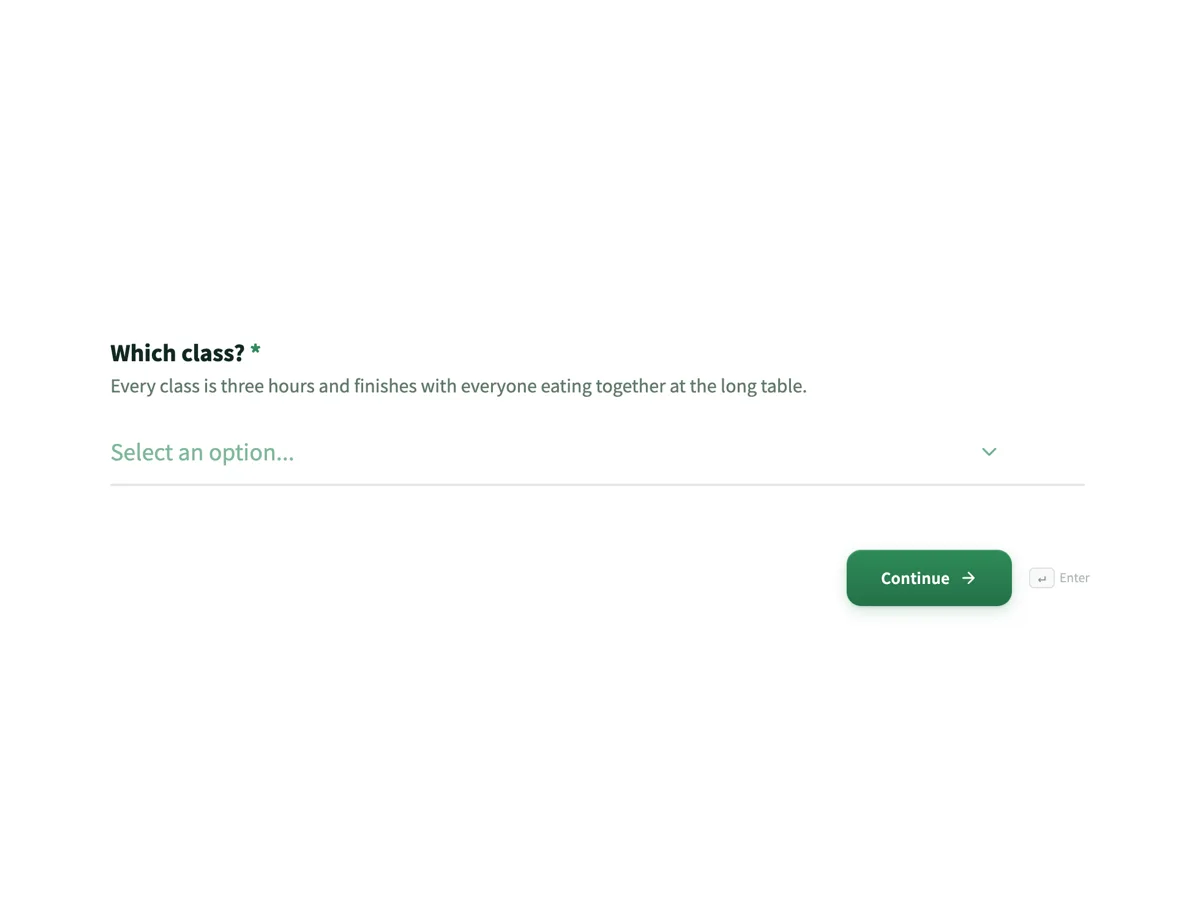
The form itself
The first screen of the form. A conversational form shows one question per screen, so the remaining screens are listed in the field table below. Nothing here can be filled in or submitted, so read it as a reference and build your own from the button above.
Every field, and what it collects
The complete field list, in the order respondents meet it.
- Which class?DropdownRequired
- Every class is three hours and finishes with everyone eating together at the long table.
- Options: Fresh pasta from scratch, Thursday 6 May, 6.00pm, 145 dollars · Dumplings and bao, Saturday 8 May, 11.00am, 135 dollars · Wood fired flatbreads and dips, Friday 14 May, 6.00pm, 130 dollars · Knife skills and stock, Sunday 16 May, 10.00am, 120 dollars · Curry pastes from the mortar, Thursday 20 May, 6.00pm, 150 dollars · Pastry, a whole Saturday, 22 May, 10.00am, 240 dollars
- How many seats?NumberRequired
- Benches seat two. Four is the largest group we place together, and anything above that is split across the room.
- What does each guest eat?Rating gridRequired
- One row per seat, and leave the rows you are not using blank. Allergies are the next screen, because an allergy is not a preference.
- Statements:
- Guest 1, the person booking
- Guest 2
- Guest 3
- Guest 4
- Allergies and intolerances, in detailLong textRequired
- Write none if there is nothing. This kitchen handles nuts, gluten, sesame and shellfish daily, so a severe airborne allergy needs a phone call before you book.
- How comfortable are you with a knife?Single choiceRequired
- Nobody is judged and nobody is turned away. It decides which bench you get and how early the chef comes over.
- Options: I avoid chopping if I can · I can chop, slowly, with a board and a big knife · Comfortable, I just want to be quicker · I cook a lot and want the technical detail
- Have you cooked with us before?Single choiceRequired
- Returning guests are seated at different benches from first timers, which is how a beginner ends up next to somebody who explains things instead of racing them.
- Options: First time · Once or twice before · I come a few times a year
- Gift voucher code, if you have oneShort text
- Vouchers are checked by hand before the payment link goes out, so the link already has the value taken off it.
- Who is booking?ProfileRequired
- One screen for the three things the kitchen needs. The mobile is only used if something changes on the day of the class.
- Is this for an occasion, or anything else we should know?Long text
- Optional. Tell us and the kitchen will do something quiet about it rather than something loud.
One row per guest beats one box for the table
Most cooking schools ask for any dietary requirements and get back a sentence like two vegetarians and one gluten free, which a chef then has to map onto four aprons at two benches. The grid does that mapping at the point of booking. Four rows, five columns, one radio each, and the answer arrives as something that can be printed and taped inside the pass. The screen says to leave unused rows blank, which matters because a grid with empty rows still reads correctly, where a table field with empty rows just looks like ruled paper.
Allergies are not a column on the grid
Vegan is a choice a kitchen accommodates. A peanut allergy is a decision about whether somebody can safely be in the room. Keeping them on separate screens means the severe cases are written in words rather than ticked in a box, and it lets the screen say the thing that actually protects people: this kitchen handles nuts, gluten, sesame and shellfish every day, so a severe airborne allergy needs a phone call before a booking rather than a note afterwards. The field is required so nobody skips past it.
How to adapt this form
A school running corporate team classes swaps the seats number for a company name and a headcount, and replaces the occasion screen with an invoice contact. A school with a fixed menu drops the knife skills screen, since there is nothing to pitch, and asks about spice tolerance instead. A kitchen that sells classes as gifts moves the voucher code to the first screen, because somebody redeeming a gift is not shopping for a class, they are looking for the box to type their code into.
What makes this form work
The dietary grid has one row per seat
Four rows, five columns, and a note saying to leave unused rows blank. It turns two vegetarians and one gluten free into a line per person, which is the form a chef can actually cook from.
Allergies get their own screen and their own wording
It asks for the guest and the severity, names coeliac against gluten avoiding, and says the kitchen handles four major allergens daily. That sentence does more for safety than any tick box on the grid could.
The knife skills question is written so nobody lies
I avoid chopping if I can is the first option, and the screen says nobody is judged and nobody is turned away. Framed as a bench allocation rather than a test, beginners answer honestly and get the help they came for.
Questions people ask
How many questions should a class sign up ask?
Nine screens here and six are required. Two of the optional three, the voucher code and the occasion note, exist to catch bookings that would otherwise arrive as an email. The knife skills question looks like a nicety but it is the one that decides where somebody sits, which is why it is required.
Why is dietary a grid rather than a tick list?
Because a tick list tells you what the table eats and not who eats it. With four seats and five columns, a grid produces a line per person, which is what a chef needs when rewriting a menu for one bench. It is also faster to answer than four separate screens would be.
Can this form take payment for the seats?
No. Seats are held and a payment link follows within the hour, with a forty eight hour expiry stated on the thank-you screen. Vouchers are the reason: they are checked by hand and the discount is applied to the link, which cannot happen if a card has already been charged the full price.
What about a severe allergy?
The allergy screen says plainly that the kitchen handles nuts, gluten, sesame and shellfish daily, and asks for a phone call before booking where the allergy is airborne. That is more useful than a tick box, because the honest answer for some guests is that a shared kitchen is not safe, and a form should say so rather than imply otherwise.
Does the seats question enforce a maximum?
No. A number field on a conversational form does not limit what can be typed, so the screen states the rule in words instead: benches seat two and four is the largest group placed together. A booking for ten arrives, gets read, and is answered by a person, which is the right outcome anyway.
Why ask whether somebody has cooked here before?
Because seating a first timer next to a regular is the single cheapest thing a cooking school can do for a nervous beginner. The regular explains, the beginner relaxes, and the chef spends their time on technique rather than reassurance. Three options are enough to sort the room.
Build your own in about a minute
The button below opens the generator with this use case already described. Change the wording to match your own, generate, then edit anything you like.
Make my cooking class sign up form with a per guest dietary gridOther form examples
Yoga retreat registration form with rooms priced on it
A retreat sells a room and a week at the same time, and the room is the part that changes the price. This thirteen screen booking prices all four room types on the question itself, then spends the rest of its screens on the two things that actually decide whether somebody enjoys the week, their body and their journey there.
Art class registration form with the materials pack on it
The thing people ask an art studio before they book is what the price actually covers, and the second thing is whether the room will work for them. This ten field registration answers both on the form itself, with the price inside every class option and a materials pack question that has a middle answer for people who want the list first.
Language course registration form with a placement check
Every language school has the same problem, which is that people rate their own level badly in both directions. This enrolment asks for a self rating and then a three sentence fill in the blank check, and when the two disagree it is a five minute phone call rather than a beginner sitting silently in a B2 room.
Want the steps in the builder? Read Create a conversational form with AI, then Every form field and when to use it. For everything this generator can do, see the form maker.
Written and checked by the OneCraft team. Last checked .