Conversational form
Language course registration form with a placement check
Every language school has the same problem, which is that people rate their own level badly in both directions. This enrolment asks for a self rating and then a three sentence fill in the blank check, and when the two disagree it is a five minute phone call rather than a beginner sitting silently in a B2 room.
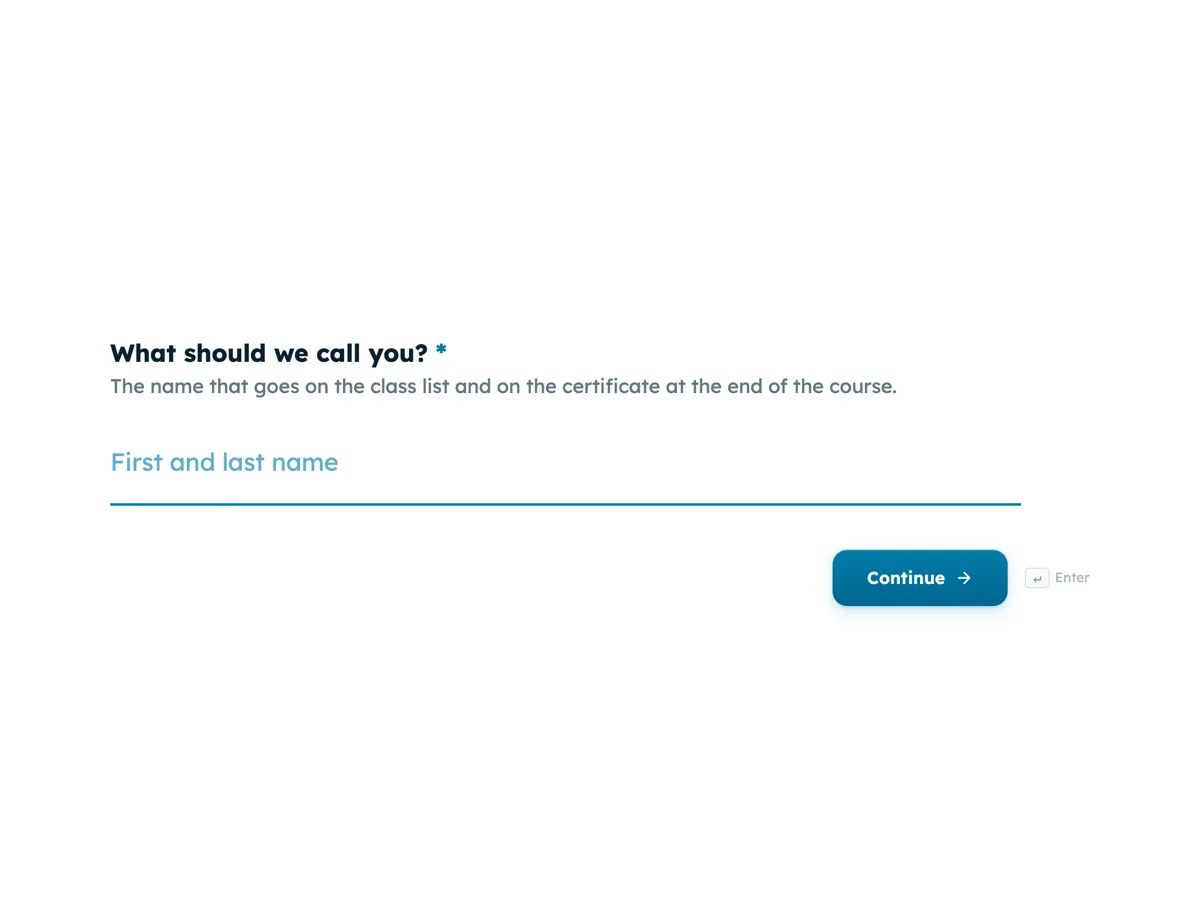
The form itself
The first screen of the form. A conversational form shows one question per screen, so the remaining screens are listed in the field table below. Nothing here can be filled in or submitted, so read it as a reference and build your own from the button above.
Every field, and what it collects
The complete field list, in the order respondents meet it.
- What should we call you?Short textRequired
- The name that goes on the class list and on the certificate at the end of the course.
- Where should the level confirmation go?EmailRequired
- One email two days from now with your level, your room and your teacher. Course reminders come from the same address.
- Which language?DropdownRequired
- Nine languages run every term. A tenth opens whenever eight people ask for the same one, so tell the school if yours is missing.
- Options: Spanish · Italian · French · German · Portuguese · Japanese · Mandarin · Korean · Arabic
- Where do you think you are now?Single choiceRequired
- These are the Common European Framework levels. Pick the one that sounds like you on a normal day, not on your best day.
- Options: A1, a handful of words and phrases · A2, I can order, shop and ask directions · B1, I can hold a simple conversation and get lost in a fast one · B2, I can follow most of a film and argue a point badly · C1, I am comfortable and want to stop making the same mistakes · Complete beginner, never studied it at all
- A three sentence placement checkInline textRequired
- Answer honestly. It takes thirty seconds and it is the difference between a class that stretches you and one that bores you.
- Which evenings can you make?Multiple choiceRequired
- Courses run 6.30pm to 8.30pm for ten weeks. Tick every evening that works, because the level you are placed in may not run on your first choice.
- Options: Monday · Tuesday · Wednesday · Thursday · Saturday morning
- Why are you learning it?Single choiceRequired
- This changes the material, not the level. A class of people moving abroad reads different things from a class of people with family to talk to.
- Options: Moving or working abroad · Family or a partner speaks it · Travel in the next year · Work needs it here · For the pleasure of it
- In the room or online?Single choiceRequired
- Both run live with the same teacher and the same book. Online classes cap at eight rather than twelve because turn taking is harder on a screen.
- Options: In the room · Online · Either, whichever has a place
- How many hours a week can you study outside class?NumberRequired
- An honest small number is more useful than an ambitious one. Two hours a week is enough to keep up at every level here.
- Anything about how you learn that would help the teacher?Long text
- Optional, and read only by the teacher you are placed with.
- Who is paying for the course?Single choiceRequired
- An employer paid place is invoiced rather than charged, and the invoice needs an address, which is the next and last screen.
- Options: I am · My employer is · A family member is
- Invoice addressAddressRequired
- For an employer paid place this is the company billing address, not your home.
Two level questions, because one is never enough
Self rating fails in both directions. A person who studied a language at school for five years calls themselves B1 and cannot order a coffee, while a person who has lived with a native speaker for a decade calls themselves a beginner because they have never opened a textbook. The fill in the blank screen catches both, because its three sentences ask about things people can actually judge: whether they can hold a conversation, how much of a menu they understand, and how long they have been at it. Where the two answers disagree, the school makes a phone call instead of a guess.
Why the placement check is three dropdowns rather than a quiz
A real language test needs marking, and a school running ten week evening courses will not mark two hundred of them in enrolment week. Three sentences with dropdown blanks take thirty seconds to answer and no time at all to read, because the answers sort. The screen says honestly what it is for, which matters, since a check that looks like an exam makes nervous beginners abandon the form. Nothing here is scored in front of the student and no result is shown, so there is nothing to game.
How to adapt this form
A school running exam preparation replaces the reason for learning screen with the exam and the sitting date, since that is the only thing that shapes the syllabus. A corporate language programme drops the payment question, because the employer is always paying, and adds a screen for the cost centre instead. A school teaching one language only removes the dropdown and spends the screen on a dialect or register question, which is the choice that actually matters when everyone in the room is learning the same thing.
What makes this form work
The self rating options describe behaviour, not grammar
B1 here reads as holding a simple conversation and getting lost in a fast one. Framework letters mean nothing to most people, and a student who has to look up what A2 covers is a student who guesses.
The placement check is three sentences with dropdown blanks
Can hold, understand the general idea, studied for one to three years. Thirty seconds to answer, no marking, and every answer lands in a column the school can sort classes by on the Friday before term.
The invoice address screen only matters to a third of enrolments
It sits last, after the question about who is paying, and its description says that for an employer paid place this is the company address. Asking for a billing address early, before the reason for it exists, is where a corporate booking usually goes wrong.
Questions people ask
How many questions should a course enrolment ask?
Twelve screens here and ten are required, which is long for an enrolment and short for one that places people correctly. The two optional screens are the note about how somebody learns and nothing else. Everything required either decides the level, decides the room, or produces an invoice.
Why use a fill in the blank field for placement?
Because it reads as a sentence rather than a form. The three blanks are dropdowns, so every answer is one of four values and the whole thing sorts in a spreadsheet. A free text placement paragraph would tell a teacher more, but nobody can read two hundred of them in the week before term starts.
Can the enrolment take the course fee?
No, and here that is more than a preference. A third of the places are employer paid and are invoiced to a company address, which is why the last two screens ask who is paying and where the invoice goes. Charging a card at enrolment would break exactly the bookings the school most wants.
What if the self rating and the placement check disagree?
A teacher rings for five minutes. The thank-you screen says so, which sets the expectation before anyone worries about it, and it adds that moving up or down in week one costs nothing. A school that quietly places people on the self rating alone spends week two rebuilding two classes.
Do the evening tick boxes guarantee a night?
No, and the screen says why. The level a student is placed in may not run on their first choice, so ticking three evenings is what makes a place possible. A school that asks for one preferred evening ends up phoning half the cohort to negotiate, which is the work the tick list removes.
Why ask how many hours a week somebody can study?
Because the answer predicts who finishes the course, and because saying two hours is enough on the screen quietly lowers the barrier for someone about to talk themselves out of enrolling. Teachers also use it when deciding how much homework to set a group that is honest about being busy.
Build your own in about a minute
The button below opens the generator with this use case already described. Change the wording to match your own, generate, then edit anything you like.
Make my language course registration form with a placement checkOther form examples
Dance class registration form that places a dancer correctly
A dance studio does not have one class to sell, it has a grid of them, and every registration is really a question about which square a dancer belongs in. This form asks the six things that decide the square, one screen at a time, and settles the costume levy before anyone is invoiced for it.
Art class registration form with the materials pack on it
The thing people ask an art studio before they book is what the price actually covers, and the second thing is whether the room will work for them. This ten field registration answers both on the form itself, with the price inside every class option and a materials pack question that has a middle answer for people who want the list first.
Yoga retreat registration form with rooms priced on it
A retreat sells a room and a week at the same time, and the room is the part that changes the price. This thirteen screen booking prices all four room types on the question itself, then spends the rest of its screens on the two things that actually decide whether somebody enjoys the week, their body and their journey there.
Want the steps in the builder? Read Create a conversational form with AI, then Every form field and when to use it. For everything this generator can do, see the form maker.
Written and checked by the OneCraft team. Last checked .