Conversational form
Music lessons registration form that matches a teacher
A teaching studio is really a matching problem, because the instrument is only one of four things that decide who should teach a new student. This eleven screen registration collects all four, and ends with an optional recording so a teacher can hear a returning player rather than guess from a grade they gave themselves.
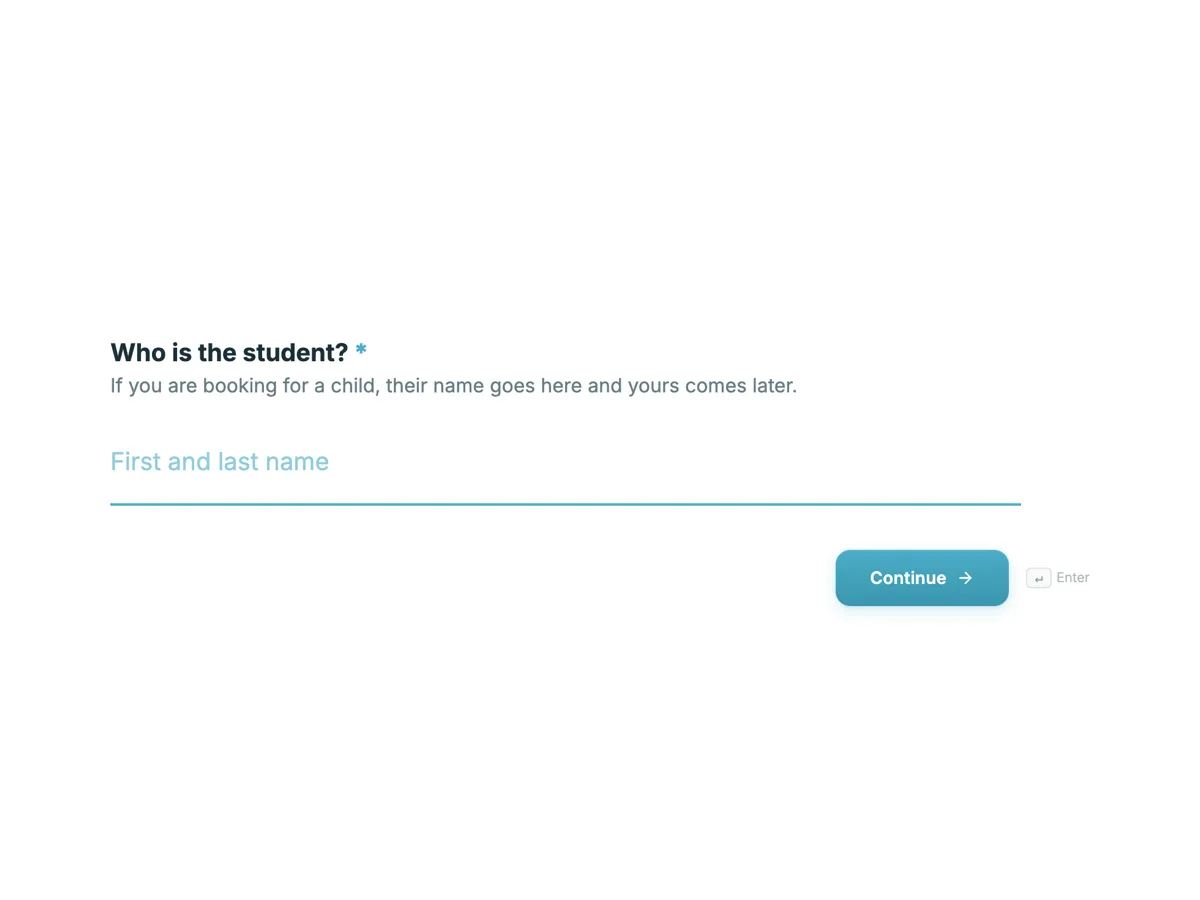
The form itself
The first screen of the form. A conversational form shows one question per screen, so the remaining screens are listed in the field table below. Nothing here can be filled in or submitted, so read it as a reference and build your own from the button above.
Every field, and what it collects
The complete field list, in the order respondents meet it.
- Who is the student?Short textRequired
- If you are booking for a child, their name goes here and yours comes later.
- How old is the student?NumberRequired
- Teachers are matched by age as much as by instrument. A seven year old and a forty year old learning the same piece need very different half hours.
- Which instrument?DropdownRequired
- One instrument per registration. Studying two is common here, but each one gets its own teacher and its own half hour.
- Options: Piano · Acoustic guitar · Electric guitar · Bass guitar · Drum kit · Violin · Cello · Flute · Voice
- Is there an instrument at home to practise on?Single choiceRequired
- Nobody is turned away for answering no. The studio hires most instruments by the term and a drum kit can be swapped for a practice pad.
- Options: Yes, we have one already · No, we would like to hire one from the studio · No, we plan to buy one before the first lesson · Not sure what to buy, please advise
- How much playing has there been so far?Single choiceRequired
- This sets the first lesson, not the price. Every option below is a normal place to start.
- Options: Complete beginner, never played · Less than a year · One to three years · More than three years · Played years ago and coming back to it
- Working towards a graded exam?DropdownRequired
- Exams are optional at this studio. Answer not at the moment and the syllabus is built around what you actually want to play instead.
- Options: Not at the moment · Preliminary or initial grade · Grade 1 or 2 · Grade 3 or 4 · Grade 5 or 6 · Grade 7 or 8 · Diploma level
- Which week would you like to start?DateRequired
- Pick any weekday. The studio starts new students on the Monday of whichever week you choose.
- What time suits best on a weekday?TimeRequired
- Lessons run from 8am to 8pm. This is a starting point for the match, not a booking, and the studio will offer the two closest slots it has.
- What do you want to be able to play?Long textRequired
- Be specific. A named song tells a teacher more about the right first six months than any grade does.
- Play or sing something, about thirty secondsRecording
- Completely optional and nobody else hears it. If you already play, this saves a whole lesson of working out where you are. Beginners should skip it.
- Where should the studio send the timetable?EmailRequired
- For a child, this is the parent or guardian email. It is the only address the studio uses for lesson times and term dates.
Four answers decide who teaches this student
Instrument is the obvious one and the least useful on its own. Age is the second, because a teacher who is brilliant with seven year olds is not automatically the right half hour for an adult returning after twenty years. The time that suits is the third, and it is the constraint that kills more matches than talent ever does. The fourth is the goal, which is why the what do you want to play screen is required and asks for something specific. A named song tells a teacher more about the next six months than a self declared grade.
The recording screen, and who it is for
The last question before the email is an optional audio recording of about thirty seconds. It exists for one group: people who already play and cannot describe their own level accurately, which is almost everyone who played as a child and stopped. Thirty seconds of actual playing replaces a whole first lesson of diagnosis. The screen says plainly that it is optional, that nobody else hears it, and that beginners should skip it, because a beginner staring at a record button is a beginner who abandons the form.
How to adapt this form
A studio that only teaches one instrument drops the dropdown and spends the saved screen on gear, which for drums means kit or practice pad and for voice means the range the singer thinks they have. A school running group classes swaps the time screen for a tick list of the fixed class slots, since nothing is negotiable there. A studio with a waiting list adds a screen asking how far the student would travel and whether an online lesson is acceptable, which is the pair of answers that decides who can be placed this term.
What makes this form work
The instrument at home question offers hire in the option itself
Four options, and two of them are a no. A studio that asks do you own an instrument gets a no and loses the enquiry, while one that offers hire inside the answer keeps a student who was about to rule themselves out over a six hundred dollar purchase.
An optional recording replaces a lesson of guesswork
Forty five seconds, audio only, with a timer. For the returning player who cannot honestly place themselves, it is the single most informative answer on the form, and the screen tells beginners to skip it so it never becomes a barrier.
Time is asked as a real time field, not as a preference paragraph
Lessons run 8am to 8pm and the screen says the answer is a starting point rather than a booking. A time value sorts into a timetable, while morning if possible has to be read by a human before it can be scheduled.
Questions people ask
How many questions should a lesson registration ask?
Eleven screens here and nine are required, which on a conversational form reads as a couple of minutes rather than a page of boxes. Everything asked either changes which teacher is offered or changes what happens in the first lesson. Billing details, term dates and policies come later, once a match exists.
Why ask for an audio recording?
Because a self assessed level is unreliable and a recording is not. Thirty seconds of playing tells a teacher about timing, tone and reading in a way that three years of lessons as a child cannot. The screen is optional, capped at forty five seconds, and the timer runs while recording so nobody wonders whether it is still going.
Can this form take the term fee?
No, and it would be premature. The first lesson here is a free half hour and the fee depends on which teacher and which length of lesson the match produces. The registration records intent, the studio replies with a timetable within three days, and the invoice follows the first paid lesson.
What about registering a child?
The student name and age go on the first two screens, and the final email screen says plainly that for a child this is the parent or guardian address. A studio that needs a guardian name as well adds a profile screen before the email, which puts the name, email and phone of the adult on one screen.
Does the age question enforce a minimum?
No. A number field on a conversational form does not limit what can be typed, so a studio with a minimum age of five should say so on the screen rather than rely on the field. Here it is simply the strongest single signal for matching a teacher, so it is required and left open.
Why is the goal question required rather than optional?
Because it is the only screen that tells a teacher what success looks like for this person. A student who wants to play one song at a wedding in November and a student who wants to read orchestral parts need different first months, and neither of those intentions shows up in an instrument or a grade.
Build your own in about a minute
The button below opens the generator with this use case already described. Change the wording to match your own, generate, then edit anything you like.
Make my music lessons registration form that matches a teacherOther form examples
Language course registration form with a placement check
Every language school has the same problem, which is that people rate their own level badly in both directions. This enrolment asks for a self rating and then a three sentence fill in the blank check, and when the two disagree it is a five minute phone call rather than a beginner sitting silently in a B2 room.
Dance class registration form that places a dancer correctly
A dance studio does not have one class to sell, it has a grid of them, and every registration is really a question about which square a dancer belongs in. This form asks the six things that decide the square, one screen at a time, and settles the costume levy before anyone is invoiced for it.
Yoga retreat registration form with rooms priced on it
A retreat sells a room and a week at the same time, and the room is the part that changes the price. This thirteen screen booking prices all four room types on the question itself, then spends the rest of its screens on the two things that actually decide whether somebody enjoys the week, their body and their journey there.
Want the steps in the builder? Read Create a conversational form with AI, then Every form field and when to use it. For everything this generator can do, see the form maker.
Written and checked by the OneCraft team. Last checked .