Conversational form
Dance class registration form that places a dancer correctly
A dance studio does not have one class to sell, it has a grid of them, and every registration is really a question about which square a dancer belongs in. This form asks the six things that decide the square, one screen at a time, and settles the costume levy before anyone is invoiced for it.
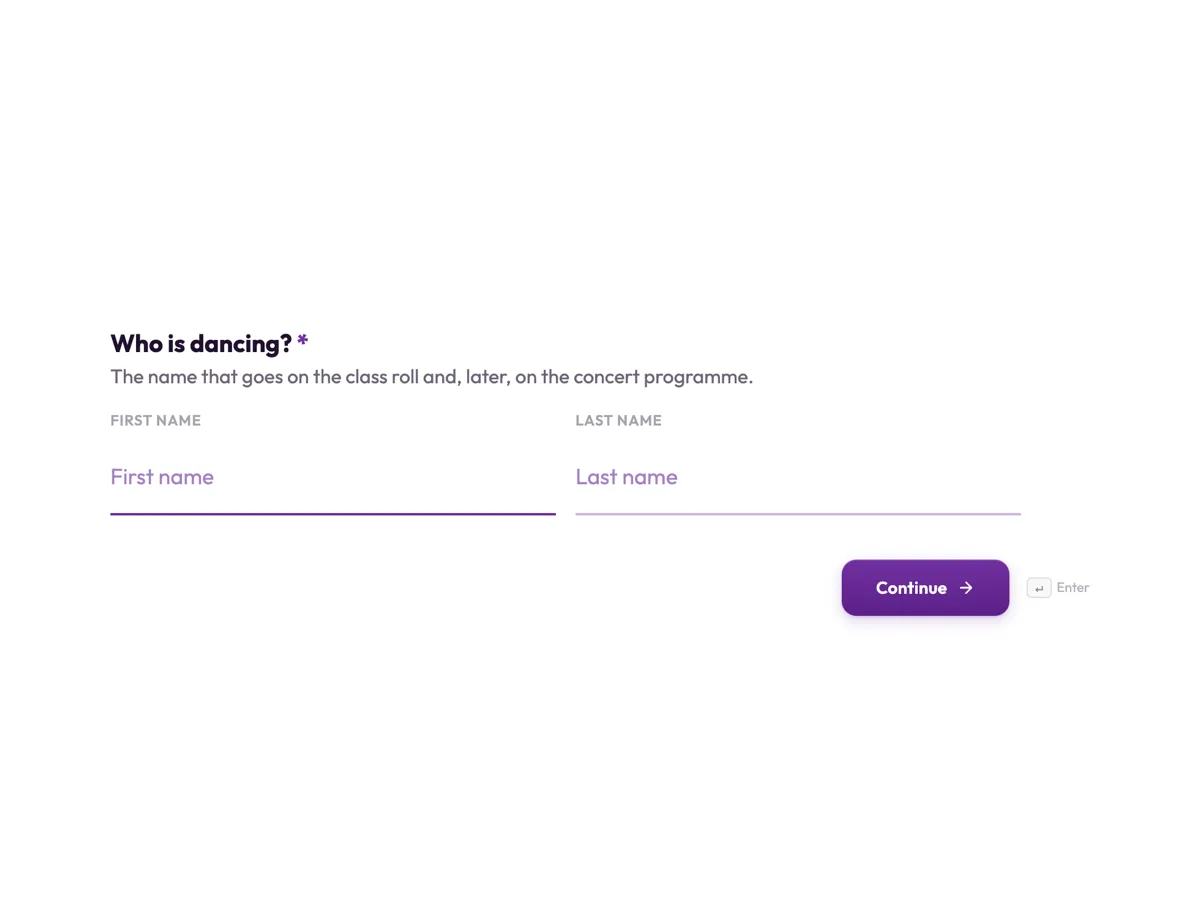
The form itself
The first screen of the form. A conversational form shows one question per screen, so the remaining screens are listed in the field table below. Nothing here can be filled in or submitted, so read it as a reference and build your own from the button above.
Every field, and what it collects
The complete field list, in the order respondents meet it.
- Who is dancing?NameRequired
- The name that goes on the class roll and, later, on the concert programme.
- Which age group?DropdownRequired
- Groups are set by age at the first class, not by school year, because the syllabus is built on what bodies can do at that age.
- Options: Tiny Feet, 3 to 4 years · Juniors, 5 to 7 years · Middles, 8 to 11 years · Seniors, 12 to 15 years · Open, 16 years and over · Adult beginners
- Which styles?Multiple choiceRequired
- Tick everything of interest. The studio builds the timetable around what the group asks for, so a style with six names on it becomes a class.
- Options: Ballet · Jazz · Hip hop · Contemporary · Tap · Acrobatics
- How much dancing has there been so far?Single choiceRequired
- Honest answers place people well. A returning dancer is not a beginner and does not want to be in a beginner class.
- Options: First class ever · Less than a year · One to three years · More than three years · Returning after a break of a year or more
- Shoe sizeNumber
- European sizing. This is only used to check the hire shelf before the first class, so a close guess is fine.
- Which afternoons can you get here?Multiple choiceRequired
- Classes run from 3.45pm on weekdays and from 9am on Saturday. Tick every afternoon that works, not only the ideal one.
- Options: Monday · Tuesday · Wednesday · Thursday · Friday · Saturday morning
- Dancing in the December concert?Single choiceRequired
- The concert is optional. Class only is a normal choice and costs nothing extra.
- Options: Yes, in the concert · Class only, no concert · Undecided, ask me in August
- The costume levySingle choiceRequired
- One levy of 95 dollars per concert routine covers the costume, which the dancer keeps. It is invoiced in August and only if a concert place is taken.
- Options: I accept the levy for each concert routine · I want to talk about it before I commit · Not applicable, class only
- Injuries, medical conditions and anything a teacher should knowLong textRequired
- Teachers read this before the first class. Write none if there is nothing.
- Who should the studio contact?ProfileRequired
- One screen for the three things the studio needs to reach an adult while a class is running.
- Photos and videoMultiple choice
- Leave this blank and nothing changes about the classes. Concert footage is filmed by a hired crew and sold separately either way.
- Options: Class photos may be used by the studio · Rehearsal clips may be posted to the studio social accounts
- How did you hear about Northside Dance?Short text
- The studio spends almost nothing on advertising, so this answer decides where the next hundred dollars goes.
A studio registration is a timetable problem
Nobody registers for dance in general. They register for jazz on a Thursday at four thirty, in the group where the other dancers are the same age and roughly the same standard. Four of these twelve screens exist only to find that square on the grid: the age band, the styles wanted, how much dancing there has been, and which afternoons a family can actually reach the studio. The afternoons question is the one that saves the most phone calls, because a family that ticks three days can be moved when a class fills, and a family that ticks one cannot.
Why the costume levy is asked before anyone owes it
The costume levy is where community dance studios lose parents. A fee of ninety five dollars per routine turns up in August, months after registration, attached to a concert nobody remembers agreeing to. So this form puts the concert question and the levy question next to each other, near the end, with a third option that says talk to me first. A parent who picks that option is not refusing, they are asking for a conversation, and the studio now has that flagged in the responses table rather than discovering it when the invoice bounces.
How to adapt this form
A performing arts school running drama and singing alongside dance keeps the same shape and widens the styles list, then adds a voice part question that only matters for the singers. A competition team registration drops the beginner options from the experience screen and adds a commitment screen listing the rehearsal Sundays by date, because that is the real ask. An adult only studio removes the guardian profile block entirely, moves the contact details onto the dancer, and replaces the concert question with a performance night that people can opt into later.
What makes this form work
The afternoons question is asked as a tick list, not a preference
Six options, including Saturday morning, and the screen asks for every afternoon that works rather than the ideal one. That single change turns a full class from a refusal into an offer of the nearest time on the same day.
The costume levy has a third option
Accept, talk first, or not applicable. A studio that only offers accept or decline learns nothing, while a parent who picks talk first has raised their hand before an invoice for ninety five dollars a routine lands in August.
Age groups are named and dated, not left to school year
Six bands from Tiny Feet at three to adult beginners, each with the ages on the option. School year varies by country and by starting age, and a dance syllabus is built on what a body can do, so the form asks the question it actually means.
Questions people ask
How many questions should a dance registration ask?
Twelve screens here, which reads as far shorter than a twelve field page because only one question is on screen at a time. Seven are required. The optional ones, shoe size, photos and how they heard about the studio, are the ones that help the studio rather than the dancer, so none of them can stall a registration.
Why ask for shoe size on a registration form?
Because the hire shelf is the difference between a first class that works and one where a child sits out. It is optional and the screen says a close guess is fine. European sizing is stated on the screen so nobody has to work out which scale the studio means before they answer.
Can this form take the term fee?
No. It records a registration and the thank-you screen says a class list follows within two days. Fees are invoiced once a class is confirmed, which matters here because a family whose first choice is full may end up in a different class at a different price. Payment lives in the studio billing system.
What about consent for a dancer under eighteen?
The guardian profile block carries the adult who is agreeing, and the photo permission is a separate screen with two ticks rather than one. Class photos and social media clips are different decisions, and splitting them means a family can allow the noticeboard without allowing an audience of strangers.
Does the experience question have to be honest?
It works better when it is, and the screen says so plainly. The five options include returning after a break, which is the answer most likely to be fudged, because a dancer who stopped for two years is neither a beginner nor where they left off. Teachers move anyone who lands wrong in the first fortnight.
Why use a profile block instead of three separate screens?
A profile component puts the guardian name, email and phone on one screen, which is right for details that belong to the same person and are filled from memory. Splitting them into three screens would add two clicks and no clarity. The avatar and address options are switched off because a dance studio needs neither.
Build your own in about a minute
The button below opens the generator with this use case already described. Change the wording to match your own, generate, then edit anything you like.
Make my dance class registration form that places a dancer correctlyOther form examples
Language course registration form with a placement check
Every language school has the same problem, which is that people rate their own level badly in both directions. This enrolment asks for a self rating and then a three sentence fill in the blank check, and when the two disagree it is a five minute phone call rather than a beginner sitting silently in a B2 room.
Music lessons registration form that matches a teacher
A teaching studio is really a matching problem, because the instrument is only one of four things that decide who should teach a new student. This eleven screen registration collects all four, and ends with an optional recording so a teacher can hear a returning player rather than guess from a grade they gave themselves.
Yoga retreat registration form with rooms priced on it
A retreat sells a room and a week at the same time, and the room is the part that changes the price. This thirteen screen booking prices all four room types on the question itself, then spends the rest of its screens on the two things that actually decide whether somebody enjoys the week, their body and their journey there.
Want the steps in the builder? Read Create a conversational form with AI, then Design your welcome and thank-you screens. For everything this generator can do, see the form maker.
Written and checked by the OneCraft team. Last checked .